US oil production will lead world by 2023: IEA
America is on its way to becoming the largest oil producer in the world. The nation will surpass Russia, the current No. 1, by 2023, the International Energy Agency estimated on Monday. U.S. crude production is projected to hit a record of 12.1 million barrels a day in 2023, which would reflect an increase of roughly 2 million barrels compared with this year.
Showing posts with label energy. Show all posts
Showing posts with label energy. Show all posts
3/05/2018
US oil production will lead world by 2023: IEA

6/28/2013

2/08/2013
America’s Oil Revival
Via-American Spectator

By William Tucker
Keeping abreast of the new energy reality — how soon before the U.S. becomes an energy exporter?
Last week Alaska Senator Lisa Murkowski unveiled the Republicans’ new plan for energy development. She called for a partial opening of the Alaska National Wildlife Refuge, the development of offshore oil tracts plus more production from federal lands. Within hours the Natural Resources Defense Council had dismissed the whole thing as “a plan from the past.” And in fact it was little more than a reiteration of the four-year-old cry, “Drill, baby, drill.”
Anyone who thinks this signals another four years of energy stalemate, however, is sadly mistaken. The very next day, energy expert Daniel Yergin was telling a hearing of the House Energy and Commerce Subcommittee that, if anything, Washington is completely out of the loop as to what’s happening in energy. “Our thinking has to catch up with reality,” said Yergin, head of the prestigious Cambridge Energy Research Associates. “Everything has been turned upside down.”
Indeed. Only six month ago Mitt Romney was being mocked on front pages across the nation for suggesting North America could achieve energy independence within the next decade. Romney was careful to include Canada and Mexico, but the editorial writers ignored him anyway. Now six months later you could cross out Canada and Mexico. Within a few months, Congress will be undertaking a contentious debate over whether we should become an energy exporter.
Everybody knows about the natural gas boom, of course, brought about by the new fracking technology. Prices have been driven so low that gas wells are now closing down, waiting for the glut to subside. Fracking has so much momentum that even the attempt by Matt Damon to do for fracking what The China Syndrome did for nuclear power slunk out of the theaters in about a week. Sorry, Hollywood, even star power won’t be able to stop this one.
But natural gas is only the beginning. Where indirect drilling and the new fracturing techniques will have an impact is on reviving American oil. Consider this. The Bakken Shale’s “tight oil” formation, opened for development in 2006, has lifted America’s oil output 38 percent over the last five years. That’s the equivalent of the entire output of Nigeria, OPEC’s 7th largest producer. North Dakota is booming as if it were the 1980s. Unemployment is 3.2 percent, lowest in the nation, and Wal-Mart is paying $17 an hour. Things have gotten so good that the New York Times has felt compelled to dispatch reporters to tell us how women are being harassed in oil towns and many roughnecks lack medical insurance. (But the roughnecks do have enough money to offer the women $3,000 a night to tend bar at private parties.)
Now here’s the big news. As far as tight oil is concerned, the Bakken is just square one. The Eagle Ford formation in Texas, which is just getting started, is estimated to have the same amount of reserves (3-4 billion barrels). But another 15.4 billion barrels — 64 percent of all U.S. reserves — lie in the Monterey formation of northern California. (Why does California always get the best of everything?) If Golden State politicians allow this oil to be developed, it will be far more significant than the ANWR or the Keystone Pipeline.
All these American resources are open for development precisely because they are not owned by the federal government. That is the saving grace. Except for the 60 percent land west of the Rockies that is owned by the government, America has the best system in the world for developing resources. Private investment and private ownership get things done while governments everywhere are consistently bogged down in bureaucracy, “baksheesh,” red tape, environmental opposition, and every other kind of impediment.
Read article here

By William Tucker
Keeping abreast of the new energy reality — how soon before the U.S. becomes an energy exporter?
Last week Alaska Senator Lisa Murkowski unveiled the Republicans’ new plan for energy development. She called for a partial opening of the Alaska National Wildlife Refuge, the development of offshore oil tracts plus more production from federal lands. Within hours the Natural Resources Defense Council had dismissed the whole thing as “a plan from the past.” And in fact it was little more than a reiteration of the four-year-old cry, “Drill, baby, drill.”
Anyone who thinks this signals another four years of energy stalemate, however, is sadly mistaken. The very next day, energy expert Daniel Yergin was telling a hearing of the House Energy and Commerce Subcommittee that, if anything, Washington is completely out of the loop as to what’s happening in energy. “Our thinking has to catch up with reality,” said Yergin, head of the prestigious Cambridge Energy Research Associates. “Everything has been turned upside down.”
Indeed. Only six month ago Mitt Romney was being mocked on front pages across the nation for suggesting North America could achieve energy independence within the next decade. Romney was careful to include Canada and Mexico, but the editorial writers ignored him anyway. Now six months later you could cross out Canada and Mexico. Within a few months, Congress will be undertaking a contentious debate over whether we should become an energy exporter.
Everybody knows about the natural gas boom, of course, brought about by the new fracking technology. Prices have been driven so low that gas wells are now closing down, waiting for the glut to subside. Fracking has so much momentum that even the attempt by Matt Damon to do for fracking what The China Syndrome did for nuclear power slunk out of the theaters in about a week. Sorry, Hollywood, even star power won’t be able to stop this one.
But natural gas is only the beginning. Where indirect drilling and the new fracturing techniques will have an impact is on reviving American oil. Consider this. The Bakken Shale’s “tight oil” formation, opened for development in 2006, has lifted America’s oil output 38 percent over the last five years. That’s the equivalent of the entire output of Nigeria, OPEC’s 7th largest producer. North Dakota is booming as if it were the 1980s. Unemployment is 3.2 percent, lowest in the nation, and Wal-Mart is paying $17 an hour. Things have gotten so good that the New York Times has felt compelled to dispatch reporters to tell us how women are being harassed in oil towns and many roughnecks lack medical insurance. (But the roughnecks do have enough money to offer the women $3,000 a night to tend bar at private parties.)
Now here’s the big news. As far as tight oil is concerned, the Bakken is just square one. The Eagle Ford formation in Texas, which is just getting started, is estimated to have the same amount of reserves (3-4 billion barrels). But another 15.4 billion barrels — 64 percent of all U.S. reserves — lie in the Monterey formation of northern California. (Why does California always get the best of everything?) If Golden State politicians allow this oil to be developed, it will be far more significant than the ANWR or the Keystone Pipeline.
All these American resources are open for development precisely because they are not owned by the federal government. That is the saving grace. Except for the 60 percent land west of the Rockies that is owned by the government, America has the best system in the world for developing resources. Private investment and private ownership get things done while governments everywhere are consistently bogged down in bureaucracy, “baksheesh,” red tape, environmental opposition, and every other kind of impediment.
Read article here
12/02/2012

11/15/2012
Energy Independent After All?
Via-RCP

By Robert Samuelson
WASHINGTON -- Preoccupied by the election, Americans may be under the delusion that most major social and economic changes proceed from the ballot box. Not so.
The latest reminder of this comes from a surprising source: the annual World Energy Outlook report from the Paris-based International Energy Agency (IEA). In the report, the IEA comes to the startling conclusion that, by 2020, the United States will displace Saudi Arabia -- albeit temporarily -- as the world's largest oil producer. Even more astonishing, the United States is projected by 2035 to be virtually self-sufficient in oil, with modest imports coming from secure suppliers.
Richard Nixon must be cheering from his grave. In 1973, Nixon launched Project Independence; the United States would be energy self-sufficient by 1980. It didn't happen, and although many politicians later embraced the same popular goal, most energy experts considered it a self-serving fantasy. Oil demand crept steadily upward, while America seemed to be slowly exhausting its once large reserves. "Output had been widely assumed, even as recently as a few years ago, to be in inevitable decline," notes the IEA.
No more. Geology and technology, it seems, are destiny.
The same technology that has resulted in a vast expansion of natural gas production -- so-called "shale gas" -- is doing the same for oil. "Fracking" (shooting highly pressurized water into oil formations) and horizontal drilling are steadily increasing production. Meanwhile, the IEA expects that much-improved vehicle fuel efficiency will slowly reduce U.S. oil demand. The Obama administration has adopted rules raising fuel efficiency for new cars to 54.5 miles per gallon by 2025 -- roughly double the present standard.
Together, rising oil production and shrinking demand should dramatically reduce U.S. imports, says the IEA. In 2011, they had already fallen to 9.5 million barrels a day (mbd), roughly half of U.S. consumption. But by 2035, the IEA expects net imports of only 3.4 mbd. The decline is split roughly between higher production -- including biofuels -- and savings from greater fuel efficiency.
The IEA sees profound consequences. For starters, the long-standing U.S. trade deficit will narrow and might disappear. In 2011, oil imports represented two-thirds of the deficit in goods. While the United States will use less imported oil, it should also become a substantial exporter of liquefied natural gas (LNG); until a few years ago, it "was expected to become a major importer of LNG." Abundant and cheap natural gas should support a manufacturing revival by attracting energy-intensive industries such as "aluminum, paper or iron and steel, or ... petrochemicals ... where feedstock costs can represent over 80 percent of total operating expenses."
Within a few decades, the United States could attain Nixon's once-impossible goal. However, the IEA warns that growing independence won't insulate the United States entirely from global markets. "Oil prices are set globally," the IEA reminds, "so consumers in the United States will continue to feel the effects of worldwide price fluctuations."

By Robert Samuelson
WASHINGTON -- Preoccupied by the election, Americans may be under the delusion that most major social and economic changes proceed from the ballot box. Not so.
The latest reminder of this comes from a surprising source: the annual World Energy Outlook report from the Paris-based International Energy Agency (IEA). In the report, the IEA comes to the startling conclusion that, by 2020, the United States will displace Saudi Arabia -- albeit temporarily -- as the world's largest oil producer. Even more astonishing, the United States is projected by 2035 to be virtually self-sufficient in oil, with modest imports coming from secure suppliers.
Richard Nixon must be cheering from his grave. In 1973, Nixon launched Project Independence; the United States would be energy self-sufficient by 1980. It didn't happen, and although many politicians later embraced the same popular goal, most energy experts considered it a self-serving fantasy. Oil demand crept steadily upward, while America seemed to be slowly exhausting its once large reserves. "Output had been widely assumed, even as recently as a few years ago, to be in inevitable decline," notes the IEA.
No more. Geology and technology, it seems, are destiny.
The same technology that has resulted in a vast expansion of natural gas production -- so-called "shale gas" -- is doing the same for oil. "Fracking" (shooting highly pressurized water into oil formations) and horizontal drilling are steadily increasing production. Meanwhile, the IEA expects that much-improved vehicle fuel efficiency will slowly reduce U.S. oil demand. The Obama administration has adopted rules raising fuel efficiency for new cars to 54.5 miles per gallon by 2025 -- roughly double the present standard.
Together, rising oil production and shrinking demand should dramatically reduce U.S. imports, says the IEA. In 2011, they had already fallen to 9.5 million barrels a day (mbd), roughly half of U.S. consumption. But by 2035, the IEA expects net imports of only 3.4 mbd. The decline is split roughly between higher production -- including biofuels -- and savings from greater fuel efficiency.
The IEA sees profound consequences. For starters, the long-standing U.S. trade deficit will narrow and might disappear. In 2011, oil imports represented two-thirds of the deficit in goods. While the United States will use less imported oil, it should also become a substantial exporter of liquefied natural gas (LNG); until a few years ago, it "was expected to become a major importer of LNG." Abundant and cheap natural gas should support a manufacturing revival by attracting energy-intensive industries such as "aluminum, paper or iron and steel, or ... petrochemicals ... where feedstock costs can represent over 80 percent of total operating expenses."
Within a few decades, the United States could attain Nixon's once-impossible goal. However, the IEA warns that growing independence won't insulate the United States entirely from global markets. "Oil prices are set globally," the IEA reminds, "so consumers in the United States will continue to feel the effects of worldwide price fluctuations."

10/17/2012
Electric Car Crash
Via-WSJ

Obama's green energy industrial policy turns up in Chapter 11.
Mitt Romney quipped in the first Presidential debate that the problem with the Obama Administration's green energy investing isn't that it tried to pick winners and losers, but that "you pick the losers." He was being generous. Another big green Administration favorite went belly-up on Tuesday with the Chapter 11 filing by battery-maker A123 Systems Inc.
Massachusetts-based A123 is—or was—part of President Obama's grand design to build a U.S. electric-car industry more or less from scratch. The company was founded by entrepreneurs in 2001 to make lithium ion phosphate batteries and attracted private investment from the likes of Sequoia Capital and GE. Then Washington picked up the green energy fad.

Obama's green energy industrial policy turns up in Chapter 11.
Mitt Romney quipped in the first Presidential debate that the problem with the Obama Administration's green energy investing isn't that it tried to pick winners and losers, but that "you pick the losers." He was being generous. Another big green Administration favorite went belly-up on Tuesday with the Chapter 11 filing by battery-maker A123 Systems Inc.
Massachusetts-based A123 is—or was—part of President Obama's grand design to build a U.S. electric-car industry more or less from scratch. The company was founded by entrepreneurs in 2001 to make lithium ion phosphate batteries and attracted private investment from the likes of Sequoia Capital and GE. Then Washington picked up the green energy fad.
10/07/2012
Revenge of the fossil fuels: Setbacks mount for renewable energy sector

BY YADULLAH HUSSAIN, FINANCIAL POST
After a fantastic run spanning a few years, the renewable energy sector has taken a number of hits recently, which suggests its inevitable march as the energy source of the future is far from certain.
“It’s pretty bleak — there is no way to sugar coat it. But I wouldn’t call it a lost cause,” says Matt Horne, director of climate change at the Pembina Institute.
While all sectors have ups and downs, there is a fear that renewables’ weaknesses could lead to structural changes, as policymakers no longer have the luxury of supporting and extending subsidies at a time of fiscal austerity.
And much to the dismay of environmentalists, fossil fuels are clawing their way back into the public’s good books. Or at least they are offering a compelling economic case that few can resist at a time of slow economic growth.
A number of factors have turned the tide. Plentiful oil and abundance of cheap natural gas, especially in the United States and Canada, with its promise of high-paying jobs has been an irresistible lure for governments desperate to create employment.
While some North American regions such as Quebec hold the practice of hydraulic fracturing in disdain, many others are warming up to its benefits. Natural gas has taken the pressure off the wider carbons industry as it has displaced coal.
“Of course, natural gas is reducing the use of coal, which emits much more greenhouse gases, so you could argue that is has helped the green movement, but it is definitely becoming an obstacle [to renewables] due to low prices,” says Ann-Louise Hittle, head of macro oil at Wood Mackenzie, an energy consultancy.
The renewable sector’s problems are most visible where it has achieved the most: Europe.
Read entire article here
9/12/2012

4/12/2011
3/29/2011
Wrecking a Nation

By Ralph R. Reiland
Here's how the economic and political system of a nation is destroyed.
Every price increase of just a dime per gallon of gasoline at the pump extracts approximately $5 billion from the pockets of U.S. consumers over the course of a year.
On top of killing family budgets, with a dollar per gallon jump at the pumps picking our pockets of $50 billion per year, there is on the macro level an inverse relationship between the price of oil and the overall health of the economy -- oil price hikes deliver less job growth, less demand for labor, more unemployment, more poverty, more inequality, more inflation, lower real income increases, and smaller advances in the standard of living.
Additionally, higher oil prices directly cause greater amounts of U.S. capital to be exported, both to pay the higher prices and to pay for the growing levels of imported oil.
In 1985, the U.S. imported 25 percent of its oil usage. Today, it's 61 percent. And still we are placing restrictions on increases in domestic production, both for oil and other sources of energy.
A few days back, President Obama, rather than sticking around a couple hours to explain to the American people or to the U.S. Congress why we were going to war in Libya, flew off to Brazil to hand out a permit to allow deep sea oil drilling in the Gulf of Mexico to Brazil's state-run oil company, Petrobras. Capitalist companies in America need not apply.
This particular foreign deal was an especially snug and nostalgic fit for Obama. Brazilian president Dilma Rousseff is somewhat of a Latin form of Obama's old Weather Underground chum Bernardine Dohrn.
In earlier days, Rousseff, a former Marxist guerrilla, was charged with running with a gang of redistributionists who accumulated revolutionary capital by way of kidnapping foreign diplomats for ransom.
A top priority for Rousseff today mirrors the "spread the wealth around" objective that Obama stated to Joe the plumber.
Dohrn, just home from a trip to Cuba in 1969 where she hoped to pick up some pointers on how to impose a "classless" society on the U.S., displayed her true psychopathic colors in a speech she made to the Weathermen's "War Council."
Speaking elatedly of the murders by the Charlie Manson gang of actress Sharon Tate, coffee heiress Abigail Folger and three other people, Dohrn proclaimed, "First they killed those pigs, then they ate dinner in the same room with them, then they even shoved a fork into the victims' stomachs! Wild!"
That's the fully hateful Bernardine on public display, seeing herself as a new George Washington, a revolutionary fighter for a new nation. It's the same role, except this founding mother was in serious need of a super-sized bottle of antipsychotic drugs and a super-tight straightjacket.
Of all the places for candidate Obama to kick off his political career in 1995 in his first run for the Illinois State Senate, he picked the living room of Bernardine Dohrn and husband Bill Ayers, co-founder of the Weather Underground and, more recently, the national vice president for curriculum studies at the American Educational Research Association.
I'd have kept up my guard when Bernardine sashayed out of the kitchen and began circulating around with the hors d'oeuvres and metal forks.
In any case, it's no surprise that things are coming apart, especially on energy. "If somebody wants to build a coal-fired plant, they can," pronounced Obama during the presidential campaign. "It's just that it will bankrupt them because they're going to be charged a huge sum for all that greenhouse gas that's being emitted."
What's the end game? "Suicide Mission Accomplished"?
3/12/2011

3/01/2011
Now Can We Drill In Alaska?

Energy Policy: Alaska's governor attacks President Obama's hostility to oil states and warns that ever-higher oil prices will doom economic recovery. The polar bears are doing fine. The American economy is not.
He didn't say "drill, baby, drill" in so many words, but the point made by Alaska Gov. Sean Parnell, Sarah Palin's successor, in a speech at the National Press Club was the same.
"This is the moment our government must re-examine its 'no new wells' policy when it comes to oil exploration and development here at home," Parnell said in a speech in which he declared the Obama administration "openly hostile" to oil-producing states.
As we have noted, the administration's mindless pursuit of green energy at all costs is coupled with an unwillingness to put downward pressure on oil prices by increasing domestic supply, leaving the U.S. perilously dependent on Iran, Libya, Venezuela and the rest.
As crude tops $100 a barrel, Parnell noted, "the U.S. foolishly imports more than 63% of its oil. That leaves us vulnerable to the economic shock of disruption of these oil supplies, and it drives down that economic recovery." Indeed, we are hemorrhaging jobs and revenues to overseas thugs.
The Interior Department and Environmental Protection Agency are "driving America's foreign policy," Parnell argued, and this has made America "dependent on an open . . . Suez Canal, a canal through an unstable region, the security of which has been purchased through our taxpayers' dollars."
Indeed, the Energy Department produces no energy and seems tirelessly dedicated through the efforts of its secretary, Steven Chu, to lock up our energy resources. With more than 100,000 federal and contract employees and a budget of $23 billion, it would be a good place to look for spending cuts.
According to the DOE, America's energy needs increased by 17 times in the past half-century while our domestic energy production decreased 40%. The slack has not been picked up, despite huge subsidies, by wind and solar; it's been picked up through imports.
Parnell talked about Interior's recent announcement to review more than 80 million acres of federal land in Alaska for "wild lands" status and condemned the administration's moratoriums through regulations and a deliberate slowdown in leasing and permitting. "If it looks like a moratorium and walks like a moratorium ... maybe it is," he said.
Parnell criticized the Obama administration for not issuing an air-quality permit to a subsidiary of Royal Dutch Shell to drill exploratory wells on two leases in the Beaufort Sea off Alaska's northern coast.
"The other Arctic nations are moving ahead without us. Only the United States, which is sitting on the largest untapped, technically recoverable (supply) and has the greatest environmental oversight, is sitting this one out," said the governor.
Writing recently in Foreign Affairs, Scott Borgerson, an international affairs fellow at the Council on Foreign Relations, noted: "The U.S. Geological Survey (USGS) and the Norwegian company Statoil Hydro estimate that the Arctic holds as much as one-quarter of the world's remaining undiscovered oil and gas deposits."
Alaska's Chukchi Sea alone is estimated to hold 1,600 trillion cubic feet of undeveloped natural gas, or 30% of the world's supply, and 83 billion barrels of undeveloped oil, 4% of the estimated global resources.
Much of the region has been designated as critical for polar bears even though Doug Vincent-Lang, the state's coordinator for endangered species, says the bear population is at an all-time high.
The harm these bans and moratoriums do to the Alaskan and national economies are devastating. Parnell pointed out that federal inaction by the EPA itself causes the loss of 54,700 jobs and $104 billion in payroll.
We stand with him when he asks federal agencies and the administration to "let Alaska help put America back to work."
With Libya aflame and other sources unstable, this is no time to be tilting at windmills.
1/21/2011
MAN-MADE OASIS WILL TRANSFORM THE DESERT

An ambitious project to pipe salt water from the Red Sea into the arid coastal city of Aqaba, Jordan, could turn the region into an oasis. A 50-acre demonstration facility, which will combine two technologies -- seawater greenhouses and concentrated solar power -- to grow crops, produce carbon neutral energy and desalinate seawater, has received approval from the government of Jordan and could be operational by 2012, with full-scale commercial use going online in 2015.
The novel development is from the Sahara Forest Project, an environmental technology group based in Norway. Back to 2009, the group presented their idea at the UN's Copenhagen climate conference. After which, the team won an audience with Majesty King Abdullah II of Jordan. Convinced that the project would be worth trying in his country, he made a deal to pilot a desert forest in the Aqaba Special Economic Zone
A structure, called a seawater greenhouse, will capitalize on the abundance of sun in Jordan and use it to evaporate seawater and condense it into fresh water. While this happens, a naturally cool and humid environment will be created -- perfect for growing crops.
Energy to run the facility will come from a concentrated solar power plant, which will use mirrors to focus sunlight onto pipes of fluid. The super-heated fluid boils and the steam is captured to drive a turbine generator, which produces electricity.

Though arid coastal locations are ideal, a forest project could still be used further inland. Several arid areas in the Sarhara are below sea level, making it relatively inexpensive to deliver water to the facility without costly pumping fees. The Qattara Depression in Egypt, for example, is about 435 feet below sea level -- a drop that could be exploited for hydro-electric power, too.
The technology could also be used to tranform existing, large-scale greenhouses used to grow acres of crops, into more efficient facilities. According to the Sarah Forest Project, in the south of Spain, the regions of Murcia and Almeria together have nearly 100,000 acres of greenhouses that consume five times more water than the area receives rainfall. Water from the Ebra River in the north of Spain has been diverted to the area to make up for the lack of rain and 20 fossil-fuel powered desalination plants are also online in order to accommodate irrigation.
These options are unsustainable, degrade the natural environment and pollute the air. Innovative ideas such as the Sahara Forest Project work with the environment, not against it. If successful, it could be a model food and energy facility for the future.
[via Science]
9/24/2010
Obama team uses flimflammery to inflate job numbers

By: Byron York
Are you a financial adviser? You may not know it, but you've got a green job. Are you a wholesale buyer? You've got a green job, too. Or maybe you're a newspaper reporter. You, too, have a green job -- at least according to the Obama administration.
For months, Republican Sen. Charles Grassley has been pushing the administration to substantiate its claims of having created nearly 200,000 green jobs. More fundamentally, Grassley has asked Labor Secretary Hilda Solis to state clearly what a green job is. So far, he hasn't gotten an answer.
Now, Grassley has learned that, in lieu of a settling on a straightforward definition of a green job, the administration has adopted an extraordinarily broad description of such jobs that could include not only financial advisers, wholesale buyers, and reporters, but also public relations specialists, marketing managers, and many more occupations that have nothing to do with protecting the environment.
If federal money has created any of those jobs, then the administration can claim to have created a green job.
Last June, Grassley sent Solis a letter questioning an administration request for public input on the definition of a green job. Grassley dryly noted that the request came after the government had already spent hundreds of millions of stimulus dollars on green jobs. Given that the administration couldn't nail down just what a green job is, Grassley asked Solis how she determined where those hundreds of millions of dollars went.
In response, Assistant Labor Secretary Jane Oates told Grassley that the department's Bureau of Labor Statistics is "working to develop a definition for green job sectors and jobs." Oates also noted that the department has "supported occupational research that begins to define green jobs." She specifically suggested he look at work done by a Labor Department project called the Occupational Information Network, also known as O*NET.
So Grassley's staff checked out O*NET and found extensive listings of jobs that could be classified, for government purposes, as "green." The list includes: "arbitrators, mediators, and conciliators," "financial analysts," "financial quantitative analysts," "investment underwriters," "marketing managers," "personal financial advisers," "public relations specialists," "wholesale and retail buyers," and "reporters and correspondents."
Grassley was appalled. "These are, no doubt, respectable and needed professions," he writes in a new letter to Solis, "but their tenuous connection to the stated goal of 'green jobs' only underscores the mismanaged efforts of the Department's stimulus dollar spending."
The senator points out that money for green jobs comes not only from the stimulus but also from the Green Jobs Act of 2007, which calls for the government to spend $125 million per year on "energy efficiency and renewable energy" worker training. The legislation specifically refers to things like retrofitting buildings, biofuels, and wind turbines. What do financial advisers, wholesale buyers and reporters have to do with that?
Grassley is waiting for an answer.
In a statement, the senator says he's a "big supporter" of green jobs. "But the government shouldn't cook the books with how it defines these jobs," he adds. "Taxpayers deserve an honest accounting for the nearly half billion of their dollars being spent on this program. If the government plans to lump reporters, marketing managers, and financial analysts into its definition, then I'm afraid this is yet another area where the administration and the American people just don't see eye to eye."
For the administration, Grassley's discovery is just the latest in a long line of embarrassments on the green jobs front. First there was the controversy surrounding departed green jobs czar Van Jones. Then there was widespread skepticism about the nearly 200,000 such jobs the administration claims to have created. And then there was the unhappiness on Capitol Hill over reports that of $2.1 billion the government has granted for renewable energy jobs, like assembling wind turbines, about 80 percent has gone to foreign companies. The stimulus has created some actual green jobs, but they're in China.
The promotion of green jobs with stimulus money -- a marriage of the Obama administration's environmental and economic agendas -- has been a top priority for the White House since Day One. It still is. Just last month, Vice President Biden traveled to New Hampshire to tout "good-paying jobs, green jobs, jobs that can't be exported."
It sounds good. But if you look a little closer into the administration's claims, you'll find they literally don't know what they're talking about.
7/18/2010
Ban on deep-water drilling adds insult to injury

By Bobby Jindal
By now, everyone no doubt realizes that I am not a fan of the pace at which the federal government has worked to contain the oil spill in the Gulf of Mexico. Sadly, federal officials were slow to act and overly bureaucratic. They have never really understood the urgency of the situation down here. I'm not raising a question of motive; it's simply a function of the federal government being a slow-moving albatross. The only way to attack a crisis like this is with the urgency of a military mind-set.
Even after the well is finally capped, the damage done to our environment, to the Gulf of Mexico, and to our marshes, wetlands and beaches will take years to repair. There is another type of damage from this spill: its human impact. Thousands of lives, businesses and families are reeling.
Against this backdrop, the federal government unwisely chose to add insult to injury by decreeing a moratorium on deepwater drilling in the gulf. This ill-advised and ill-considered moratorium, which a federal judge called "arbitrary" and "capricious," creates a second disaster for our economy, throwing thousands of hardworking folks out of their jobs and causing real damage to many families. Now this federal policy risks killing 20,000 more jobs and will result in a loss of $65 million to $135 million in wages each month.
To ensure that such a disaster does not happen again, should the federal government increase oversight, or require additional and better equipment or on-site federal inspectors, or even temporarily pause drilling at specific rigs for additional reviews? Of course. Could it? Of course. But by simply stopping all deepwater drilling, federal officials appear more interested in ideology and scoring political points -- as they have done with the misguided cap-and-trade legislation -- at the expense of Americans who derive their livelihood from the energy industry.
Let's be clear: This moratorium will do nothing to clean up the Gulf of Mexico, and it is already doing great harm to many hardworking citizens. The effects will extend well beyond Louisiana. Since the moratorium was announced, America has already lost two rigs to foreign countries. More drilling companies are negotiating right now to work elsewhere. Every time we decrease our level of production, we make America more dependent on foreign sources of energy.
On those few occasions when our country suffers a commercial airline tragedy, we do not respond by stopping all air travel for six months. Rather, we get to work figuring out the root cause and set about trying to make air travel safer. We don't grind everything to a halt and put tens of thousands of people out of work, jeopardizing our economy.
So, my state joined a lawsuit against the moratorium. We pointed out that a majority of the experts the federal government consulted before the ban, including representatives from the National Academy of Engineering, have stated publicly that they do not agree with the six-month blanket moratorium.
The court sided with the people of Louisiana in this matter. Consider the judge's statements: that the federal moratorium would result in the loss of jobs and livelihoods, that the government's action "does not seem to be fact-specific" and that the "government's hair-splitting explanation abuses reason and common sense."
One might assume that the federal government would back down, lift the moratorium and get on with the business of ensuring that nothing like this ever happens again in federal waters.
Nope.
Our federal government chose to fight on in court, and lost a second time.
Surely now, many of us thought, the federal government would stop its efforts to halt all drilling and instead get serious about more rigorous oversight and inspections.
Nope.
Instead, the federal government drafted a new moratorium. This seems to be a cynical ploy. It will take time to again take federal officials to court. If Washington loses, officials can issue a third moratorium and play this game out as long as they want. Such is the power of the federal government.
Louisianans, of all people, don't want to see another drop of oil spilled into the Gulf of Mexico. It is our land and our way of life that are being harmed. Yet the administration tells our people to simply file a claim with BP or file for unemployment. Our people want to work, not collect unemployment checks.
We don't want to see the federal government create a second disaster, an economic disaster, for the people of our state thanks to its "capricious" and "arbitrary" actions. The bottom line is this: Thousands of Louisianans shouldn't have to lose their jobs just because the federal government can't do its job.
The writer, a Republican, is governor of Louisiana.
7/14/2010
Whatever It Takes: Obama Sidesteps Law to Halt Domestic Energy Production. Twice.

The administration has shown no deference to the rule of law while trying to close Yucca Mountain and halt deepwater drilling.
by Clarice Feldman
It is disturbing, to say the least, how little deference the president and the administration give to the strictures of the Constitution and existing law. Whatever suits Obama’s partisan political interests takes precedence, regardless of the cost to us. However, it is heartening that judges are increasingly unwilling to let this rampage continue.
The most recent example involves the planned nuclear-waste repository at Yucca Mountain in Nevada.
Almost everyone acknowledges that nuclear power is clean and safe, even though there has been a decades-long campaign against it by ill-informed advocacy groups. The remaining concern about nuclear energy in this country, for some decades, has been how to dispose of the spent fuel created in the electrical generation process. In Europe, they have largely dealt with this problem by reprocessing that fuel and reusing it to create more energy. In this country, that option was discarded years ago in favor of long-term geological storage. Decades of expensive studies zeroed in on Yucca Mountain as the best site for such storage.
Presently, the nuclear waste generated by energy and weapons production is being stored in vulnerable storage facilities throughout the country, waiting for transfer to Yucca Mountain. The cost of that facility has been borne largely by electricity consumers paying into a nuclear-waste fund — already, $10 billion has been spent on developing Yucca.
7/06/2010
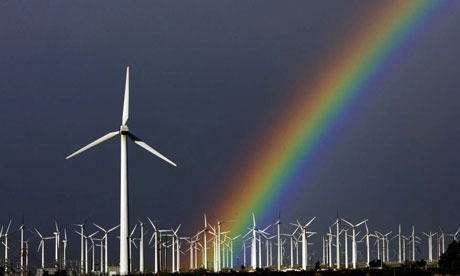
Somewhere over the wind farm
Via-American Thinker
By David Rosenthal
Somewhere over the wind farm, way up high, there's a land full of oil, so why did the industry die?
The oil patch has always had its ups and downs, but it has always provided well paying jobs to a wide array of employees. From divers to doodelbuggers, technicians to toolpushers, geoscientists to general counsel, cooks to .... You get the picture. While the oil patch has always been a scapegoat for greed, high gas prices, overall inflation, it is now under threat of extinction. Environmental fascists, and an ideological government, with help from an uninformed public, using overblown threats of planetary disaster, are the predatory warriors.
Increased government regulation, removal of tax breaks, especially those enjoyed by other industries, restrictions on offshore and onshore drillable acreage, and windfall profits taxes, will make it impossible for many private sector exploration companies to function. Many would argue that the push for cleaner energy will, as Obama put it, "necessarily cause energy prices to spike," resulting in favorable commodity prices. However, the war on fossil fuels will negate the benefit of these higher prices.
Many private sector firms typically analyze the profit to investment ratios (P/I) prior to drilling exploration prospects. This is calculated by dividing the mean expected value (minus taxes and operating expenses) by the real and estimated investment costs (land and leasing, geological and geophysical, drilling, and completion expenses). Mean expected value is the probability of success (POS), or risk, multiplied by the mean reserves at a certain commodity price. Both POS and mean reserves are estimated by geologists, geophysicists, and engineers and are derived by interpreting many attributes and elements of an exploration prospect. A POS can range from 10% for a deep wildcat to 90% for a simple development or infill well. Often these estimates of POS and reserves can be subjective and based on experience. The mean expected value is therefore a risked estimate.
Anything that increases the investment (I) expenses, like increased drilling or completion regulations, higher lease costs, etc, reduces the P/I. Increased operating regulations, taxes, and post BP spill, the potential for exorbitant liability expenses, directly reduces profits, further decreasing P/I. What this means is that companies will explore and test only prospects with huge mean reserves. These are the prospects in the deepwater Gulf of Mexico, and despite the POS of only 20-25%, are still economic. Unfortunately, only the large multinational firms like Exxon, Chevron, Shell, and other foreign owned companies will be able to absorb the increased liabilities and risk, necessary to drill these prospects. These elephants will thus be off limits for small and medium sized companies, even though several have been successful.
Another result of higher costs and regulations will be that the smaller, conventional targets, onshore and on the Gulf of Mexico shelf, become uneconomic, and therefore stay in the ground. This is when many small to medium size companies either merge or go out of business. Each of these options creates more unemployment and less energy output. As energy prices continue to soar and Americans finally realize that the conveniences enjoyed over the past several generations are rapidly diminishing, the clamoring demand for more energy will force the government to act. And continuing down the socialistic path they will act, resulting in the creation of Big Government Oil Co (BGOC).
For petroleum geophysicists like me, BGOC will be a blessing. No longer will we have to worry about the economics of exploration targets. One word never mentioned on a government agency mission statement; profit. If it glows (anomalous event) drill it! Too small, drill it! Too risky, drill it! Decisions are easy when someone else is paying the tab. Especially when it's the American taxpayer!
One must wonder if this scenario hasn't already been planned, especially considering the awkward comments of Congresswoman Maxine Waters, who in 2008 told energy executives that "the government will take over your companies?" Who would be in charge of BGOC? Perhaps it will be Nancy the Wicked Witch of the West, Harry the Wizard of Nothing, or Barack the Scarecrow. Whoever it is, this dream will certainly not win an academy award.
7/05/2010
Judges rule Obama can't close Yucca Mountain nuclear dump
Whether he likes it or not Obama is learning that we are a nation of laws. But like the Net Neutrality and the oil drilling moratorium ruling he will probably just go around the judges rulings. At some point a judge is going to slap a contempt order on them...can't wait.
 Via-McClatchy
By James Rosen
WASHINGTON — Democratic Rep. John Spratt and Republican Rep. Joe Wilson don't agree on much, yet the South Carolina congressmen are cheering a new ruling that denied the bid by the U.S. Energy Department to withdraw its application for a nuclear waste repository at Yucca Mountain in Nevada.
Three administrative judges within the Nuclear Regulatory Commission ruled last week that Congress had designated Yucca Mountain in 1987 to receive highly toxic waste from the Savannah River Site on the S.C.-Georgia border and other complexes that built atom bombs during the Cold War.
The panel found that President Barack Obama and Department of Energy Secretary Steven Chu, a nuclear physicist, lacked the power to close the Yucca repository unilaterally; doing so, it ruled, would require another act of Congress.
"Unless Congress directs otherwise, DOE may not single-handedly derail the legislated decision-making process by withdrawing the (Yucca repository) application. DOE's motion must therefore be denied," the judges wrote, adding that the DOE had weakened its arguments by "conceding that the application is not flawed nor the (Yucca) site unsafe."
"Given the stated purposes of the Nuclear Waste Policy Act and the detailed structure of that legislation, it would be illogical to allow DOE to withdraw the application without any examination of the merits," the judges found.

By James Rosen
WASHINGTON — Democratic Rep. John Spratt and Republican Rep. Joe Wilson don't agree on much, yet the South Carolina congressmen are cheering a new ruling that denied the bid by the U.S. Energy Department to withdraw its application for a nuclear waste repository at Yucca Mountain in Nevada.
Three administrative judges within the Nuclear Regulatory Commission ruled last week that Congress had designated Yucca Mountain in 1987 to receive highly toxic waste from the Savannah River Site on the S.C.-Georgia border and other complexes that built atom bombs during the Cold War.
The panel found that President Barack Obama and Department of Energy Secretary Steven Chu, a nuclear physicist, lacked the power to close the Yucca repository unilaterally; doing so, it ruled, would require another act of Congress.
"Unless Congress directs otherwise, DOE may not single-handedly derail the legislated decision-making process by withdrawing the (Yucca repository) application. DOE's motion must therefore be denied," the judges wrote, adding that the DOE had weakened its arguments by "conceding that the application is not flawed nor the (Yucca) site unsafe."
"Given the stated purposes of the Nuclear Waste Policy Act and the detailed structure of that legislation, it would be illogical to allow DOE to withdraw the application without any examination of the merits," the judges found.
7/02/2010
Florida Sees New Threat to Its Beaches

A Norwegian tanker approaching Havana last month. Several global oil companies have signed leases to explore in Cuban waters, where the U.S. Geological Survey has said there could be substantial stores of oil.
Deepwater Drilling Project in Cuban Waters Set to Launch Next Year Could Kick Off a Spate of Exploration in the Region
Via-WSJ
Florida has long fought to prevent oil drilling anywhere near its white sandy beaches. But as the state continues to deal with oil from the Gulf of Mexico spill washing up on its shores, it faces a new threat: deepwater drilling in nearby Cuban waters.
Maria Ritter, a spokeswoman for Spanish oil company Repsol YPF SA, said it plans to drill off Cuba, about 60 miles south of Key West, Fla., early next year. If successful, this would likely kick off a spate of exploration. Only one deepwater well has been drilled in Cuban waters, by Repsol in 2004. The effort found oil but not enough to justify commercial development.
Since then, the U.S. Geological Survey has said there could be a substantial amount of untapped oil off the Cuban coast, whetting the appetite of several global oil companies that have signed exploration leases.
U.S. companies won't participate because of a longstanding trade embargo against Cuba. Repsol plans to use a floating drilling rig being refurbished in a Chinese shipyard, similar to the Deepwater Horizon rig leased by BP PLC that caught fire and sank in the Gulf of Mexico in April. Almost all parts and components in the rig to be used by Repsol are from non-U.S. companies.
The Obama administration has sought a six-month ban on deepwater drilling in U.S. waters to reassess risks and establish new safety procedures if necessary. But any new rules wouldn't reach Repsol's project in Cuban waters.
A spill there, even one significantly smaller than the continuing BP spill, could turn into an economic and environmental nightmare for Florida. Some oceanographers say the oil would likely be carried up Florida's Atlantic Coast, the heart of its tourism industry.
"We have one of the world's largest coral reefs and a protected marine sanctuary there," said Dan McLaughlin, a spokesman for Sen. Bill Nelson (D., Fla.) "We should not be drilling there."
Cuba's state oil firm, Union Cuba Petroleo, could not be reached for comment. Ms. Ritter, the Repsol spokeswoman, declined to comment on the project beyond confirming plans for the rig. Repsol has operations in many parts of the world, including the U.S. portion of the Gulf of Mexico.
Drilling off Florida in U.S. waters has been banned by federal moratorium for decades. To protect the state's tourism-based economy, Gov. Charlie Crist, who is running for the U.S. Senate as an independent, is floating a proposal for an amendment to the Florida constitution to ban offshore drilling there permanently.
It's not clear what U.S. or Florida officials could do to stop oil exploration in Cuba. The U.S. controls coastal waters up to 200 miles from its shores, but under a 1977 treaty it agreed to divide the Straits of Florida equally with Cuba. That means Repsol can drill a deepwater well about the same distance from Key West, Fla., as the Deepwater Horizon was from the Louisiana coast.
The rig headed for Cuban waters has five rams in its blowout preventer, each designed to help shut off an out-of-control well. The Deepwater Horizon's blowout preventer had only four.
In the event of a spill in Cuban waters, many ships, equipment and personnel from the U.S. Gulf Coast could be prevented from helping because of the embargo. But that may be changing. A Treasury Department spokeswoman said some U.S. firms involved in oil cleanup have been issued licenses to travel to Cuba in case oil from the continuing spill hits beaches there.
Cuba's efforts to promote offshore oil exploration appear close to paying off. Cuba imports about 110,000 barrels of oil daily and produces an additional 52,000 barrels, mostly from onshore and shallow-water fields, according to the U.S. Energy Information Administration.
Ms. Ritter said Madrid-based Repsol plans to drill a new well near the 2004 well as soon as the rig—called the Scarabeo 9—is ready. Construction of Scarabeo 9 is expected to be complete at the end of 2010 or early 2011, said a spokesman for Enis SpA, an Italian company that controls the rig. Repsol's partners on the well include Norway's Statoil ASA and the overseas arm of India's state-run Oil & Natural Gas Corp. Eight other foreign oil companies hold offshore leases in Cuban waters.

Subscribe to:
Posts (Atom)