Showing posts with label terrorism. Show all posts
Showing posts with label terrorism. Show all posts
2/05/2014
MY Seal of approval
One of the main reasons I was never really opposed to the Iraq War, especially as it evolved was that we ended up fighting terrorist from all over the world in a foreign nation (not here in the USA) with our military, rather than having those terrorist coming here to kill civilians. It seemed to me then and still seems to me now that this was a win, win for America.
The only counter argument is that our being there actually created the terrorist. This argument is foolish on its face, since the vast majority of terrorist who came to Iraq to fight us were not Iraqis but came from other nations. So the argument seems to be that Libyans, Jordanians, Saudis, etc suddenly became terrorist because we went in and ousted Saddam Husein, whom they hated. The primary leader (until we killed him) was a Jordanian born terrorist who was killing innocent people long before we invaded Iraq. The truth is that the terrorist we fought in Iraq were terrorist before we invaded and the ones that lived mostly still are. America is not responsible for radical Islamic terrorism, or their hatred for America, radical Islam is.
So all these terrorist from all over the world flood into Iraq and we kill them with the military we have precisely to protect us from such threats and this is somehow a bad thing? The reason I bring this up is that almost every night I watch some story on FOX news about how thousand of Islamic terrorist are flooding into Syria from all over the world, including European nations. These terrorist are being identified by US and other western intelligence agencies and the reports all make this out to be a bad thing.
Granted it is a terrible thing for the Syrians whose nation is not only in the midst of a terrible civil war, but their nation is being infested with terrorist but even the left would have a hard time blaming that on the United States. It is the result of having a tyrannical dictator not wanting to give up control and willing to do anything to keep it. It is indeed very sad for the Syrian people, not unlike the Iraqi people especially the Kurds who lived under a tyrannical dictator for years who was willing to do anything to keep power including the genocide of large segments of his own population. As an aside here, the Kurds and for that matter the Kuwaitis were not really too upset at us invading Iraq and getting rid of a mass murderer, but that is not the main point here.
The point is that thousands of terrorist who, if not otherwise engaged in Syria, would be looking to kill Americans are not only being identified, they are being killed fighting another terrible dictator, and this is a bad thing? Terrorist at war with dictators in foreign nations sounds like a bigger win, win for us than the American military fighting terrorist over there. Not only this we are identifying these terrorist from other nations so we know where they are.
I have a suggestion for our government, close down the NSA and assign each of these terrorist a Navy Seal.

8/16/2013
Crush the Muslim Brotherhood
Via-Front Page Magazine
 By Daniel Greenfield
Like all terrorist organizations, the Muslim Brotherhood has only one commodity to trade in. Blood.
In the war of ideas for the future of Egypt, the Brotherhood had nothing to offer but the blood of its followers and victims. It has no new ideas. It has no record of accomplishments. It has no vision for the future except the same old corruption and authoritarianism cloaked in a deceptive Islamist garb.
The outcome of any interaction with the Brotherhood could have been predicted from its motto; “Allah is our objective. The Prophet is our leader. The Qur’an is our law. Jihad is our way. Dying in the way of Allah is our highest hope.”
In the streets of Egyptian cities, Muslim Brotherhood activists achieved their highest hope. They died in their Jihad against the liberal opposition and the military, fighting against human rights for women and Christians, against multi-party rule, freedom of speech, museums, libraries and the future in the way that the armies of Allah have died for over a thousand years.
Some died trying to kill Egyptian soldiers and police officers. Others were killed by their own people in order to maximize the death toll and spread shock and horror through the international community.
read entire article

Like all terrorist organizations, the Muslim Brotherhood has only one commodity to trade in. Blood.
In the war of ideas for the future of Egypt, the Brotherhood had nothing to offer but the blood of its followers and victims. It has no new ideas. It has no record of accomplishments. It has no vision for the future except the same old corruption and authoritarianism cloaked in a deceptive Islamist garb.
The outcome of any interaction with the Brotherhood could have been predicted from its motto; “Allah is our objective. The Prophet is our leader. The Qur’an is our law. Jihad is our way. Dying in the way of Allah is our highest hope.”
In the streets of Egyptian cities, Muslim Brotherhood activists achieved their highest hope. They died in their Jihad against the liberal opposition and the military, fighting against human rights for women and Christians, against multi-party rule, freedom of speech, museums, libraries and the future in the way that the armies of Allah have died for over a thousand years.
Some died trying to kill Egyptian soldiers and police officers. Others were killed by their own people in order to maximize the death toll and spread shock and horror through the international community.
read entire article
5/02/2013
Federal Bureau of Incompetence
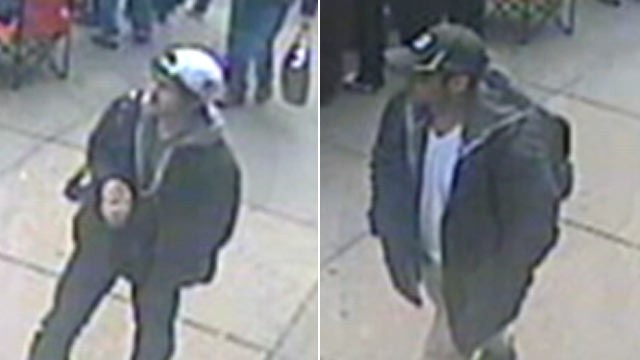
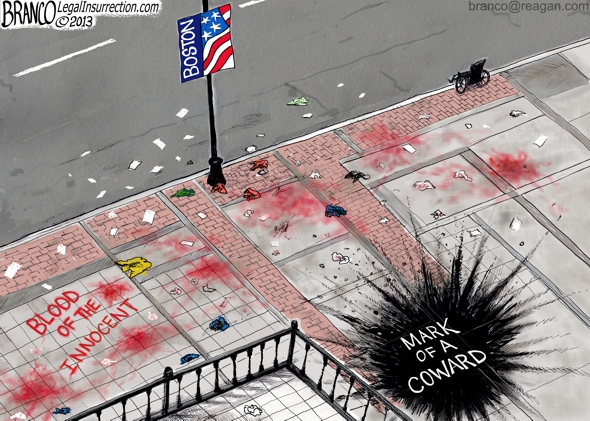
Since I have been off of the blogosphere for over a week I know what I am about to post is somewhat dated, but it is the one item I most wanted to comment on, so here it goes.
I find any praise of the FBI for their handling of the Boston massacre, before during or after not only unwarranted but counterproductive. Since this is now becoming old news I'll just point out some relevant points.
Before
It is obvious that the deadly duo were on the FBI's radar. They, after all, interviewed the older brother and evidently did not find him to be a serious threat. This despite the fact that he posted extreme jihadist videos on his You Tube page. In other words they either did not even monitor his social network sites or simply ignored what was there. Either way they failed to identify a real threat and failed to monitor his activities.
During
This in itself could be written off as someone just "falling through the cracks" which can and does happen in a large organization. However and this is a big however, once the Boston bombing occurred and the FBI took charge of the case, within a couple of days they, the FBI, had pictures of suspects which they were distributing to law enforcement even before they released it to the public. One would assume they would release these photos to their own agents, and one would assume that the agent(s) who interviewed the older brother less than two years before should have recognized the older brother as someone they interviewed about possible terrorist "sympathies", right? You would think that but obviously, for whatever reason nothing happened.
I want to re-empathize this. One of the largest man hunts in American history is underway, the FBI is in charge. They have a picture of a suspect whom their own agent(s) from the same field office in the locality where the crime occurred interviewed the suspect for terrorist related suspicions two years prior and he was not only not picked up for questioning he was obviously not identified. How can that be possible?
Then there is the question of why they waited so long to distribute the pictures to the public. For whatever reason law enforcement could not identify the suspects, suspects who we know were planning further attacks which at the very least the FBI would have to assume was possible. When, after a quick check through their available resources, they could not identify the men whom they had photo/video of, why did they not immediately put out the images asking for the public's help? It was rumored that law enforcement had picture(s) of suspect(s) at least twenty four hours prior to them releasing them, yet they did not put these images out for millions of potential witnesses to look at? Why? If they were wrong, the persons of interest would immediately come forward and proclaim their innocence, thus taking this lead off of the table. But instead, for at least twenty four hours the FBI held onto the image(s) of the terrorist. Why?
After
The most irritating aspect of all this is the praise the FBI is getting for their "quick" actions after they released the photos/videos of the suspects. Really? What did they do? Actually they did nothing. If the guy who was car jacked by the brothers had not escaped and sounded the alarm. If they had killed him or kept him while they made their escape, then the brothers would have gone to New York and potentially set off bombs in Time Square. The FBI did not capture them in some "manhunt", they and we just got lucky that their captive escaped and sounded the alarm.
Now we have three other morons who are being charged with helping the bombers post event. Well that is nice. Fifteen days after the explosion, twelve days after "suspect 2" sent text messages to one of his buddies "jokingly" admitting his part in the bombing, they arrest these guys for destroying evidence. Now that is quick police work there.
I find it utterly humiliating as a US citizen that a nineteen year old kid can "lock down" an entire metropolitan area for a day and we somehow think that this is some great accomplishment by our premier law enforcement agency. To me it is the height of incompetence at every juncture of this sad event.
4/19/2013

Is this suspect #2 ?
Dan Riehl has been posting on the resemblance between the missing college student from Brown University. Sunil Tripathi and Suspect #2. I downloaded some pictures of both and enlarged them to see if they appear to be the same. Looks pretty close to me, but the more intriguing aspect is the second story that Riehl posted about the missing college student and explosives.


4/18/2013
Tale of two terrorists
Via-NY POST

Columbia job for Boston bomber?
By JOHN M. MURTAGH
Somewhere near Boston early Monday morning, he packed a bomb in a bag. It was by all accounts relatively crude — a pressure cooker, explosives, some wires, ball bearings and nails . . . nails which, hours later, doctors would struggle to remove from the flesh of bleeding victims.
His motive is unclear. His intent is not: It was to maximize injury, suffering, pain, trauma and, yes, death.
Perhaps Monday’s bomber will be caught, perhaps not.
Perhaps Monday’s bomber will be offered a teaching job at Columbia University.
Forty-three years ago last month, Kathy Boudin, now a professor at Columbia but then a member of the Weather Underground, escaped an explosion at a bomb factory operated in a townhouse in Greenwich Village. The story is familiar to people of a certain age
Three weeks earlier, Boudin’s Weathermen had firebombed a private home in Upper Manhattan with Molotov cocktails. Their target was my father, a New York state Supreme Court justice. The rest of the family, was presumably, an afterthought. I was 9 at the time, only a year older than the youngest victim in Boston.
One of Boudin’s colleagues, Cathy Wilkerson, related in her memoir that the Weathermen were disappointed with the minimal effects of the bombs at my home. They decided to use dynamite the next time and bought a large quantity along with fuses, metal pipes and, yes, nails. The group designated as its next target a dance at an Officer’s Club at Fort Dix, NJ.
Despite the misgivings of some, it is reported that Kathy Boudin urged the use of “anti-personnel bombs.” In other words, she wanted to kill people not just damage property. Before they could act, her fellows were killed in the townhouse explosion. The townhouse itself collapsed; Boudin fled.
She reappeared over a decade later driving the getaway car for the rag tag mix of Weathermen and Black Panthers who held up a Rockland County bank in 1981, murdering three in the process. Survivors of the ambush along the New York State Thruway recount how Boudin emerged from the driver’s door, arms raised in surrender, asking the police to lower their guns. When they did, her accomplices burst from the back of the van guns blazing.
As I said, people of a certain age remember this history. For those that don’t, Robert Redford is kindly about to release a movie recounting the Rockland robbery (albeit relocated to Michigan). By all accounts, the film lionizes the Weather Underground terrorists, Boudin and her accomplices.
Perhaps to bring it full circle, Professor Boudin can soon guest-lecture at a film class at Columbia when the Redford movie is screened.
Other than the passage of time, one can find no real distinction between the cowardly actions of last Monday’s Boston murderer and the terror carried out by Boudin and her accomplices. Yet today we live in a country where our leading educational institutions see fit to trust our children’s education to murderers and Hollywood sees fit to celebrate terrorists.
The Web site of Columbia’s School of Social Work sums up Boudin’s past thus: “Dr. Kathy Boudin has been an educator and counselor with experience in program development since 1964, working within communities with limited resources to solve social problems.”
“Since 1964” — that would include the bombing of my house, it would include the anti-personnel devices intended for Fort Dix and it would include the dead policeman on the side of the Thruway in 1981.
Maybe, if he is caught, Monday’s bomber can explain that, like Boudin, he was merely working within the community to solve social problems.
Perhaps Monday’s bomber will be caught, perhaps not. Perhaps, some day, Monday’s bomber will be offered tenure at Columbia University.

Columbia job for Boston bomber?
By JOHN M. MURTAGH
Somewhere near Boston early Monday morning, he packed a bomb in a bag. It was by all accounts relatively crude — a pressure cooker, explosives, some wires, ball bearings and nails . . . nails which, hours later, doctors would struggle to remove from the flesh of bleeding victims.
His motive is unclear. His intent is not: It was to maximize injury, suffering, pain, trauma and, yes, death.
Perhaps Monday’s bomber will be caught, perhaps not.
Perhaps Monday’s bomber will be offered a teaching job at Columbia University.
Forty-three years ago last month, Kathy Boudin, now a professor at Columbia but then a member of the Weather Underground, escaped an explosion at a bomb factory operated in a townhouse in Greenwich Village. The story is familiar to people of a certain age
Three weeks earlier, Boudin’s Weathermen had firebombed a private home in Upper Manhattan with Molotov cocktails. Their target was my father, a New York state Supreme Court justice. The rest of the family, was presumably, an afterthought. I was 9 at the time, only a year older than the youngest victim in Boston.
One of Boudin’s colleagues, Cathy Wilkerson, related in her memoir that the Weathermen were disappointed with the minimal effects of the bombs at my home. They decided to use dynamite the next time and bought a large quantity along with fuses, metal pipes and, yes, nails. The group designated as its next target a dance at an Officer’s Club at Fort Dix, NJ.
Despite the misgivings of some, it is reported that Kathy Boudin urged the use of “anti-personnel bombs.” In other words, she wanted to kill people not just damage property. Before they could act, her fellows were killed in the townhouse explosion. The townhouse itself collapsed; Boudin fled.
She reappeared over a decade later driving the getaway car for the rag tag mix of Weathermen and Black Panthers who held up a Rockland County bank in 1981, murdering three in the process. Survivors of the ambush along the New York State Thruway recount how Boudin emerged from the driver’s door, arms raised in surrender, asking the police to lower their guns. When they did, her accomplices burst from the back of the van guns blazing.
As I said, people of a certain age remember this history. For those that don’t, Robert Redford is kindly about to release a movie recounting the Rockland robbery (albeit relocated to Michigan). By all accounts, the film lionizes the Weather Underground terrorists, Boudin and her accomplices.
Perhaps to bring it full circle, Professor Boudin can soon guest-lecture at a film class at Columbia when the Redford movie is screened.
Other than the passage of time, one can find no real distinction between the cowardly actions of last Monday’s Boston murderer and the terror carried out by Boudin and her accomplices. Yet today we live in a country where our leading educational institutions see fit to trust our children’s education to murderers and Hollywood sees fit to celebrate terrorists.
The Web site of Columbia’s School of Social Work sums up Boudin’s past thus: “Dr. Kathy Boudin has been an educator and counselor with experience in program development since 1964, working within communities with limited resources to solve social problems.”
“Since 1964” — that would include the bombing of my house, it would include the anti-personnel devices intended for Fort Dix and it would include the dead policeman on the side of the Thruway in 1981.
Maybe, if he is caught, Monday’s bomber can explain that, like Boudin, he was merely working within the community to solve social problems.
Perhaps Monday’s bomber will be caught, perhaps not. Perhaps, some day, Monday’s bomber will be offered tenure at Columbia University.
4/16/2013

2/16/2011
Major Hasan, 'Star Officer'

Every branch of the military issued a final report on the Fort Hood massacre. Not a single one mentioned radical Islam.
By DOROTHY RABINOWITZ
In a month of momentous change, it was easy to overlook the significance of another revolutionary event. Who would have believed that in the space of a few weeks the leaders of the three major European powers would publicly denounce multiculturalism and declare, in so many words, that it was a proven disaster and a threat to society?
One after another they announced their findings—Germany's Chancellor Angela Merkel, Great Britain's Prime Minister David Cameron, and France's President Nicolas Sarkozy. Multicultural values had not only led to segregated communities: They had, Mr. Cameron noted, imposed policies of blind toleration that had helped nurture radical Islam's terrorist cells.
There can be no underestimating the in-so-many-words aspect of these renunciations. This was multiculturalism they were talking about—the unofficial established religion of the universities, the faith whose requirements have shaped every aspect of cultural, economic and political life in Western democracies for the last 50 years. Still, they were out there—words coolly specific, their target clear.
They came at a fitting moment, just as Americans had been handed a report providing the fullest disclosures so far about the multiculturalist zeal that had driven Army and medical school superiors to smooth Nidal Malik Hasan's rocky way through training, promote him, and, despite blatant evidence of his unfitness, raise not a single concern. Maj. Hasan, U.S. Army psychiatrist, would be assigned to Fort Hood where, in November 2009, he opened fire, killing 12 fellow soldiers and a civilian employee, and wounding 32 others.
In this report, titled "A Ticking Time Bomb" and put out by the Senate Committee on Homeland Security and Governmental Affairs, there is a detail as dazzling in its bleak way as all the glowing misrepresentations of Dr. Hasan's skills and character, which his superiors poured into their evaluations of him. It concerns the Department of Defense's official report on the Foot Hood killings—a study whose recital of fact made no mention of Hasan's well-documented jihadist sympathies. Subsequent DoD memoranda portray the bloodbath—which began with Hasan shouting "Allahu Akbar!"—as a kind of undefined extremism, something on the order, perhaps, of work-place violence.
This avoidance of specifics was apparently contagious—or, more precisely, policy. In November 2010, each branch of the military issued a final report on the Fort Hood shooting. Not one mentioned the perpetrator's ties to radical Islam. Even today, "A Ticking Time Bomb," co-authored by Sen. Joe Lieberman (I., Conn.) and Susan Collins (R., Maine), reminds us that DoD still hasn't specifically named the threat represented by the Fort Hood attack—a signal to the entire Defense bureaucracy that the subject is taboo.
For the superiors in charge of Hasan's training at Walter Reed and his two years at Uniformed Services University of the Health Sciences, the taboo was of a more complicated order—one that required elaborately inventive analyses through which Hasan's stated beliefs, ominous pronouncements, and evident unconcern with standards of behavior required of an officer could all be represented as singular virtues, proof of his exceptional value to the Army. It could not have been easy. Still, they managed.
They did so despite Hasan's astounding trail of performances, each more telling than the next. To fulfill Walter Reed's academic requirement for a presentation on a psychiatric theme, Hasan proffered a draft consisting almost entirely of wisdom from the Quran arguing for the painful punishment and liquidation of non-Muslims. Hasan evidently viewed the Quranic verses as a sufficient presentation—a view his superior didn't share, given its lack of any mention of a psychiatric theme. When that guide warned him the presentation was "not scholarly" and might prevent his graduation, Hasan revised. The finished product was not much different. Still, Hasan was allowed to graduate.
He went on to his medical fellowship, where he soon delivered another class lecture, this one on the Islamist theme that the West, in particular the U.S military, had mounted a war on Islam. The presentation brimmed with views sympathetic to Osama bin Laden, the motives of the 9/11 perpetrators, and suicide bombers. It so infuriated his classmates that their outraged eruptions caused the instructor to end the presentation.
There would be more of the same to come. One classmate witness told investigators that Hasan sought every possible opportunity to share his radical Islamist sympathies. His highest obligation, he told classmates, wasn't to the Constitution, which he had sworn to protect and defend, but to his religion.
His Islamist sympathies would attract the interest of the FBI, which soon picked up on this U.S Army major's contacts with a terrorist suspect, unnamed in the Senate report. The agency would, however, have no continuing great interest in Hasan. Among other reasons, its agents had seen the impressive evaluation reports characterizing Hasan as an authority on Islam—one whose work even had "extraordinary potential to inform national policy and military strategy," as one of his superiors put it in his officer evaluation report.
The same Hasan who set off silent alarms in his supervisors—the Psychiatric Residency Program Director at Walter Reed was one of them—would garner only plaudits in the official written evaluations at the time. He was commended in these as a "star officer," one focused on "illuminating the role of culture and Islamic faith within the Global War on Terrorism." One supervisor testified, "His unique interests have captured the interest and attention of peers and mentors alike." No single word of criticism or doubt about Hasan ever made its way into any of his evaluations.
Some of those enthusiastic testaments strongly suggested that the writers were themselves at least partly persuaded of their reasoning. In magical thinking, safety and good come to those who obey taboos, and in the multiculturalist world, there is no taboo more powerful than the one that forbids acknowledgment of realities not in keeping with the progressive vision. In the world of the politically correct—which can apparently include places where psychiatrists are taught—magical thinking reigns.
A resident who didn't represent the diversity value that Hasan did as a Muslim would have faced serious consequences had he behaved half as disturbingly. Here was a world in which Hasan was untouchable, in which all that was grim and disturbing in him was transformed. He was a consistently mediocre performer, ranking in the lowest 25% of his class, but to his evaluators, he was an officer of unique talents.
He was a star not simply because he was a Muslim, but because he was a special kind—the sort who posed, in his flaunting of jihadist sympathies, the most extreme test of liberal toleration. Exactly the kind the progressive heart finds irresistible.
A decision as to whether Maj. Hasan will go to trial—it would be before a military court-martial —should be forthcoming next month. He stands charged with 13 counts of premeditated murder, committed when he turned his laser equipped semi-automatic on members of the military at the Soldier Readiness Center. The likelihood is that the trial will go forward. If it does, the forces of multiculturalist piety, which played so central a role in advancing this Army major and concealing the menace he posed, will be the invisible presence on trial with him.
Ms. Rabinowitz, a member of the Journal's editorial board, is the author of "No Crueler Tyrannies: Accusations, False Witness And Other Terrors Our Times" (Free Press, 2003).
11/18/2010
Holder Strikes Out in First Gitmo Civilian Trial
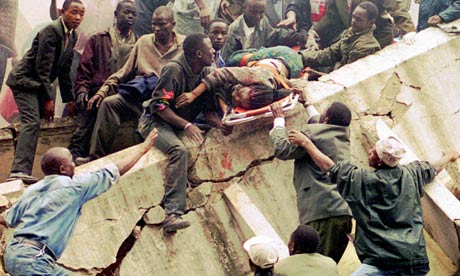
Ahmed Ghailani, a key figure in the 1998 bombings of U.S. embassies in Africa, was cleared by a jury of 276 murder and attempted murder counts.
by Clarice Feldman
The position of attorney general is one of the most important slots in the executive branch of the government. One of the key responsibilities of the attorney general is to prevent the president from violating the law. Another of his responsibilities is to act as a check on the president’s more fanciful notions about the law and what it can and should accomplish.
Because Attorney General Eric Holder shares with President Obama the notion that there is something wrong about military tribunals and something far better about trying captured suspected terrorists in civilian criminal courts which operate under far more rigid rules of evidence, he has flopped in suggesting Khalid Sheikh Mohammed should be tried in Manhattan criminal court, something no sane New York politician will agree to.
Just days ago, the administration seemed to indicate that it recognized that the trial in New York wasn’t feasible. It still looked down on the notion of a military tribunal. The suggestion was that the administration wouldn’t try Mohammed at all — but simply hold him in indefinite detention:
Khalid Sheik Mohammed, the self-proclaimed mastermind of the Sept. 11, 2001, attacks, will probably remain in military detention without trial for the foreseeable future, according to Obama administration officials.How holding people for years without any trial (or even after they’ve been acquitted by a civilian jury) is fairer than a military tribunal, I cannot say. The article also says that Obama will make the final decision, so he may simply be hoping to run out the clock , thinking that when he’s re-elected he’ll be in a better position to force an unpopular civilian trial over the objection of local politicians. Or he may just be paralyzed with indecision, as he so often dithers on matters of great importance.
The administration has concluded that it cannot put Mohammed on trial in federal court because of the opposition of lawmakers in Congress and in New York. There is also little internal support for resurrecting a military prosecution at Guantanamo Bay, Cuba. The latter option would alienate liberal supporters.
The administration asserts that it can hold Mohammed and other al-Qaeda operatives under the laws of war, a principle that has been upheld by the courts when Guantanamo Bay detainees have challenged their detention.
8/08/2010
Shut Up, He Explained

Mayor Michael Bloomberg to New Yorkers.
BY William Kristol
Last Tuesday, standing in front of the Statue of Liberty, New York mayor Michael Bloomberg spoke on the subject of the proposed mosque at Ground Zero. His remarks will be read with curiosity by future generations of Americans, who will look back in astonishment at the self-deluding pieties and self-destructive dogmas that are held onto, at once smugly and desperately, by today’s liberal elites. Our liberation from those dogmas, and from those elites, is underway across the nation. But it’s worth taking a look at Bloomberg’s speech, if only to remind us of what we need to ascend from so our descendants can look back with curiosity at the ethos to which we did not succumb.
As is the way of contemporary liberals, Bloomberg spoke at a very high level of abstraction. He appealed to the principle of religious toleration, while never mentioning the actual imam who is responsible for and would control the planned Ground Zero mosque. To name Imam Feisal Abdul Rauf might invite a consideration of his background, funding, and intentions. Do Rauf and his backers believe in the principles underlying the “inspiring symbol of liberty” that greets immigrants to the United States and before which Bloomberg stood? Bloomberg didn’t say. It apparently doesn’t matter. Toleration means asking nothing, criticizing nothing, saying nothing, about whom or what one is tolerating. This is the Sergeant Schultz standard of toleration: I know nothing.
Knowing nothing, or wishing to know nothing, about the mosque, Bloomberg took it upon himself to lecture his fellow New Yorkers on their obligation to be true to “the best part of ourselves.” That part is apparently the part of us that allows at once for intellectual obfuscation and moral preening. Bloomberg never acknowledged that sane and tolerant people might object to a 15-story Islamic community center and mosque right next to Ground Zero. He could not be bothered to take seriously the reservations and objections of a clear majority of his constituents. “In fact, to cave to popular sentiment would be to hand a victory to the terrorists—and we should not stand for that.” So public sentiment be damned. There’s nothing to be learned from the ignorant and bigoted residents of New York.

In fact, he denied the propriety of asking such a question. It would have been one thing—a more defensible thing—if Bloomberg had argued that there was little that could be done legally to stop the mosque and that New Yorkers should therefore make the best of a bad situation. But that was not his message. Instead, Bloomberg came to the Statue of Liberty not simply to accept the mosque, but to praise it: “Of course, it is fair to ask the organizers of the mosque to show some special sensitivity to the situation—and in fact, their plan envisions reaching beyond their walls and building an interfaith community. By doing so, it is my hope that the mosque will help to bring our City even closer together. . . . I expect the community center and mosque will add to the life and vitality of the neighborhood and the entire City.”
But have the real, existing organizers of the mosque shown much sensitivity to other New Yorkers? The answer is no—but if you’re a contemporary liberal, you don’t get into the actual, existing facts in order to make a judgment. You govern on the basis of what the organizers’ “plan” nominally “envisions,” you appeal to a hope and expectation that even Bloomberg can’t really believe in. But it allows him to avoid coming to grips with what is really happening and what lies behind the popular sentiment of disgust, even revulsion.
The conclusion of Bloomberg’s speech was odd: “Political controversies come and go, but our values and our traditions endure—and there is no neighborhood in this City that is off limits to God’s love and mercy, as the religious leaders here with us can attest.” Do the rest of us need Bloomberg’s hand-picked religious leaders to tell us that there are no limits to God’s love and mercy? We do doubt that encouraging this mosque to be built is an appropriate expression of respect for God’s love and mercy for those who were killed almost nine years ago. And we would note that no expression of New Yorkers’ love and gratitude for the victims of September 11 has yet been built at the site of Ground Zero during Mayor Bloomberg’s tenure.
It is likely, we believe, that civic pressure will cause the mosque to be moved elsewhere—Bloomberg’s lecture notwithstanding. But if Bloomberg were to have his way, it’s worth noting that he would presumably attend a dedication of Feisal Abdul Rauf’s mosque at Ground Zero before he would attend a dedication of a proper memorial to those who died there.
Contemporary liberalism means building a mosque rather than a memorial at Ground Zero—and telling your fellow citizens to shut up about it.
—William Kristol
7/11/2010
The Last Great Cover-up
TWA Flight 800 and Its Consequences

If TWA Flight 800 had exploded off the coast of Long Island in July 2001 as visibly as it had in July 1996, the world would have been told a different story, even if there had been a Democrat in the White House.
On the night of July 17, 1996, and into the early morning hours of the 18 th, Bill and Hillary Clinton and Deputy National Security Adviser Sandy Berger huddled fretfully in the family quarters of the White House.
The election they thought was in the bag no longer was.
The air traffic controllers had already reported. The radar data told a story not easily untold.
And now, eyewitness reports were flooding in. The explosion had taken place right at sunset, just ten miles off the coast, on a perfect night, with thousands of people looking out over the sea from Long Island’s popular south shore.
In 2001, some clever soul would have started collecting their tales on a web site before the tide turned, literally and figuratively. And the tales they had to tell!
FBI witness #73, an aviation buff, watched a “red streak” with a “light gray smoke trail” move up towards the airline, and then go “past the right side and above the aircraft before arcking [sic] back down toward the aircrafts [sic] right wing.”
She even reported the actual break-up sequence down before the authorities figured it out on their own..
High school principal Joseph Delgado might have posted his comments as well. He would tell the FBI that he had seen an object like "a firework," ascend "fairly quick," then "slow" and "wiggle" then "speed up" and get "lost." Then he saw a second object that "glimmered" in the sky, higher than the first, then a red dot move up to that object, then a puff of smoke, then another puff, then a "firebox."
Mike Wire would surely have gone public. The no-nonsense millwright and U.S. Army vet watched events unfold from the Beach Lane Bridge in Westhampton on Long Island.
Wire had seen a white light traveling skyward from the ground at approximately a 40-degree angle, sparkling and zig-zagging before culminating in a massive fireball.
In addition to the testimony, others would have been posting their videos and stills, all of which supported the eyewitness testimony. Others still would have shared the drawings of the incident that they would later give to the FBI.
But in 1996, the Internet was still in its embryonic stages. All information posted thereon was deemed, by the major media at least, suspect and even laughable.
In the absence of an effective Internet, the White House hit upon a control strategy that dazzled in its simplicity and in its sheer nerve.
The Clintons’ trusted point person, Deputy Attorney General Jamie Gorelick, would take the investigation away from the professionals in the National Transportation Safety Board and give it to the amateurs of the FBI. There was one reason why. The FBI reported to her. The NTSB did not.
This was illegal, of course, but the media had a president to re-elect soon enough, and they were not about to scruple over details.
The second part of the strategy was as simple as the first. The FBI would talk only to the New York Times. This essentially made the Times’ Gorelick’s ministry of propaganda.
Of the 270 eyewitnesses who told the FBI they saw what looked like a missile strike TWA Flight 800, the New York Times would interview exactly none of them.
Fearing perhaps to lose their privileged status and trusting the FBI more than they should have, the Times people followed the FBI lead. The other media, some grudgingly, followed the Times.
Most FBI agents, of course, worked hard and tried to do the right thing. They may have suspected but could not know that their work was being subverted at the top.
As each week passed, the Clintons had to be stunned that so obvious a truth remained so thoroughly ignored. To sustain the lie, however, insiders had to tell more lies still.
The FBI would fabricate a second interview with Witness #73. The CIA would fabricate a second interview with Mike Wire. The NTSB would lie outright about what Joseph Delgado saw, but the election came and went without anyone even knowing who these people were.
Gorelick could not have slept easily through all of this, but the Lotto was around the corner, and she knew she had the winning ticket. In May 1997, they called her number.
Out of all the likely finance and mortgage experts in America, the Fannie Mae Board picked her, a lawyer with no relevant experience, to be its new Vice Chair Gorelick would earn more than $4 million a year for the next six years, and no one in the media asked why.
They did not even ask why when she stepped down. Always the patriot, Gorelick resigned to take one of five Democratic seats on the 9-11 Commission.
Who knew where talk of aviation terrorism might lead? Someone had to keep talk of TWA Flight 800 off the table, just as someone had kept it off from 1996 to 2001.
And lest some messy scraps of information find their way to the Committee’s Republicans, the Clintons dispatched their most trusted adviser to do a little clean-up work.
Alas, Sandy Berger got caught, but this proved much easier to bury than TWA 800. The Justice Department slapped his wrist on a Friday, the day after Terry Schiavo died and the day before Pope John Paul II did.
The media did not want to know anyhow, and this time, there would be no eyewitnesses.
If you want to read a great thriller on this, read "Night Fall" by Nelson DeMille. Even though it is fiction, like "Climate of Fear" it is based on a great deal of factual research and is a gripping read too.
7/09/2010
Holder Sticks to His Guns

Jennifer Rubin
Attorney General Eric Holder is nothing if not persistent. Despite the logistical, national security, budgetary and political problems, he still wants a public trial for KSM. Politico notes:
The AG said the civilian court system “has proven effective in a wide range of cases over the last 200 years. Why can’t we use that system?” Asked about holding such a trial in Virginia, Holder said “there are any number of possibilities” that state, local and federal officials are discussing. … Holder’s continued support for a civilian trial isn’t a surprise, but it’s mildly surprising he’d state his personal view while the issue is still under review at the White House. Some press accounts have suggested that virtually all of Obama’s top advisers have advised him to reject Holder’s counsel.
There are three possibilities here. Holder could be off the reservation and about to “spend more time with his family” after the midterms. Holder could be letting the official policy (KSM goes to trial in a civilian court in a state Obama has no hope of winning in 2012) slip out, which the administration doesn’t have the nerve to announce before the midterms. Or, it may be that the administration has decided it’s lunacy to try KSM in civilian court and Holder is there to keep the loony left’s hopes alive — and prevent a complete meltdown in Democratic turnout. Each is plausible. But it is shocking that we have an attorney general willing to risk his own credibility and that of the entire Justice Department by spouting such hooey.
7/02/2010
Terror -- and candor in describing the Islamist ideology behind it

By Charles Krauthammer
The Fort Hood shooter, the Christmas Day bomber, the Times Square attacker. On May 13, the following exchange occurred at a hearing of the House Judiciary Committee:
Rep. Lamar Smith (R-Tex.): Do you feel that these individuals might have been incited to take the actions that they did because of radical Islam?
Attorney General Eric Holder: There are a variety of reasons why I think people have taken these actions. . . .Potentially, mind you. This went on until the questioner gave up in exasperation.
Smith: Okay, but radical Islam could have been one of the reasons?
Holder: There are a variety of reasons why people --
Smith: But was radical Islam one of them?
Holder: There are a variety of reasons why people do these things. Some of them are potentially religious-based.
A similar question arose last week in U.S. District Court when Faisal Shahzad, the Times Square attacker, pleaded guilty. Explained Shahzad:
"One has to understand where I'm coming from . . . I consider myself a mujahid, a Muslim soldier."
Well, that is clarifying. As was the self-printed business card of Maj. Nidal Malik Hasan, the Fort Hood shooter, identifying himself as SoA: Soldier of Allah.
Holder's avoidance of the obvious continues the absurd and embarrassing refusal of the Obama administration to acknowledge who out there is trying to kill Americans and why. In fact, it has banned from its official vocabulary the terms jihadist, Islamist and Islamic terrorism.
Instead, President Obama's National Security Strategy insists on calling the enemy -- how else do you define those seeking your destruction? -- "a loose network of violent extremists." But this is utterly meaningless. This is not an anger-management therapy group gone rogue. These are people professing a powerful ideology rooted in a radical interpretation of Islam, in whose name they propagandize, proselytize, terrorize and kill.
Why is this important? Because the first rule of war is to know your enemy. If you don't, you wander into intellectual cul-de-sacs and ignore the real causes that might allow you to prevent recurrences.
The Pentagon review of the Fort Hood shooting runs 86 pages with not a single mention of Hasan's Islamism. It contains such politically correct inanities as "religious fundamentalism alone is not a risk factor."
Of course it is. Indeed, Islamist fundamentalism is not only a risk factor. It is the risk factor, the common denominator linking all the great terror attacks of this century -- from 9/11 to Mumbai, from Fort Hood to Times Square, from London to Madrid to Bali. The attackers varied in nationality, education, age, social class, native tongue and race. The one thing that united them was the jihadist vision in whose name they acted.
To deny this undeniable truth leads to further absurdities. Remember the wave of speculation about Hasan's supposed secondary post-traumatic stress disorder -- that he was so deeply affected by the heart-rending stories of his war-traumatized patients that he became radicalized? On the contrary. He was moved not by their suffering but by the suffering they (and the rest of the U.S. military) inflicted on Hasan's fellow Muslims, in whose name he gunned down 12 American soldiers while shouting "Allahu Akbar."
With Shahzad, we find the equivalent ridiculous -- and exculpating -- speculation that perhaps he was driven over the edge by the foreclosure of his home. Good grief. Of course his home went into foreclosure -- so would yours if you voluntarily quit your job and stopped house payments to go to Pakistan for jihadist training. As The Post's Charles Lane pointed out, foreclosure was a result of Shahzad's radicalism, not the cause.
There's a final reason the administration's cowardice about identifying those trying to kill us cannot be allowed to pass. It is demoralizing. It trivializes the war between jihadi barbarism and Western decency, and diminishes the memory of those (including thousands of brave Muslims -- Iraqi, Pakistani, Afghan and Western) who have died fighting it.
Churchill famously mobilized the English language and sent it into battle. But his greatness lay not in mere eloquence. It was his appeal to the moral core of a decent people to rise against an ideology the nature of which Churchill never hesitated to define and describe -- and to pronounce ("Nahhhhzzzzi") in an accent dripping with loathing and contempt.
No one is asking Obama or Holder to match Churchill's rhetoric -- just Shahzad's candor.
6/11/2010
The left’s strange hostility to Hirsi Ali

MARK STEYN: Nicholas Kristof is just the latest great thinker to talk himself into a rosy view of Islam
Despite being a bit of an old showbiz queen, I’m not much for the huggy-kissy photo wall of me sharing a joke with various luvvies. I make an exception on the bureau behind my desk for a shot of yours truly and a beautiful woman, Somali by birth, Dutch by citizenship, at a beachfront bar in Malibu at sunset. I like the picture because, while I look rather bleary with a few too many chins, my companion is bright-eyed with a huge smile on her face and having a grand old time—grand, that is, because of its very normality: a crappy bar, drinks with cocktail umbrellas, a roomful of blithely ignorant California hedonists who’ll all be going back home at the end of the evening to Dancing With the Stars or Conan O’Brien or some other amusement.
Ayaan Hirsi Ali can’t lead that life. She lives under armed guard and was forced to abandon the Netherlands because quite a lot of people want to kill her. And not in the desultory behead-the-enemies-of-Islam you-will-die-infidel pro forma death-threats-R-us way that many of us have perforce gotten used to in recent years: her great friend and professional collaborator was murdered in the streets of Amsterdam by a man who shot him eight times, attempted to decapitate him, and then drove into his chest two knives, pinning to what was left of him a five-page note pledging to do the same to her.
What would you do in those circumstances? Ayaan and I had repaired to that third-rate bar after a day-long conference on Islam, jihad, free speech and whatnot. That’s usually where I run into her, whether in Malibu or at the Carlton Club in London or at a less illustrious venue. Would you be doing that with a price on your head? Or would you duck out of sight, lie low, change your name, move to New Zealand, and hope one day to get your life back? After the threats against the Comedy Central show South Park the other week, Ms. Hirsi Ali turned up on CNN to say that the best defence against Islamic intimidation is for us all to stand together and thereby “share the risk.” But, around the world, every single translator of her books has insisted on total anonymity. When push comes to shove, very few are willing to share the risk. The British historian Andrew Roberts calls her “the bravest woman I know.” I would say she is not only the bravest but also, given her circumstances, the most optimistic. I have an unbounded admiration for her personally, but a not insignificant difference philosophically, of which more momentarily.
6/10/2010
Hezbollah, Hamas Raise Money for ‘Terrorist Activities’ From Drug Trade in South America, Congressional Research Service Says

By Edwin Mora
- Amid growing concern about the illicit drug trade across the U.S.-Mexico border, the terrorist groups Hezbollah and Hamas have been linked to South American drug trafficking organizations–and the money Hezbollah and Hamas make from narco-trafficking is used to finance their organizations, according to the non-partisan Congressional Research Service (CRS).
“International terrorist groups, including Hamas and Hezbollah, have also reportedly raised funding for their terrorist activities through linkages formed with DTOs in South America, particularly those operating in the tri-border area (TBA) of Brazil, Paraguay, and Argentina,” stated CRS in an April 30 report.
As evidence that Hezbollah and Hamas are doing business with South American drug traffickers, CRS referred to comments by Anthony Placido, the assistant administrator for intelligence at the U.S. Drug Enforcement Administration.
In testimony before a House Oversight and Government Reform subcommittee on March 3, Placido stated, “Some DTOs based in the tri-border area have ties to radical Islamic terrorist groups such as Hezbollah. It is important to note that this is not an emerging threat per se, but one that has existed since the late 1980s or early 1990s,” he added.
“Investigations into these groups as part of DEA’s Drug Flow Prevention Strategy reveal DTOs are exporting cocaine from South America to Europe and the Middle East,” Placido testified. “There are numerous reports of cocaine proceeds entering the coffers of Islamic Radical Groups (IRG) such as Hezbollah and Hamas in Europe and the Middle East.”
Placido warned of the “danger” resulting from drug trafficking organizations and Islamic radical groups engaging in the lucrative cocaine trade: It “can lead to an unlimited source of cheap and easy revenue to carry out potential terrorist acts,” he said.
Hezbollah is a Lebanese-based terrorist organization with ties to Iran. It was formed in 1982 by Lebanese Shiite Muslim clerics who supported Iran’s Islamic revolution.
Hamas is the Arabic acronym for "Islamic Resistance Movement.” The terrorist group, dedicated to the eradication of Israel, is now based in the Gaza Strip.
Both Hamas and Hezbollah are designated as terrorist organizations by the U.S. government.
'Strategic relationships' a concern
The DEA has not yet responded to a request for comment on the CRS report. However, Michael Braun, the DEA’s former administrator and chief of operations, told CNSNews.com, “What concerns me the most is the fact that the cocaine trade brings Hezbollah and Hamas into very close contact with Colombian and Mexican drug trafficking cartels.”
Braun pointed to the potential for terrorist groups to develop “close strategic relationships and partnerships” with drug traffickers. “I believe that there is plenty of open source reporting that clearly reveals Hezbollah has connected with some Mexican drug trafficking cartels,” he added.
Dr. Matthew Levitt, senior fellow and director of terrorism studies at The Washington Institute for Near East Policy who has testified on Hezbollah’s presence in South America before congressional panels, told CNSNews.com that Hezbollah’s ties to Latin American drug smugglers poses a “significant” threat for U.S. national security.
“In the event that the nuclear confrontation with Iran gets worse rather than better, having a militant organization like Hezbollah on, and even within our border -- it certainly does pose a threat,” said Levitt.
“Hezbollah isn’t targeting the United States right now, but if it chooses to do so it would be very capable of doing so, both in terms of its presence and large financial and logistical presence in South America, particularly in the tri-border area, but [also] in terms of networks they have here in the United States,” he added.
“One of the things that’s of concern is that you see Hezbollah now engaging in trans-Atlantic drug shipments to Africa and failed states there and then north into Europe,” Levitt said.
According to a 2006 report by the House Committee on Homeland Security, "Members of Hezbollah, the Lebanon-based terrorist organization, have already [illegally] entered to the United States across our Southwest border."
The report noted, for example, that in December 2002, “Salim Boughader Mucharrafille, a cafe owner in Tijuana, Mexico, was arrested for illegally smuggling more than 200 Lebanese illegally into the United States, including several believed to have terrorist ties to Hezbollah.”
Furthermore, Robert L. Boatwright, assistant chief patrol agent of the El Paso, Texas sector, has said, “We have apprehended people from countries that support terrorism … they were thoroughly debriefed and there was a tremendous amount of information collected from them.
"These examples highlight the dangerous intersection between traditional transnational criminal activities, such as human and drug smuggling, and more ominous threats to national security.”
Sheriff Sigifredo Gonzalez was also quoted in the report: “If smugglers can bring in tons of marijuana and cocaine at one time and can smuggle 20 to 30 persons at one time, one can just imagine how easy it would be to bring in 2 to 3 terrorists or their weapons of mass destruction across the river and not be detected. Chances of apprehension are very slim.”
'Financial-narcotics nexus'
In his March 3 testimony, Placido pointed out that the DEA is working to “identify and track” Islamic radical groups’ networks in Latin America, Europe and the Middle East, “which are reaping the financial benefits from the lucrative European and Middle East cocaine markets.” The key to disrupting those networks will be an attack on the “financial-narcotics nexus,” he said.
In its report, CRS noted that South America is the sole producer of cocaine for the global market. Pointing to Justice Department statistics, CRS said the Mexican and Colombian DTOs combined “generate, remove and launder” between $18 billion and $39 billion in wholesale drug proceeds annually.
A 2004 study by the Naval War College revealed that Hezbollah raises close to $10,000,000 a year in the Tri-border region, although not all of it comes from the drug trade. “U.S. Southern Command estimates that Islamist terrorist groups raise between three hundred million and five hundred million dollars per year in the Triple Frontier and the duty-free zones of Iquique, Colon, Maicao, and Margarita Island [in South America],” the study said.
Dr. Ray Walser, the Heritage Foundation’s senior policy analyst who specializes in Latin America, and Vanda Felbab-Brown, a Brookings Institution expert on national security, agreed that the money Hezbollah and Hamas generate from their links to South American drug trafficking organizations is supplemental – a secondary financial source.
Hezbollah also has been linked to other financial schemes, including taxing the residents in areas where they operate.
Felbab-Brown told CNSNews.com that Hezbollah is more prominent in South America than Hamas is.
Iranian-funded and supported Hezbollah also has a presence outside South America’s tri-border area, in countries such as Venezuela, where socialist President Hugo Chavez, an ally of Iran, spreads anti-American sentiment.
In June 2008, a U.S. Treasury official stated, “It is extremely troubling to see the Government of Venezuela employing and providing safe harbor to Hizballah facilitators and fundraisers.”
Brazil, which is part of the tri-border area, recently has worked to stave off U.S.-backed sanctions against Iran.
The Brookings Institution’s Felbab-Brown told CNSNews.com that Hezbollah’s and Hamas’ “primary connection” is with the Brazilians and the Colombians.
6/08/2010
Under The Radar Stories

It is all rather chilling when you think about it. What would this guy be doing illegally collecting such an arsenal if he did not intend to use it and he certainly would not have use of all of this for himself so does he have associates and what are their intentions? Good thing their is no such thing as radical Islam jihad, huh?
I've linked a couple of the local stories on it which are quite scary. when you think about it.
Related:
Oliver King, Suspected Iranian Arms Dealer, Caught With Stockpile of Weapons
Iranian indicted in rifles, ammo stockpiling case
Hamid Malekpour of Iran Brings Illegal Weapons into US, Picks Up Weapons in Oregon, and Stores Them in Washington State
Arms cache tied to Mac
Via-Yamhill News Register
By Paul Daquilante
By Paul Daquilante
When federal Immigration and Customs Enforcement agents served a search warrant last Wednesday on a storage unit in Ferndale, Wash., just south of the Canadian border, they discovered more than $30,000 worth of high-powered weaponry, including a .50-caliber sniper rifle.
The find was detailed in an affidavit filed by the Western District Court of Washington against illegal alien Iranian Hamid Malekpour, also known as Oliver King, about 35 years old.
Much of the weaponry was packed into boxes bearing shipping labels addressed to McMinnville Hunting & Police Supplies Inc., the affidavit states. The obscure business, located in a shuttered, unsigned office at 1900 N.E. Highway 99W, is owned by Amir Zarandi.
McMinnville does not require business licensing, according to City Attorney Candice Haines, but the state does. The gun dealership has been registered with the Secretary of State’s Corporation Division in the past, but missed its scheduled renewal date of May 11.
A small sign on the door indicates hours are by appointment only. Its website dead-ends with “under construction” notices.
Yamhill County Sheriff’s Capt. Ken Summers said he’d never heard of the business, and knew of no one in the department who had.
He said the sheriff’s office buys its firearms from Keith’s Sporting Goods in Gresham. He said he knows of no law enforcement agency that might deal with Zarandi.
City and county law enforcement personnel were also in the dark about the federal activity conducted in connection with the shop — and weren’t particularly happy about that.
Capt. Dennis Marks said McMinnville police were not contacted by ICE agents regarding the surveillance work they were engaged in, or about King.
“After he had been arrested, I believe, the sheriff faxed a copy of a story to the chief and asked if we were aware of this,” Marks said.
Chief Ron Noble replied in the negative, he said.
Sheriff Jack Crabtree said his office had not been notified either, which he found disturbing.
“I have been in contact with Chief Noble,” Crabtree said. “Initial inquiries have been made to federal agencies involved. Why were we not informed? I’ve been asked that by a lot of people.”
Crabtree added, “We have a great relationship with agencies like the FBI and ICE. Quite frankly, I would have expected to be informed. This is not acceptable to me. Absolutely, we should have been informed.”
He doesn’t believe local law enforcement agencies were intentionally ignored. He feels there was a lack of communcation at ICE’s end.
The McMinnville office building is owned by FH Project Inc. of Milwaukie, according to the Yamhill County Assessor’s office.
The business is registered with the state, with a scheduled renewal date of July 9. It is actively occupied by other tenants engaging in more open and better advertised modes of operation.
Agents started tailing King — the name on the passport he used both for recent visits to Iran and last week’s border crossing — in Blaine, Wash. They followed him to the McMinnville gun shop, where he is listed on the lease, and watched him load several boxes of high-powered firearms and ammunition there last Wednesday morning.
They then followed him back north to a storage facility in Ferndale, where they took him into custody.
6/04/2010
The Convenient Villain

by Jonah Goldberg
On May 29, two days before Israel's botched raid of six "humanitarian" ships bound for Gaza, Robert Naiman, the policy director of something called "Just Foreign Policy," wrote an item on the Huffington Post headlined "Gaza Freedom Flotilla Shows Awesome Power of Nonviolent Resistance."
Naiman waxed lyrical about how the moral authority of nonviolence had compelled Turkish-controlled Cyprus to help the flotilla while Greek-controlled Cyprus had allegedly caved to Israeli pressure in refusing to help the heirs of Gandhi (it couldn't have been because the Turks were up to no good).
"All this," Naiman gushed, "and the main confrontation between the Israeli occupation authorities and the Gaza Freedom Flotilla has not yet begun."
Roughly 48 hours later, the "main confrontation" unfolded. In fairness, the majority of "peace activists" on the ships were nonviolent, offering passive resistance. But on the last boat Israelis boarded, the supposed disciples of peace attacked the Israeli commandos. These new Gandhians beat the Israelis with metal bars and even threw one Israeli overboard.
Funny, I'm no expert, but that's not how Gandhi behaved in the movie. Maybe there was a sequel with Chuck Norris as the Mahatma? "Gandhi's back, and this time it's personal!"
6/03/2010
The $64,000 Question Is...

Will people now change their minds and realize this was a cowardly attempt by terrorists, guised under noble, humanitarian clothing to smuggle weapons in (and thus in part admit there is now a desire of lefter leaning elements to combined forces with terrorism) and therefore condemn it
or
Will they refuse to admit they're wrong and tacitly support terrorism because their leftist ideology blinds them from any kind of capacity for intellectual honesty
or
They will cowardly claim this report is false and that the Israeli's made it up.
It is a very important question because it's going to test whether people (primarily of the lefter persuasion) can set aside their ideologies and as adults acknowledge they were wrong and condemn terrorism or if their ideology is so strong they will still maintain their positions and thus tacitly APPROVE OF TERRORISM.
I shall now sit back and watch this unfold like a movie, much like a did the housing crash, without an utter care or concern because simply it's a lost cause and life is too short to worry about things you don't control. So, enjoy the decline!
6/02/2010
Calling a State Sponsor a State Sponsor

Via-The American
By Roger F. Noriega
This month a dozen U.S. senators fired the opening salvo in what promises to be an aggressive oversight campaign to get to the bottom of Venezuelan dictator Hugo Chávez’s support for terrorism. A May 25 letter challenges Secretary of State Hillary Clinton to explain what the administration knows about Venezuela’s support for a sprawling network of terrorist states and groups, including Iran, Hezbollah, Colombian “narcoterrorists,” Cuba, and Syria.
Rallied by John Ensign (R-Nevada) and George LeMieux (R-Florida), the senators are asking that Secretary Clinton explain what the administration knows about alleged arms shipments, high-level contacts, and financial dealings linking Venezuela to a rogue’s gallery of, well, rogues. The detailed letter signals that the senators already know more than the administration has been willing or able to substantiate about dictator Chávez’s collaboration with anti-American terror groups and hostile regimes.
“We are deeply concerned about Venezuelan president Hugo Chávez’s growing ties to U.S.-designated foreign terrorist organizations and state sponsors of terrorism,” the letter begins. Following a litany of examples of how Chávez economically bolsters terrorist regimes (including Cuba and Iran) and provides material support to terrorist groups (from Hezbollah to the Revolutionary Armed Forces of Colombia), the senators ask Clinton to explain why Venezuela evades designation under U.S. law as a state sponsor of terrorism.
Among Chávez’s notorious actions the senators cite:
• The provision of “sanctuary” and the “flow of guns and money”—including the provision of portable missiles, anti-tank rockets, and other weaponry—to Colombian guerrillas;
• Complicity in the illegal narcotics trade that fuels terrorism—including the burgeoning traffic from Venezuelan territory to west and north Africa;
• The “presence and activities of Hezbollah inside Venezuela,” and a November 2009 shipment of Russian weapons from a Venezuelan arms cache to that group;
• “Extensive support of the Castro regime in Cuba,” and Chávez’s reliance on Castro henchman Ramiro Valdes to repress internal opponents;
• Possible support for “Iran’s covert nuclear enrichment program” in exchange for Iran’s providing “nuclear knowhow” to Chávez;
• Venezuela’s delivery of gasoline to Iran and its help for Iran to evade international sanctions; and
• Suspicious air traffic and lax immigration controls on Caracas-Damascus-Tehran airline flights.
The Ensign-LeMieux letter was co-signed by John McCain (R-Arizona), Robert Bennett (R-Utah), Scott Brown (R-Massachusetts), Sam Brownback (R-Kansas), Jim Bunning (R-Kentucky), John Cornyn (R-Texas), James Inhofe (R-Oklahoma), Republican Whip Jon Kyl (R-Arizona), James Risch (R-Idaho), and Roger Wicker (R-Mississippi). LeMieux’s involvement is significant because he was one of several senators who held up multiple diplomatic nominations last year over concerns regarding the administration’s policy toward Latin America.
This stepped-up congressional oversight is bound to build on the growing body of evidence pointing to Chávez’s singular role in supporting terrorism and related criminality. The Obama administration’s decision to the pull the trigger on Venezuela may hinge on whether the United States can afford to forfeit petroleum exports from that South American country.
Anticipating the argument that Venezuela’s oil supply is too essential to the U.S. economy to risk slapping that country with the terrorist label, the senators ask the administration to explain its “contingency plan” for dealing with a “sudden and prolonged unavailability of Venezuelan oil exports to the United States.”
The reality is, although the United States will likely find new sources of oil on the international market within a few weeks, Venezuela’s economy will be crippled by the loss of oil revenue and consumer imports. Moreover, Chávez has wrecked Venezuela’s state-owned oil company and has failed to identify new importers with the special refineries required to distill the viscous heavy crude his country produces. Ironically, oil-rich Venezuela may be one of the few countries against which these anti-terror sanctions may have a decisive impact.
Since the last years of the George W. Bush administration, U.S. diplomats have steered clear of Chávez for fear of “provoking” him. Thanks to congressional oversight, we are about to confront the terrible downside of that naïve, passive policy.
Roger F. Noriega was Ambassador to the Organization of American States from 2001-2003 and Assistant Secretary of State from 2003-2005. He is a visiting fellow at the American Enterprise Institute and managing director of Vision Americas LLC, which represents U.S. and foreign clients
Subscribe to:
Posts (Atom)