Tip Jar

Showing posts with label 2012 campaign. Show all posts

8/11/2012

Scaring a dead grandma to death


My grandfather was a true blue FDR Democrat as were  many of his generation, including I might add Ronald Reagan. My grandfather "came of age" during the depression raising a family and like nearly everyone of that generation he struggled just to get by.  To that generation of Americans and to some degree their children the whole "social contract" philosophy of governance if not sacristan was at least ingrained.

This predisposition towards government's "social contract" with citizens was reinforced by LBJ's Great Society of the mid sixties so it is not surprising that the idea of any changes to programs like Social Security or Medicare would be anathema to people of that generation.

Democratic politicians doing what  Democratic politicians have done for a generation, demagogue any proposals to reform or touch these programs with the assurance that in doing so they will turn elderly voters against any politician who might dare touch the "social contract".

This is why the Democrats and the Obama campaign are all but salivating over Mitt Romney selecting Paul Ryan as his VP nominee. Regardless of the absolute and undeniable need to reform these programs to insure their very existence, they feel that they can turn elderly voters against the Republican ticket especially in key states like Florida, Ohio and Pennsylvania all of which have large elderly populations and are critical swing states. Ryan being the primary architect to entitlement reform, the Democrats feel that this is a perfect opportunity to pull out the old tried and true demagoguery stick and beat the Republicans into submission and defeat.

There is just one problem with this strategy, it not only won't work, it will be counter productive, rather than scaring seniors it more likely motivate them in the opposite direction. The fact is the Democrats along with most of the pundit class on both sides is fighting the last war and generals who fight the last war generally loose the one that they are now in.

You see my grandfather died over twenty years ago. The older generation that this trick of "scaring granny" worked effectively on is being replaced by a newer generation of seniors that have neither the life experience or the political views of my grandfather's so called "greatest generation".

This is not all that difficult to see it actually is quite obvious. The fact that talking heads and politician's seem to ignore this obvious change only goes to show how out of touch they truly are with what is going on in the nation they claim to observe and govern.

A simple study of voting patterns would show this to anyone who cared to look, The political make up of older Americans has been trending more and more Conservative and Republican for the last thirty plus years but has begun to accelerate more in the last decade as the "younger elderly" begin to replace the "older elderly" so to speak. In 2000 Gore received 50% of the over 65 vote while Bush got 49% about what you would expect based on both the closeness of the election and the previous Democratic domination with older voters. By 2004, another very close election, but the tide had really begun to turn when it came to older voters, and Bush beat Kerry among the over 65 vote 52% to 47%.

To show how the political leaning of seniors has changed, in 1988 when George H W Bush beat Dukakis by seven points in a near landslide he only carried the over 65 vote. by 1%.  The full switch over from Democratic domination of the older vote came in 2008. Whereas George H W Bush could only get 1% of the over 65 vote while winning the election by 7% in 1988, just 20 years later McCain beat Obama by 8% (53-45) among the over 65 voter while loosing the election to Obama by 8%. 

Obviously the political leanings of older voters have shifted to the right. After all isn't that what the media and the progressives have been saying for the past three years, the Tea Party is nothing but old white folks? Well it isn't but they do have a very large role in the movement.

 At the beginning of the month Fred Newport the editor and chief of Gallup Polling, in discussing the presidential race made the following observation, (emphasis mine)
Obama’s core support comes from nonwhites, young people, those with postgraduate educations, those with very low incomes, those who are not religious, those who are not married, and women. Romney’s core support comes essentially in the obverse groups -- in particular, whites, older Americans, the very religious, and those who are married.

Polling for years has shown that older Americans are trending more to the right than the general population.  Obama's lowest approval ratings are always among the elderly. Just one example, without getting into the specifics of the poll itself,  is the most recent IBD/TIPP poll which shows Obama up by 7 (46-39) over Romney nationally, but among those over 65 Romney leads 49-40, and all polling has reflected this for some time.

 Virtually every poll you see that shows the breakdown by age shows Romney not only ahead with older voters, he generally is far ahead. This isn't just some national trend it is true in the battleground states as well. In a recent Survey USA  poll of Florida shows Obama leading (48-43) but loosing to Romney by 10% among those over 65 (53-43)

So not only is Obama least popular among the elderly, Romney's greatest support is among the elderly both in individual states and nationally. Not only that but last month Rasmussen Report showed that Paul Ryan's favorably among over 65 voters was 52/29, that is 52 favorable.

The reason for this is obvious, like my grandfather who "came of age during the FDR years, the current crop of seniors "came of age" during the Reagan Revolution, and they have not forgotten what they learned. Consider this, anyone today between the age of 60 and 80 in 1980 was between the ages of 28 and 48, the prime of their lives. Increasingly today;s seniors were the ones who benefited most and saw first hand what supply side economics can do for an economy and their Reagan generation 401K's. Today's seniors not only remember the Reagan Revolution  they were the ones who voted it into affect, they were the Reagan Revolution. 

So Obama and the Democrats now think that these same people who lived and experienced what they (Progressives) are now trying to destroy are going to suddenly to be demagogued into voting for them? I don't think so. The Ryan pick intensifies today's seniors support for Romney not diminishes it, Ryan is a Reagan Republican where Romney was always suspect.

Even right leaning pundits seem to be blind to the fact that the the elderly voters in America are actually the least likely to be swayed by the attacks about to be unleashed, once again, against common sense. As I said the Democrats and much of the media is living in a political world that has past them by, they are trying in affect  to scare dead grandmas. Unfortunately for them today's grandma's carry signs and vote overwhelmingly Republican.

10/12/2011

Game Changer?


Being an avid student of history it always is exciting to me when reading the chronicles of an event or of a time period when I come to a the point where something occurs and you just know, that was it. That was the event, the speech, the vote, the battle, the happening that changed the direction of history. Almost always it is not some spontaneous thing, it is just the culmination of the direction events were going anyway, but that happening takes place and the unfocused clarifies itself and the game changes.

With a along way to go and not a vote cast it is difficult to say that something in the current Republican Preidential nominating process could be a game changer, but perhaps this is.

"Herman Cain’s 9-9-9 plan would be a vast improvement over the current tax system and a boon to the U.S. economy, the goal of supply-side tax reform is always a broadening of the tax base and lowering of marginal tax rates."
and
"Mr. Cain’s plan is simple, transparent, neutral with respect to capital and labor, and savings and consumption, and also greatly decreases the hidden costs of tax compliance. There is no doubt that economic growth would surge upon implementation of 9-9-9."

That sounds like a ringing endorsement for, if not Herman Cain, at least his tax plan which has gotten so much attention of late. What makes it truly significant is that it comes not from some politician wishing to jump on the "Cain Train" but rather from the Godfather of Supply Side Economics himself, Art Laffer. For those who may not know who Dr Laffer is, for whom the Laffer Curve is named, here is a portion of his biography from CNBC.

Dr. Laffer’s economic acumen and influence in triggering a world-wide tax-cutting movement in the 1980s have earned him the distinction in many publications as "The Father of Supply-Side Economics." One of his earliest successes in shaping public policy was his involvement in Proposition 13, the groundbreaking California initiative that drastically cut property taxes in the state in 1978.

Years of experience and success in advising on a governmental level have distinguished Dr. Laffer in the business community as well. He currently sits on the board of directors of several public companies, which include: MPS Group Inc. (MPS) and Oxigene Inc. (OXGN). He also sits on the board of directors or board of advisors of a number of private companies including: Nicholas Applegate Institutional Funds, Retirement Capital Group, Pillar Data Systems, LifePics, Jovian Holdings, Roth Capital, Atrevida Partners, Health Edge Partners, First Q Capital, The Mayfair Group, and Endovascular Instruments. In the past, he has served on the board of directors of: Veolia Environnement, Provide Commerce, Neff Corporation, Petco, Clarcor and Amplicon Financial.

Dr. Laffer is a founding member of the Congressional Policy Advisory Board, a select group of advisors who assist in shaping legislative policies for the 105th, 106th and 107th United States Congress.

Dr. Laffer was a member of President Reagan’s Economic Policy Advisory Board for both of his two terms (1981-1989). He was a member of the Executive Committee of the Reagan/Bush Finance Committee in 1984 and was a founding member of the Reagan Executive Advisory Committee for the presidential race of 1980. He also advised Prime Minister Margaret Thatcher on fiscal policy in the United Kingdom during the 1980s.

To put it simply much of conservative and Republican economic policies are based upon the work and theories of Art Laffer. Only Milton Friedman is held in higher esteem in the "right's" economic realm than Art Laffer.

To put it bluntly had Dr Laffer made these views known prior to this past debate I doubt any of the other candidates would have dared criticize Herman Cain's 9-9-9 plan, at least not without much trepidation.

What can the other candidates now say when the man recognized as being the driving force behind Reganomics praises the plan? They now look slightly foolish making so light of something that has now been endorsed by a super star of right side economics.

More from the brief story in Human Events:
Laffer also said that "such a system provides the least avenues to avoid paying taxes, yet also maintains the strongest incentives for work effort, production, and investment."
Herman Cain's 9-9-9 plan will now have to be seriously considered and the fact that Dr Laffer is backing it will only increase it's popularity with fiscal conservative voters, even if the other candidates still attempt to make it out to be not a serious proposal.

It is however a serious and bold proposal the kind which American's have been looking for. It now has the potential to be a game changer, with the endorsement of a man who can not be dismissed.

10/08/2011

Can SCOTUS save Obama?

There has been much speculation as to why the Obama Administration suddenly changed course on Obamacare. Despite the conventional thinking that the administration would delay and "slow walk" court cases through the judicial process, which they had been doing, they reversed course and chose not to appeal the three judge panels ruling to the entire Eleventh Circuit that the mandate is unconstitutional. In addition they joined with the states and parties who brought the suit in asking the Supreme Court to rule on the case which almost assures that it will do so some time early next summer, right at the beginning of the general election campaign.

I have my own explanation for this which I have not heard anyone yet put forth, but first we must understand a couple key points.

The first point is that unlike the ruling Judge Vinson made which said that not only was the individual  mandate  unconstitutional, without the mandate the law itself was in affect void because there was no severability clause written into it and that without the mandate the law itself is unworkable.. The 11th Circuit panel did not rule that the whole law (Obamacare) was  void as Judge Vinson had, but rather only the individual mandate was was unconstitutional.

This is key to what I am about to present. Remember the ruling now in affect by the 11th Circuit Court is that the mandate is unconstitutional but the rest of  the law is still valid. In affect the panel did what congress did not do, they severed the mandate from the law but left the law in place.

Why is this important ?

Well it goes back to why there had to be a mandate in the first place. Most of us who oppose Obamacare do so because of the individual mandate which we find an affront to our liberties which it most assuredly is, but the reason for the mandate are more practical. Obmacare did not eliminate private insurance though that is the hoped for ultimate outcome, but what it did do is dictate to insurance companies certain coverage mandates which they must follow which is as  egregious an affront to liberty as the individual mandate but less popularly opposed. In fact these coverage mandates are quite popular with the public even if unworkable without the individual mandate. These coverage mandates such as covering preexisting conditions, covering children until they are twenty-six and a host of others written into the law and others being regulated into the law through Health and Human Services would break the insurance companies without the individual mandate requiring all Americans to have insurance which pays for it.

The scenario of the law without the individual mandate but with the other provisions still in place has been referred to as a "death spiral" for the insurance industry. Philip Klein in the American Spectator explained back in 2010 when the Vinson ruling first came out.

It's long been accepted as a given in health care policy circles that if the government is going to force insurers to offer coverage to those with pre-existing conditions, they're also going to have to require that everybody purchase insurance. Without a mandate, you end up with the infamous "death spiral" -- healthy people forgo purchasing coverage because they know they can wait until they get sick, leaving insurers with sicker beneficiaries, which drives up premiums and causes more healthy people to exit the market, and so on.

Which brings us back to the administration's decision to expedite a Supreme Court ruling on Obamacare. Remember where we stand now is that the individual mandate has been ruled unconstitutional but the rest of the law still stands. If the individual mandate is ruled Constitutional by SCOTUS, then Obama wins the political battle and the fight becomes about just repealing Obamacare, a fight I might add that Mitt Romney would be at a severe disadvantage in compared to the other candidates. Most people had expected that this would be the political battle going into the 2012 elections if the Supreme Court had not ruled anyway which is why everyone expected Obama to "slow walk" the legal battle.

Now however we have the likelihood that the Supreme Court will rule come next June and there is a very real  possibility, that SCOTUS upholds the Eleventh Circuit's ruling and finds the individual mandate unconstitutional but leaves the rest of the law for the other two branches to figure out. Although this might appear to be a severe loss to the Administration it might not be so bad, in fact it could be a game changer in Obama's favor in several ways.

Most observers particularly on the right believe that the threat of Obamacare is a severe drag on the economy. Many have said that a repeal of Obamacare  would have a stimulative affect on the economy. People and businesses would initially react very positively to the ruling believing that an unnecessary and huge regulatory burden was about to be lifted from the American economy. I suspect that if the individual mandate were ruled unconstitutional the immediate affect would be a strong surge in consumer and business confidences which could even generate an uptick in America's economy. This of course would occur in the summer of 2012 most likely after the Republican candidate is already known.

A ruling overturning the individual mandate without voiding the entire law would in reality be disastrous, creating the "death spiral" situation explained above. This situation is well understood by policy makers but far less understood by the general public and would take some time to sink in. The Republican candidate would have to explain this to the public and Obama could correctly though cynically say that he had been opposed to the individual mandate but was forced to accept it in order to pay for all the "good things" in Obamacare such as the not yet in affect preexisting condition coverage and the already in place twenty six year old children rule. The "good things" that the nasty Republicans want to eliminate with their calls for repeal of the rest of the law, the rest of the law that the general public likes.

So it is very possible that a ruling that kills the individual mandate but does not void the law could work to Obama's advantage on a couple of levels. It could create a brief surge in economic confidence or even growth going into the heart of the political season and it could give Obama a very potent issue to run on. Now that the odious individual mandate is off the table only I, Obama can claim, can save the benefits of the law America wants from the evil clutches of the Republicans who want to take them away from you.

The fact that the only way that this can be accomplished is by a total government take over of the nations health care with a single payer system, which is what he wants anyway, is secondary. the argument will be to save the anticipated benefits of Obamacare from being taken away. As it is now it will be very difficult for the Republican candidate to argue against the 26 year old child rule since many Americans are already benefiting by it, even though other Americans are paying  for it in higher premiums on their policies.

The hope is that the Supreme Court will rule the individual mandate unconstitutional (at minimum) and void the entire law, but I think this is doubtful. More  likely they will hold with the 11th circuit's recent ruling and leave it up to Congress to fix the mess they created. If they do then I can see Obama using it to not only to rally his base to save or even, in their eyes, improve Obamacare, but to use it as a sledgehammer to beat the Republican candidate with. If that candidate is Romney, it could be a very effective tool indeed.

Perhaps this is why they chose to speed up the process.

"Vote for Obama-Biden and every American's healthcare will be covered -the Republican's will take that away"

9/27/2011

Cain he do it?


Cain he do it?

There has been much talk about Herman Cain since he won the recent Florida straw poll and much discussion about whether or not he really has a legitimate shot at the Republican nomination. I will adress that in a bit but first a couple of items, a little about Herman Cain and the Florida straw poll.

Unlike the other "grass root" backed candidate in the running Michelle Backmann, Herman Cain has extensive executive experience though absolutely no political public service experience. Not having held elected office has both benefits and drawbacks but I would say on balance in the current political environment this is a net plus for Cain, especially in the Republican nominating process.

Americans especially the activist base of the GOP are desperately looking for new, reform minded thinking in Washington and Cain fits into that mold very well. The only other candidate articulating bold new reform minded policies is Newt Gingrich, but Newt is not only not an outsider he comes with a great deal of baggage which hurt him in both the nominating process and the general election.

There is a lot about Cain's resume that is both impressive and some of which is as yet little known outside of those following him closely. Most people know that he was the former CEO of Godfather's Pizza and know of his famous confrontation with Bill Clinton during the Hillary Care debate. However I doubt few know that he is a mathematician who once worked for the US Navy in charge of doing the mathematics on battleship's ability to shoot and hit their targets. Or that Cain was once the President of the Federal Reserve Bank of Kansas City. Even the liberal elitist will have a hard time making the case that a man with his background is a dummy which liberals are wont to do with conservative candidates.

His life story is even more impressive. Unlike Obama Cain truly does represent the rags to riches of a black man who overcame the segregation and racism of a southern background to reach success. From his web site

Herman Cain grew up in Atlanta, Georgia with loving parents and little else. His father worked three jobs—as a janitor, a barber and a chauffeur—and his mother was a domestic worker. Even though these jobs required hard work and little glamour, his parents knew this life was better than the dirt farms upon which they grew up. They also knew that this hard work was the key to achieving their American Dreams.

Herman’s parents had two dreams. First, they wanted to own their own house. Secondly, they wanted both of their children to graduate from college. During the segregation era in the Deep South, these aspirations might have seemed lofty, but they knew that if they kept their faith in God, faith in themselves and faith in the greatest country on the Earth, they could achieve.

The first dream was realized in a modest brick house on Albert Street in Atlanta, Georgia. After years of saving from his many jobs, Herman’s father surprised the whole family, even his wife, by purchasing a home for their family. The second dream was realized when Herman graduated from Morehouse College with a degree in mathematics in 1967. His brother, Thurman, would go on to graduate from Morris Brown College.

What narrative can Democrats use to mitigate that compelling life's story? No, Herman Cain's background is not only impressive it is inspiring and I did not even mention that he is a stage four liver cancer survivor.

As to the Florida straw poll one thing tat is not being reported is the difference between the straw poll in Iowa, which Backmann won, and the one in Florida which Cain won.

The Iowa Caucus was much more like a general election, anyone who paid $10 could buy a ticket and vote. This is why the various candidates bought tickets and gave them out to supporters and others in the weeks leading up to the caucus which in itself is like a Fair. Not surprisingly Backmann and Ron Paul gave out the most tickets and finished first and second in the poll.

The Florida straw vote is much more like a party convention. The delegates were primarily selected by their county Republican parties and in fact had to not only have been registered Republicans but have caucused with their local Republican Party prior to selection. There were other ways a person could vote in the process but by and large the people who voted were people representing their county Republican Party. This is why despite the much larger size of Florida compared to Iowa only 2657 people voted in Florida's straw poll whereas Iowa had 16892 voters in theirs. It is true that neither straw poll is either scientific or necessarily indicative of how the particular states electorate will vote, the Florida straw poll is much more representative of how the state's Republican infrastructure feels about the candidates.

The distinction between the processes used in various straw polls and their significance in determining what they mean in the nominating process is not reported on. Herman Cains victory in Florida is a far more significant development in the Republican race than Backmann's Iowa victory.

Having said all of that, it is doubtful that Herman Cain can win the Republican nomination, though not nearly so doubtful as the talking head pundits make it out to be.

Cain's biggest obstacle is money, it takes a tremendous amount of money to run a national campaign. Although according to reports Cain is being swamped with donations since his Florida victory, he still has a long way to go in order to compete with the deep pockets of Romney and Perry. However if he can stay in it and other candidates begin to fall off, it is possible he could compete. If he is seen as the true anti-establishment candidate and Perry continues to falter things could change dramatically.

The introduction of the Tea Party Movement as a powerful political force in the country and especially in the Republican Party, changes the normal political rules greatly. We don't yet know how much this will change the normal political landscape, but based on what has already happened I would not be surprised if the old rules are thrown to the winds.

Where Herman Cain is concerned there is a lot of as yet unexplored possibilities both for the Tea Party Movement and the Republican Party which could make him an inviting candidate. Just a couple to think about which I may explore more as time goes on if Cain continues to look viable.

What would a Cain candidacy do to the Democrats hold on the African American constituency?

What if Cain picked one of the "leaders in waiting" faction of the Republican Party as a VP IE Rubio, Ryan?

What if Cain (like his 9-9-9 plan) began to propose even more bold and popular reforms to the US government?

What is the attack strategy of the Democrats against a Herman Cain in general election? He does not have enough experience?


As Sarah Palin recently opined this indeed could be a very unconventional election season and no more so than if Herman Cain begins to rise in the polls.

9/03/2011

Why Obama may not run


Several articles have been written recently suggesting that Obama may not run for a second term. I have even stated that if he reached the point where he believed that he could not win he might not seek a second term in order to protect his massive ego. Most people speculating on this pretty much follow this logic, that to loose would be unbearable to Obama so he simply won't run.

The problem in this is the hypothesis itself has the seeds to it's own discrediting. Obama's ego will not allow him to admit to himself that he can not win, at least in time in which he could conceivably drop out of the race. After all it is not like he can wait until next summer to decide not to run that would throw the entire Democratic Party under the bus. If Obama is going to drop out of the presidential race he will have to do it before February to avoid chaos and in order to give the Democrats a chance at picking someone else, realistically he needs to do it by the end of the year.

With the election so far in the future it is doubtful that a man of Obama's massive self regard would reach the conclusion that he can not somehow talk his way out of his current situation, his personal history is one of talking and charming his way into getting what he wants. One reason he may decide not to run is that, what he will get by winning is not what he wants.

Although he may not be able to admit that he can loose, I seriously doubt that his ego is so generous as to include the rest of his party. The midterms of 2010 showed that he could not bring his fellow Democrats along with him on his narcissistic journey and 2012 is shaping up to be as least as bad a defeat for the Democrats in Congress. The Republicans are almost assured to hold the House and due to redistricting as a result of the census may even pick up some more seats.

In the Senate the situation is shaping up to be even worse for the Democrats. The math alone makes a Republican Senate almost assured, 23 Democratic seats are up compared to just 10 Republicans. Of the 23 Democratic Senate seats that are in play four of the long time incumbents have chosen not to run for re-election all of which are in "swing" states, North Dakota, Wisconsin, Virginia and New Mexico and these are not the only vulnerable Democratic held seats. The Democratic Senators in Missouri, Nebraska, Florida, Ohio and Pennsylvania are among those seeking re-election, again all swing states whose other Senators are Republican showing how open they are. This does not include other potentially vulnerable Democrats in Michigan, New York, Washington and Montana. The Republicans by contrast only have one real vulnerable seat, Scott Brown in Massachusetts. To put it bluntly it would take a minor miracle for the Democrats to hold the Senate.

Some people have mentioned it would be a blessing in disguise for Obama if the Supreme Court overturned Obamacare before the election, thus avoiding him having to defend it as much during the Presidential campaign and people running on repealing it. I doubt that he would get off the hook quite that easily but I am sure that the Democratic Senators will not. If Obamacare is ruled unconstitutional then all these Democratic Senators will have their opponents constantly reminding the voters of all the wasted time spent on a unconstitutional law which every one of them voted for. If it is not overturned then the election will become a referendum on repeal of a law which is severely underwater in the polls.

All of this leads us back to why Obama may not run for re-election. What if he wins, what would he have to look forward to?

If Obama believes that he can win in 2012 but knows that he will probably loose congress to total Republican control, why would he want to subject himself to the conservative onslaught which is bound to follow? Can the same man who sees himself as a transformative historical figure endure the idea of being an inconsequential hanger on?

Bill Clinton faced a similar, though not nearly as intense, situation in 1996. But there was some very important differences. The most important being that there is now a Tea Party Movement which will keep Republicans far more accountable and less likely to "compromise" which Obama is less likely to do anyway since he is far more ideological driven than Clinton was. This means that Obama will be left trying to "go over the congresses head" to the American people. The chances are that if Obama is re-elected it will be by a very narrow margin so this is not going to work. Reagan could do it because he won "mandate" type electoral victories, if Obama somehow wins it will be by a whisker.

This means we will have the most Liberal/Progressive President in American history with what is setting up to be the most conservative congress in modern American political history. It will be a complete stalemate from a legislative standpoint, far more than it is now. From Obama's standpoint it will be even worse than that. Everything that the Obama Administration has enacted over his first term will be under constant attack. Every appointment will be held up or rejected, every legislative initiative he takes will not only be intensely scrutinized but most likely will be rejected. In order to stave off the total undoing of his first term and to stop legislation he disagrees with he will have to employ the veto with all the public scrutiny that this would entail. If Republicans control the entire congress Obama would not be driving the agenda as he did the first two years, he would be on constant defense much as he has been this year but magnified five fold

Despite the portrayal in the sycophant media the Obama Administration, besides being extremely liberal, has been very corrupt. They got away with it for the first two years because of the media's failure to hold them to account and a Democratic congress, but now with a Republican majority in the House, more and more is being investigated and is seeing the light of day. If he were to win re-election and the Republican's were to control both houses of congress there would be no containing the inquiries and investigations into not only questionable constitutional practices but probable criminal activities. Fast and Furious is a political crime where perhaps some laws were broken but a serious probing into some of the financial dealings conducted by this administration could lead to serious corruption probes. Impeachment proceedings would not be outside the realm of possibilities.

This is what Obama has to look forward to if he wins a second term, the question is does he realize this? In the end the best thing that could happen to Obama is to run and loose because if he runs and wins (very doubtful)he will drag himself and the nation into four years of political war the likes of which we have not seen in generations.

8/26/2011

Early Thoughts

Early Thoughts (part 1)

Even though it is a long time until the presidential election and as all the political pundits constantly remind us "a lot can happen between now and the election," I will gladly make a prediction, actually two.

The first is the easiest and the most obvious and if it does not come true it will be because something drastic and unprecedented (either good or bad) will take place in the next year,

Obama will not be re-elected, if he even runs.

I say this is obvious because America's economic situation for at least the next year is pretty much set in stone and it is not good. Although I tend to put little faith in the projections of those who forecast economic trends being as they are so often wrong, the forecasts for the coming year is like shooting fish in a barrel, they can't miss. All the forecasters are now projecting stagnant GDP growth at best and continued high unemployment with a very real chance of another recession which in reality if not technically we are already in.

There is only one way to change this downward trajectory and even that would probably not bare fruit fast enough to save Obama, though it's impact on the American electorate's psyche might. Obama would have to go Palin on the energy sector, "drill baby drill". If Obama unleashed the energy sector, oil, gas, and coal announcing some sort of face saving national emergency plan to allow for a boost in traditional energy exploration and exploitation it would, excuse the pun, energize the economy. Does anyone see that happening?

Additionally does anyone see Obama undoing Obamacare or Dodd-Frank or reigning in the EPA or any of the other regulatory monsters he has created which have business in America sitting on their hands waiting for the next shoe to drop on them?

Ain't gonna happen. Obama is a man of the Left and it would be an admission of failure to use the Right's playbook to bail himself out. Even if he tried as Clinton did "the era of big Government is over" the Democratic Party is now so dominated by progressives and far left ideologues that he would entirely loose his base.

Think about it, with all that he has done, Obamacare etc, his base is still angry at him for "compromising" with Republicans and not doing enough to institute their statist dreams. These so called "compromises" not only angered his base, they did not keep the Independents that helped elect him on his side, all the polls show that he has lost the support of Independent voters. He certainly did not loose them for not being left enough, he lost them because they believed (his history though not his rhetoric to the contrary)that he would be a "centrist". Policies not withstanding most Independents that voted for Obama were far less interested in policy than they were in some sort of "political harmony". Not only did Obama not deliver them "harmony" he enacted policies that they had ignored in the campaign which were far to the left of their general political views.

Some like to believe that if he tacks right in order to draw back in the Independents his base will stay with him because they have nowhere else to go. That is fine but why would the Independents return to a candidate that has already burned them once when there is a candidate (the Republican nominee) who is already closer to what they are looking for than the one they ran away from?

Back in 1979 when this almost identical scenario played out there were far fewer Independents, you were either a Democrat or a Republican. A large segment of the Independents of today are the Reagan Democrats, or their children, of that era, they may not be "right wingers" but they certainly are not progressive liberals. What could Obama possibly do in the next year that would attract this "middle" back to him? The answer is almost nothing. That is why he is left with the strategy of personal destruction of his opposition.

Ah can't you just feel that "Hope and Change" washing over you?

Who will be the next President...prediction two tomorrow.

Part two

I decided I needed to expand on why I believe Obama can not win beyond those I posted in part one below. I will post on who I believe will be the Republican nominee in my nest post. Regardless of who it is, that person will be the next president of the United States, and here are more reasons why.

Not So Main Stream Anymore

Most people on the right side of the political spectrum recognize that the media has a liberal bias and have a belief that few outside of the right see this bias and are therefore unduly influenced by the media. Although this had some validity in the past, the influence of the not so main stream media is quickly eroding and the proof of this can be found where it is always found, in the market.

In the past decade there has been a growing popularity and audience for FOX News, talk radio, and alternative media sources IE the internet. This coupled with the decaying share of viewers and consumers in the not so MSM is proof that the general population is less and less influenced by the media and is more and more searching out and digesting other sources of information and ideological input. It is also becoming more and more obvious that the less influence (market share) that the old media has the more extreme their ideological bias becomes which is creating a death spiral for the old media. The more influence they loose the more extreme they are which drives more and more consumers to seek out alternative sources. What makes this worse for old media and the liberal/progressive movement as a whole is that those who are the primary consumers of information are also those who are most politically involved and active. In affect the liberal media is driving away those most likely to cast votes in elections.

It is quickly reaching the point that the old media is basically just a facade that is only recognized as a powerful dispenser of information and influence within an ever decreasing base of followers primarily itself, while an ever growing portion of society ignores or disdains it. This media death spiral has only quickened during the Obama administration.

The Popularity Myth

Part of the narrative of the old media which is not really born out by facts is that Obama has been and remains a very popular president. First let's consider the election itself although Obama won the electoral college vote by a wide margin he did it by tiny margins in key states where he was able to tremendously outspend McCain. As I wrote just after the election:


Looking at the state by state comparisons of money spent it is obvious that Obama was able to pour money into key battleground states, far beyond the resources of McCain. Some Examples

In Florida Barack Obama spent a total of $36.7 million to McCain's $8.3 million a staggering $24.4 million dollar advantage or as a per vote basis Obama spent $8.86 for every vote he received while McCain spent $2.11 for each of his votes. That number is even more staggering when you consider that includes just 205,000 more votes for Obama out of over 8 million cast.

In North Carolina Obama outspent McCain $10.7 to $3.5 million or $5.04 to $1.66 for every vote they each received, basically a 3 to 1 margin to win a state by fewer than 14,000 votes or less than 1% of the votes cast.

In Virginia Obama outspent McCain $23.8 to $7.5 million or $12.15 to $4.35 per vote received.

In Ohio Obama outspent McCain $21.4 to $14.5 million or $7.90 to $5.80 per vote received.

The overwhelming money advantage allowed Obama to go after traditionally Republican states and compete. Take Indiana which borders his home state and where Obama was expected to have a very outside chance. Obama outspent McCain $11,800,000 to $428,895 or $8.63 to $0.32 for every vote received. This 25 to 1 advantage in spending helped Obama eke out a win by fewer than 26,000 votes or less than 1% of votes cast. With that large of an advantage in cash, an advantage that McCain had no chance of matching even if his campaign had been up to the challenge an outside chance at victory became a reality for Obama.

This is not to say that Obama would not have won with everything else this election cycle flowing his way, but it sure did not hurt. One is left to wonder though what would have happened if our next President had not broken his promise and taken public financing.

Or as the The Congressional Quarterly pointed out
It is in their spending rates, however, that the extent of the Obama campaign’s advantage over McCain is most dramatic.

Obama spent a total of $740 million, including $252 million since Oct. 1. McCain, who was limited to $84 million in spending after the Republican convention due to his participation in the public financing scheme, spent less than half that — $293 million total.

McCain was vastly outspent in the final two and a half weeks of the campaign, reporting $26.5 million in disbursements to Obama’s $146.6 million.

At a conference on election law held in Washington D.C. on Thursday, campaign finance expert and McCain general counsel Trevor Potter reflected on the moment when the enormity sunk in about what the Republican campaign was up against.

Potter called the Obama campaign’s 30-minute broadcast “infomercial” in the final week “a brilliant move,” adding, “I think it was at that moment when our . . . outside finance people and others realized they were dealing with a different league here.”

If you want an interesting contrast go back and watch that infomercial from the campaign and compare it to the president Obama has become and you can see why he was able to "fool some of the people, some of the time"

However even with this tremendous unprecedented spending and situation advantage Obama had, his popular vote victory was less than that of George H W Bush over Michael Dukakis in 1988.

Though Obama initially enjoyed a very strong "honeymoon" approval from the American public, it quickly dissolved when he began governing far to the left of his campaign rhetoric. The Tea Party for all the attacks on it by the once influential media sprung up within months of his inauguration based solely on his policy initiatives. Liberal media narratives not withstanding, the source for the Tea Party's name and it's initial catalyst was based on the rant of Rick Santili on the floor of the Chicago Mercantile Exchange Note the description on the CNBC web site:

CNBC's Rick Santelli and the traders on the floor of the CME Group express outrage over the notion they may have to pay their neighbor's mortgage, particularly if they bought far more house than they could actually afford, with Jason Roney, Sharmac Capital.

Santili's outrage as well as the movement his rant inspired were the result of Obama's policies. As I have pointed out before, in both the Rasmussen (June 2009) and Gallup (December 2009)Obama has not enjoyed a monthly approval rating above 50% his first year in office. Worse, for Obama, he is underwater in approval ratings and has been so for some time on almost every important issue. Nowhere is this more illustrated and damaging to him than the recent Gallup poll which sows that 71% of Americans disprove of handling of the economy.

Then there is this

The poll finds that just 36% of New Yorkers approve of Obama's job performance -- a 17-point plummet from the 53% rating he received in May. Meanwhile, 63% of voters give the president a negative job performance rating.

This does not mean that Obama will loose New York, though that is not outside the realm of possibility anymore, but as the story points out:

"If the Democratic National Committee has to spend money competing in New York for the presidential victory next year, they are in big trouble,” Greenberg said. “Because if they are competing in New York, which is a two-to-one Democratic state, that does not bode well for them nationally."

Then there is this:

Following up on his rough results in the last Quinnipiac poll, a new Muhlenberg College poll puts Obama's approval rating in Pennsylvania at 35 percent

All of this is being largely ignored or downplayed in the old media, but as they say, "this is the situation on the ground" President Obama, media narrative to the not withstanding, has not really ever been and is growing less popular as time goes on. In a nutshell, the idea of Obama is far more popular than the man and certainly of his job performance.

The Playing Field Has Changed

Two very important developments occurred in 2010 both of which work against Obama, the census and the mid-term elections. First the census has shifted electoral votes from traditionally blue states to Red and Purple states. As an example New York will have two less electoral votes (and congressman) while Florida will have two more of both. Texas is picking up four. In a close race this could be critical but I suspect it will not be close at all.

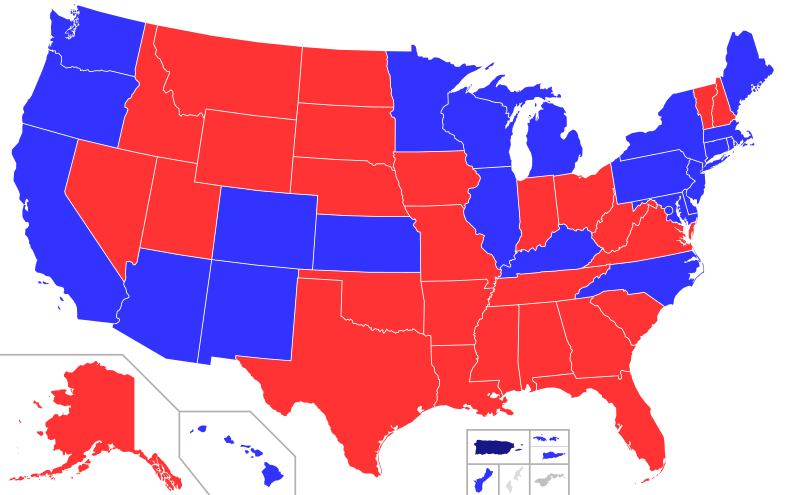
The far more important development is the 2010 mid term elections. First the governors. Governors are important because they control the political apparatus in a state, a presidential candidate going into a state controlled by an opposing parties governor receives virtually no support and certainly no photo ops with the most influential man in the state. The following states were won by Obama in 2008 and had a Democratic Governor but now have a Republican Governor and their electoral votes.

Maine (2)
New Mexico (3)
New Jersey (12)
Pennsylvania (18)
Ohio (16)
Virginia (11)
Wisconsin (8)
Iowa (4)
Michigan (14)

The only state that McCain won that flipped from a Republican Governor to a Democrat was Missouri (8). This is not to say that having these changes guarantees the Republican candidate victory but it does help. More importantly these switches in state governors represents a dissatisfaction in Democratic governance which Obama so clearly represents. For all the commentary about how the Republican candidates are too extreme these states which voted for Obama in 2008 quickly changed directions.

Not only do the states indicate a sea change in American politics at the Executive level it is even more true in the State legislatures. Over 700 net state legislative seats switched from Democrat to Republican

2010 Party Control
State legislatures saw an extreme shift in power after the November 2010 elections. Republicans now control 25 state legislatures, nearly double the 14 they controlled prior to the election.1 Democrats experienced a similar shift but in the opposite direction, from control of 27 legislatures prior to the election to just 16 currently.2

Of the 6,102 legislative seats up for election in 453 states, 13 percent changed party hands. Republicans took 732 of the 794 seats that switched. In stark contrast, just 46 seats switched to Democratic control, while 11 went to third-party candidates. In 2008, only seven percent of the seats changed hands, with the gain enjoyed mostly by Democrats, and just seven states experienced changes greater than 10 percent. That jumped to 24 states in 2010.

Most of the takeover occurred in House4 chambers, where 624 seats changed party hands. Republicans took 585 seats previously held by Democrats or third-party lawmakers. Just 30 seats changed to Democratic control and 9 changed to third-party candidates.

Senate chambers experienced similar changes, with 147 of the 1,146 seats up for election changing to Republican control.

Again the most important aspect of this drastic switch is not just the control of government at the state level, it is an undeniable indication of the direction the country is headed. But where it is important on the process level is this, states formerly controlled by Democrats such as Michigan, Wisconsin, Pennsylvania are now controlled by Republicans who are enacting far reaching reforms to the election process. Many states are now enacting voter ID laws, diminishing the power of special interest in elections, IE unions and in general undoing decades of Democrat control of state governments.

Summary

For all of the above reasons and those I posted in part 1, there is little doubt in my mind that Obama is done, we just have to endure a year of nastiness. If the past few months have proven nothing else it is that the Tea Party Movement is the most influential force in American politics. The progressive and their allies in the media can scream and slander to their hearts content but the people are less and less buying it and the more they play their childish games the more devastating will be their defeat.

Early Thoughts Part three

A New Day

The first thing that must be understood in trying to discern how the Republican selection process is going to shake out is that it is a new day in the Republican Party. The Tea Party Movement for all intent and purpose is going to be the driving factor. It is not as if the TPM will simply anoint a winner like in the old days when party bosses made back room deals and a nominee emerged. But the Tea Party will be the single most influential voice and force in the selection process.

Which brings us to the first point of discussion, Michelle Backmann. If Michelle Backmann is the Tea party candidate, how come she is not doing better among Republican voters in the polls? The simple answer is that she is not the Tea Party candidate, nobody is....yet. The reason that Michelle Backmann is so identified with the Tea Party is that she is head of the Tea Party Caucus in the House. How did this happen? She created the Tea Party Caucus and declared herself its head. It is not as if the Tea Party asked her to do this or even agreed with her doing it, as a matter of fact among the Tea Party there was and still is much disagreement whether or not they really want a caucus in the House and Senate claiming to represent them. Michelle Backmann saw an opportunity and took it, she was not chosen for it.

I would say that Michelle Backmann was the candidate whom, when she entered the race, most represented the anti-establishment wing of the party. Many people respect her for her uncompromising adherence to small government principles but I suspect that few consider her the best candidate in the race. She will probably stay in the 10 to 20% range as long as she stays in which very well could be until the end when whatever delegates she gets may be important.

It is noteworthy that Backmann has chosen not to participate in the Florida straw poll next month. Most see this as a mistake but I believe it is an indication that she knows her weakness and does not want to be a big looser here and would rather feed off her Iowa straw poll win as long as possible. Romney is also not participating probably because he did not want to offend Iowa Republicans because he did not participate in their straw poll and so has made the decision not to participate in straw polls at all.

Backmann I believe will be in it for awhile unlike the other two Tea Party favorites who have been in since the beginning Rick Santorum and Herman Caine both of whom are well liked but really don't stand much of a chance and may stay in until the Iowa caucuses but not much further.

John Huntsman is a non factor and will get very liitle support except from the Main Stream Media.

Newt is a non factor but he probably will stay in for awhile just so that he can stay in the public spot light which is good for the Republicans since he is the most dynamic in the debates.

Ron Paul is always an important factor because he has a very strong base of support and good financing but there is no chance that he will be the Republican nominee. Paul like Backmann could be influential if the nominee is not decided before the convention, unlikely, and he is the most likely to attempt a third party bid, but this is doubtful simply because he would not want to destroy his son's future political career.

Of the remaining declared candidates that leaves Perry and Romney. Pundits believe that all the so called "far right" candidates will divide the vote leaving the nomination open for Romney. However the first Rasmussen poll conducted after Perry entered the race does not reflect this. Perry quickly took a commanding lead over both Romney and Backmann.

The thinking is that Backmann will win in Iowa, Romney will win in New Hampshire and Nevada and Perry will have to win in South Carolina in order to keep his candidacy viable going into the important Florida primary. I do not believe that is going to happen.

Perry will win Iowa. In the coming months Republican voters, Iowa included, will recognize that Perry is a far superior candidate and would be a far better president than Backmann. Backmann will continue to have a strong core of committed followers but nearly all the undecided and other right leaning voters will coalesce around Perry and as the Caine, Santorum, Gindrich voters start to look for a winner, they will go to Perry more than to Backmann.

The one tactical mistake that Romney made by not participating in the Florida straw poll next month is that it leaves it open for Perry to win. The Florida straw poll is different than Iowa and an organization like Romney's could still do well, but I suspect that Perry will win it. If that happens it not only greatly diminishes Backmann's momentum coming out of her Iowa straw poll win it also adds to Perry's reputation as a front runner.

When the primaries begin in earnest next year if Perry wins Iowa and South Carolina and Romney wins New Hampshire and Nevada then the big showdown will be in Florida and money will not be an issue for either of them. Both candidates have a lot going for them in Florida, Romney has a superior and well established campaign organization. He also has a large northeast transplant constituency. But Perry has a couple of advantages that should not only neutralize Romney they will probably bury him.

Perry will have the Tea Party almost completely behind him at that point and the Tea Party in Florida is growing and growing more dominate in state politics, can you say Marco Rubio and Allen West. This will by far offset Romney's superior conventional campaign, not only in Florida but pretty much everywhere, it is a new day in Republican politics. The other advantage that Perry has that will greatly help in Florida and perhaps New Hampshire as well, is Rudy Gulliani.

For those who may not know, Rudy and Rick Perry are very close friends in fact Perry endorsed Gulliani for president in 2008. If Gulianni does not run for president himself, still an if, he will be campaigning vigorously for Perry which will in part offset the "transplant" factor. If Gulianni gets in the race himself he would eat more into Romney's support than Perry's.

If Perry wins the Florida primary which I believe he will then Romney will be in the same position he was in 2008 on the defensive trying to generate enthusiasm for his candidacy.

But there is no enthusiasm for Romney not in 2008 and certainly not in 2012. All the enthusiasm
in the Republican Party has been and will continue to be with the Tea Party and the Tea Party will be with Perry because he is the most conservative candidate with a chance to win. He a;so has "creds" with the TPM and Romney does not. I believe Romney could win the presidency too, but first he would have to win the nomination not with but against a highly energized Tea Party movement which looks at him as the status quo and the status quo will not win the Republican nomination in 2012.

But what if Palin or Ryan or Christie or Gulianni,or,or,or get in. I'll cover that in part four (when and if it happens)

3/29/2011

The Central Front


Via-The Weekly Standard

Why health care is the essential issue for 2012.


James C. Capretta and Yuval Levin


Even as they engage in heated battles over the budget and try to define a new agenda from their perch in the House of Representatives, conservatives clearly understand that the key to turning things around​—​to averting a debt crisis and defending the ideal of limited government​—​is winning the 2012 election. Only with a new president can they halt and reverse the leftward leaps of the past few years and address the increasingly dire consequences of six decades of welfare-state expansion.

It may be less obvious, however, that the key to what that president will need to do, and therefore also to how he will need to run, is health care reform: undoing Obamacare and replacing it with real reforms that can contain costs while providing consumers with high-quality care.

This is so, first of all, for political reasons. Obamacare remains very unpopular with Republican and independent voters​—​no less so than it was when it passed a year ago​—​and even Democratic voters are not very happy with it. To a degree that Democrats in Washington seem not quite to have grasped, health care was at the center of the populist uprising that produced a Republican House in last year’s elections. Other issues​—​the oversold “stimulus,” the bailouts, the regulatory overreach, the persistent levels of high unemployment​—​certainly provoked outrage. But President Obama’s health care push was the fuel that kept the populist fire going.

This was no coincidence. For substantive reasons, and not only political ones, it is right that health care should be so important to voters alarmed about our fiscal crisis and intent on restoring some limits to government. Even before Obama-care, health care spending was the number one reason for growth in government and the driving force behind the explosion of our debt. In 1975, spending on Medicare and Medicaid was just 1.3 percent of GDP. By 2010, it had risen to 5.5 percent, a 400 percent increase.

Moreover, Medicare and Medicaid are big reasons why health care costs are rising for everyone. Instead of encouraging efficiency, both programs reward excessive cost growth with larger taxpayer subsidies. Medicare has a massive unfunded liability that will leave future generations with punishing tax hikes, paltry benefits, or quite possibly both. Medicaid claims to provide millions with insurance coverage but its reimbursement rates are so low that Medicaid patients can’t get care in mainstream physician practices or clinics. The government estimates the programs pay out nearly $70 billion annually in fraudulent claims.

Obamacare doubles down on this failed entitlement approach, adding 15 to 20 million more people to the Medicaid rolls (so that more than 70 million Americans will be Medicaid recipients) and at least 20 million more to a new entitlement for the lower middle class.

Even with very optimistic assumptions, that’s at least $200 billion annually in new entitlement obligations on top of the massive amounts already being spent. There’s little question that if these obligations are allowed to stand, pressure for large tax increases will not be far behind.

Obamacare attempts to deal, moreover, with the problem of rising costs by centralizing management of the health sector at the federal level. Through Medicare’s price controls, and other mechanisms like comparative effectiveness research, the federal government is going to micromanage how doctors and hospitals organize and care for patients.

The result will be even more bloated government expenditures, crushing tax burdens, and middle-class dependency on government-arranged health services.

The design of Obamacare, particularly the fact that its major provisions do not take effect until 2014, means that there is time to avert this disaster. But there is not much time. Once Obama-care’s major entitlement expansions go into effect in three years, it will be very difficult to reverse them. And the structure of our existing health care entitlements, combined with the retirement of the baby boomers (which began last year), means that serious reforms of Medicare and Medicaid are needed very soon.

The outlines of such a reform have been clear for some time. What’s needed is a functioning marketplace in health care, with cost-conscious consumers seeking and finding more value for their money. To get there, the government must stop subsidizing excess in all of the major health care settings​—​Medicare, Medicaid, and employer-sponsored plans. Instead, the government should provide fixed levels of financial support toward insurance and care that patients can control. The government would oversee the marketplace, but resources would be allocated based on consumer choices and preferences.

This reform would bring costs under control and head off the impending fiscal crisis. But it’s not simply a fiscal reform. It would also transform American health care for the better. Health care and insurance providers would have to become far more efficient and productive to avoid losing market share to competitors, and they would be forced to focus on the needs and desires of patients, not government payers.

For Republicans committed to maintaining a vibrant and free society, there is no choice but to make genuine health care reform the centerpiece of their domestic agenda. If the health care debate is lost, then the fight for limited government is lost as well.

That means that the effort to repeal and replace Obamacare and to fix our health care entitlements must be well underway by 2013. And that, in turn, means that a Republican president must be elected in 2012 having run on a platform of real health care reform. For those who aspire to be that Republican president, the time to develop that platform is now.

James C. Capretta is a fellow at the Ethics and Public Policy Center and a health policy consultant. Yuval Levin, also a fellow at EPPC, is the editor of National Affairs.

3/25/2011

The Battle Moves to the States


Via-American Spectator

By Grover Norquist

The pundits who live in cable TV-land tell us to keep our eyes on the looming battle royale in Washington, D.C. In one corner, the 242-member-strong Reagan Republican majority in the House of Representatives, which can pass almost any conservative legislation and defeat any liberal effort. They are assisted by the 47 Republican senators who can (unless the Democrats change the rules) filibuster any truly destructive liberal proposal. And on some issues, Senate Republicans might be able to join forces with any four of 12 vulnerable Democratic senators up for reelection in 2012 to pass legislation through the Senate.

In the other corner stand Obama with his veto and Harry Reid's Democratic majority in the Senate. The Senate Democrats have near-total control over the schedule and the determination of which votes will take place. And the Democrat-friendly establishment media will referee the bout.

Yes, out in America voters support the GOP agenda of repealing Obamacare and reducing both spending and taxes, but within the Beltway the two teams each have veto power over the other. Watching this "Mexican standoff" for the next two years will, to mix metaphors, look like watching well-matched sumo wrestlers push each other around, or two rugby teams contest the same two yards for hours.

There will be no big victories or losses. Obama's plans for ever bigger government cannot pass the House. Republicans' plans to roll back the damage of the last two (or 20) years can be stopped in the Senate and/or vetoed by Obama. So in D.C. the real action will be each party positioning itself for 2012. Republicans are likely to win a net gain of at least four of the 23 Democratic seats contested in 2012, thereby gaining a majority. It is possible they could win 13 seats for a 60-vote filibuster-proof majority. The big prize, therefore, is the presidential veto pen.

The battlefield is quite different in the 50 states. There the 2010 elections yielded examples of unified government, as opposed to the gridlock gripping the U.S. Congress. It is at the state level that legislatures and governors will enact game-changing legislation that could move the country toward or away from European welfare statism.

WHEN THE DUST SETTLED from the 2010 elections, in which Republicans gained six governorships and 715 state legislative seats -- including winning control of an additional 21 legislative bodies (taking into account the 25 party switchers from the Democratic side). The GOP now has control of the governor's office and both houses of the legislature in 21 states. The 21 unified Republican states are: Alabama, Arizona, Florida, Georgia, Idaho, Indiana, Kansas, Maine, Michigan, Nebraska, North Dakota, Ohio, Oklahoma, Pennsylvania, Tennessee, Texas, South Carolina, South Dakota, Utah, Wisconsin, and Wyoming. Republicans also possess majorities in both houses of the state legislature, but lack the governorship, in Minnesota, Missouri, Montana, New Hampshire, and North Carolina.

Democrats have complete, unfettered control and the opportunity to create little Greeces in just 11 states: Arkansas, California, Connecticut, Delaware, Hawaii, Maryland, Illinois, Massachusetts, Vermont, Washington, and West Virginia.

There is a legislative stalemate in D.C.: liberal senators from California can vote to stop conservative senators from Texas from reducing taxes, reforming entitlements, liberalizing labor law, and dismantling regulatory schemes. But at the state level, majorities can have significant effects. Illinois is a good example: the unchallenged Democratic majority there had no one to stop it from raising the personal income tax by 67 percent as its first official act.

In states with GOP majorities in both legislatures, governors are consciously channeling New Jersey's Chris Christi -- although Christie, working with a Democratic-controlled assembly and senate, does his high wire act without a net. The governors of Florida, Ohio, Pennsylvania, and Texas have taken the Taxpayer Protection Pledge to oppose any tax increase. What that pledge means in effect is a requirement to reduce future spending by $5 billion in Pennsylvania, $8 billion in Ohio, and $3.6 billion in Florida. Spending will have to be cut by more than $20 billion in Texas, according to its comptroller's office.

Such large reductions in the growth of spending fall heavily on the key constituents of the modern Democratic Party, namely public sector unions, big city political machines, and the grant recipients who use taxpayer dollars for "community organizing." And the promise for tort reform, which would never escape a Democrat's veto, threatens the power and financial clout of trial lawyers, another key Democratic bloc.

Labor laws written to force millions of Americans to pay union dues to labor union bosses are another obstacle that Republican governors and legislatures could undo. States like Pennsylvania, Wisconsin, Ohio, Michigan, and Indiana could enact right-to-work laws making union membership voluntary, or "paycheck protection" laws that stop unions from taking your union dues and spending them on politics without your express consent.

PERHAPS THE MOST IMPORTANT TASK for state-level Republicans will be redistricting. Redistricting for the 2012 election will work to maintain the unified party control of the incumbents, in both Republican and Democratic states. The partisan gap between red and blue states will continue to grow over the next 10 years. In turn, many small businessmen, high-skilled workers, and wealthy retirees will move from D to R states. And that dynamic will confirm and reinforce the partisan trends. For example, Illinois may drive away all of its entrepreneurs. Texas would welcome their talent and their resources...and their Republican votes.

In 2012, based on population migration, 10 states will lose congressional seats, and eight states will gain seats. Personal income tax rates are twice as high in the loser states. Government spending is one-third higher in losers, and four states gaining seats levy no personal income tax at all. Republican-controlled states such as Arizona, Georgia, and North Dakota could encourage further immigration of talented, productive, and industrious workers to their own voting rolls by eliminating their income taxes. By the same token, if states like Illinois and California continue their "job creator-cleansing" policies, they will create a more solidly government-employed and welfare-dependent Democratic voting bloc.

The question before America is whether, when this process reaches its natural conclusion, the productive, well-governed, job-creating states have more electoral votes than the mini-Greeces being created in states like Illinois and California. Ultimately, control of the presidency, the Senate, and the House will depend on the answer to that question.

12/14/2010

Why tax cut is a bad deal

Via-USA TODAY

by Mitt Romney

Death and taxes, it is said, are life's only two certainties. But in the wake of President Obama's tax compromise with congressional Republicans, only death retains the status of certainty: The future for taxes has been left up in the air. And uncertainty is not a friend of investment, growth and job creation.
The deal has several key features. It reduces payroll taxes, extends unemployment benefits and keeps current tax rates intact. So far, so good. But intermixed with the benefits are considerable costs of consequence. Given the unambiguous message that the American people sent to Washington in November, it is difficult to understand how our political leaders could have reached such a disappointing agreement. The new, more conservative Congress should reach a better solution.

The deal keeps current tax rates from rising to pre-Bush era levels for two years. But in 2013, unless Congress acts again, rates will increase dramatically.

Extension temporary

Of course, delay now is better than an immediate tax hike. But because the extension is only temporary, a large portion of the investment and job growth that characteristically accompanies low taxes will be lost. When entrepreneurs and employers make decisions to start or expand an enterprise, uncertainty about tax rates translates directly into a reduced propensity to invest and to hire. With only a two-year extension, investors know that before their returns are realized, tax rates may be jacked up to the levels favored by President Obama. So while the tax deal will succeed in temporarily putting more money in the hands of consumers, it will fail to deliver its full potential for creating lasting growth.

It will also add to the deficit. In many cases, lowering taxes can actually increase government revenues. If new businesses, new investments and new hiring are spurred by the prospects of better after-tax returns, the taxes paid by these new or growing businesses and employees can more than make up for the lower rates of taxation. But once again, because the tax deal is temporary, a large portion of this beneficent effect is missing. What some are calling a grand compromise is not grand at all, except in its price tag. The total package will cost nearly $1 trillion, resulting in substantial new borrowing at a time when we are already drowning in red ink.

Part of the tax deal is a temporary reduction in payroll taxes. The president was insistent, however, that only the employee's payroll taxes be reduced — the portion paid by the employer is to remain the same. Again, the president is looking to get more money into the hands of the consumer to boost near-term spending. But by refusing to lower the cost of hiring a new employee, he fails to encourage what the American people want even more than lower taxes — more good jobs. Like the income tax deal, the payroll tax deal will add to the deficit.

For those without jobs, the tax compromise extends unemployment benefits for 13 months. A decent and humane society must have a strong safety net for the unemployed. I served for 15 years as a lay pastor in my church and saw the heartbreak of joblessness up close; a shattering loss of faith in oneself is but only one of many forms the suffering can take. Nonetheless, the vital necessity of providing for those without work should not be used as an excuse to ignore the very real problems of our unemployment system.

In this, as in so many other arenas of government policy, unemployment insurance has many unintended effects. The indisputable fact is that unemployment benefits, despite a web of regulations, actually serve to discourage some individuals from taking jobs, especially when the benefits extend across years.

Redo jobless benefits

The system is also not designed for a flexible economy like ours in which some employees move from job to job for short periods, and are therefore ineligible for unemployment compensation when they are faced with a protracted spell without work.

To remedy such problems we need a very different model, perhaps establishing individual unemployment savings accounts over which employees would exercise direct control when they lose their jobs, or putting in place financial incentives for employers to hire and train the long-term unemployed. One thing is certain: While we cannot rebuild our flawed system overnight, we are surely not required to borrow the funds to pay for it. In spending $56.5 billion to extend benefits, the deal is sacrificing the bedrock Republican principle that new expenditures be paid for with offsetting budget cuts.

President Obama has reason to celebrate. The deal delivers short-term economic stimulus, and it does so at the very time he wants it most, before the 2012 elections. But the long term health of our great engine of prosperity will remain very much in doubt. To the twin inevitabilities of death and taxes, we may now have to add persistent high unemployment.

Mitt Romney, the former governor of Massachusetts, sought the Republican presidential nomination in 2008.

11/21/2010

Dems run a'Ground'

Via-NY POST

By MICHAEL GOODWIN

Pick your favorite: "Those who ignore history are doomed to repeat it." Or, "Insanity is doing the same thing over and over and expecting a different result."

Either way, the wisdom is wasted on President Obama and congressional Democrats. They learned nothing from the historic shellacking voters gave them.

Whether through ignorance or intent, the White House, Harry Pelosi and Nancy Reid -- what's in a name? -- are again setting their sails against public opinion. Damn the voters, full speed backwards.

They still want to raise taxes on small businesses and families making over $250,000. They want to pour billions more into the unemployment pot, which is becoming a welfare program.

11/15/2010

The Liberal Crisis

Via-Commentary

John Podhoretz

The defeat of Russ Feingold in the November 2 election has unexpectedly provided the most uncompromisingly left-wing Democrat in the U.S. Senate with a new job opportunity—that of candidate for the presidency of the United States. Feingold hinted in his concession speech on election night that he might challenge Barack Obama in the Democratic primaries. “It’s on to 2012,” Feingold said, “and it is on to our next adventure.”

The next day, a spokesman said that Feingold had “no interest” in running for the presidency, but such a denial is meaningless. The scale of the Democratic Party’s defeat and the parlous condition of the country’s finances inevitably raise the specter of a challenge to a first-term president from within his own party. Such challenges have been part of the political landscape for the past half-century. Eight presidents since 1960 have run for re-election. Four of them have had to fight off a significant primary opponent whose key message was that the president had betrayed his party’s core principles. In each case, the challenge preceded the president’s eventual ouster in the general election.

_____________

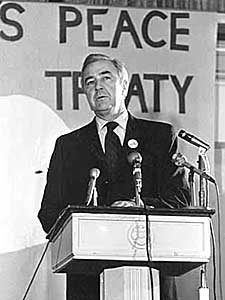
In 1968, Eugene McCarthy came at Lyndon Johnson from the anti-war left and, in losing in the New Hampshire primary by a mere seven points, convinced the man who had won the biggest landslide in American history three years earlier that he could not secure a second full term. Ronald Reagan went at Gerald Ford in 1976 in part on the grounds that Ford was capitulating to the Soviet Union; Reagan went on to win several major states, galvanized the Republican Convention far more than its actual nominee, and left Ford to close a 30-point gap in the polls with Jimmy Carter (which Ford almost did).

With stagflation at home and chaos abroad, Edward Kennedy confronted Jimmy Carter in the 1980 election. Kennedy went on to win 10 primaries, upstage Carter at the Democratic Convention just as Reagan had upstaged Ford, and in general, presage Carter’s doom. Twelve years later, George H. W. Bush began his re-election campaign in the economic doldrums and came under unexpected pressure in New Hampshire from the paleoconservative Pat Buchanan, who got a stunning 38 percent. Ross Perot saw this and designed an independent bid against Bush on the single issue of the budget deficit, which Bush had actually taken aggressive measures to confront; Perot’s bid got Bill Clinton elected.1

There is great ideological irony here. McCarthy and Kennedy ran to their presidents’ left at the beginning of an election cycle that concluded with the victory of a hated conservative—Nixon in 1968, Reagan in 1980. Reagan ran to Ford’s right in an election that went to Carter. And by running to Bush’s right, Buchanan helped establish the conditions under which Clinton would achieve victory in 1992. Both Carter and Clinton ran as Southern moderates but began governing as aggressive liberals. Feingold, or any other Democrat who considers a challenge to Barack Obama, will have to contend with the knowledge that the better he does, the more likely it will be that a conservative Republican will occupy the White House come 2013.

Given this history, what conceivable justification can there be for a primary challenge to Obama for an ideologically driven politician who would not wish his worst enemies to achieve power? The only principled justification is, precisely, principle: you do so because you think the president of your party has acted in ways that are especially injurious to the things you believe in most deeply by suborning those beliefs to his political ambitions. Pat Buchanan’s quixotic effort against George H. W. Bush was driven by this; he opposed the Gulf War, had become a Bryanesque economic populist, and wanted to fight for his (repugnant) vision of what the Republican Party ought to be.

In the case of McCarthy and Reagan and Kennedy, something rather more layered was at play. Kennedy’s 1980 bid was clearly opportunistic, so much so that he himself found it literally inexplicable when CBS’s Roger Mudd asked him why he wanted to be president. The plain fact is that he and his pseudo– royal court had seen an opening for him a decade after Chappaquiddick, but they couldn’t close the deal, and in the process did significant damage to the incumbent.2

Reagan certainly did believe that the policy of détente undertaken by Richard Nixon and continued by Ford was a moral and geopolitical abomination. But he also knew that Ford had not been elected to anything other than the Michigan House seat from which Ford had been elevated to the vice presidency only 10 months before Nixon slunk from office. For Ford to skate into the 1976 Republican nomination without having ever received a single vote as part of a presidential ticket seemed anti-democratic; the logic of the American political system dictated a challenge by someone.

It was the logic of the 1960s that dictated a challenge to Lyndon Johnson in 1968 from within his own party—notwithstanding the fact that he had received 61 percent and 486 electoral votes in November 1964 and had ushered in a new era of activist government with the passage of the Civil Rights Act of 1964, the Voting Rights Act of 1965, and the initiation of Medicare in 1966.

Indeed, one might say that Eugene McCarthy’s entry into the 1968 presidential primaries against Johnson was less a matter of his own choosing than it was a willed manifestation of the anti-war movement, which had turned out hundreds of thousands of demonstrators across the country in 1967. Members of the movement over 21 (then the voting age) were natural Democratic voters, but the policies they were protesting were being enacted by a Democratic administration. Their negative electoral energy had to go somewhere, and it was channeled into McCarthy in New Hampshire. But it did not belong to him; after McCarthy knocked off Johnson, Robert F. Kennedy entered the fray to steal McCarthy’s voters away. After Kennedy’s assassination, Johnson’s vice president, Hubert Humphrey, secured his party’s nomination— which was, to many on the left, no different from having nominated Johnson again. The Democratic Convention in Chicago at the end of August became the epicenter of a guerrilla war launched by leftists against traditional FDR Democrats (in the persons of Humphrey and Chicago mayor Richard Daley), with rioters setting upon Chicago cops, getting savagely beaten in response, and being placed under arrest by the thousands.

The carnage in the streets of Chicago figured prominently in the explanations for the electoral triumph of Richard Nixon in the 1968 general election. And the enduring memory of the way in which a policy disagreement within the Democratic Party had resulted in blood and panic in Grant Park may have contributed inchoately to Nixon’s own 20-point win in 1972.

It is tempting to look at this brief history and say that primary challenges are purely destructive. But that may overrate them. They may not have altered the political atmosphere against incumbents so much as they reflected a change that had already taken place within the body politic. For there is another reason these primary challenges arise, other than a principle or opportunism—a reason that is inchoate, hard to capture, and hard to define. They happen because the president has begun to look like a loser.

_____________

Does Barack Obama now look like a loser? It would be foolish to write Obama’s political epitaph, though it would be even more foolish to assume that his 2008 performance before the national electorate offers much in the way of guidance about how he will fare a second time. A recent president whose election results most closely compare with his is George H. W. Bush, who won 53.4 percent in 1988 (slightly better, in fact, than Obama’s 2008 tally) and had, moreover, a 91 percent approval rating in March 1991. Twenty months later, in November 1992, Bush went on to secure a shockingly low 38 percent of the vote.

Obama is certainly in political peril. In 2008 he won independent voters by 17 points in 2008; on November 2, independents preferred Republicans by eight points, an unprecedented 25-point shift. The percentage of the electorate that called itself Democratic shrank by 9 percent (from 39 percent in 2008 to 36 percent this year). Republicans’ participation grew from 32 percent to 36 percent—proportionately, a 12 percent gain. Let us assume that Obama succeeds in changing the trend line in 2012 by bringing back half the independents his party lost in 2010 and increasing Democratic participation by a percentage point or two over Republicans. If he does so, he will not suffer the kind of defeat his party did in November. But he will still lose.

Obama has acknowledged that he took a “shellacking” in the November 2 election, though in point of fact he had not personally been shellacked. Instead, more than 750 elected Democrats (or positions held by elected Democrats) from the House to the Senate to governors’ mansions to state legislatures were ousted from office in the largest and deepest partisan rout in American history.

It was perhaps more meaningful that Democrats who had had nothing to do with the controversies in Washington—the ones serving in state legislatures— were wiped out at the same time that 66 House seats went from Democratic to Republican control. You have to go back 37 national elections to find a larger number of Republicans in the House. You have to go back 82 years to find as many Republicans in state legislatures.

These numbers are particularly significant because they suggest the end of one of the shortest eras in American political history—a period lasting two elections, in which non-liberal, non-leftist voters in Republican-leaning states flirted with the possibility that the Democratic Party and a charismatic young liberal might have answers to problems the GOP was unable to address effectively. By assigning control of Congress after 2006 and veto-proof dominance of Washington after 2008 to Democrats, voters gave them the perfect opportunity to provide the answers.

And answer they did, with a vengeance. Democrats committed to increases in federal spending that will total, at a minimum, $2 trillion (and almost certainly more) if they come to full fruition—and all that in the wake of financial-bailout commitments of some $900 billion. Obama nationalized two of the Big Three carmakers and took a giant step toward the effective nationalization of the country’s health-care system. And he was stalwart in his insistence (at least until the election results came in) that he would allow the so-called Bush tax cuts of 2001 and 2003 to expire, an effective tax increase of as much as $3 trillion. The answer Democrats provided was that they are activists who govern from the left.

It became common in the days following the election for conservatives and Republicans to say that the GOP should consider itself “on probation.” That is certainly true. But viewing the election as a warning shot to Republicans—which, astonishingly, Obama sought to do in his press conference the day after the voting by saying the election was a “message to Republicans” to “focus on our shared responsibilities and work together”—is wrong. The election was a referendum on left-liberal governance. Voters rejected it, and rejected it with even more of a vengeance than Democrats had shown in undertaking it.

That is why it matters just how deep and thoroughgoing the results were. It wasn’t just that voters wanted to punish Obama and the Washington Democrats because the economy was sour, or because they spent too much, or because they didn’t keep their eye on the ball when they took up health care.

Voters wanted to take governing power away from Democrats at all levels before liberals did more damage.

Presidents in political peril have proved capable of winning over parts of the electorate that had rejected them earlier. Nixon received only 43 percent of the vote in 1968 before going on to score 61 percent in 1972; Clinton got 43 percent in 1992 and 49 percent in 1996. Obama is in a better position than either of them because he needs only the voters who voted for him in 2008 to vote for him again in 2012. That is a tall order because of the way independents deserted the Democrats in November. It is not, however, unthinkable.

But what if the disaffection with Obama comes not only from the right, as was the case in this election, but also from his left? That is where a challenge from Russ Feingold or Howard Dean or someone else will be telling. Ever since Obama took office, leftists have issued complaints against him that, to the non-leftist ear, sound insane.

They claim he has been too moderate, too compromising, too much of a technocrat. They say the $863 billion stimulus was too small by half—an assertion impossible to prove, and pointless in any case, since the stimulus that did become law was as large as the political system in Washington controlled entirely by Democrats could stomach. Liberals were and are angry that Obama gave up the so-called public option on health care, when he had no choice but to do so to win Democratic support to get the bill through the Senate.

In point of fact, Obama has done everything in his power to advance the most unshakably leftist agenda since Johnson’s time, and possibly since the days of Franklin Roosevelt—with remarkable results. He should be celebrated by liberals and the left, not criticized by them, and certainly not abandoned by them. If Obama is indeed threatened by a candidate who comes at him from the left and who gains some traction doing so, that will suggest two things. First, that members of his own base are picking up the scent of a loser from him. And second, that many on the left will prefer to abandon a president they should be hailing as a tough-minded hero rather than confront the stark reality that the American electorate got a good look at what the left truly wants this country to become—and said, with a clarion’s clarity, no.