I believe Republicans lost the Presidential election during the primaries. Not that they were hard fought, which they were, but that in the end they nominated a candidate that was opposed to by their base.
Remember all those primaries that Romney eked out a victory like Ohio and Michigan, hell it turned out he even lost Iowa after the fact. Remember South Carolina going overwhelmingly for Newt and most of the south going for an ex- Pennsylvania Senator Santorum. Remember all the excitement when Perry got in and he had huge support before he self destructed in 27 seconds. Remember 9-9-9 and Herman Cain of all people looking like someone who could finally dispose of the RINO Mitt. Do you remember all this and more, much more. Like Sarah Palin never endorsing anyone-especially Romney in fact who but fat Chris of New Jersey of the new breed of Republicans actually endorsed Mitt before it was virtually inevitable that he would win? Ryan did near the end, Rubio did not until the writing was unmistakable, certainly not during the Florida primaries when it would have cost him political capital in his home state and by the way neither did Jeb.
In fact during the whole primary season the entire narrative was about the "anyone but Mitt" candidate that would save Republicans from nominating Romneycare .
I admit I was almost violently opposed to Romney during the primaries, as too were millions of others on the right. I came to like him during the general election process but even I am not sure if this wasn't due to comparing him to the alternative rather than an actual conversion.
Romney, like so many others that the Republicans put up as their standard bearer was not the choice of the larger portion of their base. He won the nomination by division not by acclimation and I suspect many on the right, particularly those of libertarian leaning just said "not this time, no more."
Do I agree with this sentiment, this "no more compromise" attitude? Not this time, it is too costly to the nation, perhaps even fatal, but I understand it and unless the Republican Party machine understands it rather than flaying around for other reasons, they and perhaps the US is doomed.
The burden of those who love freedom is to not only to protect liberty but to explain the superiority of it.
Showing posts with label 2010 Campaign. Show all posts
11/09/2012
3/25/2011
The Battle Moves to the States
Via-American Spectator
By Grover Norquist
The pundits who live in cable TV-land tell us to keep our eyes on the looming battle royale in Washington, D.C. In one corner, the 242-member-strong Reagan Republican majority in the House of Representatives, which can pass almost any conservative legislation and defeat any liberal effort. They are assisted by the 47 Republican senators who can (unless the Democrats change the rules) filibuster any truly destructive liberal proposal. And on some issues, Senate Republicans might be able to join forces with any four of 12 vulnerable Democratic senators up for reelection in 2012 to pass legislation through the Senate.
In the other corner stand Obama with his veto and Harry Reid's Democratic majority in the Senate. The Senate Democrats have near-total control over the schedule and the determination of which votes will take place. And the Democrat-friendly establishment media will referee the bout.
Yes, out in America voters support the GOP agenda of repealing Obamacare and reducing both spending and taxes, but within the Beltway the two teams each have veto power over the other. Watching this "Mexican standoff" for the next two years will, to mix metaphors, look like watching well-matched sumo wrestlers push each other around, or two rugby teams contest the same two yards for hours.
There will be no big victories or losses. Obama's plans for ever bigger government cannot pass the House. Republicans' plans to roll back the damage of the last two (or 20) years can be stopped in the Senate and/or vetoed by Obama. So in D.C. the real action will be each party positioning itself for 2012. Republicans are likely to win a net gain of at least four of the 23 Democratic seats contested in 2012, thereby gaining a majority. It is possible they could win 13 seats for a 60-vote filibuster-proof majority. The big prize, therefore, is the presidential veto pen.
The battlefield is quite different in the 50 states. There the 2010 elections yielded examples of unified government, as opposed to the gridlock gripping the U.S. Congress. It is at the state level that legislatures and governors will enact game-changing legislation that could move the country toward or away from European welfare statism.
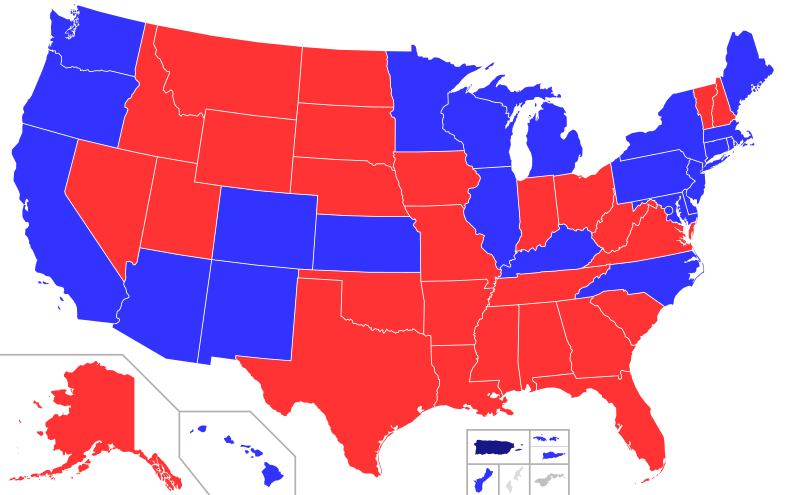
WHEN THE DUST SETTLED from the 2010 elections, in which Republicans gained six governorships and 715 state legislative seats -- including winning control of an additional 21 legislative bodies (taking into account the 25 party switchers from the Democratic side). The GOP now has control of the governor's office and both houses of the legislature in 21 states. The 21 unified Republican states are: Alabama, Arizona, Florida, Georgia, Idaho, Indiana, Kansas, Maine, Michigan, Nebraska, North Dakota, Ohio, Oklahoma, Pennsylvania, Tennessee, Texas, South Carolina, South Dakota, Utah, Wisconsin, and Wyoming. Republicans also possess majorities in both houses of the state legislature, but lack the governorship, in Minnesota, Missouri, Montana, New Hampshire, and North Carolina.
Democrats have complete, unfettered control and the opportunity to create little Greeces in just 11 states: Arkansas, California, Connecticut, Delaware, Hawaii, Maryland, Illinois, Massachusetts, Vermont, Washington, and West Virginia.
There is a legislative stalemate in D.C.: liberal senators from California can vote to stop conservative senators from Texas from reducing taxes, reforming entitlements, liberalizing labor law, and dismantling regulatory schemes. But at the state level, majorities can have significant effects. Illinois is a good example: the unchallenged Democratic majority there had no one to stop it from raising the personal income tax by 67 percent as its first official act.
In states with GOP majorities in both legislatures, governors are consciously channeling New Jersey's Chris Christi -- although Christie, working with a Democratic-controlled assembly and senate, does his high wire act without a net. The governors of Florida, Ohio, Pennsylvania, and Texas have taken the Taxpayer Protection Pledge to oppose any tax increase. What that pledge means in effect is a requirement to reduce future spending by $5 billion in Pennsylvania, $8 billion in Ohio, and $3.6 billion in Florida. Spending will have to be cut by more than $20 billion in Texas, according to its comptroller's office.
Such large reductions in the growth of spending fall heavily on the key constituents of the modern Democratic Party, namely public sector unions, big city political machines, and the grant recipients who use taxpayer dollars for "community organizing." And the promise for tort reform, which would never escape a Democrat's veto, threatens the power and financial clout of trial lawyers, another key Democratic bloc.
Labor laws written to force millions of Americans to pay union dues to labor union bosses are another obstacle that Republican governors and legislatures could undo. States like Pennsylvania, Wisconsin, Ohio, Michigan, and Indiana could enact right-to-work laws making union membership voluntary, or "paycheck protection" laws that stop unions from taking your union dues and spending them on politics without your express consent.
PERHAPS THE MOST IMPORTANT TASK for state-level Republicans will be redistricting. Redistricting for the 2012 election will work to maintain the unified party control of the incumbents, in both Republican and Democratic states. The partisan gap between red and blue states will continue to grow over the next 10 years. In turn, many small businessmen, high-skilled workers, and wealthy retirees will move from D to R states. And that dynamic will confirm and reinforce the partisan trends. For example, Illinois may drive away all of its entrepreneurs. Texas would welcome their talent and their resources...and their Republican votes.
In 2012, based on population migration, 10 states will lose congressional seats, and eight states will gain seats. Personal income tax rates are twice as high in the loser states. Government spending is one-third higher in losers, and four states gaining seats levy no personal income tax at all. Republican-controlled states such as Arizona, Georgia, and North Dakota could encourage further immigration of talented, productive, and industrious workers to their own voting rolls by eliminating their income taxes. By the same token, if states like Illinois and California continue their "job creator-cleansing" policies, they will create a more solidly government-employed and welfare-dependent Democratic voting bloc.
The question before America is whether, when this process reaches its natural conclusion, the productive, well-governed, job-creating states have more electoral votes than the mini-Greeces being created in states like Illinois and California. Ultimately, control of the presidency, the Senate, and the House will depend on the answer to that question.
12/06/2010
Window of Opportunity
Via-The Weekly Standard
By MATTHEW CONTINETTI
Did America hold an election last month? Sometimes it’s hard to tell. Congress is back in town, and the Democratic majorities in the House and Senate are acting as though the shellacking of 2010 never happened. Nancy Pelosi and Harry Reid, oblivious as usual, have stuffed this Christmas turkey of a lame duck session with votes on side issues like Don’t Ask, Don’t Tell, the DREAM Act immigration amnesty, and a resolution “supporting the goals and ideals of National Homeless Persons’ Memorial Day.” Meanwhile, back in the real world, unemployment climbed to 9.8 percent, the debt is piling up, and the economy is struggling.
Important business remains undone. Congress still hasn’t passed a budget. Nor has it extended the tax rates that are due to expire in a few weeks. What Kevin Phillips once dubbed the “reactionary left” is busy running television ads urging President Obama to raise taxes on the rich, while House Democrats hold meaningless votes intended to expose Republicans as plutocrats. The obvious compromise—extension of current tax rates for two to three years in exchange for a vote to extend unemployment insurance—languishes on the table.
The dysfunction and desperation of the waning Democratic majority is staggering. But is anyone really surprised? Soon the House will be under new management and Harry Reid will have fewer votes in the Senate. Come January, Speaker John Boehner will try to chart a new course, to demonstrate that conservatives can govern responsibly, to start repairing America’s broken budget. Around 80 new, Tea Partying Republicans will be there to back him up. We’re happy to report that a center-right fiscal coalition is beginning to emerge outside Congress, as well.
The president’s debt commission may have failed to reach a consensus. Its plan may rely too heavily on tax hikes, defense cuts, and the Obamacare model of health insurance for our taste. But, as commission member Paul Ryan of Wisconsin pointed out the other day, chairmen Erskine Bowles and Alan Simpson have provided a valuable service nonetheless. They’ve shown that the rising tide of red ink is a huge problem. They’ve proven that Democrats and Republicans can agree that the situation must be addressed. They’ve acknowledged that tax hikes alone won’t balance the budget. They’ve proposed a drastic and intriguing overhaul of the tax code that would close subsidies and loopholes in exchange for lower rates.
So the Bowles-Simpson plan is a step in the right direction. But it’s only a baby step, and with the left foot. The commission’s true legacy may be in the number of additional plans it’s inspired. Representative Ryan’s Roadmap for America’s Future, released in 2008, suddenly has brothers and sisters. Ryan and Alice Rivlin, President Clinton’s former budget director, have come up with a Medicare proposal that would protect the current system of benefits for everyone 55 years old and over while transforming Medicare for future generations. Back in August, Paul Volcker’s commission warned that America’s tax code is too complicated and the corporate tax rate too high. The surplus of center-right ideas has forced the left to get in on the act. Representative Jan Schakowsky of Illinois and a bunch of liberal groups have all released their own plans for reducing the debt. For these folks, just talking about the deficit is a concession.
President Obama himself is the best evidence of how deficit politics have shifted to the right. He spent the last two years arguing that deficit spending—blithely tripled on his watch—was necessary to create jobs. Like a good Keynesian, Obama said that when consumers stopped spending, government needed to step in and fill the gap. But the failure of his economic program contributed to the Republicans’ historic gains in the midterm elections. Last week the president changed his tune, calling for a pay freeze for nondefense government employees and saying that “small-businesses and families are tightening their belts. Their government should too.” Somebody get a medic—those words are enough to drive Paul Krugman into cardiac arrest.
These reports and proposals will be worthless, however, if they aren’t taken up by a bold and imaginative leader. In our system of government, that responsibility falls to the president. And all that prevents President Obama from taking up the challenge of fiscal responsibility are his own ideological commitments and the left wing of his party. He’d benefit from abandoning both.
And if the president punts? Then it will be up to someone like Ryan to explain why an overhaul of the American welfare state is both necessary and beneficial. And why we must act quickly, before this window of opportunity slams shut on our fingers.
By MATTHEW CONTINETTI
Did America hold an election last month? Sometimes it’s hard to tell. Congress is back in town, and the Democratic majorities in the House and Senate are acting as though the shellacking of 2010 never happened. Nancy Pelosi and Harry Reid, oblivious as usual, have stuffed this Christmas turkey of a lame duck session with votes on side issues like Don’t Ask, Don’t Tell, the DREAM Act immigration amnesty, and a resolution “supporting the goals and ideals of National Homeless Persons’ Memorial Day.” Meanwhile, back in the real world, unemployment climbed to 9.8 percent, the debt is piling up, and the economy is struggling.
Important business remains undone. Congress still hasn’t passed a budget. Nor has it extended the tax rates that are due to expire in a few weeks. What Kevin Phillips once dubbed the “reactionary left” is busy running television ads urging President Obama to raise taxes on the rich, while House Democrats hold meaningless votes intended to expose Republicans as plutocrats. The obvious compromise—extension of current tax rates for two to three years in exchange for a vote to extend unemployment insurance—languishes on the table.
The dysfunction and desperation of the waning Democratic majority is staggering. But is anyone really surprised? Soon the House will be under new management and Harry Reid will have fewer votes in the Senate. Come January, Speaker John Boehner will try to chart a new course, to demonstrate that conservatives can govern responsibly, to start repairing America’s broken budget. Around 80 new, Tea Partying Republicans will be there to back him up. We’re happy to report that a center-right fiscal coalition is beginning to emerge outside Congress, as well.
The president’s debt commission may have failed to reach a consensus. Its plan may rely too heavily on tax hikes, defense cuts, and the Obamacare model of health insurance for our taste. But, as commission member Paul Ryan of Wisconsin pointed out the other day, chairmen Erskine Bowles and Alan Simpson have provided a valuable service nonetheless. They’ve shown that the rising tide of red ink is a huge problem. They’ve proven that Democrats and Republicans can agree that the situation must be addressed. They’ve acknowledged that tax hikes alone won’t balance the budget. They’ve proposed a drastic and intriguing overhaul of the tax code that would close subsidies and loopholes in exchange for lower rates.
So the Bowles-Simpson plan is a step in the right direction. But it’s only a baby step, and with the left foot. The commission’s true legacy may be in the number of additional plans it’s inspired. Representative Ryan’s Roadmap for America’s Future, released in 2008, suddenly has brothers and sisters. Ryan and Alice Rivlin, President Clinton’s former budget director, have come up with a Medicare proposal that would protect the current system of benefits for everyone 55 years old and over while transforming Medicare for future generations. Back in August, Paul Volcker’s commission warned that America’s tax code is too complicated and the corporate tax rate too high. The surplus of center-right ideas has forced the left to get in on the act. Representative Jan Schakowsky of Illinois and a bunch of liberal groups have all released their own plans for reducing the debt. For these folks, just talking about the deficit is a concession.
President Obama himself is the best evidence of how deficit politics have shifted to the right. He spent the last two years arguing that deficit spending—blithely tripled on his watch—was necessary to create jobs. Like a good Keynesian, Obama said that when consumers stopped spending, government needed to step in and fill the gap. But the failure of his economic program contributed to the Republicans’ historic gains in the midterm elections. Last week the president changed his tune, calling for a pay freeze for nondefense government employees and saying that “small-businesses and families are tightening their belts. Their government should too.” Somebody get a medic—those words are enough to drive Paul Krugman into cardiac arrest.
These reports and proposals will be worthless, however, if they aren’t taken up by a bold and imaginative leader. In our system of government, that responsibility falls to the president. And all that prevents President Obama from taking up the challenge of fiscal responsibility are his own ideological commitments and the left wing of his party. He’d benefit from abandoning both.
And if the president punts? Then it will be up to someone like Ryan to explain why an overhaul of the American welfare state is both necessary and beneficial. And why we must act quickly, before this window of opportunity slams shut on our fingers.
11/21/2010
Dems run a'Ground'
Via-NY POST
By MICHAEL GOODWIN
Pick your favorite: "Those who ignore history are doomed to repeat it." Or, "Insanity is doing the same thing over and over and expecting a different result."
Either way, the wisdom is wasted on President Obama and congressional Democrats. They learned nothing from the historic shellacking voters gave them.
Whether through ignorance or intent, the White House, Harry Pelosi and Nancy Reid -- what's in a name? -- are again setting their sails against public opinion. Damn the voters, full speed backwards.
They still want to raise taxes on small businesses and families making over $250,000. They want to pour billions more into the unemployment pot, which is becoming a welfare program.
By MICHAEL GOODWIN
Pick your favorite: "Those who ignore history are doomed to repeat it." Or, "Insanity is doing the same thing over and over and expecting a different result."
Either way, the wisdom is wasted on President Obama and congressional Democrats. They learned nothing from the historic shellacking voters gave them.
Whether through ignorance or intent, the White House, Harry Pelosi and Nancy Reid -- what's in a name? -- are again setting their sails against public opinion. Damn the voters, full speed backwards.
They still want to raise taxes on small businesses and families making over $250,000. They want to pour billions more into the unemployment pot, which is becoming a welfare program.
11/18/2010
Why the Democratic Party Cannot Survive
Via-American Thinker
By Monty Pelerin
After the election two years ago, Time Magazine questioned whether the Elephant had become an extinct political animal. The most recent election raised questions as to whether the Donkey should be deemed an endangered species. Questioning either party's ability to survive is reasonable, and it helps sell magazines. However one or two elections are not sufficient to life-death assessments.
Political parties are not immortal. They are born and eventually die. Survivability is dependent upon Darwinian adaptations rather than a genetically determined lifespan. Actuarial analyses can be reasonably attempted if they are based on longer periods.
Enormous change in the American landscape is coming. The "pendulum theory" of politics -- one party disappoints, is removed, and then is returned when the other party disappoints -- is too simplistic to capture major trends. Peggy Noonan's recent take is an example of such analysis.
The Democratic Party is unlikely to survive. This outcome is effected by Obama, but not directly caused by him. Likewise, the latest election results are confirming rather than causal. The party's amazing success since the 1930s contained the seed of its demise.
The Meaning of the Recent Elections
In the two most recent elections, each political party was soundly, sequentially rejected, but for different reasons. Simply and bluntly:
Obama's election was erroneously interpreted as a mandate for radical change by left-wing loonies. In spite of his uniqueness, Obama's election was more a vote against Republican spending, hypocrisy, and general misbehavior than a vote for Democrats. Socialist Obama unwisely tried to impose his vision on the country.
His overreach scared many and unleashed the coerciveness that George Washington warned about: "Government is not reason; it is not eloquent; it is force. Like fire, it is a dangerous servant and a fearful master."
Government arrogance and arbitrariness initiated a groundswell of concern that coalesced into the Tea Party movement. Ridiculed by the elites in both major parties, the Tea Party provided an outlet for voter rage, a point still not grasped by either party.
The last election was a referendum on Obama and his extremist policies. The Democrat raw grasp for power ensures that they will not do well in the next several elections. This is troubling, but not enough to destroy the Party.
Party Principles
The alleged principles of both major parties need to be understood. "Alleged" is a necessary modifier because these principles are little more than marketing props that appear when useful and disappear otherwise. Groucho Marx probably best captured the flexibility of both parties when he said, "Those are my principles, and if you don't like them...well, I have others."
Republican principles are closer to George Washington's view of government -- government is necessary but dangerous. Hence, it is best kept small and weak. Republicans claim to stand for limited government because it allows for maximum individual freedom. These principles require a governing model that focuses on less tax, less spending, and less regulation. The keyword is "less," as in less government.
Democrat principles are based on government being a force for good. Government is presumed necessary to help individuals and ensure "social justice" (a term impossible to reasonably define). This philosophy leads to bigger government, as in more spending, more taxes, and more regulatory control. For Democrats, the keyword is "more," as in more government.
Elections
Getting elected (and then reelected) is the primary political motivation. But getting elected and governing are two different activities. Party principles have to serve both functions. Often they serve one better than the other. Content from an e-mail cleverly illustrates the difference:
Johnny's election campaign is similar to Republicans', while Mary's is similar to Democrats'. Republican principles are not as effective in an election campaign when competing against free ice cream. Sacrifice, abstinence, and/or self-reliance are a form of political "root canal" when compared to "freebies."
Not surprisingly, voters have chosen ice cream more often than root canals. In the 66 years from 1945 forward, Democrats controlled both Houses of Congress and the presidency for twelve years, and Republicans two years. Democrats controlled both Houses for 23 years, and Republicans six years, with five of those since 1995.
The ice cream strategy was implemented by Franklin D. Roosevelt in the 1930s. Arguably, this strategy created the modern Democratic Party. It rescued a floundering party and enabled it to become dominant. From a political standpoint, the strategy was pure genius. From an economic standpoint, it produced a slower growth path for the country.
Flaws in the Democrat Strategy
One problem with the "ice cream" strategy is that you cannot promise ice cream to everyone. As a result, the political base for Democrats developed as a motley collection of beneficiaries "bought" at various times. These include minorities, government employees, big labor, trial lawyers, teachers' unions, gays, radical women's groups, and environmentalists, among others.
Another problem is the lack of commonality. Whatever is provided to one group demands that less be available for another. An underlying tension between groups must always be managed. This surfaced when Dems tried to attract Hispanics. Blacks looked at this as a threat to their importance.
Governing presents another problem. Interest group politics, while perhaps a good election strategy, is not conducive to effective governing.
The fatal flaw in the strategy, however, is the dependence on the continuing flow of goodies. Once you run out of ice cream, you can no longer buy or maintain your "clients." As Margaret Thatcher famously said, "The trouble with Socialism is, sooner or later, you run out of other people's money."
Thatcher's end point has arrived. For eighty years, government grew, as did the welfare state. The Democrat strategy was dependent upon this flow of largesse. Funds are no longer there, and the Democrat strategy is now bankrupt.
The Ice Cream Is Gone
Welfare states around the world are insolvent. Welfare State R.I.P. discusses the debt burdens. Governments will begin defaulting on promises and obligations. It is mathematically impossible to honor all promises. The ice cream is gone, and so is the key to eighty years of Democrat success.
Voters know government is insolvent. That knowledge was the driving force behind the Tea Party movement. While no one wants his or her goodies reduced or removed, a majority recognizes the problems and is willing to vote to at least stop the growth in government.
This new reality is devastating for Democrats. They are dependent upon a diverse, disjointed collection of groups pieced together over the years by ad hoc, quid pro quo tactics. Holding a disparate coalition together was tenuous when benefits were available. Holding them together when benefits are being cut is unlikely.
The Democrats have no coherent message other than bigger government and more benefits. Both parts of that message are now obsolete. Is it possible for them to develop a meaningful strategy that can keep them alive? I think not. Their coalition is too fragmented to hold under a governing rather than electing strategy. Furthermore, the groups are so conditioned to "more" that it is unlikely that they can be maintained under the "less" strategy in store for the country.
It is not impossible for the Democratic Party to survive, but only unlikely. If there is a strategy that they might successfully adopt, it is apt to be that we will give you less than you got before but more than the other guys will. With so many voters sucking on the government teat, it is possible that such a strategy could be implemented with some success.
My guess is that the Republicans will become the party of the left, although not much left of where they are today. A new party will evolve to the right of the Republicans, probably based on an original interpretation of the Constitution. Many Democrats will migrate to the Republican Party, while many Republicans will migrate to the newly formed party.
This realignment, which will take place over a decade or two, will formalize a major shift rightward in the politics and policies of the country. Similar adjustments will occur in other social welfare states.
By Monty Pelerin
After the election two years ago, Time Magazine questioned whether the Elephant had become an extinct political animal. The most recent election raised questions as to whether the Donkey should be deemed an endangered species. Questioning either party's ability to survive is reasonable, and it helps sell magazines. However one or two elections are not sufficient to life-death assessments.
Political parties are not immortal. They are born and eventually die. Survivability is dependent upon Darwinian adaptations rather than a genetically determined lifespan. Actuarial analyses can be reasonably attempted if they are based on longer periods.
Enormous change in the American landscape is coming. The "pendulum theory" of politics -- one party disappoints, is removed, and then is returned when the other party disappoints -- is too simplistic to capture major trends. Peggy Noonan's recent take is an example of such analysis.
The Democratic Party is unlikely to survive. This outcome is effected by Obama, but not directly caused by him. Likewise, the latest election results are confirming rather than causal. The party's amazing success since the 1930s contained the seed of its demise.
The Meaning of the Recent Elections
In the two most recent elections, each political party was soundly, sequentially rejected, but for different reasons. Simply and bluntly:
•The Republicans were tossed out because they did not govern according to their principles.One party lost because it misbehaved; the other because it revealed itself.
•The Democrats were tossed out because they did govern according to their principles.
Obama's election was erroneously interpreted as a mandate for radical change by left-wing loonies. In spite of his uniqueness, Obama's election was more a vote against Republican spending, hypocrisy, and general misbehavior than a vote for Democrats. Socialist Obama unwisely tried to impose his vision on the country.
His overreach scared many and unleashed the coerciveness that George Washington warned about: "Government is not reason; it is not eloquent; it is force. Like fire, it is a dangerous servant and a fearful master."
Government arrogance and arbitrariness initiated a groundswell of concern that coalesced into the Tea Party movement. Ridiculed by the elites in both major parties, the Tea Party provided an outlet for voter rage, a point still not grasped by either party.
The last election was a referendum on Obama and his extremist policies. The Democrat raw grasp for power ensures that they will not do well in the next several elections. This is troubling, but not enough to destroy the Party.
Party Principles
The alleged principles of both major parties need to be understood. "Alleged" is a necessary modifier because these principles are little more than marketing props that appear when useful and disappear otherwise. Groucho Marx probably best captured the flexibility of both parties when he said, "Those are my principles, and if you don't like them...well, I have others."
Republican principles are closer to George Washington's view of government -- government is necessary but dangerous. Hence, it is best kept small and weak. Republicans claim to stand for limited government because it allows for maximum individual freedom. These principles require a governing model that focuses on less tax, less spending, and less regulation. The keyword is "less," as in less government.
Democrat principles are based on government being a force for good. Government is presumed necessary to help individuals and ensure "social justice" (a term impossible to reasonably define). This philosophy leads to bigger government, as in more spending, more taxes, and more regulatory control. For Democrats, the keyword is "more," as in more government.
Elections
Getting elected (and then reelected) is the primary political motivation. But getting elected and governing are two different activities. Party principles have to serve both functions. Often they serve one better than the other. Content from an e-mail cleverly illustrates the difference:
Two third-graders are running for class president. Johnny's platform includes a detailed program to improve various school matters and a commitment to work hard. His opponent, Mary, promises free ice cream for everyone. Mary is elected by an overwhelming margin.
Johnny's election campaign is similar to Republicans', while Mary's is similar to Democrats'. Republican principles are not as effective in an election campaign when competing against free ice cream. Sacrifice, abstinence, and/or self-reliance are a form of political "root canal" when compared to "freebies."
Not surprisingly, voters have chosen ice cream more often than root canals. In the 66 years from 1945 forward, Democrats controlled both Houses of Congress and the presidency for twelve years, and Republicans two years. Democrats controlled both Houses for 23 years, and Republicans six years, with five of those since 1995.
The ice cream strategy was implemented by Franklin D. Roosevelt in the 1930s. Arguably, this strategy created the modern Democratic Party. It rescued a floundering party and enabled it to become dominant. From a political standpoint, the strategy was pure genius. From an economic standpoint, it produced a slower growth path for the country.
Flaws in the Democrat Strategy
One problem with the "ice cream" strategy is that you cannot promise ice cream to everyone. As a result, the political base for Democrats developed as a motley collection of beneficiaries "bought" at various times. These include minorities, government employees, big labor, trial lawyers, teachers' unions, gays, radical women's groups, and environmentalists, among others.
Another problem is the lack of commonality. Whatever is provided to one group demands that less be available for another. An underlying tension between groups must always be managed. This surfaced when Dems tried to attract Hispanics. Blacks looked at this as a threat to their importance.
Governing presents another problem. Interest group politics, while perhaps a good election strategy, is not conducive to effective governing.
The fatal flaw in the strategy, however, is the dependence on the continuing flow of goodies. Once you run out of ice cream, you can no longer buy or maintain your "clients." As Margaret Thatcher famously said, "The trouble with Socialism is, sooner or later, you run out of other people's money."
Thatcher's end point has arrived. For eighty years, government grew, as did the welfare state. The Democrat strategy was dependent upon this flow of largesse. Funds are no longer there, and the Democrat strategy is now bankrupt.
The Ice Cream Is Gone
Welfare states around the world are insolvent. Welfare State R.I.P. discusses the debt burdens. Governments will begin defaulting on promises and obligations. It is mathematically impossible to honor all promises. The ice cream is gone, and so is the key to eighty years of Democrat success.
Voters know government is insolvent. That knowledge was the driving force behind the Tea Party movement. While no one wants his or her goodies reduced or removed, a majority recognizes the problems and is willing to vote to at least stop the growth in government.
This new reality is devastating for Democrats. They are dependent upon a diverse, disjointed collection of groups pieced together over the years by ad hoc, quid pro quo tactics. Holding a disparate coalition together was tenuous when benefits were available. Holding them together when benefits are being cut is unlikely.
The Democrats have no coherent message other than bigger government and more benefits. Both parts of that message are now obsolete. Is it possible for them to develop a meaningful strategy that can keep them alive? I think not. Their coalition is too fragmented to hold under a governing rather than electing strategy. Furthermore, the groups are so conditioned to "more" that it is unlikely that they can be maintained under the "less" strategy in store for the country.
It is not impossible for the Democratic Party to survive, but only unlikely. If there is a strategy that they might successfully adopt, it is apt to be that we will give you less than you got before but more than the other guys will. With so many voters sucking on the government teat, it is possible that such a strategy could be implemented with some success.
My guess is that the Republicans will become the party of the left, although not much left of where they are today. A new party will evolve to the right of the Republicans, probably based on an original interpretation of the Constitution. Many Democrats will migrate to the Republican Party, while many Republicans will migrate to the newly formed party.
This realignment, which will take place over a decade or two, will formalize a major shift rightward in the politics and policies of the country. Similar adjustments will occur in other social welfare states.
11/15/2010
Feisty Republican freshmen vow to fight GOP leadership if asked to compromise conservative principles
Via-Daily Caller
By Chris Moody
On the first day of orientation for the incoming congressmen, newly-elected Republicans vowed to give establishment GOP leaders a rough ride if pushed to compromise on their conservative campaign promises. The soon-to-be members, who are spending the week in a congressional crash course, were optimistic about their opportunity to “change Washington,” but are keeping a sharp eye on their own party’s incumbents.
“I’m a team player,” said Florida Rep.-elect Steve Southerland, who owns a funeral home in Panama City. “But I will say that I’ve never been a ‘yes man’ in my life. I’ll be honest with you, I’ve met several other members in this class that are like-minded. They’re not ‘yes people.’”
Interviews with other fresh-faced future lawmakers reflected Southerland’s assessment. Talk, as they say, is cheap, but they appeared to be a class that is leaving little room for compromise, even within their own party.
“I’m an independent thinker,” said Rep.-elect Allen West, also of Florida. “Sometimes maybe I’ll do some of the things that the Republican Party establishment up here may not want.”
The former Army lieutenant colonel joined the new class of lawmakers for a series of speeches and seminars, using his camouflage U.S. Army helmet bag that once carried military equipment during his tours in Afghanistan and Iraq as a tout bag for pamphlets, letters and freshman orientation packets.
Tea Party groups that backed candidates like West have said they would keep close tabs on the freshman class. Given their treatment of centrist Republicans with strong chances of victory, (see: Delaware’s Mike Castle), the Tea Party groups appear to care deeply about the purity of members.
That puts a lot of pressure on new lawmakers who are likely to find that the legislative process in Washington cumbersome and complicated. About 40 new members have claimed ties to the Tea Party movement and now that the future-members are in Washington, they’re still happy to talk Tea Party.
“We’ve been tea partyin’ in the 7th District of Missouri before the Tea Party was cool,” said Missouri Rep.-elect Billy Long, a fast-talking professional auctioneer who had never been to the U.S. Capitol before his congressional orientation.
Long, who arrived at the orientation without his trademarked wide brimmed cowboy hat, said Republicans lost their way the last time they came into power.
“If you always do what you’ve always done you’ll always get what you’ve always got and if we keep doin’ the way things have been done in Washington, how can we expect anything different?” he said, adding that when Republicans took over in 1994, “principles sold out to politics.” “We’ve got a large freshman class that is not going to let that happen this time.”
But what if it does happen?
“Well I’ll tell you, that’s my nightmare,” said Texas Rep.-elect Blake Farenthold, an attorney and former talk-radio host. “I’m going to try to work within the system, but when the system doesn’t go the way I think the people who elected me want it to go, I’m going to be right here in front of you guys yelling and screaming.”
Some members of the new class are so optimistic, they won’t entertain the thought that a leader in their party would lead them astray.
“I think that’s an unfathomable prospect that this Republican leadership would veer away from less government, less taxes and less regulation,” said Florida Rep.-elect David Rivera.
From the start, it is clear that the stern-talking new kids on the block have allies within the ranks of more senior members: Senate Minority Leader Mitch McConnell, for example, put his support behind a ban on earmarks Monday afternoon. Last week, presumed House Speaker John Boehner made it clear that he will refuse to compromise on whether to raise taxes. And speaking to a crowd of supporters in Washington Monday, Indiana Rep. Mike Pence echoed what many of the new members said throughout their campaigns. “For my fellow Republicans, let me say as we gather in this lame duck session in the coming weeks: There must be no compromise."
By Chris Moody
On the first day of orientation for the incoming congressmen, newly-elected Republicans vowed to give establishment GOP leaders a rough ride if pushed to compromise on their conservative campaign promises. The soon-to-be members, who are spending the week in a congressional crash course, were optimistic about their opportunity to “change Washington,” but are keeping a sharp eye on their own party’s incumbents.
“I’m a team player,” said Florida Rep.-elect Steve Southerland, who owns a funeral home in Panama City. “But I will say that I’ve never been a ‘yes man’ in my life. I’ll be honest with you, I’ve met several other members in this class that are like-minded. They’re not ‘yes people.’”
Interviews with other fresh-faced future lawmakers reflected Southerland’s assessment. Talk, as they say, is cheap, but they appeared to be a class that is leaving little room for compromise, even within their own party.
“I’m an independent thinker,” said Rep.-elect Allen West, also of Florida. “Sometimes maybe I’ll do some of the things that the Republican Party establishment up here may not want.”
The former Army lieutenant colonel joined the new class of lawmakers for a series of speeches and seminars, using his camouflage U.S. Army helmet bag that once carried military equipment during his tours in Afghanistan and Iraq as a tout bag for pamphlets, letters and freshman orientation packets.
Tea Party groups that backed candidates like West have said they would keep close tabs on the freshman class. Given their treatment of centrist Republicans with strong chances of victory, (see: Delaware’s Mike Castle), the Tea Party groups appear to care deeply about the purity of members.
That puts a lot of pressure on new lawmakers who are likely to find that the legislative process in Washington cumbersome and complicated. About 40 new members have claimed ties to the Tea Party movement and now that the future-members are in Washington, they’re still happy to talk Tea Party.
“We’ve been tea partyin’ in the 7th District of Missouri before the Tea Party was cool,” said Missouri Rep.-elect Billy Long, a fast-talking professional auctioneer who had never been to the U.S. Capitol before his congressional orientation.
Long, who arrived at the orientation without his trademarked wide brimmed cowboy hat, said Republicans lost their way the last time they came into power.
“If you always do what you’ve always done you’ll always get what you’ve always got and if we keep doin’ the way things have been done in Washington, how can we expect anything different?” he said, adding that when Republicans took over in 1994, “principles sold out to politics.” “We’ve got a large freshman class that is not going to let that happen this time.”
But what if it does happen?
“Well I’ll tell you, that’s my nightmare,” said Texas Rep.-elect Blake Farenthold, an attorney and former talk-radio host. “I’m going to try to work within the system, but when the system doesn’t go the way I think the people who elected me want it to go, I’m going to be right here in front of you guys yelling and screaming.”
Some members of the new class are so optimistic, they won’t entertain the thought that a leader in their party would lead them astray.
“I think that’s an unfathomable prospect that this Republican leadership would veer away from less government, less taxes and less regulation,” said Florida Rep.-elect David Rivera.
From the start, it is clear that the stern-talking new kids on the block have allies within the ranks of more senior members: Senate Minority Leader Mitch McConnell, for example, put his support behind a ban on earmarks Monday afternoon. Last week, presumed House Speaker John Boehner made it clear that he will refuse to compromise on whether to raise taxes. And speaking to a crowd of supporters in Washington Monday, Indiana Rep. Mike Pence echoed what many of the new members said throughout their campaigns. “For my fellow Republicans, let me say as we gather in this lame duck session in the coming weeks: There must be no compromise."
The Liberal Crisis
Via-Commentary
John Podhoretz
The defeat of Russ Feingold in the November 2 election has unexpectedly provided the most uncompromisingly left-wing Democrat in the U.S. Senate with a new job opportunity—that of candidate for the presidency of the United States. Feingold hinted in his concession speech on election night that he might challenge Barack Obama in the Democratic primaries. “It’s on to 2012,” Feingold said, “and it is on to our next adventure.”
The next day, a spokesman said that Feingold had “no interest” in running for the presidency, but such a denial is meaningless. The scale of the Democratic Party’s defeat and the parlous condition of the country’s finances inevitably raise the specter of a challenge to a first-term president from within his own party. Such challenges have been part of the political landscape for the past half-century. Eight presidents since 1960 have run for re-election. Four of them have had to fight off a significant primary opponent whose key message was that the president had betrayed his party’s core principles. In each case, the challenge preceded the president’s eventual ouster in the general election.
_____________
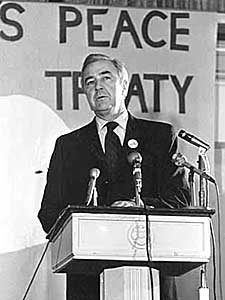
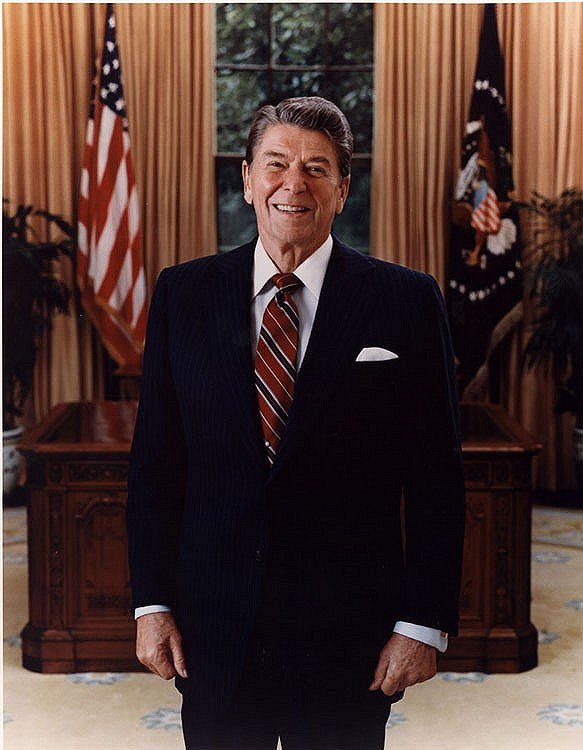
In 1968, Eugene McCarthy came at Lyndon Johnson from the anti-war left and, in losing in the New Hampshire primary by a mere seven points, convinced the man who had won the biggest landslide in American history three years earlier that he could not secure a second full term. Ronald Reagan went at Gerald Ford in 1976 in part on the grounds that Ford was capitulating to the Soviet Union; Reagan went on to win several major states, galvanized the Republican Convention far more than its actual nominee, and left Ford to close a 30-point gap in the polls with Jimmy Carter (which Ford almost did).
With stagflation at home and chaos abroad, Edward Kennedy confronted Jimmy Carter in the 1980 election. Kennedy went on to win 10 primaries, upstage Carter at the Democratic Convention just as Reagan had upstaged Ford, and in general, presage Carter’s doom. Twelve years later, George H. W. Bush began his re-election campaign in the economic doldrums and came under unexpected pressure in New Hampshire from the paleoconservative Pat Buchanan, who got a stunning 38 percent. Ross Perot saw this and designed an independent bid against Bush on the single issue of the budget deficit, which Bush had actually taken aggressive measures to confront; Perot’s bid got Bill Clinton elected.1
There is great ideological irony here. McCarthy and Kennedy ran to their presidents’ left at the beginning of an election cycle that concluded with the victory of a hated conservative—Nixon in 1968, Reagan in 1980. Reagan ran to Ford’s right in an election that went to Carter. And by running to Bush’s right, Buchanan helped establish the conditions under which Clinton would achieve victory in 1992. Both Carter and Clinton ran as Southern moderates but began governing as aggressive liberals. Feingold, or any other Democrat who considers a challenge to Barack Obama, will have to contend with the knowledge that the better he does, the more likely it will be that a conservative Republican will occupy the White House come 2013.
Given this history, what conceivable justification can there be for a primary challenge to Obama for an ideologically driven politician who would not wish his worst enemies to achieve power? The only principled justification is, precisely, principle: you do so because you think the president of your party has acted in ways that are especially injurious to the things you believe in most deeply by suborning those beliefs to his political ambitions. Pat Buchanan’s quixotic effort against George H. W. Bush was driven by this; he opposed the Gulf War, had become a Bryanesque economic populist, and wanted to fight for his (repugnant) vision of what the Republican Party ought to be.
In the case of McCarthy and Reagan and Kennedy, something rather more layered was at play. Kennedy’s 1980 bid was clearly opportunistic, so much so that he himself found it literally inexplicable when CBS’s Roger Mudd asked him why he wanted to be president. The plain fact is that he and his pseudo– royal court had seen an opening for him a decade after Chappaquiddick, but they couldn’t close the deal, and in the process did significant damage to the incumbent.2
Reagan certainly did believe that the policy of détente undertaken by Richard Nixon and continued by Ford was a moral and geopolitical abomination. But he also knew that Ford had not been elected to anything other than the Michigan House seat from which Ford had been elevated to the vice presidency only 10 months before Nixon slunk from office. For Ford to skate into the 1976 Republican nomination without having ever received a single vote as part of a presidential ticket seemed anti-democratic; the logic of the American political system dictated a challenge by someone.
It was the logic of the 1960s that dictated a challenge to Lyndon Johnson in 1968 from within his own party—notwithstanding the fact that he had received 61 percent and 486 electoral votes in November 1964 and had ushered in a new era of activist government with the passage of the Civil Rights Act of 1964, the Voting Rights Act of 1965, and the initiation of Medicare in 1966.
Indeed, one might say that Eugene McCarthy’s entry into the 1968 presidential primaries against Johnson was less a matter of his own choosing than it was a willed manifestation of the anti-war movement, which had turned out hundreds of thousands of demonstrators across the country in 1967. Members of the movement over 21 (then the voting age) were natural Democratic voters, but the policies they were protesting were being enacted by a Democratic administration. Their negative electoral energy had to go somewhere, and it was channeled into McCarthy in New Hampshire. But it did not belong to him; after McCarthy knocked off Johnson, Robert F. Kennedy entered the fray to steal McCarthy’s voters away. After Kennedy’s assassination, Johnson’s vice president, Hubert Humphrey, secured his party’s nomination— which was, to many on the left, no different from having nominated Johnson again. The Democratic Convention in Chicago at the end of August became the epicenter of a guerrilla war launched by leftists against traditional FDR Democrats (in the persons of Humphrey and Chicago mayor Richard Daley), with rioters setting upon Chicago cops, getting savagely beaten in response, and being placed under arrest by the thousands.
The carnage in the streets of Chicago figured prominently in the explanations for the electoral triumph of Richard Nixon in the 1968 general election. And the enduring memory of the way in which a policy disagreement within the Democratic Party had resulted in blood and panic in Grant Park may have contributed inchoately to Nixon’s own 20-point win in 1972.
It is tempting to look at this brief history and say that primary challenges are purely destructive. But that may overrate them. They may not have altered the political atmosphere against incumbents so much as they reflected a change that had already taken place within the body politic. For there is another reason these primary challenges arise, other than a principle or opportunism—a reason that is inchoate, hard to capture, and hard to define. They happen because the president has begun to look like a loser.
_____________
Does Barack Obama now look like a loser? It would be foolish to write Obama’s political epitaph, though it would be even more foolish to assume that his 2008 performance before the national electorate offers much in the way of guidance about how he will fare a second time. A recent president whose election results most closely compare with his is George H. W. Bush, who won 53.4 percent in 1988 (slightly better, in fact, than Obama’s 2008 tally) and had, moreover, a 91 percent approval rating in March 1991. Twenty months later, in November 1992, Bush went on to secure a shockingly low 38 percent of the vote.
Obama is certainly in political peril. In 2008 he won independent voters by 17 points in 2008; on November 2, independents preferred Republicans by eight points, an unprecedented 25-point shift. The percentage of the electorate that called itself Democratic shrank by 9 percent (from 39 percent in 2008 to 36 percent this year). Republicans’ participation grew from 32 percent to 36 percent—proportionately, a 12 percent gain. Let us assume that Obama succeeds in changing the trend line in 2012 by bringing back half the independents his party lost in 2010 and increasing Democratic participation by a percentage point or two over Republicans. If he does so, he will not suffer the kind of defeat his party did in November. But he will still lose.
Obama has acknowledged that he took a “shellacking” in the November 2 election, though in point of fact he had not personally been shellacked. Instead, more than 750 elected Democrats (or positions held by elected Democrats) from the House to the Senate to governors’ mansions to state legislatures were ousted from office in the largest and deepest partisan rout in American history.
It was perhaps more meaningful that Democrats who had had nothing to do with the controversies in Washington—the ones serving in state legislatures— were wiped out at the same time that 66 House seats went from Democratic to Republican control. You have to go back 37 national elections to find a larger number of Republicans in the House. You have to go back 82 years to find as many Republicans in state legislatures.
These numbers are particularly significant because they suggest the end of one of the shortest eras in American political history—a period lasting two elections, in which non-liberal, non-leftist voters in Republican-leaning states flirted with the possibility that the Democratic Party and a charismatic young liberal might have answers to problems the GOP was unable to address effectively. By assigning control of Congress after 2006 and veto-proof dominance of Washington after 2008 to Democrats, voters gave them the perfect opportunity to provide the answers.
And answer they did, with a vengeance. Democrats committed to increases in federal spending that will total, at a minimum, $2 trillion (and almost certainly more) if they come to full fruition—and all that in the wake of financial-bailout commitments of some $900 billion. Obama nationalized two of the Big Three carmakers and took a giant step toward the effective nationalization of the country’s health-care system. And he was stalwart in his insistence (at least until the election results came in) that he would allow the so-called Bush tax cuts of 2001 and 2003 to expire, an effective tax increase of as much as $3 trillion. The answer Democrats provided was that they are activists who govern from the left.
It became common in the days following the election for conservatives and Republicans to say that the GOP should consider itself “on probation.” That is certainly true. But viewing the election as a warning shot to Republicans—which, astonishingly, Obama sought to do in his press conference the day after the voting by saying the election was a “message to Republicans” to “focus on our shared responsibilities and work together”—is wrong. The election was a referendum on left-liberal governance. Voters rejected it, and rejected it with even more of a vengeance than Democrats had shown in undertaking it.
That is why it matters just how deep and thoroughgoing the results were. It wasn’t just that voters wanted to punish Obama and the Washington Democrats because the economy was sour, or because they spent too much, or because they didn’t keep their eye on the ball when they took up health care.
Voters wanted to take governing power away from Democrats at all levels before liberals did more damage.
Presidents in political peril have proved capable of winning over parts of the electorate that had rejected them earlier. Nixon received only 43 percent of the vote in 1968 before going on to score 61 percent in 1972; Clinton got 43 percent in 1992 and 49 percent in 1996. Obama is in a better position than either of them because he needs only the voters who voted for him in 2008 to vote for him again in 2012. That is a tall order because of the way independents deserted the Democrats in November. It is not, however, unthinkable.
But what if the disaffection with Obama comes not only from the right, as was the case in this election, but also from his left? That is where a challenge from Russ Feingold or Howard Dean or someone else will be telling. Ever since Obama took office, leftists have issued complaints against him that, to the non-leftist ear, sound insane.
They claim he has been too moderate, too compromising, too much of a technocrat. They say the $863 billion stimulus was too small by half—an assertion impossible to prove, and pointless in any case, since the stimulus that did become law was as large as the political system in Washington controlled entirely by Democrats could stomach. Liberals were and are angry that Obama gave up the so-called public option on health care, when he had no choice but to do so to win Democratic support to get the bill through the Senate.
In point of fact, Obama has done everything in his power to advance the most unshakably leftist agenda since Johnson’s time, and possibly since the days of Franklin Roosevelt—with remarkable results. He should be celebrated by liberals and the left, not criticized by them, and certainly not abandoned by them. If Obama is indeed threatened by a candidate who comes at him from the left and who gains some traction doing so, that will suggest two things. First, that members of his own base are picking up the scent of a loser from him. And second, that many on the left will prefer to abandon a president they should be hailing as a tough-minded hero rather than confront the stark reality that the American electorate got a good look at what the left truly wants this country to become—and said, with a clarion’s clarity, no.
John Podhoretz
The defeat of Russ Feingold in the November 2 election has unexpectedly provided the most uncompromisingly left-wing Democrat in the U.S. Senate with a new job opportunity—that of candidate for the presidency of the United States. Feingold hinted in his concession speech on election night that he might challenge Barack Obama in the Democratic primaries. “It’s on to 2012,” Feingold said, “and it is on to our next adventure.”
The next day, a spokesman said that Feingold had “no interest” in running for the presidency, but such a denial is meaningless. The scale of the Democratic Party’s defeat and the parlous condition of the country’s finances inevitably raise the specter of a challenge to a first-term president from within his own party. Such challenges have been part of the political landscape for the past half-century. Eight presidents since 1960 have run for re-election. Four of them have had to fight off a significant primary opponent whose key message was that the president had betrayed his party’s core principles. In each case, the challenge preceded the president’s eventual ouster in the general election.
_____________
In 1968, Eugene McCarthy came at Lyndon Johnson from the anti-war left and, in losing in the New Hampshire primary by a mere seven points, convinced the man who had won the biggest landslide in American history three years earlier that he could not secure a second full term. Ronald Reagan went at Gerald Ford in 1976 in part on the grounds that Ford was capitulating to the Soviet Union; Reagan went on to win several major states, galvanized the Republican Convention far more than its actual nominee, and left Ford to close a 30-point gap in the polls with Jimmy Carter (which Ford almost did).
With stagflation at home and chaos abroad, Edward Kennedy confronted Jimmy Carter in the 1980 election. Kennedy went on to win 10 primaries, upstage Carter at the Democratic Convention just as Reagan had upstaged Ford, and in general, presage Carter’s doom. Twelve years later, George H. W. Bush began his re-election campaign in the economic doldrums and came under unexpected pressure in New Hampshire from the paleoconservative Pat Buchanan, who got a stunning 38 percent. Ross Perot saw this and designed an independent bid against Bush on the single issue of the budget deficit, which Bush had actually taken aggressive measures to confront; Perot’s bid got Bill Clinton elected.1
There is great ideological irony here. McCarthy and Kennedy ran to their presidents’ left at the beginning of an election cycle that concluded with the victory of a hated conservative—Nixon in 1968, Reagan in 1980. Reagan ran to Ford’s right in an election that went to Carter. And by running to Bush’s right, Buchanan helped establish the conditions under which Clinton would achieve victory in 1992. Both Carter and Clinton ran as Southern moderates but began governing as aggressive liberals. Feingold, or any other Democrat who considers a challenge to Barack Obama, will have to contend with the knowledge that the better he does, the more likely it will be that a conservative Republican will occupy the White House come 2013.
Given this history, what conceivable justification can there be for a primary challenge to Obama for an ideologically driven politician who would not wish his worst enemies to achieve power? The only principled justification is, precisely, principle: you do so because you think the president of your party has acted in ways that are especially injurious to the things you believe in most deeply by suborning those beliefs to his political ambitions. Pat Buchanan’s quixotic effort against George H. W. Bush was driven by this; he opposed the Gulf War, had become a Bryanesque economic populist, and wanted to fight for his (repugnant) vision of what the Republican Party ought to be.
In the case of McCarthy and Reagan and Kennedy, something rather more layered was at play. Kennedy’s 1980 bid was clearly opportunistic, so much so that he himself found it literally inexplicable when CBS’s Roger Mudd asked him why he wanted to be president. The plain fact is that he and his pseudo– royal court had seen an opening for him a decade after Chappaquiddick, but they couldn’t close the deal, and in the process did significant damage to the incumbent.2
Reagan certainly did believe that the policy of détente undertaken by Richard Nixon and continued by Ford was a moral and geopolitical abomination. But he also knew that Ford had not been elected to anything other than the Michigan House seat from which Ford had been elevated to the vice presidency only 10 months before Nixon slunk from office. For Ford to skate into the 1976 Republican nomination without having ever received a single vote as part of a presidential ticket seemed anti-democratic; the logic of the American political system dictated a challenge by someone.
It was the logic of the 1960s that dictated a challenge to Lyndon Johnson in 1968 from within his own party—notwithstanding the fact that he had received 61 percent and 486 electoral votes in November 1964 and had ushered in a new era of activist government with the passage of the Civil Rights Act of 1964, the Voting Rights Act of 1965, and the initiation of Medicare in 1966.
Indeed, one might say that Eugene McCarthy’s entry into the 1968 presidential primaries against Johnson was less a matter of his own choosing than it was a willed manifestation of the anti-war movement, which had turned out hundreds of thousands of demonstrators across the country in 1967. Members of the movement over 21 (then the voting age) were natural Democratic voters, but the policies they were protesting were being enacted by a Democratic administration. Their negative electoral energy had to go somewhere, and it was channeled into McCarthy in New Hampshire. But it did not belong to him; after McCarthy knocked off Johnson, Robert F. Kennedy entered the fray to steal McCarthy’s voters away. After Kennedy’s assassination, Johnson’s vice president, Hubert Humphrey, secured his party’s nomination— which was, to many on the left, no different from having nominated Johnson again. The Democratic Convention in Chicago at the end of August became the epicenter of a guerrilla war launched by leftists against traditional FDR Democrats (in the persons of Humphrey and Chicago mayor Richard Daley), with rioters setting upon Chicago cops, getting savagely beaten in response, and being placed under arrest by the thousands.
The carnage in the streets of Chicago figured prominently in the explanations for the electoral triumph of Richard Nixon in the 1968 general election. And the enduring memory of the way in which a policy disagreement within the Democratic Party had resulted in blood and panic in Grant Park may have contributed inchoately to Nixon’s own 20-point win in 1972.
It is tempting to look at this brief history and say that primary challenges are purely destructive. But that may overrate them. They may not have altered the political atmosphere against incumbents so much as they reflected a change that had already taken place within the body politic. For there is another reason these primary challenges arise, other than a principle or opportunism—a reason that is inchoate, hard to capture, and hard to define. They happen because the president has begun to look like a loser.
_____________
Does Barack Obama now look like a loser? It would be foolish to write Obama’s political epitaph, though it would be even more foolish to assume that his 2008 performance before the national electorate offers much in the way of guidance about how he will fare a second time. A recent president whose election results most closely compare with his is George H. W. Bush, who won 53.4 percent in 1988 (slightly better, in fact, than Obama’s 2008 tally) and had, moreover, a 91 percent approval rating in March 1991. Twenty months later, in November 1992, Bush went on to secure a shockingly low 38 percent of the vote.
Obama is certainly in political peril. In 2008 he won independent voters by 17 points in 2008; on November 2, independents preferred Republicans by eight points, an unprecedented 25-point shift. The percentage of the electorate that called itself Democratic shrank by 9 percent (from 39 percent in 2008 to 36 percent this year). Republicans’ participation grew from 32 percent to 36 percent—proportionately, a 12 percent gain. Let us assume that Obama succeeds in changing the trend line in 2012 by bringing back half the independents his party lost in 2010 and increasing Democratic participation by a percentage point or two over Republicans. If he does so, he will not suffer the kind of defeat his party did in November. But he will still lose.
Obama has acknowledged that he took a “shellacking” in the November 2 election, though in point of fact he had not personally been shellacked. Instead, more than 750 elected Democrats (or positions held by elected Democrats) from the House to the Senate to governors’ mansions to state legislatures were ousted from office in the largest and deepest partisan rout in American history.
It was perhaps more meaningful that Democrats who had had nothing to do with the controversies in Washington—the ones serving in state legislatures— were wiped out at the same time that 66 House seats went from Democratic to Republican control. You have to go back 37 national elections to find a larger number of Republicans in the House. You have to go back 82 years to find as many Republicans in state legislatures.
These numbers are particularly significant because they suggest the end of one of the shortest eras in American political history—a period lasting two elections, in which non-liberal, non-leftist voters in Republican-leaning states flirted with the possibility that the Democratic Party and a charismatic young liberal might have answers to problems the GOP was unable to address effectively. By assigning control of Congress after 2006 and veto-proof dominance of Washington after 2008 to Democrats, voters gave them the perfect opportunity to provide the answers.
And answer they did, with a vengeance. Democrats committed to increases in federal spending that will total, at a minimum, $2 trillion (and almost certainly more) if they come to full fruition—and all that in the wake of financial-bailout commitments of some $900 billion. Obama nationalized two of the Big Three carmakers and took a giant step toward the effective nationalization of the country’s health-care system. And he was stalwart in his insistence (at least until the election results came in) that he would allow the so-called Bush tax cuts of 2001 and 2003 to expire, an effective tax increase of as much as $3 trillion. The answer Democrats provided was that they are activists who govern from the left.
It became common in the days following the election for conservatives and Republicans to say that the GOP should consider itself “on probation.” That is certainly true. But viewing the election as a warning shot to Republicans—which, astonishingly, Obama sought to do in his press conference the day after the voting by saying the election was a “message to Republicans” to “focus on our shared responsibilities and work together”—is wrong. The election was a referendum on left-liberal governance. Voters rejected it, and rejected it with even more of a vengeance than Democrats had shown in undertaking it.
That is why it matters just how deep and thoroughgoing the results were. It wasn’t just that voters wanted to punish Obama and the Washington Democrats because the economy was sour, or because they spent too much, or because they didn’t keep their eye on the ball when they took up health care.
Voters wanted to take governing power away from Democrats at all levels before liberals did more damage.
Presidents in political peril have proved capable of winning over parts of the electorate that had rejected them earlier. Nixon received only 43 percent of the vote in 1968 before going on to score 61 percent in 1972; Clinton got 43 percent in 1992 and 49 percent in 1996. Obama is in a better position than either of them because he needs only the voters who voted for him in 2008 to vote for him again in 2012. That is a tall order because of the way independents deserted the Democrats in November. It is not, however, unthinkable.
But what if the disaffection with Obama comes not only from the right, as was the case in this election, but also from his left? That is where a challenge from Russ Feingold or Howard Dean or someone else will be telling. Ever since Obama took office, leftists have issued complaints against him that, to the non-leftist ear, sound insane.
They claim he has been too moderate, too compromising, too much of a technocrat. They say the $863 billion stimulus was too small by half—an assertion impossible to prove, and pointless in any case, since the stimulus that did become law was as large as the political system in Washington controlled entirely by Democrats could stomach. Liberals were and are angry that Obama gave up the so-called public option on health care, when he had no choice but to do so to win Democratic support to get the bill through the Senate.
In point of fact, Obama has done everything in his power to advance the most unshakably leftist agenda since Johnson’s time, and possibly since the days of Franklin Roosevelt—with remarkable results. He should be celebrated by liberals and the left, not criticized by them, and certainly not abandoned by them. If Obama is indeed threatened by a candidate who comes at him from the left and who gains some traction doing so, that will suggest two things. First, that members of his own base are picking up the scent of a loser from him. And second, that many on the left will prefer to abandon a president they should be hailing as a tough-minded hero rather than confront the stark reality that the American electorate got a good look at what the left truly wants this country to become—and said, with a clarion’s clarity, no.
The Failed Notions of Racism
Via-American Thinker
By George Scaggs
Last month, just weeks before the elections, the very capable Rasmussen Report revealed that most Democrat voters think the Tea Party movement is racist.
The report highlighted that 56% of self-described Democrats viewed most tea partiers as racially biased. The poll also found that 30% of GOP voters and 45% of those not affiliated with either major party likewise hold this view.
Also of note, a rather significant 46% of the "Political Class" believes most members of the Tea Party are racist but then 34% of elites happen to think a majority of all Americans possess this nasty trait.
As impressive as the most recent election results were for conservatives and Tea Party advocates, an interesting question arises -- if not for this widely held belief and the cacophony of shrill accusations that accompany it, how much more effective could Tea Party supported candidates have been?
For most of us, there are few things as despicable as a racist. The mere thought of racism produces an instinctive re-coil in many Americans, regardless of skin color.
Since the inception of the current citizens' rebellion, Americans have been subject to a constant drumbeat of Tea Partier equals racist Nazi whacko. As absurd as they are, the poll results should come as no big surprise.
Who could forget the lunatic rant by Janeane Garofalo on MSNBC in response to the first big nationwide round of Tea Party rallies on April 15, 2009? "This is racism straight up", she spouted, going on to explain that the whole lot of tea partiers suffered from a mental affliction.
Almost a year later, as Tea Party advocates gathered at the U.S. Capitol to protest the final health care vote in the House, members of the Congressional Black Caucus manufactured a story that they were spat upon and subject to racial slurs as they made their way through the assembled crowd.
While widely parroted by Democrats and much of the press, a review of all the evidence clearly indicates that the incident never took place. Indeed, though dozens of video cameras recorded the event, Andrew Brietbart's offer to pay $100K for proof of the CBC's claims never produced any takers.
Regardless, influenced by the alleged racism, In July the NAACP adopted a resolution repudiating racist elements in the Tea Party, giving the "Big Lie" yet more life.
It seems that a good number of Americans have a love affair with the notion of victimization, particularly of the racial sort. Given the likes of the NAACP stoking the fires, we've developed a sub-class of perpetual victims led by charlatans and entertainers whose ridiculous obsessions are considered the stuff of celebrity. From Al Sharpton to Bill Maher, a league of what might be best described as professional race-baiters are sold as objective, authoritative figures.
Clearly, some people are simply incapable of setting aside racial identity, so let's call them Racialists. Unable to conceive that others might group themselves by common interests and fundamental values in lieu of things like race, religion or ethnicity, the racialist often lashes out when his reality is challenged. This sentiment is reflected in the poll results.
There can be little doubt that among those who believe the Tea Party is racist, few have actually bothered to attend a Tea Party rally or meeting, or even sat down for a chat with one of their engaged countrymen who have come to personify the movement.
Interestingly, while the elites have long propagated the view that conservatives are an unenlightened rabble of reactionaries, the Rasmussen poll reveals that Democrats and their elitist brethren harbor these very tendencies, for their accusations reveal their methods.
For avid Tea Party aficionados who know first-hand whether or not racism exists among their ranks, a majority of Democrats have exposed themselves as, let's just say, literal symbols of their party, willing to judge others on nothing more than conjecture.
But not all is lost, far from it. On the other side of the coin, the poll also indicates that a fair number of Democrats happen to know better. Not only a sign that registered Dems are indeed among those incessantly protesting their government but clearly signaling a portentous future for the Democratic Party.
This is among emerging trends indicating that the veneer of Democratic identity politics is beginning to crack. We need only look at some of the developments of the most recent elections for proof.
Largely obscured and untold by Big Media, an unprecedented slate of black, Latino and Hispanic conservatives ran for office at state and national levels in the 2010 elections.
In the south, where conservatives are equated with "a bunch of rednecks" by their detractors, Tim Scott was enthusiastically elected to Congress in South Carolina, as was Allen West in Florida. Similarly, Marco Rubio was elected to the Senate from Florida in a runaway. The same scenario played out throughout the country in various state races.
Races in states along the southern border were particularly telling. Formerly, Democrats held all ten U.S. Congressional districts which border Mexico. Of the sixty plus seats the GOP gained in the U.S. House, three were border districts, two in Texas and one in New Mexico.
Both border districts in Arizona were also extremely competitive with the GOP challengers losing narrowly, the 7th district by less than 4,000 votes.
Otherwise in Arizona, not only was Governor Jan Brewer handily re-elected but the GOP pulled off a clean sweep of statewide races for the first time since 1994. Among the casualties was the Democrat state attorney general who opposed SB1070.
Conservatives also built on the GOP's standing majority in Arizona's House and Senate, producing a two-thirds majority in the legislative body. To top it all off, SB1070 architect, Russell Pearce has been tagged to head the Arizona Senate.
That's right, those very same bold conservatives who were savaged by Democrats and the press as racists for the better part of a year were given a rousing vote of confidence at the ballot box.
In New Mexico, Susana Martinez became the nation's first female Hispanic state executive, easily defeating the Democrat incumbent. Though the state government has always been lead by Democrats, Republicans gained at least four seats in the state house and are close to a record number of Republicans in the chamber.
Increasingly, Republican and conservative Hispanics are stepping forward in states with high concentrations of Hispanic voters. Because race is not a factor, white conservatives are voting for them and more Hispanics are voting for conservatives in general.
Perhps Texas, more so than any other state, tells the story of what may be to come.
Not only did the state produce newly elected conservatives Bill Flores and Francisco Canseco as members of Congress but in the Texas House, where the GOP gained an astounding 22 seats, nearly one-third of new Republicans are ethnic minorities. Five Hispanic and two African-American Republicans now occupy the body where none existed previously.
Race obsessed Democrats have good reason to worry.
By George Scaggs
Last month, just weeks before the elections, the very capable Rasmussen Report revealed that most Democrat voters think the Tea Party movement is racist.
The report highlighted that 56% of self-described Democrats viewed most tea partiers as racially biased. The poll also found that 30% of GOP voters and 45% of those not affiliated with either major party likewise hold this view.
Also of note, a rather significant 46% of the "Political Class" believes most members of the Tea Party are racist but then 34% of elites happen to think a majority of all Americans possess this nasty trait.
As impressive as the most recent election results were for conservatives and Tea Party advocates, an interesting question arises -- if not for this widely held belief and the cacophony of shrill accusations that accompany it, how much more effective could Tea Party supported candidates have been?
For most of us, there are few things as despicable as a racist. The mere thought of racism produces an instinctive re-coil in many Americans, regardless of skin color.
Since the inception of the current citizens' rebellion, Americans have been subject to a constant drumbeat of Tea Partier equals racist Nazi whacko. As absurd as they are, the poll results should come as no big surprise.
Who could forget the lunatic rant by Janeane Garofalo on MSNBC in response to the first big nationwide round of Tea Party rallies on April 15, 2009? "This is racism straight up", she spouted, going on to explain that the whole lot of tea partiers suffered from a mental affliction.
Almost a year later, as Tea Party advocates gathered at the U.S. Capitol to protest the final health care vote in the House, members of the Congressional Black Caucus manufactured a story that they were spat upon and subject to racial slurs as they made their way through the assembled crowd.
While widely parroted by Democrats and much of the press, a review of all the evidence clearly indicates that the incident never took place. Indeed, though dozens of video cameras recorded the event, Andrew Brietbart's offer to pay $100K for proof of the CBC's claims never produced any takers.
Regardless, influenced by the alleged racism, In July the NAACP adopted a resolution repudiating racist elements in the Tea Party, giving the "Big Lie" yet more life.
It seems that a good number of Americans have a love affair with the notion of victimization, particularly of the racial sort. Given the likes of the NAACP stoking the fires, we've developed a sub-class of perpetual victims led by charlatans and entertainers whose ridiculous obsessions are considered the stuff of celebrity. From Al Sharpton to Bill Maher, a league of what might be best described as professional race-baiters are sold as objective, authoritative figures.
Clearly, some people are simply incapable of setting aside racial identity, so let's call them Racialists. Unable to conceive that others might group themselves by common interests and fundamental values in lieu of things like race, religion or ethnicity, the racialist often lashes out when his reality is challenged. This sentiment is reflected in the poll results.
There can be little doubt that among those who believe the Tea Party is racist, few have actually bothered to attend a Tea Party rally or meeting, or even sat down for a chat with one of their engaged countrymen who have come to personify the movement.
Interestingly, while the elites have long propagated the view that conservatives are an unenlightened rabble of reactionaries, the Rasmussen poll reveals that Democrats and their elitist brethren harbor these very tendencies, for their accusations reveal their methods.
For avid Tea Party aficionados who know first-hand whether or not racism exists among their ranks, a majority of Democrats have exposed themselves as, let's just say, literal symbols of their party, willing to judge others on nothing more than conjecture.
But not all is lost, far from it. On the other side of the coin, the poll also indicates that a fair number of Democrats happen to know better. Not only a sign that registered Dems are indeed among those incessantly protesting their government but clearly signaling a portentous future for the Democratic Party.
This is among emerging trends indicating that the veneer of Democratic identity politics is beginning to crack. We need only look at some of the developments of the most recent elections for proof.
Largely obscured and untold by Big Media, an unprecedented slate of black, Latino and Hispanic conservatives ran for office at state and national levels in the 2010 elections.
In the south, where conservatives are equated with "a bunch of rednecks" by their detractors, Tim Scott was enthusiastically elected to Congress in South Carolina, as was Allen West in Florida. Similarly, Marco Rubio was elected to the Senate from Florida in a runaway. The same scenario played out throughout the country in various state races.
Races in states along the southern border were particularly telling. Formerly, Democrats held all ten U.S. Congressional districts which border Mexico. Of the sixty plus seats the GOP gained in the U.S. House, three were border districts, two in Texas and one in New Mexico.
Both border districts in Arizona were also extremely competitive with the GOP challengers losing narrowly, the 7th district by less than 4,000 votes.
Otherwise in Arizona, not only was Governor Jan Brewer handily re-elected but the GOP pulled off a clean sweep of statewide races for the first time since 1994. Among the casualties was the Democrat state attorney general who opposed SB1070.
Conservatives also built on the GOP's standing majority in Arizona's House and Senate, producing a two-thirds majority in the legislative body. To top it all off, SB1070 architect, Russell Pearce has been tagged to head the Arizona Senate.
That's right, those very same bold conservatives who were savaged by Democrats and the press as racists for the better part of a year were given a rousing vote of confidence at the ballot box.
In New Mexico, Susana Martinez became the nation's first female Hispanic state executive, easily defeating the Democrat incumbent. Though the state government has always been lead by Democrats, Republicans gained at least four seats in the state house and are close to a record number of Republicans in the chamber.
Increasingly, Republican and conservative Hispanics are stepping forward in states with high concentrations of Hispanic voters. Because race is not a factor, white conservatives are voting for them and more Hispanics are voting for conservatives in general.
Perhps Texas, more so than any other state, tells the story of what may be to come.
Not only did the state produce newly elected conservatives Bill Flores and Francisco Canseco as members of Congress but in the Texas House, where the GOP gained an astounding 22 seats, nearly one-third of new Republicans are ethnic minorities. Five Hispanic and two African-American Republicans now occupy the body where none existed previously.
Race obsessed Democrats have good reason to worry.
11/14/2010
.2010 elections highlight Obama's eroding base
Via-AP
By LIZ SIDOTI AND JENNIFER AGIESTA, Associated Press Liz Sidoti And Jennifer Agiesta, Associated Press
WASHINGTON – Near the midpoint of his presidency, Barack Obama's diverse voter coalition reveals giant cracks and he faces major work repairing his standing among independents in states crucial to his re-election chances. Catholics. Older people. Women. Young adults. They shifted toward Republicans in this month's elections and failed to support Obama's Democratic Party as they did in 2008.
Two years before voters render judgment on his tenure, Obama's most critical task may be winning back those who aren't affiliated with a party but who hold enormous sway in close contests. National exit polls from the midterm elections show these voters broke heavily for Republicans after helping elect Obama and Democrats in the two previous elections.
The trouble with this constituency appears even deeper for Obama in places expected to be closely contested in the next White House race, according to an analysis by The Associated Press of exit polls in 26 states. It shows just how much ground Obama must make up with independents between now and November 2012.
"Over the last two years, we've made progress. But clearly too many Americans haven't felt that progress yet," the president said after the election. "As president, I take responsibility for that."
It's impossible to predict a presidential election based on midterm results. That's even truer considering that 131.2 million people voted in 2008, when Obama was elected, compared with 87 million this month, based on an AP tally of official and unofficial results. The slow-moving economic recovery could speed up, lifting Obama and the Democrats.
By LIZ SIDOTI AND JENNIFER AGIESTA, Associated Press Liz Sidoti And Jennifer Agiesta, Associated Press
WASHINGTON – Near the midpoint of his presidency, Barack Obama's diverse voter coalition reveals giant cracks and he faces major work repairing his standing among independents in states crucial to his re-election chances. Catholics. Older people. Women. Young adults. They shifted toward Republicans in this month's elections and failed to support Obama's Democratic Party as they did in 2008.
Two years before voters render judgment on his tenure, Obama's most critical task may be winning back those who aren't affiliated with a party but who hold enormous sway in close contests. National exit polls from the midterm elections show these voters broke heavily for Republicans after helping elect Obama and Democrats in the two previous elections.
The trouble with this constituency appears even deeper for Obama in places expected to be closely contested in the next White House race, according to an analysis by The Associated Press of exit polls in 26 states. It shows just how much ground Obama must make up with independents between now and November 2012.
"Over the last two years, we've made progress. But clearly too many Americans haven't felt that progress yet," the president said after the election. "As president, I take responsibility for that."
It's impossible to predict a presidential election based on midterm results. That's even truer considering that 131.2 million people voted in 2008, when Obama was elected, compared with 87 million this month, based on an AP tally of official and unofficial results. The slow-moving economic recovery could speed up, lifting Obama and the Democrats.
11/13/2010
Tea Partiers To GOP: Fall In Line Or Face Challengers
Via-Daily Caller
By John Rossomando
Prominent leaders within the Tea Party Movement have a warning to presumptive Speaker John Boehner, R-Ohio, and Senate Minority Leader Mitch McConnell, R-Ky – keep their campaign promises to cut spending and repeal the health care law or face defeat in their next primaries.
Tea Partiers plan to remain a political force to be reckoned with going into the 2012 presidential races and beyond, and they plan to prove party politics as it has existed for the past century are over. They
see a sharp contrast between themselves and earlier conservative groups such as the Christian Right or the Reagan coalition, which allowed themselves to be manipulated and outmaneuvered by the
Republican establishment.
“We are not going to back down, and we are going to be holding people’s feet to the fire- the new incoming freshmen as well as the old guard that’s still there,” said Tea Party Express leader Amy Kremer. “We’ve heard from the Republicans over the past 12 or 24 months about what they would do if they gained control.
“Now is the time to stop with the lip service and show actions; you know actions speak a lot louder than words, so now we in the movement are now going to see if they are going to walk the walk.”
Compromise with Democrats on key issues would be a non-starter for Tea Partiers, and doing so would prompt a Tea Party backlash, Meckler said.
Meckler warns Republican senators up for re-election in 2012 to think twice about voting on compromise with the Democrats because they will face the same fate at outgoing Utah Sen. Robert Bennett or Delaware Rep. Mike Castle.
McConnell’s support for earmarks, for example, could put him in hot water with the Tea Partiers who promise to take him down the next time he runs unless he relents.
“I guarantee there will be primary challenges in 2012 for those folks that don’t hold strong,” Meckler told The Daily Caller. “I guarantee in two years we will vote all of them out and have another celebration.”
Boehner would find himself at the top of the Tea Party’s list of primary targets if he goes back on any of his campaign promises, Meckler said.
“We can’t expect in three months to have ObamaCare repealed; to have the budget balanced, or have our debt paid down,” Kremer said. “That’s unrealistic and we need to be realistic, but we want to see progress.
“We didn’t get here overnight, and it’s going to take a couple of election cycles before we get enough conservatives in there, so that we can completely turn things around.”
By John Rossomando
Prominent leaders within the Tea Party Movement have a warning to presumptive Speaker John Boehner, R-Ohio, and Senate Minority Leader Mitch McConnell, R-Ky – keep their campaign promises to cut spending and repeal the health care law or face defeat in their next primaries.
Tea Partiers plan to remain a political force to be reckoned with going into the 2012 presidential races and beyond, and they plan to prove party politics as it has existed for the past century are over. They
see a sharp contrast between themselves and earlier conservative groups such as the Christian Right or the Reagan coalition, which allowed themselves to be manipulated and outmaneuvered by the
Republican establishment.
“We are not going to back down, and we are going to be holding people’s feet to the fire- the new incoming freshmen as well as the old guard that’s still there,” said Tea Party Express leader Amy Kremer. “We’ve heard from the Republicans over the past 12 or 24 months about what they would do if they gained control.
“Now is the time to stop with the lip service and show actions; you know actions speak a lot louder than words, so now we in the movement are now going to see if they are going to walk the walk.”
Compromise with Democrats on key issues would be a non-starter for Tea Partiers, and doing so would prompt a Tea Party backlash, Meckler said.
Meckler warns Republican senators up for re-election in 2012 to think twice about voting on compromise with the Democrats because they will face the same fate at outgoing Utah Sen. Robert Bennett or Delaware Rep. Mike Castle.
McConnell’s support for earmarks, for example, could put him in hot water with the Tea Partiers who promise to take him down the next time he runs unless he relents.
“I guarantee there will be primary challenges in 2012 for those folks that don’t hold strong,” Meckler told The Daily Caller. “I guarantee in two years we will vote all of them out and have another celebration.”
Boehner would find himself at the top of the Tea Party’s list of primary targets if he goes back on any of his campaign promises, Meckler said.
“We can’t expect in three months to have ObamaCare repealed; to have the budget balanced, or have our debt paid down,” Kremer said. “That’s unrealistic and we need to be realistic, but we want to see progress.
“We didn’t get here overnight, and it’s going to take a couple of election cycles before we get enough conservatives in there, so that we can completely turn things around.”
11/11/2010
He Won't Be Moving to the Center
Via-American Spectator
By Janice Shaw Crouse
President Obama told students in India that the 2010 election "requires me to make some midcourse corrections and adjustments," but Americans are wondering whether he really understands that voters rejected his policies in the early-November midterm elections. Instead of acknowledging that his policies are behind the defeat, the president blames "faulty communication," as though the election massacre were just a public relations miscue. Even Ruth Marcus of the Washington Post scoffed at the president's claim that the public "failed to grasp" the reasons for his actions because he didn't explain "clearly enough." Other Democrats question the president's "act of contrition" and acknowledge that the hard part will be to actually change direction and move to the center. Many Democrats believe such changes are impossible because the president has alienated many of his closest political allies. "He's isolated himself from virtually every group that matters in American politics," reported Politico. Those close enough to receive White House invitations complain that those prestigious, and formerly personal, visits are now nothing more than campaign events where guests are kept behind the ropes or never even see the president.
As the saying goes, with friends like these, who needs enemies? Even Congressional Democrats blame the president for the "shellacking" the party suffered in losing the House to the GOP. They see a "tone deaf" and "distant" president who is "inattentive" and runs a "hapless political operation." Some Democrats get highly personal in describing their president's "holier-than-thou" attitudes and posturing. On November 8, Politico reported, "Many Democrats privately say they are skeptical that Obama is self-aware enough to make the sort of dramatic changes they feel are needed -- in his relations with other Democrats or in his very approach to the job." This view is supported by House Speaker Nancy Pelosi's (D-California) refusal to step aside for new leadership and her public assertions of pride at their "historic achievements."
In short, few people see a humbled Obama; instead, they see a man who "learned the wrong lessons."
The Obama administration's inability to cope with the grave implications of the Democrats' "stinging defeat" at the ballot box was summed up by two who survived the onslaught, Reps. Marcy Kaptur of Ohio and Peter DeFazio of Oregon. As reported by ABC's "The Note," they wrote: "Following the loss of our majority, we should fully understand the causes of our historic losses before we begin the process of rebuilding. If we do not to learn from our losses we will remain in the minority until we do learn."
More and more observers are concluding that the president is incapable of understanding the reasons for the public repudiation of his policies; further, they think he is unable to learn the lessons of 2010.
In an editorial closely scrutinizing President Obama's trip to India, the Washington Times characterized the trip as an announcement of "the decline of the United States as an economic power." Mr. Obama, according to the Washington Times, "ignores the fact that it was American invention, innovation and competitive spirit that gave the country its economic pre-eminence in the first place. Rather than lecturing Americans to get in the game, he would do better to reverse the anti-business political climate he has helped foster." Further, the Times wrote, the president "has never been comfortable with American global pre-eminence." The Times summarized their analysis:
Clearly, the election of 2010 was a rejection of Mr. Obama's ideology and agenda -- a matter of the president's chickens coming home to roost. The Obama presidency -- with its anti-exceptionalism, anti-capitalist, anti-freedom emphases -- is a wake-up call for America. The president's rhetoric may continue to resonate with those who want big-government solutions to all of their wants and needs, but if we have learned nothing else, we now know that our nation will survive and thrive only with a fully informed and actively engaged electorate who can tell the difference between truthful analyses of the challenges facing America today and mere demagoguery about "enemies" and divisive appeals to emotion.
By Janice Shaw Crouse
President Obama told students in India that the 2010 election "requires me to make some midcourse corrections and adjustments," but Americans are wondering whether he really understands that voters rejected his policies in the early-November midterm elections. Instead of acknowledging that his policies are behind the defeat, the president blames "faulty communication," as though the election massacre were just a public relations miscue. Even Ruth Marcus of the Washington Post scoffed at the president's claim that the public "failed to grasp" the reasons for his actions because he didn't explain "clearly enough." Other Democrats question the president's "act of contrition" and acknowledge that the hard part will be to actually change direction and move to the center. Many Democrats believe such changes are impossible because the president has alienated many of his closest political allies. "He's isolated himself from virtually every group that matters in American politics," reported Politico. Those close enough to receive White House invitations complain that those prestigious, and formerly personal, visits are now nothing more than campaign events where guests are kept behind the ropes or never even see the president.
As the saying goes, with friends like these, who needs enemies? Even Congressional Democrats blame the president for the "shellacking" the party suffered in losing the House to the GOP. They see a "tone deaf" and "distant" president who is "inattentive" and runs a "hapless political operation." Some Democrats get highly personal in describing their president's "holier-than-thou" attitudes and posturing. On November 8, Politico reported, "Many Democrats privately say they are skeptical that Obama is self-aware enough to make the sort of dramatic changes they feel are needed -- in his relations with other Democrats or in his very approach to the job." This view is supported by House Speaker Nancy Pelosi's (D-California) refusal to step aside for new leadership and her public assertions of pride at their "historic achievements."
In short, few people see a humbled Obama; instead, they see a man who "learned the wrong lessons."
The Obama administration's inability to cope with the grave implications of the Democrats' "stinging defeat" at the ballot box was summed up by two who survived the onslaught, Reps. Marcy Kaptur of Ohio and Peter DeFazio of Oregon. As reported by ABC's "The Note," they wrote: "Following the loss of our majority, we should fully understand the causes of our historic losses before we begin the process of rebuilding. If we do not to learn from our losses we will remain in the minority until we do learn."
More and more observers are concluding that the president is incapable of understanding the reasons for the public repudiation of his policies; further, they think he is unable to learn the lessons of 2010.
In an editorial closely scrutinizing President Obama's trip to India, the Washington Times characterized the trip as an announcement of "the decline of the United States as an economic power." Mr. Obama, according to the Washington Times, "ignores the fact that it was American invention, innovation and competitive spirit that gave the country its economic pre-eminence in the first place. Rather than lecturing Americans to get in the game, he would do better to reverse the anti-business political climate he has helped foster." Further, the Times wrote, the president "has never been comfortable with American global pre-eminence." The Times summarized their analysis:
In place of liberty, [Mr. Obama] substitutes redistributionist notions of social justice. Rather than a single American nation, he institutionalizes differences for political gain. Instead of patriotism and pride, he promotes internationalism and guilt. America's decline is not the result of historical forces out of our control, but of condemning the history that brought the United States to its position of leadership. America will only resurge when it recaptures the moral image of the country as a land of individualism, opportunity and patriotism. That is an America Mr. Obama would rather do without.Ben Shapiro, in a Creator's Syndicate article, describes recent photos of President Obama as alarming, "They depict a man boiling over with rage. Have we ever witnessed a U.S. President so pugnacious, so incensed and inflamed by his own people?" Answering his own question, Shapiro declares that we are not the president's people; instead he sees Obama following his mother's isolation. His mother, according to Shapiro, "reinforced and celebrated their misfit status" and did not socialize with other Americans in Indonesia when Barack was a boy because "they are not my people." In addition to all of the non-American, "hate-America" people who had influence on the president during his formative years, Shapiro also notes the socialists and other "hate-America" mentors that the president chose as his friends and associates later in life. America's supposed decline, Shapiro believes, is for our president -- in accordance with all he was taught by his hate-mongering pastor, Reverend Jeremiah Wright -- a matter of the "chickens coming home to roost."
Clearly, the election of 2010 was a rejection of Mr. Obama's ideology and agenda -- a matter of the president's chickens coming home to roost. The Obama presidency -- with its anti-exceptionalism, anti-capitalist, anti-freedom emphases -- is a wake-up call for America. The president's rhetoric may continue to resonate with those who want big-government solutions to all of their wants and needs, but if we have learned nothing else, we now know that our nation will survive and thrive only with a fully informed and actively engaged electorate who can tell the difference between truthful analyses of the challenges facing America today and mere demagoguery about "enemies" and divisive appeals to emotion.
11/10/2010
Rubio Knows Where He's Going
Via-American Spectator
By Larry Thornberry
TAMPA -- "Marvin, what do we do now?" This is one of those memorable lines, familiar to most movie-goers of a certain age. The line concludes the 1972 Robert Redford movie, The Candidate, and is uttered by Redford's much compromised liberal senator-elect Bill McKay.
Florida's new senator-elect, Marco Rubio of Miami, doesn't have McKay's problem. Rubio is not a liberal. And he in no way compromised his conservative principles to win big last Tuesday, though his main opponent, partyless Florida Governor Charlie Crist (I-Narcissus), compromised whatever principles he may have once had by floating, unsuccessfully, a series of bogus charges against Rubio during the campaign.
Crist's political career is almost certainly over. Few here are weeping for the guy who changed his political positions so often, so completely, and so opportunistically that Brit Hume called him "the most flexible politician I've ever seen." In a column this week George Will referred to Crist as "Plasticman." In Florida politics, Crist is so 2006.
Rubio knows exactly what he wants to do now, which is to work to bring about a clear alternative to the toxic leftist agenda of President Obama and the Democratic Congress, an agenda which is turning America into something that it's never been and that most Americans don't want. After the election Rubio said his first priorities would be to cut federal spending, to see that the Bush tax cuts are made permanent, and to repeal and replace ObamaCare.
In his acceptance speech last Tuesday Rubio called the Republican surge "a second chance for Republicans to be what they said they were going to be not so long ago." Exactly. Rubio realizes the profligacy of Republicans in 2006 and 2008 is partly responsible for the country's woes. "Our nation is headed in the wrong direction and both parties are to blame," he said repeatedly on the campaign trail. If most members of the Republican Class of 2010 understand this, and I hope and trust they do, the better the chances Washington's wild spending will be brought under control.
Showing the influence the rookie senator-elect has in the new Republican Party, he was chosen to deliver the weekly Republican address Saturday. In it he said the Republican Party had given nothing less than a promise that if given power again "we would not squander the chance you gave us… we must not. Because nothing less than the identity of our country and what kind of future we will leave our children is at stake."
Marco gets it. And he invites voters to "hold us accountable to the ideas and principles we campaigned on. This is our second chance to get this right. To make the right decisions and the tough calls and to leave our children what they deserve -- the freest and most exceptional society in all of human history." (And if the Brits or the Greeks want to complain that we go on too much about our exceptionalism, they can complain to President Obama, who agrees with them.)
Timing is critical in war, love, and hitting a baseball. It's no less so in politics. And Rubio was the guy in Florida's three-way Senate race whose time had come.
Democratic Kendrick Meek watched Obama's dramatic win in 2008, in which he won 52 percent of red-state Florida's vote, and concluded it was time for another black liberal candidate to win state-wide in Florida. But the air went out of "that hopey-changey thing" (thanks to Sarah Palin for the expression) so fast that all Meek could scare up in 2010 was 20 percent of the vote in the Senate race.
Crist, who has never had a fixed ideological address, listened to the Republican establishment, and therefore thought 2010 was the year for moderate Republicans. When it turned out not to be, he tried to out-conservative Rubio to win the Republican nomination. When he fell hopelessly behind, he became an independent, gussied up all new liberal positions, and tried to fish for Democratic voters. He got more of these than Meek did, but ended with only 30 percent of the vote, a full 20 points behind Rubio.
Looks like Rubio was right when he repeated on the campaign trail, "We already have a Democratic Party. We don't need another one."
Rubio pledges to pursue policies that will help grow our economy, policies that re-assert our reliance on the free market and limited government. In addition to reigning in spending and extending the 2001 and 2003 tax cuts, Rubio would like to cut corporate taxes to make American companies competitive, end the death tax, end double taxation, reform the U.S. Tax Code, stop consideration of the value-added tax, repeal regulations that hurt job creation, reduce barriers to free and fair trade, and fix entitlements.
These may not be all the actions and answers we need. But they're good ideas, and enough to keep Rubio and the Republican Class of 2010 off of K Street for a good long while. Maybe until another of Rubio's campaign suggestions is fulfilled. He said on the trail, "If you don't like the Republican establishment, get another establishment." Who said there are no new good ideas?
By Larry Thornberry
TAMPA -- "Marvin, what do we do now?" This is one of those memorable lines, familiar to most movie-goers of a certain age. The line concludes the 1972 Robert Redford movie, The Candidate, and is uttered by Redford's much compromised liberal senator-elect Bill McKay.
Florida's new senator-elect, Marco Rubio of Miami, doesn't have McKay's problem. Rubio is not a liberal. And he in no way compromised his conservative principles to win big last Tuesday, though his main opponent, partyless Florida Governor Charlie Crist (I-Narcissus), compromised whatever principles he may have once had by floating, unsuccessfully, a series of bogus charges against Rubio during the campaign.
Crist's political career is almost certainly over. Few here are weeping for the guy who changed his political positions so often, so completely, and so opportunistically that Brit Hume called him "the most flexible politician I've ever seen." In a column this week George Will referred to Crist as "Plasticman." In Florida politics, Crist is so 2006.
Rubio knows exactly what he wants to do now, which is to work to bring about a clear alternative to the toxic leftist agenda of President Obama and the Democratic Congress, an agenda which is turning America into something that it's never been and that most Americans don't want. After the election Rubio said his first priorities would be to cut federal spending, to see that the Bush tax cuts are made permanent, and to repeal and replace ObamaCare.
In his acceptance speech last Tuesday Rubio called the Republican surge "a second chance for Republicans to be what they said they were going to be not so long ago." Exactly. Rubio realizes the profligacy of Republicans in 2006 and 2008 is partly responsible for the country's woes. "Our nation is headed in the wrong direction and both parties are to blame," he said repeatedly on the campaign trail. If most members of the Republican Class of 2010 understand this, and I hope and trust they do, the better the chances Washington's wild spending will be brought under control.
Showing the influence the rookie senator-elect has in the new Republican Party, he was chosen to deliver the weekly Republican address Saturday. In it he said the Republican Party had given nothing less than a promise that if given power again "we would not squander the chance you gave us… we must not. Because nothing less than the identity of our country and what kind of future we will leave our children is at stake."
Marco gets it. And he invites voters to "hold us accountable to the ideas and principles we campaigned on. This is our second chance to get this right. To make the right decisions and the tough calls and to leave our children what they deserve -- the freest and most exceptional society in all of human history." (And if the Brits or the Greeks want to complain that we go on too much about our exceptionalism, they can complain to President Obama, who agrees with them.)
Timing is critical in war, love, and hitting a baseball. It's no less so in politics. And Rubio was the guy in Florida's three-way Senate race whose time had come.
Democratic Kendrick Meek watched Obama's dramatic win in 2008, in which he won 52 percent of red-state Florida's vote, and concluded it was time for another black liberal candidate to win state-wide in Florida. But the air went out of "that hopey-changey thing" (thanks to Sarah Palin for the expression) so fast that all Meek could scare up in 2010 was 20 percent of the vote in the Senate race.
Crist, who has never had a fixed ideological address, listened to the Republican establishment, and therefore thought 2010 was the year for moderate Republicans. When it turned out not to be, he tried to out-conservative Rubio to win the Republican nomination. When he fell hopelessly behind, he became an independent, gussied up all new liberal positions, and tried to fish for Democratic voters. He got more of these than Meek did, but ended with only 30 percent of the vote, a full 20 points behind Rubio.
Looks like Rubio was right when he repeated on the campaign trail, "We already have a Democratic Party. We don't need another one."
Rubio pledges to pursue policies that will help grow our economy, policies that re-assert our reliance on the free market and limited government. In addition to reigning in spending and extending the 2001 and 2003 tax cuts, Rubio would like to cut corporate taxes to make American companies competitive, end the death tax, end double taxation, reform the U.S. Tax Code, stop consideration of the value-added tax, repeal regulations that hurt job creation, reduce barriers to free and fair trade, and fix entitlements.
These may not be all the actions and answers we need. But they're good ideas, and enough to keep Rubio and the Republican Class of 2010 off of K Street for a good long while. Maybe until another of Rubio's campaign suggestions is fulfilled. He said on the trail, "If you don't like the Republican establishment, get another establishment." Who said there are no new good ideas?
Let's Take This Country Back
Via-American Thinker
By Kevin Jackson
Though this election was a resounding defeat of white liberals and the policies of Obama, members of the Congressional Black (Progressive and Socialist) Caucus went essentially unscathed. Black people continued to support these government-funded extortionists, despite the destruction these black overseers have wreaked in black neighborhoods. Blacks seem annoyed at the idea that Obama lost ground in the last two years, and the Right is said to be taking the country back.
The Right would argue that they are taking the country back from the socialist policies that have weakened the country. Back to the Constitution.
Blacks argue differently, saying that conservatives want to take black people back to slavery. This may explain why black Democrats continue to allow ineffective and criminal leaders to be their caretakers.
One thing is for sure: Black Democrats love handouts. They know that the Congressional Black Caucus will continue to fight for these handouts, which black Democrats now consider "entitlements." Payback for slavery.
By Kevin Jackson
Though this election was a resounding defeat of white liberals and the policies of Obama, members of the Congressional Black (Progressive and Socialist) Caucus went essentially unscathed. Black people continued to support these government-funded extortionists, despite the destruction these black overseers have wreaked in black neighborhoods. Blacks seem annoyed at the idea that Obama lost ground in the last two years, and the Right is said to be taking the country back.
The Right would argue that they are taking the country back from the socialist policies that have weakened the country. Back to the Constitution.
Blacks argue differently, saying that conservatives want to take black people back to slavery. This may explain why black Democrats continue to allow ineffective and criminal leaders to be their caretakers.
One thing is for sure: Black Democrats love handouts. They know that the Congressional Black Caucus will continue to fight for these handouts, which black Democrats now consider "entitlements." Payback for slavery.
11/08/2010
Takeaway From 2010 Elections: Serious Conservatism Is Back
Via-Political Daily
Matt Lewis
From its beginnings, a tension existed in the heart of American conservatism between winning hearts and minds -- and winning elections. A slogan from the 1964 presidential campaign hinted at this dichotomy. "In your heart you know he's right" implied that although we believed in Barry Goldwater, we knew you might not – at least not enough of you, not yet.
By 1980, a majority of Americans certainly did rally to the side of the conservative star of the Goldwater campaign, but Ronald Reagan's eight years in the White House did not lay to rest the intramural Republican tug of war between conservatives and moderate "pragmatists." A new battle could be heard in conservative circles: Let Reagan be Reagan.
Matt Lewis
From its beginnings, a tension existed in the heart of American conservatism between winning hearts and minds -- and winning elections. A slogan from the 1964 presidential campaign hinted at this dichotomy. "In your heart you know he's right" implied that although we believed in Barry Goldwater, we knew you might not – at least not enough of you, not yet.
By 1980, a majority of Americans certainly did rally to the side of the conservative star of the Goldwater campaign, but Ronald Reagan's eight years in the White House did not lay to rest the intramural Republican tug of war between conservatives and moderate "pragmatists." A new battle could be heard in conservative circles: Let Reagan be Reagan.
11/07/2010
Media Bias? What Media Bias?
I was just checking out the undeclared Congressional House races throughout the country, yes there are still a few. One of them is in NY-25 where Republican Ann Marie Buerkle is leading incumbent Democratic Rep. Dan Maffei.
Wanting to know where it stood I Googled (NY-25) and looked to see if their is any recent news on it. Right at the top was this article from The New York Daily News by Celeste Katz. The title itself gives you a good idea that there is more than just straight out reporting involved, "No Conclusions And An Appeal For Cash In NY-25."
It would be a fair article if Ms. Katz mentioned that both candidates are appealing for cash to help with the possible recounts etc. but it doesn't it just mentions the Democrat incumbents need for financial support:
Not only doesn't Ms. Katz reference Ann Marie Buerkle statement requesting support, Ms Katz posts Rep. Maffei's e-mail request complete with links for contributions.
This is nothing less than free advertising for Representative Maffei's campaign. How can you be any more transparent in your bias than to actually freely solicit for funds for one candidate over another by targeting New York states largest, wealthiest and most liberal market? Pathetic.
Wanting to know where it stood I Googled (NY-25) and looked to see if their is any recent news on it. Right at the top was this article from The New York Daily News by Celeste Katz. The title itself gives you a good idea that there is more than just straight out reporting involved, "No Conclusions And An Appeal For Cash In NY-25."
It would be a fair article if Ms. Katz mentioned that both candidates are appealing for cash to help with the possible recounts etc. but it doesn't it just mentions the Democrat incumbents need for financial support:
With a possible fight ahead (the AP is also reporting that there are more than 7,000 absentee ballots to be counted, and those probably won't be done until Nov. 15), Maffei sent out the email below, evoking the specter of the dreaded Florida recount and saying his team needs $25,000 to duke it out
Not only doesn't Ms. Katz reference Ann Marie Buerkle statement requesting support, Ms Katz posts Rep. Maffei's e-mail request complete with links for contributions.
This is nothing less than free advertising for Representative Maffei's campaign. How can you be any more transparent in your bias than to actually freely solicit for funds for one candidate over another by targeting New York states largest, wealthiest and most liberal market? Pathetic.
Harry Reid should not be above the law
Via-Washington Examiner
Examiner Editorial
Senate Majority Leader Harry Reid looked like toast a few days before the Nov. 2 election, trailing his Republican challenger Sharron Angle by three or more points in the campaign's concluding polls, according to RealClearPolitics. But when ballots were counted, Reid had somehow converted that deficit to a nearly six-point margin of victory. Most observers attributed the phenomenal success of Reid's last-ditch comeback to the Nevada Democratic Party's highly polished get-out-the-vote "ground game." But an internal e-mail from a Reid campaign operative to a Harrah's executive strongly suggests the Reid ground game depended at least in part on breaking the law.
As former Federal Election Commissioner Hans A. von Spakovsky explained Friday in The Examiner, federal law makes it illegal for officials with a Senate campaign to coordinate with corporate or union officials: "Both the Reid campaign and Harrah's may have violated federal campaign finance law that prohibits in-kind corporate and union contributions to, and coordination with, political campaigns. Corporations and unions may spend money to run ads in support of or opposing a candidate, but they are not allowed to make direct or in-kind contributions to federal candidates. Federal criminal law also prohibits intimidation and coercion of a person exercising his or her right to vote (or not to vote)."
According to the e-mail, which was first made public by National Review Online's Elizabeth Crum, the Reid staffer pleaded with Marybel Batjer, Harrah's vice president for government relations, to do everything possible to get the firm's thousands of employees and their families in Nevada's largest county to the polls to vote for the Senate majority leader, including putting a "headlock" on recalcitrant supervisors "to get them to follow through." In response, Batjer instructed her fellow Harrah's executives that they were to "do whatever we need to do to get the supervisors to know that there is NOTHING more important than to get employees out to vote. Waking up to a defeat of Harry Reid Nov 3rd will be devastating for our industry's future."
It is clear that the pro-Reid effort by Harrah's executive met with some level of resistance within the company, as one of the e-mails obtained by Crum referred to problems encountered by the Reid backers with midlevel supervisors in the company's culinary department. "They simply are not cooperating and listening with upper management" in the companywide get-out-the-Reid vote campaign, a Harrah's executive complained in one of the e-mails. Because intimidation and coercion were apparently involved, this matter requires the attention of the Department of Justice's Public Integrity Section. Attorney General Eric Holder can be sure that the House Judiciary Committee will be closely watching his actions on this matter.
Examiner Editorial
Senate Majority Leader Harry Reid looked like toast a few days before the Nov. 2 election, trailing his Republican challenger Sharron Angle by three or more points in the campaign's concluding polls, according to RealClearPolitics. But when ballots were counted, Reid had somehow converted that deficit to a nearly six-point margin of victory. Most observers attributed the phenomenal success of Reid's last-ditch comeback to the Nevada Democratic Party's highly polished get-out-the-vote "ground game." But an internal e-mail from a Reid campaign operative to a Harrah's executive strongly suggests the Reid ground game depended at least in part on breaking the law.
As former Federal Election Commissioner Hans A. von Spakovsky explained Friday in The Examiner, federal law makes it illegal for officials with a Senate campaign to coordinate with corporate or union officials: "Both the Reid campaign and Harrah's may have violated federal campaign finance law that prohibits in-kind corporate and union contributions to, and coordination with, political campaigns. Corporations and unions may spend money to run ads in support of or opposing a candidate, but they are not allowed to make direct or in-kind contributions to federal candidates. Federal criminal law also prohibits intimidation and coercion of a person exercising his or her right to vote (or not to vote)."
According to the e-mail, which was first made public by National Review Online's Elizabeth Crum, the Reid staffer pleaded with Marybel Batjer, Harrah's vice president for government relations, to do everything possible to get the firm's thousands of employees and their families in Nevada's largest county to the polls to vote for the Senate majority leader, including putting a "headlock" on recalcitrant supervisors "to get them to follow through." In response, Batjer instructed her fellow Harrah's executives that they were to "do whatever we need to do to get the supervisors to know that there is NOTHING more important than to get employees out to vote. Waking up to a defeat of Harry Reid Nov 3rd will be devastating for our industry's future."
It is clear that the pro-Reid effort by Harrah's executive met with some level of resistance within the company, as one of the e-mails obtained by Crum referred to problems encountered by the Reid backers with midlevel supervisors in the company's culinary department. "They simply are not cooperating and listening with upper management" in the companywide get-out-the-Reid vote campaign, a Harrah's executive complained in one of the e-mails. Because intimidation and coercion were apparently involved, this matter requires the attention of the Department of Justice's Public Integrity Section. Attorney General Eric Holder can be sure that the House Judiciary Committee will be closely watching his actions on this matter.
Democrats in denial
Via-WAPO
George Will
When Alexander Pope was on his deathbed, his doctor assured him that his breathing, pulse and other vital signs were improving. "Here I am," Pope said to a friend, "dying of a hundred good symptoms."
George Will
When Alexander Pope was on his deathbed, his doctor assured him that his breathing, pulse and other vital signs were improving. "Here I am," Pope said to a friend, "dying of a hundred good symptoms."
Some Democrats read the election returns as symptoms of health because things could have been worse: "Happily, we have leprosy, not cholera." But embracing the fallacy of false alternatives is not a step toward recuperation. Neither is continuing the attitude that Democrats adopted when passing Obamacare and that foretold their unhappy election: "No compromise with the voters!"
For the second time in 24 months, Barack Obama has been at the epicenter of a historic election, this time with voters reconsidering the first one. For the third time in four years, they have emphatically complained. Democrats gained a total of 54 House seats in 2006 and 2008, but after Tuesday are in a net deficit over the past three cycles.
11/06/2010
The Pelosi Minority
Via-WSJ
The Speaker decides to reward herself for an epic defeat..
We're beginning to wonder if any Democrats take responsibility for this week's election rout. President Obama blamed it Wednesday on a failure to communicate rather than substance, and now Speaker Nancy Pelosi is making a bid to keep her job as House Democratic leader. Lose 61 seats? Whatever.
As an historical matter, Mrs. Pelosi's announcement yesterday was almost as extraordinary as the election itself, which saw the largest turnover of House seats since 1938. Speakers almost always resign after an electoral repudiation—even Newt Gingrich, who stepped down after the GOP lost a handful of seats in 1998 while retaining the majority. The last Speaker who accepted a demotion to minority leader was Democrat Sam Rayburn in 1946, who reclaimed the gavel two years later on Harry Truman's coattails.
Presumably Mrs. Pelosi is entertaining similar hopes, which suggests that Democrats really do believe their own post-election spin. How else to explain her bid as a matter of political logic?
Remaining in power deprives her party of one of its better opportunities to show the public that Tuesday's message was received. Even if Democrats have no plans for a policy turn, sacrificing the unpopular Mrs. Pelosi might stand as a down payment on winning back the trust of the independent and suburban voters who fled Democrats this year. Something like a dozen House Democrats ran against her as much as they did against their GOP opponents.
Nonetheless, in her letter to the Democratic caucus, Mrs. Pelosi eulogized "the most productive Congress in a half century," adding that "Our work is far from finished." (Cue the string section.) "We have no intention of allowing our great achievements to be rolled back," she continued, citing ObamaCare, financial reregulation and job noncreation programs like the stimulus, with unspecified threats to Social Security and Medicare thrown in at no extra charge.
In other words, Mrs. Pelosi thinks she should remain in power to preserve the agenda that forfeited the House. And she may well succeed, not least because of her fund-raising and proven log-rolling skills that were necessary to pass some of the worst legislation in generations.
The Democrats who lost in 2010 were in the swing seats that matter for controlling the House, and now that the caucus is leaner its political wavelength is more in sync with Mrs. Pelosi's San Francisco liberalism than with the rare Blue Dog survivors like Heath Shuler of North Carolina or Jason Altmire of Pennsylvania. Lucky for them the vote for minority leader, as opposed to Speaker, is a secret ballot.
Mrs. Pelosi's run also puts her chief lieutenants in a squeeze play. Current Majority Leader Steny Hoyer of Maryland was expected to sidle into the top slot but said yesterday he's weighing a run for whip, the No. 2 in the minority leadership. But current whip James Clyburn is a liberal Pelosi loyalist closer to the rump caucus mood than is a moderate like Mr. Hoyer. Mr. Clyburn also enjoys support from his colleagues in the Congressional Black Caucus, most of whom come from safe or gerrymandered districts.
In Mr. Clyburn's whip letter, he too writes that "we should have no regrets about the achievements of the last two years," though he was willing to concede "general acknowledgement that we lost the communications battle on too many fronts." Mr. Obama echoed that sentiment in an interview due to air Sunday on CBS's "60 Minutes," claiming that "over the course of two years we were so busy and so focused on getting a bunch of stuff done that we stopped paying attention to the fact that leadership isn't just legislation. That it's a matter of persuading people . . . and making an argument that people can understand."
All of which explains how the Democrats made themselves a House minority in a modern record of a mere four years. In his Weekend Interview with the Journal last week, retiring Democrat Brian Baird of Washington state described what he called the "authoritarian, closed leadership" and "general groupthink" that has prevailed under Speaker Pelosi. Nothing confirms Mr. Baird's judgment more than her decision to reward herself for an epic defeat by once again vouchsafing her leadership upon her Members.
The Speaker decides to reward herself for an epic defeat..
We're beginning to wonder if any Democrats take responsibility for this week's election rout. President Obama blamed it Wednesday on a failure to communicate rather than substance, and now Speaker Nancy Pelosi is making a bid to keep her job as House Democratic leader. Lose 61 seats? Whatever.
As an historical matter, Mrs. Pelosi's announcement yesterday was almost as extraordinary as the election itself, which saw the largest turnover of House seats since 1938. Speakers almost always resign after an electoral repudiation—even Newt Gingrich, who stepped down after the GOP lost a handful of seats in 1998 while retaining the majority. The last Speaker who accepted a demotion to minority leader was Democrat Sam Rayburn in 1946, who reclaimed the gavel two years later on Harry Truman's coattails.
Presumably Mrs. Pelosi is entertaining similar hopes, which suggests that Democrats really do believe their own post-election spin. How else to explain her bid as a matter of political logic?
Remaining in power deprives her party of one of its better opportunities to show the public that Tuesday's message was received. Even if Democrats have no plans for a policy turn, sacrificing the unpopular Mrs. Pelosi might stand as a down payment on winning back the trust of the independent and suburban voters who fled Democrats this year. Something like a dozen House Democrats ran against her as much as they did against their GOP opponents.
Nonetheless, in her letter to the Democratic caucus, Mrs. Pelosi eulogized "the most productive Congress in a half century," adding that "Our work is far from finished." (Cue the string section.) "We have no intention of allowing our great achievements to be rolled back," she continued, citing ObamaCare, financial reregulation and job noncreation programs like the stimulus, with unspecified threats to Social Security and Medicare thrown in at no extra charge.
In other words, Mrs. Pelosi thinks she should remain in power to preserve the agenda that forfeited the House. And she may well succeed, not least because of her fund-raising and proven log-rolling skills that were necessary to pass some of the worst legislation in generations.
The Democrats who lost in 2010 were in the swing seats that matter for controlling the House, and now that the caucus is leaner its political wavelength is more in sync with Mrs. Pelosi's San Francisco liberalism than with the rare Blue Dog survivors like Heath Shuler of North Carolina or Jason Altmire of Pennsylvania. Lucky for them the vote for minority leader, as opposed to Speaker, is a secret ballot.
Mrs. Pelosi's run also puts her chief lieutenants in a squeeze play. Current Majority Leader Steny Hoyer of Maryland was expected to sidle into the top slot but said yesterday he's weighing a run for whip, the No. 2 in the minority leadership. But current whip James Clyburn is a liberal Pelosi loyalist closer to the rump caucus mood than is a moderate like Mr. Hoyer. Mr. Clyburn also enjoys support from his colleagues in the Congressional Black Caucus, most of whom come from safe or gerrymandered districts.
In Mr. Clyburn's whip letter, he too writes that "we should have no regrets about the achievements of the last two years," though he was willing to concede "general acknowledgement that we lost the communications battle on too many fronts." Mr. Obama echoed that sentiment in an interview due to air Sunday on CBS's "60 Minutes," claiming that "over the course of two years we were so busy and so focused on getting a bunch of stuff done that we stopped paying attention to the fact that leadership isn't just legislation. That it's a matter of persuading people . . . and making an argument that people can understand."
All of which explains how the Democrats made themselves a House minority in a modern record of a mere four years. In his Weekend Interview with the Journal last week, retiring Democrat Brian Baird of Washington state described what he called the "authoritarian, closed leadership" and "general groupthink" that has prevailed under Speaker Pelosi. Nothing confirms Mr. Baird's judgment more than her decision to reward herself for an epic defeat by once again vouchsafing her leadership upon her Members.
The State-Level Tsunami
While they will not get the credit for it, or care, much of this is the result of the Tea Party Movement. While the media was focused on vilifying the TPM and their candidates at the national level, the TPM was very active at the local level. Not only in state legislatures but right down into the city and county levels of local governments. The Tea Part Patriots and even more so the 9-12 Project have always promoted and encouraged a bottom-up movement to restore America, this was the just the first wave of that effort.
Via-American Thinker
By Bruce Walker
Was the 2010 midterm election a Republican tsunami? Although pundits waffle because a few Senate races were not won, the clearest proof of a Republican Tsunami is found in state legislative elections. On November 2, 2010, Republicans and Democrats vied for seats in 87 state legislative chambers. (Nebraska has a nonpartisan legislature; Virginia, Mississippi, Louisiana and New Jersey did not have state legislative elections this year; and Kansas, New Mexico, and South Carolina did not hold elections for seats in the upper chamber of their state legislatures.) There were about 6,115 state legislative elections this November in those 87 chambers.
In those 6,115 state legislative elections, Republicans picked a net gain of 998 seats from Democrats. Republicans captured seats held by Democrats in a mind-boggling 16% of these races. A post-election map from Tim Storey at the National Conference of State Legislatures gives an eye-popping idea of the geographical spread of Republican control in state legislatures. Look at that map. Consider that there were no state legislative elections in Louisiana, Virginia, Mississippi, or New Jersey and that there was no election in the New Mexico Senate. If there had been races in those states, nearly all of America, except for the Northeast and the West Coast, would be red.
Republicans now hold 3,735 state legislative seats to 3,119 state legislative seats held by Democrats, a stunning reversal of power from 2006 and 2008. Republicans have more seats in state legislatures than at any time since Reconstruction. These gains in state legislative seats led to a number of state legislative changes flipping from Democrat to Republican. In those 87 state legislative chambers contested on November 2nd, Republicans captured control from Democrats in at least 19 chambers. In stark contrast, Democrats failed to gain a single state legislative chamber from Republicans.
How broad were Republican gains across America? Republicans increased their numbers in a 73 state legislative chambers of the 87 up for election. Democrats did one or two seats in six states: California House (+1); Pennsylvania Senate (+1); Delaware House (+2); Hawaii Senate (+1); Washington State Senate (+1); and West Virginia Senate (+2.)
Compare these tiny gains with the massive Republican gains in many state legislative chambers, like these: Texas House (+24); Pennsylvania House (+14); Ohio House (+14); Ohio Senate (+11); Michigan House (+18) and Michigan Senate (+5); North Carolina House (+15) and North Carolina Senate (+11); Wisconsin House (+26) and Wisconsin Senate (+16); Iowa House (+16) and Iowa Senate (+6); Missouri House (+18); Alabama House (+15) and Alabama Senate (+6); Arkansas House (+12) and Arkansas Senate (+8); Tennessee House (+14); Minnesota House (+26) and Minnesota Senate (+16); New Hampshire House (+117); Maine House (+21) and Maine Senate (6); Connecticut House (+16); Montana House (+18); North Dakota House (+10); and Massachusetts House (+17.)
Several of these states in which Republicans won sweeping state legislative victories are vital to Obama's reelection, like Ohio, North Carolina, Wisconsin, Iowa, Michigan, Minnesota, and Pennsylvania. Some of these states also have Democrat senators who saw Dorgan and Bayh retire and then saw Feingold and Lincoln lose. Some of these states have one or two Democrats in the Senate who will surely feel even more skittish about following doctrinaire leftism. In these states there are fifteen Senate Democrats who could lose their seats if they are not careful: Ohio, North Carolina, Wisconsin, Iowa, Michigan (2 senators), Minnesota (2 senators), Pennsylvania, Arkansas, Missouri, New Hampshire, Montana (2 senators), and North Dakota.
Political power in state legislatures, as many pundits have already noted, combined with the election of many Republican governors in this vital post-census redistricting legislative session, will mean big Republican gains in the House of Representatives after 2010 redistricting even if the vote in the 2012 congressional elections are exactly the same for every voter as in 2010. This will mean that the 240 or so Republicans in the House rise to 260 or more for most of this decade.
But congressional redistricting is only half of the problem that Democrats will face in the next decade. Republicans in state legislatures will also be drawing state legislative districts. That means the majorities which Republicans enjoy in state legislative chambers will grow even if every American in 2012 voted exactly the same way he did in 2010.
State legislatures are also the farm teams for the two political parties. Principled conservative Republicans will have the chance as majority party members of state legislatures to gain name recognition and to achieve meaningful reforms, providing us with proven and competent candidates for future elections to Congress and to governorships. The State Legislative Republican Tsunami was real and massive. At the lowest level of constitutional government, state legislatures, Democrats faced utter and complete routs. The long term political consequences for Democrats are profound.
Via-American Thinker
By Bruce Walker
Was the 2010 midterm election a Republican tsunami? Although pundits waffle because a few Senate races were not won, the clearest proof of a Republican Tsunami is found in state legislative elections. On November 2, 2010, Republicans and Democrats vied for seats in 87 state legislative chambers. (Nebraska has a nonpartisan legislature; Virginia, Mississippi, Louisiana and New Jersey did not have state legislative elections this year; and Kansas, New Mexico, and South Carolina did not hold elections for seats in the upper chamber of their state legislatures.) There were about 6,115 state legislative elections this November in those 87 chambers.
In those 6,115 state legislative elections, Republicans picked a net gain of 998 seats from Democrats. Republicans captured seats held by Democrats in a mind-boggling 16% of these races. A post-election map from Tim Storey at the National Conference of State Legislatures gives an eye-popping idea of the geographical spread of Republican control in state legislatures. Look at that map. Consider that there were no state legislative elections in Louisiana, Virginia, Mississippi, or New Jersey and that there was no election in the New Mexico Senate. If there had been races in those states, nearly all of America, except for the Northeast and the West Coast, would be red.
Republicans now hold 3,735 state legislative seats to 3,119 state legislative seats held by Democrats, a stunning reversal of power from 2006 and 2008. Republicans have more seats in state legislatures than at any time since Reconstruction. These gains in state legislative seats led to a number of state legislative changes flipping from Democrat to Republican. In those 87 state legislative chambers contested on November 2nd, Republicans captured control from Democrats in at least 19 chambers. In stark contrast, Democrats failed to gain a single state legislative chamber from Republicans.
How broad were Republican gains across America? Republicans increased their numbers in a 73 state legislative chambers of the 87 up for election. Democrats did one or two seats in six states: California House (+1); Pennsylvania Senate (+1); Delaware House (+2); Hawaii Senate (+1); Washington State Senate (+1); and West Virginia Senate (+2.)
Compare these tiny gains with the massive Republican gains in many state legislative chambers, like these: Texas House (+24); Pennsylvania House (+14); Ohio House (+14); Ohio Senate (+11); Michigan House (+18) and Michigan Senate (+5); North Carolina House (+15) and North Carolina Senate (+11); Wisconsin House (+26) and Wisconsin Senate (+16); Iowa House (+16) and Iowa Senate (+6); Missouri House (+18); Alabama House (+15) and Alabama Senate (+6); Arkansas House (+12) and Arkansas Senate (+8); Tennessee House (+14); Minnesota House (+26) and Minnesota Senate (+16); New Hampshire House (+117); Maine House (+21) and Maine Senate (6); Connecticut House (+16); Montana House (+18); North Dakota House (+10); and Massachusetts House (+17.)
Several of these states in which Republicans won sweeping state legislative victories are vital to Obama's reelection, like Ohio, North Carolina, Wisconsin, Iowa, Michigan, Minnesota, and Pennsylvania. Some of these states also have Democrat senators who saw Dorgan and Bayh retire and then saw Feingold and Lincoln lose. Some of these states have one or two Democrats in the Senate who will surely feel even more skittish about following doctrinaire leftism. In these states there are fifteen Senate Democrats who could lose their seats if they are not careful: Ohio, North Carolina, Wisconsin, Iowa, Michigan (2 senators), Minnesota (2 senators), Pennsylvania, Arkansas, Missouri, New Hampshire, Montana (2 senators), and North Dakota.
Political power in state legislatures, as many pundits have already noted, combined with the election of many Republican governors in this vital post-census redistricting legislative session, will mean big Republican gains in the House of Representatives after 2010 redistricting even if the vote in the 2012 congressional elections are exactly the same for every voter as in 2010. This will mean that the 240 or so Republicans in the House rise to 260 or more for most of this decade.
But congressional redistricting is only half of the problem that Democrats will face in the next decade. Republicans in state legislatures will also be drawing state legislative districts. That means the majorities which Republicans enjoy in state legislative chambers will grow even if every American in 2012 voted exactly the same way he did in 2010.
State legislatures are also the farm teams for the two political parties. Principled conservative Republicans will have the chance as majority party members of state legislatures to gain name recognition and to achieve meaningful reforms, providing us with proven and competent candidates for future elections to Congress and to governorships. The State Legislative Republican Tsunami was real and massive. At the lowest level of constitutional government, state legislatures, Democrats faced utter and complete routs. The long term political consequences for Democrats are profound.
11/05/2010
The New Victory Caucus in Congress
For some time when asked why I thought that in the end America would right its course and move away from the progressive/statist direction we are headed down, one of my primary arguments was that we have an entire generation of volunteer soldiers getting ready to enter mainstream leadership rolls in American society, including politics. Always our warriors have been the backbone of American values and tradition this is why the leftist try so hard to destroy their reputation and their influence in our society particularly in the post Viet Nam era. They have failed to do so as they were destined to and Americans true patriots will more and more take their rightful place in the political discourse of the nation, as the following article points out.
Via-NRO
By Pete Hegseth
On Tuesday, six Iraq and Afghanistan veterans were elected to Congress (and possibly seven, if Jesse Kelly pulls out his race in Arizona’s 8th district). All six (seven) of them support victory on the battlefield in Iraq and Afghanistan and a hawkish national-security posture overall. The impressive list of warriors can be found at the bottom of this post, and also at Vets for Freedom’s website.
These warriors — and the two pro-victory Iraq veterans already in Congress (Duncan Hunter and Mike Coffman) — constitute a formidable new Victory caucus in the House. All eight (or nine) Iraq and Afghanistan veterans — an infantry-squad-sized element of Republicans — speak with special authority on very important issues facing the next Congress, especially winning the war in Afghanistan, winning the peace in Iraq, preventing a nuclear-armed Iran, and ensuring that the Pentagon has adequate resources to project American power and preserve American interests around the world.
But that’s not the only good news. Tuesday also brought losses for every single anti-war Iraq and Afghanistan veteran running for Congress — including the only two anti-war Iraq war incumbents in Congress (Patrick “the surge can’t work” Murphy in PA-8 and John Boccieri in OH-16). The group most undermined by this trouncing is VoteVets, the blatantly partisan anti-war “veterans” group that came up empty on Election Night (and has already removed all the candidates from its website).
All of this taken together means that every single Iraq and Afghanistan veteran in Congress today is pro-victory. The true voice of our warrior generation will soon be heard on Capitol Hill, and the anti-war movement no longer has a veteran to prop up in defense of its reckless policies. This is all great news for America, and motivation for her warriors. The list of new Iraq/Afghanistan vets in Congress is:
– Lt. Col. Allen West (FL-22) – Iraq, Afghanistan, & Gulf wars
– Lt. Col. Steve Stivers (OH-15) — Iraq war
– Capt. Adam Kinzinger (IL-11) — Iraq & Afghanistan wars
– Col. Joe Heck (NV-3) — Iraq war
– Maj. Tim Griffin (AR-2) — Iraq war
– Col. Chris Gibson (NY-20) — Iraq war (4 tours)
– Pete Hegseth is executive director of Vets for Freedom.
Via-NRO
By Pete Hegseth
On Tuesday, six Iraq and Afghanistan veterans were elected to Congress (and possibly seven, if Jesse Kelly pulls out his race in Arizona’s 8th district). All six (seven) of them support victory on the battlefield in Iraq and Afghanistan and a hawkish national-security posture overall. The impressive list of warriors can be found at the bottom of this post, and also at Vets for Freedom’s website.
These warriors — and the two pro-victory Iraq veterans already in Congress (Duncan Hunter and Mike Coffman) — constitute a formidable new Victory caucus in the House. All eight (or nine) Iraq and Afghanistan veterans — an infantry-squad-sized element of Republicans — speak with special authority on very important issues facing the next Congress, especially winning the war in Afghanistan, winning the peace in Iraq, preventing a nuclear-armed Iran, and ensuring that the Pentagon has adequate resources to project American power and preserve American interests around the world.
But that’s not the only good news. Tuesday also brought losses for every single anti-war Iraq and Afghanistan veteran running for Congress — including the only two anti-war Iraq war incumbents in Congress (Patrick “the surge can’t work” Murphy in PA-8 and John Boccieri in OH-16). The group most undermined by this trouncing is VoteVets, the blatantly partisan anti-war “veterans” group that came up empty on Election Night (and has already removed all the candidates from its website).
All of this taken together means that every single Iraq and Afghanistan veteran in Congress today is pro-victory. The true voice of our warrior generation will soon be heard on Capitol Hill, and the anti-war movement no longer has a veteran to prop up in defense of its reckless policies. This is all great news for America, and motivation for her warriors. The list of new Iraq/Afghanistan vets in Congress is:
– Lt. Col. Allen West (FL-22) – Iraq, Afghanistan, & Gulf wars
– Lt. Col. Steve Stivers (OH-15) — Iraq war
– Capt. Adam Kinzinger (IL-11) — Iraq & Afghanistan wars
– Col. Joe Heck (NV-3) — Iraq war
– Maj. Tim Griffin (AR-2) — Iraq war
– Col. Chris Gibson (NY-20) — Iraq war (4 tours)
– Pete Hegseth is executive director of Vets for Freedom.
Subscribe to:
Posts (Atom)