Showing posts with label Reagan. Show all posts
Showing posts with label Reagan. Show all posts
12/30/2012

2/10/2011
Reaganomics: What We Learned

From December 1982 to June 1990, Reaganomics created over 21 million jobs. The right policies can do it again.
Via-WSJ
By ARTHUR B. LAFFER
For 16 years prior to Ronald Reagan's presidency, the U.S. economy was in a tailspin—a result of bipartisan ignorance that resulted in tax increases, dollar devaluations, wage and price controls, minimum-wage hikes, misguided spending, pandering to unions, protectionist measures and other policy mistakes.
In the late 1970s and early '80s, 10-year bond yields and inflation both were in the low double digits. The "misery index"—the sum of consumer price inflation plus the unemployment rate—peaked at well over 20%. The real value of the S&P 500 stock price index had declined at an average annual rate of 6% from early 1966 to August 1982.
For anyone old enough today, memories of the Arab oil embargo and price shocks—followed by price controls and rationing and long lines at gas stations—are traumatic. The U.S. share of world output was on a steady course downward.
Then Reagan entered center stage. His first tax bill was enacted in August 1981. It included a sweeping cut in marginal income tax rates, reducing the top rate to 50% from 70% and the lowest rate to 11% from 14%. The House vote was 238 to 195, with 48 Democrats on the winning side and only one Republican with the losers. The Senate vote was 89 to 11, with 37 Democrats voting aye and only one Republican voting nay. Reaganomics had officially begun.
President Reagan was not alone in changing America's domestic economic agenda. Federal Reserve Chairman Paul Volcker, first appointed by Jimmy Carter, deserves enormous credit for bringing inflation down to 3.2% in 1983 from 13.5% in 1981 with a tight-money policy. There were other heroes of the tax-cutting movement, such as Wisconsin Republican Rep. Bill Steiger and Wyoming Republican Sen. Clifford Hansen, the two main sponsors of an important capital gains tax cut in 1978.
What the Reagan Revolution did was to move America toward lower, flatter tax rates, sound money, freer trade and less regulation. The key to Reaganomics was to change people's behavior with respect to working, investing and producing. To do this, personal income tax rates not only decreased significantly, but they were also indexed for inflation in 1985. The highest tax rate on "unearned" (i.e., non-wage) income dropped to 28% from 70%. The corporate tax rate also fell to 34% from 46%. And tax brackets were pushed out, so that taxpayers wouldn't cross the threshold until their incomes were far higher.
Changing tax rates changed behavior, and changed behavior affected tax revenues. Reagan understood that lowering tax rates led to static revenue losses. But he also understood that lowering tax rates also increased taxable income, whether by increasing output or by causing less use of tax shelters and less tax cheating.
Moreover, Reagan knew from personal experience in making movies that once he was in the highest tax bracket, he'd stop making movies for the rest of the year. In other words, a lower tax rate could increase revenues. And so it was with his tax cuts. The highest 1% of income earners paid more in taxes as a share of GDP in 1988 at lower tax rates than they had in 1980 at higher tax rates. To Reagan, what's been called the "Laffer Curve" (a concept that originated centuries ago and which I had been using without the name in my classes at the University of Chicago) was pure common sense.
There was also, in Reagan's first year, his response to an illegal strike by federal air traffic controllers. The president fired and replaced them with military personnel until permanent replacements could be found. Given union power in the economy, this was a dramatic act—especially considering the well-known fact that the air traffic controllers union, Patco, had backed Reagan in the 1980 presidential election.
On the regulatory front, the number of pages in the Federal Register dropped to less than 48,000 in 1986 from over 80,000 in 1980. With no increase in the minimum wage over his full eight years in office, the negative impact of this price floor on employment was lessened.
And, of course, there was the decontrol of oil markets. Price controls at gas stations were lifted in January 1981, as were well-head price controls for domestic oil producers. Domestic output increased and prices fell. President Carter's excess profits tax on oil companies was repealed in 1988.
The results of the Reagan era? From December 1982 to June 1990, Reaganomics created over 21 million jobs—more jobs than have been added since. Union membership and man-hours lost due to strikes tumbled. The stock market went through the roof. From July 1982 through August 2000, the S&P 500 stock price index grew at an average annual real rate of over 12%. The unfunded liabilities of the Social Security system declined as a share of GDP, and the "misery index" fell to under 10%.
Even Reagan's first Democratic successor, Bill Clinton, followed in his footsteps. The negotiations for what would become the North American Free Trade Agreement began in Reagan's second term, but it was President Clinton who pushed the agreement through Congress in 1993 over the objections of the unions and many in his own party.
President Clinton also signed into law the biggest capital gains tax cut in our nation's history in 1997. It effectively eliminated any capital gains tax on owner-occupied homes. Mr. Clinton reduced government spending as a share of GDP by 3.5 percentage points, more than the next four best presidents combined. Where Presidents George H.W. Bush and Bill Clinton slipped up was on personal income tax rates—allowing the highest personal income tax rate to eventually rise to 39.6% from 28%.
The true lesson to be learned from the Reagan presidency is that good economics isn't Republican or Democrat, right-wing or left-wing, liberal or conservative. It's simply good economics. President Barack Obama should take heed and not limit his vision while seeking a workable solution to America's tragically high unemployment rate.
Mr. Laffer is the chairman of Laffer Associates and co-author of "Return to Prosperity: How America Can Regain Its Economic Superpower Status" (Threshold, 2010).
11/12/2010
The Boom Box

By Jeffrey Folk
In 1986, I was sitting in the American Center in Belgrade when I was approached by a distraught young man. In his hand, he held a copy of an American newspaper with a full-page ad for electronics.
"Is it true?" he asked. "Are these prices true?"
I glanced at the page, which included an ad for a Sony boom box for less than one hundred dollars. It was about what I'd expect to pay at the time.
"Yes, it's true."
"But here it is three, four times that. How is it possible in America it is so cheap?"
That is a question I've been thinking about for a long time.
Economists will offer a macroeconomic explanation for the cheapness of that boom box. They will tell you that the dollar was strong relative to nearly all other currencies, to say nothing of the Yugoslav lev, as a result of the coincidence of relatively high interest rates and a resurgent American economy in which inflation had been brought under control. They will speak in abstract terms of the fluctuation of percentages and other numerical figures. But those numbers and abstractions are not the cause of the economic resurgence of the 1980s; they are merely the result.
The real cause of the disparity in living standards between communist Eastern Europe and America was the renewal of faith in democratic capitalism that was taking place under Ronald Reagan. After four dismal years of the Carter administration, with Carter bashing his country at home and abroad, Reagan restored the nation's faith in its ability to compete in a global economy. More than that, he restored faith in the quintessentially American quality of can-do optimism. Once again, Americans were proud of their country and hopeful about the future. The result was confidence in financial markets, surging productivity, and renewed prestige abroad. It was this restored patriotism that produced the great advance in living standards in the eighties and nineties and, by providing the material and political basis for a strong national defense, that resulted in the fall of the Soviet empire.
I'm afraid I was unable to communicate all of this to the young man in Belgrade during the few minutes I spent with him. At the time, I did not fully understand it myself, or appreciate its importance. But I did understand that under communism there were shortages, high prices, and demoralization everywhere. Through the winter, there were no fresh vegetables, there was little meat, and for a time, there was no milk. At the university, there were unheated classrooms and offices. There was even a shortage of chalk. In the local hospital, if one had the misfortune to fall ill, there were antiquated facilities and a shortage of basic supplies. Medical staff were being trained with textbooks decades out of date. This was not the fault of the Yugoslav people; it was the inevitable consequence of communism.
The rage that one young man felt over the price of a boom box was just one small example of the failure of communism. Nearly everyone felt the same sort of rage. The gray masses shuffled about the dirty streets of Belgrade in their outworn clothes, warming themselves in stand-up bars with shots of cheap alcohol and endless cups of sweetened tea. Everywhere there was disillusionment with the government, but few dared to speak out. As a senior professor, a famous translator and distinguished academic, told me privately, "Forty years and I have nothing. Nothing but a Volkswagen that is almost that old, but I can never leave."
It was the difference between capitalism and communism that explained the great affluence of America and the poverty of Eastern Europe. But it was not just this. It was also America's faith in capitalism. A capitalist economy held back by taxes and regulation, and by a president who has no faith in capitalism to begin with, won't do much better than a communist one.
It was not just that America in the 1980s was a capitalist nation; it was that she had rediscovered the miracle of the free market, and as a result, all good things were beginning to come her way. There is a world of difference between a capitalist nation led by a derisive, detached, anti-business Marxist and the same nation led by president who believes with all his heart in the virtue of the free market and the rights of ordinary citizens to choose for themselves. That was the difference between Carter and Reagan, and it is the difference between Obama and a man like John Boehner.
As the midterm elections proved, many Americans are now disillusioned with government, just as they were in 1978. They have good reason to be. Unemployment stands at 9.6% and is predicted to increase over the next six months. GDP growth is running at between 1.5% and 2%, as opposed to over 10% growth in China and 6% in India and other parts of the developing world. Even Germany is expanding at twice the rate of the United States.
Americans have every reason to be angry, but it is not just unemployment rates or GDP numbers that are to blame. It is a profound sense that our nation's leaders have betrayed America's founding principles. Like Carter, they seem to think that America stands guilty before the world -- guilty of imperialism, of racism, or of militarism. Like Carter, they think that the solution to a failing economy is more government and specifically more redistribution of wealth. Like Carter, they wish to hamper successful businesses with more regulation. They confiscate the profits of small businesses while their owners are alive and finish them off with the death tax when their owners die. No wonder Americans are demoralized and the economy is going nowhere. A lot of American cities are starting to look like Belgrade.
Along with the outrage, though, there are stirrings of hope. We have arrived at the beginning of the end of Obama's presidency and of the socialism that he has been peddling. Soon, like Carter, Obama will be out of office, another befuddled do-gooder schmoozing with his leftist friends as he drifts further into irrelevance.
What follows Obama, hopefully, is renewal of faith in America as a capitalist democracy. Soon, as Reagan declared in 1984, it may be "morning again in America." Americans may be returning to work, and faith in our great nation may be restored.
11/08/2010
Takeaway From 2010 Elections: Serious Conservatism Is Back
Matt Lewis
From its beginnings, a tension existed in the heart of American conservatism between winning hearts and minds -- and winning elections. A slogan from the 1964 presidential campaign hinted at this dichotomy. "In your heart you know he's right" implied that although we believed in Barry Goldwater, we knew you might not – at least not enough of you, not yet.
By 1980, a majority of Americans certainly did rally to the side of the conservative star of the Goldwater campaign, but Ronald Reagan's eight years in the White House did not lay to rest the intramural Republican tug of war between conservatives and moderate "pragmatists." A new battle could be heard in conservative circles: Let Reagan be Reagan.
7/31/2010
HBO TKOs Muhammad Ali
Jack Cashill
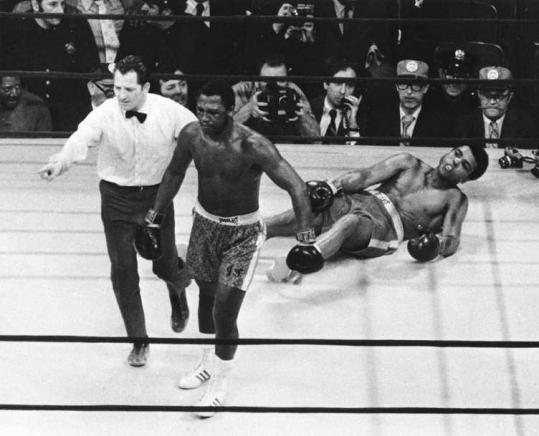
Although it debuted last year, I just this week happened to catch the HBO documentary “Thriller in Manila.” As fate would have it, I was staying in the town in which the documentary’s antagonist, Muhammad Ali, was born and raised—Louisville, Kentucky.
You read that right, “antagonist.” Stunningly, John Dower’s documentary shows the Ali of his glory years for the cruel, racist, hypocritical, mind-numbed Nation of Islam (NOI) zombie that he was.
It did not surprise me to learn, however, that “Thriller in Manila” is a British production. It is hard to imagine an American director making such a film.
The protagonist in Dower’s film, rightfully so, is the beleaguered Joe Frazier, a sharecropper’s son from South Carolina whom Ali successfully taught liberal America, including black America, to despise.
A few years back, I had written a book on the Ali myth called “Sucker Punch.” Although ESPN did an hour-long show on the book and the New York Times, shockingly, gave it a favorable review, the rest of the media predictably ignored it and continued to lionize Ali.
Dower’s film may have sobered the media up. Seeing Ali’s vicious, gratuitous racist jibes stings more than reading about them.
Dower does not pull his punches. He shows, for instance, Ali speaking to the Ku Klux Klan about the horrors of interracial marriage and then publicly humiliating his Black Muslim wife by showing up in Manila with his exquisitely light-skinned, multiracial girl friend.
What Dower does not do, although he hints at the answer, is to explain exactly how Ali became an American institution—the torchbearer at the 1996 Atlanta Olympics, for instance—despite his consistently reprehensible behavior.
The answer is pretty obvious. When the NOI coerced Ali into dodging the draft in the late 1960s, he gave the emerging, anti-war left a symbol that was something other than white and weak-kneed. As these people began to take over the media in the 1970s, they did so with Ali perched triumphantly on their shoulders.
On the ESPN special, I explained this theory to the audience, and Ali’s best biographer, Thomas Hauser, himself an anti-war liberal of that era, agreed that it was true.
This is not to say that Ali is an evil person. It is just that the American left continues to honor him for his evil period. When Ali came back to his instinctively patriotic senses, the media pretended not to notice.
Ali traces his hour of enlightenment to “around 1983.” Before this moment, he confesses to Hauser, “I thought I was a true believer, but I wasn’t. I fit my religion to do what I wanted. I did things that were wrong, and chased women all the time.”
A year later, in 1984, Ali showed his new found maturity by publicly supporting Ronald Reagan and even attending the Republican National Convention.
Hauser is very nearly alone in even broaching the subject of Ali’s Republican affiliations, and he does so with unintentionally comic effect, to wit, “Then another problem arose.”
Hauser admits that Ali supported both Reagan and later the senior George Bush, as well as a number of other Republican candidates, most notably Utah Senator Orrin Hatch.
This turn of events “saddened” at least several of those that Hauser interviews. Andrew Young, UN Ambassador under Jimmy Carter, “bemoaned” Ali’s support for candidates “whose policies are harmful to the great majority of Americans, black and white.” Said Democrat activist Julian Bond at the time, “I don’t know why he’s doing it.”
To say the least, Ali has not been a terribly dependable Republican voice. Outside the ring, his only area of true authority, Ali had long been vulnerable to the whims of those he trusted.
Still, if no more clear-headed than ever, the Ali who emerged in the summer of 1984 was at least more true to himself than the earlier incarnations.
"I was a zombie then – like all Muslims," Malcolm X told biographer Alex Haley about his 12 years in the Nation of Islam. "I was hypnotized, pointed in a certain direction and told to march."
If our leftist friends celebrate Malcolm’s emergence from zombiehood, they still insist on celebrating Ali’s zombie years. Let us hope the Dower documentary wakes them up.
Once awakened, they might tell the civic leaders of Louisville that “Muhammad Ali Boulevard” makes visitors like myself doubt their good sense, if not their sanity.
7/04/2010
2/06/2010
The Next Reagan
Via-Jer

One of the great political transformations in American history is seldom mentioned, its importance barely analyzed in popular culture some reading this may not even be aware of it. In less than a twenty-year span Ronald Reagan went from being a staunch Franklin Roosevelt Democrat to a Barry Goldwater Republican. Reagan went from a supporter of the icon of modern liberalism to the keynote speaker at the convention for the political father of modern conservatism.
It is not my intention to explain what caused this transformation only to point out that it happens and really is not all that rare. I would guess that many of my generation, who in their youth, were vehement anti war, stick it to the man liberals are now staunch conservatives. People change as they grow older more informed and forgive me for saying it- wiser. Only closed-minded ideologues hold onto ideas that have been proven by practical observation to have failed. Much of what FDR instituted into American society along with his ideological offspring has been shown to be utter folly.
Even popular programs such as Social Security, Medicare and Medicaid are dragging our once prosperous country to financial Armageddon. Just because something is popular does not mean that it is the right thing to do less alone sustainable. If you want to be popular parent buy your child every toy, every gadget your child desires, you will be popular, you will also be the broke parent of a spoiled child who does not know how to take care of himself.
Ronald Reagan came onto the American scene not with new ideas, FDR had new ideas, LBJ had new ideas, but with old ideas. The problem is that when you say that the old ideas are the ones that work ideologues immediately try to tie old ideas with historical injustices to discredit them. If you say that the founding fathers really did create a system of government that was not only the best, it was the fairest for all people, ideologues will try to discredit it by pointing to the fact that many of the founding fathers were slave holders so they are hypocritical. Besides separating the founders from historical context dragging them into twentieth century norms when they lived in the eighteenth century, it does not really address the magnificence of their accomplishment. It is like saying that a mother cannot be a great mother because she is not beautiful. Ronald Reagan reminded us that we are the offspring of a great mother-Liberty.
When Reagan made his famous quote “Government is not a solution to our problem, government is the problem." He was not speaking from an ideological standpoint, but as one who had watched the failure of the application of an ideology he had once embraced. His convictions were based not upon theory but rather upon the only true test there is, observed practical application. As I said and firmly believe the difference between ideologues and wisdom is no more than an open minded view and acceptance of reality as opposed to a closed minded belief in a theory.
In a nutshell what Reagan taught a generation of Americans was that individual liberty works, government-controlled societies don’t. It is not like this has not been proven over and over again throughout history especially in the twentieth century. It is not like we have not observed that government is like the camel’s nose let into the tent, once in you will soon find yourself sleeping in the cold.
Despite all the leftist propaganda to the contrary, Ronald Reagan was the champion of the people and the people who lived through it with an open mind, knew it. Only the ideologues missed the reality as they always do being so wrapped up in their theories of the way they think it should be rather than the way it really is.
So who is the next Reagan? We are, those of us who were blessed to have our eyes opened by the greatest president of the twentieth century. A man so wise that he could see that he was going down the wrong path and instead of arrogantly following that path to destruction, he found the old path and led millions towards freedom.
Happy Birthday Ronald Reagan we are you.

More...
One of the great political transformations in American history is seldom mentioned, its importance barely analyzed in popular culture some reading this may not even be aware of it. In less than a twenty-year span Ronald Reagan went from being a staunch Franklin Roosevelt Democrat to a Barry Goldwater Republican. Reagan went from a supporter of the icon of modern liberalism to the keynote speaker at the convention for the political father of modern conservatism.
It is not my intention to explain what caused this transformation only to point out that it happens and really is not all that rare. I would guess that many of my generation, who in their youth, were vehement anti war, stick it to the man liberals are now staunch conservatives. People change as they grow older more informed and forgive me for saying it- wiser. Only closed-minded ideologues hold onto ideas that have been proven by practical observation to have failed. Much of what FDR instituted into American society along with his ideological offspring has been shown to be utter folly.
Even popular programs such as Social Security, Medicare and Medicaid are dragging our once prosperous country to financial Armageddon. Just because something is popular does not mean that it is the right thing to do less alone sustainable. If you want to be popular parent buy your child every toy, every gadget your child desires, you will be popular, you will also be the broke parent of a spoiled child who does not know how to take care of himself.
Ronald Reagan came onto the American scene not with new ideas, FDR had new ideas, LBJ had new ideas, but with old ideas. The problem is that when you say that the old ideas are the ones that work ideologues immediately try to tie old ideas with historical injustices to discredit them. If you say that the founding fathers really did create a system of government that was not only the best, it was the fairest for all people, ideologues will try to discredit it by pointing to the fact that many of the founding fathers were slave holders so they are hypocritical. Besides separating the founders from historical context dragging them into twentieth century norms when they lived in the eighteenth century, it does not really address the magnificence of their accomplishment. It is like saying that a mother cannot be a great mother because she is not beautiful. Ronald Reagan reminded us that we are the offspring of a great mother-Liberty.
When Reagan made his famous quote “Government is not a solution to our problem, government is the problem." He was not speaking from an ideological standpoint, but as one who had watched the failure of the application of an ideology he had once embraced. His convictions were based not upon theory but rather upon the only true test there is, observed practical application. As I said and firmly believe the difference between ideologues and wisdom is no more than an open minded view and acceptance of reality as opposed to a closed minded belief in a theory.
In a nutshell what Reagan taught a generation of Americans was that individual liberty works, government-controlled societies don’t. It is not like this has not been proven over and over again throughout history especially in the twentieth century. It is not like we have not observed that government is like the camel’s nose let into the tent, once in you will soon find yourself sleeping in the cold.
Despite all the leftist propaganda to the contrary, Ronald Reagan was the champion of the people and the people who lived through it with an open mind, knew it. Only the ideologues missed the reality as they always do being so wrapped up in their theories of the way they think it should be rather than the way it really is.
So who is the next Reagan? We are, those of us who were blessed to have our eyes opened by the greatest president of the twentieth century. A man so wise that he could see that he was going down the wrong path and instead of arrogantly following that path to destruction, he found the old path and led millions towards freedom.
Happy Birthday Ronald Reagan we are you.
More...
Subscribe to:
Posts (Atom)