Tip Jar

Showing posts with label census. Show all posts

3/27/2011

The eyes of Texas are sparkling in the 2010 census

Via-Washington Examiner

Michael Barone

The Census Bureau last week released county and city populations for the last of the 50 states from the 2010 census last week, ahead of schedule. Behind the columns of numbers are many vivid stories of how our nation has been changing -- and some lessons for public policy as well.

Geographically, our population is moving to the south and west, to the point that the center of the nation's population has moved to Texas County, Missouri.

That sounds like the familiar story of people moving from the Snow Belt to the Sun Belt, but that's not exactly what's happening. Instead, the fastest growth rates in the 2000-to-2010 decade have been in Texas, the Rocky Mountain states and the South Atlantic states.

We're familiar with the phenomenon of people moving to the West Coast. But the three Pacific Coast states -- California, Oregon and Washington -- grew by 11 percent in the last decade, just 1 percent above the national average, while the South Atlantic states from Virginia through the Carolinas and Georgia to Florida grew by 17 percent.

In 2000 the South Atlantic states had 121,000 more people than the Pacific Coast states. In 2010 they had 2.8 million more.

What's been happening is that people from the Northeast and the Midwest have been flocking to the South Atlantic states, not to retirement communities but to Tampa and Jacksonville, Atlanta and Charlotte and Raleigh, which are among the nation's fastest-growing metro areas. The South Atlantic has been attracting smaller numbers of immigrants as well.

Coastal California, in contrast, has had a vast inflow of immigrants and a similarly vast outflow of Americans. High housing costs, exacerbated by no-growth policies and environmental restrictions, have made modest homes unaffordable to middle-class families who don't want to live in Spanish-speaking neighborhoods or commute 50 miles to work.

California for the first time in its history grew only microscopically faster than the nation as a whole (10.0 percent to 9.7 percent). Metro Los Angeles and San Francisco increasingly resemble Mexico City and Sao Paulo, with a large affluent upper class, a vast proletariat and a huge income gap in between.

Public policy plays an important role here -- one that's especially relevant as state governments seek to cut spending and reduce the power of the public employee unions that seek to raise spending and prevent accountability.

The lesson is that high taxes and strong public employee unions tend to stifle growth and produce a two-tier society like coastal California's.

The eight states with no state income tax grew 18 percent in the last decade. The other states (including the District of Columbia) grew just 8 percent.

The 22 states with right-to-work laws grew 15 percent in the last decade. The other states grew just 6 percent.

The 16 states where collective bargaining with public employees is not required grew 15 percent in the last decade. The other states grew 7 percent.

Now some people say that low population growth is desirable. The argument goes that it reduces environmental damage and prevents the visual blight of sprawl.

But states and nations with slow growth end up with aging populations and not enough people of working age to generate an economy capable of supporting them in the style to which they've grown accustomed.

Slow growth is nice if you've got a good-size trust fund and some nice acreage in a place like Aspen. But it reduces opportunity for those who don't start off with such advantages to move upward on the economic ladder.

The most rapid growth between 2000 and 2010, 21 percent, was in the Rocky Mountain states and in Texas. The Rocky Mountain states tend to have low taxes, weak unions and light regulation. Texas has no state income tax, no public employee union bargaining and light regulation.

Texas' economy has diversified far beyond petroleum, with booming high-tech centers, major corporate headquarters and thriving small businesses. It has attracted hundreds of thousands of Americans and immigrants, high-skill as well as low-skill. Its wide-open spaces made for low housing costs, which protected it against the housing bubble and bust that has slowed growth in Phoenix and Las Vegas.

The states, said Justice Louis Brandeis, are laboratories of reform. The 2010 census tells us whose experiment worked best. It's the state with the same name as the county that's the center of the nation's population: Texas.

3/25/2011

The Battle Moves to the States


Via-American Spectator

By Grover Norquist

The pundits who live in cable TV-land tell us to keep our eyes on the looming battle royale in Washington, D.C. In one corner, the 242-member-strong Reagan Republican majority in the House of Representatives, which can pass almost any conservative legislation and defeat any liberal effort. They are assisted by the 47 Republican senators who can (unless the Democrats change the rules) filibuster any truly destructive liberal proposal. And on some issues, Senate Republicans might be able to join forces with any four of 12 vulnerable Democratic senators up for reelection in 2012 to pass legislation through the Senate.

In the other corner stand Obama with his veto and Harry Reid's Democratic majority in the Senate. The Senate Democrats have near-total control over the schedule and the determination of which votes will take place. And the Democrat-friendly establishment media will referee the bout.

Yes, out in America voters support the GOP agenda of repealing Obamacare and reducing both spending and taxes, but within the Beltway the two teams each have veto power over the other. Watching this "Mexican standoff" for the next two years will, to mix metaphors, look like watching well-matched sumo wrestlers push each other around, or two rugby teams contest the same two yards for hours.

There will be no big victories or losses. Obama's plans for ever bigger government cannot pass the House. Republicans' plans to roll back the damage of the last two (or 20) years can be stopped in the Senate and/or vetoed by Obama. So in D.C. the real action will be each party positioning itself for 2012. Republicans are likely to win a net gain of at least four of the 23 Democratic seats contested in 2012, thereby gaining a majority. It is possible they could win 13 seats for a 60-vote filibuster-proof majority. The big prize, therefore, is the presidential veto pen.

The battlefield is quite different in the 50 states. There the 2010 elections yielded examples of unified government, as opposed to the gridlock gripping the U.S. Congress. It is at the state level that legislatures and governors will enact game-changing legislation that could move the country toward or away from European welfare statism.

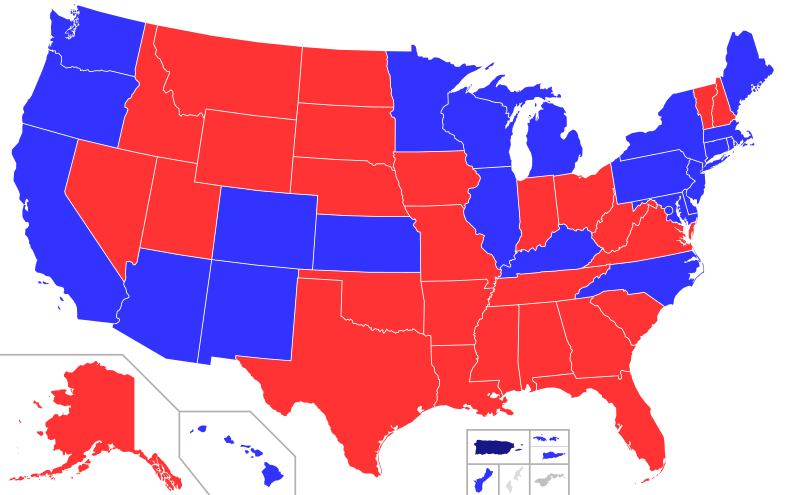
WHEN THE DUST SETTLED from the 2010 elections, in which Republicans gained six governorships and 715 state legislative seats -- including winning control of an additional 21 legislative bodies (taking into account the 25 party switchers from the Democratic side). The GOP now has control of the governor's office and both houses of the legislature in 21 states. The 21 unified Republican states are: Alabama, Arizona, Florida, Georgia, Idaho, Indiana, Kansas, Maine, Michigan, Nebraska, North Dakota, Ohio, Oklahoma, Pennsylvania, Tennessee, Texas, South Carolina, South Dakota, Utah, Wisconsin, and Wyoming. Republicans also possess majorities in both houses of the state legislature, but lack the governorship, in Minnesota, Missouri, Montana, New Hampshire, and North Carolina.

Democrats have complete, unfettered control and the opportunity to create little Greeces in just 11 states: Arkansas, California, Connecticut, Delaware, Hawaii, Maryland, Illinois, Massachusetts, Vermont, Washington, and West Virginia.

There is a legislative stalemate in D.C.: liberal senators from California can vote to stop conservative senators from Texas from reducing taxes, reforming entitlements, liberalizing labor law, and dismantling regulatory schemes. But at the state level, majorities can have significant effects. Illinois is a good example: the unchallenged Democratic majority there had no one to stop it from raising the personal income tax by 67 percent as its first official act.

In states with GOP majorities in both legislatures, governors are consciously channeling New Jersey's Chris Christi -- although Christie, working with a Democratic-controlled assembly and senate, does his high wire act without a net. The governors of Florida, Ohio, Pennsylvania, and Texas have taken the Taxpayer Protection Pledge to oppose any tax increase. What that pledge means in effect is a requirement to reduce future spending by $5 billion in Pennsylvania, $8 billion in Ohio, and $3.6 billion in Florida. Spending will have to be cut by more than $20 billion in Texas, according to its comptroller's office.

Such large reductions in the growth of spending fall heavily on the key constituents of the modern Democratic Party, namely public sector unions, big city political machines, and the grant recipients who use taxpayer dollars for "community organizing." And the promise for tort reform, which would never escape a Democrat's veto, threatens the power and financial clout of trial lawyers, another key Democratic bloc.

Labor laws written to force millions of Americans to pay union dues to labor union bosses are another obstacle that Republican governors and legislatures could undo. States like Pennsylvania, Wisconsin, Ohio, Michigan, and Indiana could enact right-to-work laws making union membership voluntary, or "paycheck protection" laws that stop unions from taking your union dues and spending them on politics without your express consent.

PERHAPS THE MOST IMPORTANT TASK for state-level Republicans will be redistricting. Redistricting for the 2012 election will work to maintain the unified party control of the incumbents, in both Republican and Democratic states. The partisan gap between red and blue states will continue to grow over the next 10 years. In turn, many small businessmen, high-skilled workers, and wealthy retirees will move from D to R states. And that dynamic will confirm and reinforce the partisan trends. For example, Illinois may drive away all of its entrepreneurs. Texas would welcome their talent and their resources...and their Republican votes.

In 2012, based on population migration, 10 states will lose congressional seats, and eight states will gain seats. Personal income tax rates are twice as high in the loser states. Government spending is one-third higher in losers, and four states gaining seats levy no personal income tax at all. Republican-controlled states such as Arizona, Georgia, and North Dakota could encourage further immigration of talented, productive, and industrious workers to their own voting rolls by eliminating their income taxes. By the same token, if states like Illinois and California continue their "job creator-cleansing" policies, they will create a more solidly government-employed and welfare-dependent Democratic voting bloc.

The question before America is whether, when this process reaches its natural conclusion, the productive, well-governed, job-creating states have more electoral votes than the mini-Greeces being created in states like Illinois and California. Ultimately, control of the presidency, the Senate, and the House will depend on the answer to that question.

12/23/2010

Census: Fast Growth in States With No Income Tax

Via-Townhall

Michael Barone

For those of us who are demographic buffs, Christmas came four days early when Census Bureau Director Robert Groves announced yesterday the first results of the 2010 Census and the reapportionment of House seats (and therefore electoral votes) among the states.
The resident population of the United States, he told us in a webcast, was 308,745,538. That's an increase of 9.7 percent from the 281,421,906 in the 2000 Census -- the smallest proportional increase than in any decade other than the Depression 1930s but a pretty robust increase for an advanced nation. It's hard to get a grasp on such large numbers. So let me share a few observations on what they mean.

First, the great engine of growth in America is not the Northeast Megalopolis, which was growing faster than average in the mid-20th century, or California, which grew lustily in the succeeding half-century. It is Texas.

Its population grew 21 percent in the last decade, from nearly 21 million to more than 25 million. That was more rapid growth than in any states except for four much smaller ones (Nevada, Arizona, Utah and Idaho).

Texas' diversified economy, business-friendly regulations and low taxes have attracted not only immigrants but substantial inflow from the other 49 states. As a result, the 2010 reapportionment gives Texas four additional House seats. In contrast, California gets no new House seats, for the first time since it was admitted to the Union in 1850.

There's a similar lesson in the fact that Florida gains two seats in the reapportionment and New York loses two.

This leads to a second point, which is that growth tends to be stronger where taxes are lower. Seven of the nine states that do not levy an income tax grew faster than the national average. The other two, South Dakota and New Hampshire, had the fastest growth in their regions, the Midwest and New England.

Altogether, 35 percent of the nation's total population growth occurred in these nine non-taxing states, which accounted for just 19 percent of total population at the beginning of the decade.

My third observation is that immigration is slowing down and may be reversed. Immigration accelerated during the 1990s, and the 2000 Census showed more immigrants than the Census Bureau had estimated.

In contrast, immigration has clearly slowed down since the housing bubble burst and the construction industry went bust in 2007. And the 2010 Census showed fewer residents in several high-immigration states than the Census Bureau had estimated were there in 2009.

The drop was particularly big, 3 percent, in Arizona, where state and local governments have cracked down on illegals, notably by requiring employers to use the E-Verify system to determine immigration status (that law was signed by Janet Napolitano, then-governor and now homeland security secretary).

We can't be sure until more detailed data are reported, but it looks like we're seeing significant reverse migration. The lesson is that states' public policy and law enforcement practices can make a difference.

Finally, let's get to politics. The net effect of the reapportionment was to add six House seats and electoral votes to the states John McCain carried in 2008 and to subtract six House seats and electoral votes from the states Barack Obama carried that year. Similarly, the states carried by George W. Bush in 2004 gained six seats, and the states carried by John Kerry lost six.

That's not an enormous change. But it's part of a long-term trend that has reshaped the nation's politics. If you go back to the 1960 election, when the electoral votes were based on the 1950 Census, you will find that John Kennedy won 303 electoral votes. But the states he carried then will have only 272 electoral votes in 2012, a bare majority. And without Texas, which he narrowly carried, the Kennedy states would have only 234 electoral votes.

The bottom line: You need a lot more than the Northeast and the industrial Midwest to get elected president these days.

And to control a majority in the House of Representatives. Thanks to unexpectedly large gains in state legislatures, Republicans stand to control the redistricting process in 18 states with 204 House districts, while Democrats will control it in only seven states with 49 districts. That doesn't guarantee continued Republican majorities, but it's probably worth 10 to 15 seats.

Meanwhile, I await the post-Christmas treat of more detailed Census results to come.