Via-NRO
Showing posts with label libertarianism. Show all posts
Showing posts with label libertarianism. Show all posts
8/04/2013

4/17/2013
Clinging to Guns—and Abortion
Via-WSJ

By DANIEL HENNINGER
Atop the quotable Barack Obama there will be this: "And it's not surprising then that they get bitter, they cling to guns or religion or antipathy to people who aren't like them."
Everyone clings to something. But when it comes to criticizing unseemly political dependencies, it's almost always liberals accusing them of clinging to positions and ideas that an enlightened society would have abandoned.
But what do liberals cling to? Recent events have revealed two things. Gun control and abortion.
The gun-control cling we know about because rarely a day passes without a news story about the Senate's gun-control legislation. Then there's the Kermit Gosnell abortion trial, which until recently few people knew about because there was little media coverage of it. The rise of the Web notwithstanding, it's still true that unless the mainstream press covers a story, it pretty much doesn't exist.
Kermit Gosnell is a Philadelphia abortion doctor who has been on trial the past five weeks on accusations that he murdered a pregnant woman and a number of fetuses who emerged from the abortion procedure still alive.
By now, many details of the accusations against Dr. Gosnell have become known. One will suffice. The Philadelphia grand-jury report, which is a hard read, says: "The way he ensured fetal demise [Dr. Gosnell's phrase] was by sticking scissors into the back of the baby's neck and cutting the spinal cord. He called that 'snipping.' Over the years, there were hundreds of 'snippings.'" Most were third-trimester babies. Eight of his clinic staff have pleaded guilty.
In these times of a media that need to fill a bottomless electronic news hole, a story as sensational as the Gosnell abortion trial should be everywhere. But as conservative bloggers and a few liberal writers such as Kirsten Powers have established in recent weeks, most major newspapers and TV networks have produced little or cursory coverage of this trial. The two exceptions are the Associated Press and Fox News.
The basic conservative criticism here is that the media have underplayed the Gosnell story because its details might undermine support for the abortion status quo, or at least cause people to ask what exactly that status quo is these days. Rather than risk that, the Gosnell story was demoted.
In response, some have said the conservative bloggers are wrongly seeing a conspiracy of silence where there is only a difference over news judgment. By now, this response is implausible. It is hardly a revelation anymore that the media play the news in subtle but tilted ways to protect what they think is a settled social good, such as access to abortion, no matter what.
Another question raised by the trial of this abortion doctor is the matter of reactionaries clinging to the past.
Mr. Obama's remark about rural Pennsylvanians clinging to guns and religion is the coin of the realm in his crowd. But let's put their shared consensus another way: Somehow it became a conventional view in contemporary American politics that it is non-urban conservatives who in every case have to accommodate their beliefs to a national culture created by people who live somewhere else. "They" must adjust on abortion, guns, school prayer, sexual mores and all the rest of it. Liberals, meanwhile, not only feel no need to concede anything but use the commanding heights of the press and academia to define anyone who dissents from their ever-evolving national culture as a political fringe obsessed with people, one might say, who aren't like them.
The gun-control bill is collapsing in the Senate because its liberal sponsors, led by Barack Obama and California's Dianne Feinstein, lost the support of Democratic senators from states with traditional hunting cultures, such as Mark Pryor of Arkansas, Heidi Heitkamp of North Dakota, Mark Begich of Alaska or Max Baucus of Montana. Why so many people in these states and many others to this day still distrust public authorities on guns is a good, but untold, story. Kentuckians recently voted the right to hunt into their constitution. Instead, gun-control's failure will be spun as a win for mindless Neanderthals "out there."
But what about Kermit Gosnell? This story suggests something Neanderthal-like may have developed around the fringe of abortion practice in the 40 years since Roe v. Wade. But rather than re-examine and even reform those practices, the curtain will be pulled on the Gosnell case. They'll cling to Roe, no matter how unseemly its status quo.
Political correctness—the silent code that decides whose side of the story gets elevated and whose side gets buried—has been a blunt but effective weapon, which the dominant liberal culture has used to achieve a lot of victories over "them" the past 40 years. But the wins have come at a price. That price is the return of an unmistakable, growing and potentially destabilizing bitterness in American politics.
A fairer-minded media would be the best way to level the playing field. Absent that, our politics will be leveled by other means. What the major media think then, if they're still around, won't matter.

By DANIEL HENNINGER
Atop the quotable Barack Obama there will be this: "And it's not surprising then that they get bitter, they cling to guns or religion or antipathy to people who aren't like them."
Everyone clings to something. But when it comes to criticizing unseemly political dependencies, it's almost always liberals accusing them of clinging to positions and ideas that an enlightened society would have abandoned.
But what do liberals cling to? Recent events have revealed two things. Gun control and abortion.
The gun-control cling we know about because rarely a day passes without a news story about the Senate's gun-control legislation. Then there's the Kermit Gosnell abortion trial, which until recently few people knew about because there was little media coverage of it. The rise of the Web notwithstanding, it's still true that unless the mainstream press covers a story, it pretty much doesn't exist.
Kermit Gosnell is a Philadelphia abortion doctor who has been on trial the past five weeks on accusations that he murdered a pregnant woman and a number of fetuses who emerged from the abortion procedure still alive.
By now, many details of the accusations against Dr. Gosnell have become known. One will suffice. The Philadelphia grand-jury report, which is a hard read, says: "The way he ensured fetal demise [Dr. Gosnell's phrase] was by sticking scissors into the back of the baby's neck and cutting the spinal cord. He called that 'snipping.' Over the years, there were hundreds of 'snippings.'" Most were third-trimester babies. Eight of his clinic staff have pleaded guilty.
In these times of a media that need to fill a bottomless electronic news hole, a story as sensational as the Gosnell abortion trial should be everywhere. But as conservative bloggers and a few liberal writers such as Kirsten Powers have established in recent weeks, most major newspapers and TV networks have produced little or cursory coverage of this trial. The two exceptions are the Associated Press and Fox News.
The basic conservative criticism here is that the media have underplayed the Gosnell story because its details might undermine support for the abortion status quo, or at least cause people to ask what exactly that status quo is these days. Rather than risk that, the Gosnell story was demoted.
In response, some have said the conservative bloggers are wrongly seeing a conspiracy of silence where there is only a difference over news judgment. By now, this response is implausible. It is hardly a revelation anymore that the media play the news in subtle but tilted ways to protect what they think is a settled social good, such as access to abortion, no matter what.
Another question raised by the trial of this abortion doctor is the matter of reactionaries clinging to the past.
Mr. Obama's remark about rural Pennsylvanians clinging to guns and religion is the coin of the realm in his crowd. But let's put their shared consensus another way: Somehow it became a conventional view in contemporary American politics that it is non-urban conservatives who in every case have to accommodate their beliefs to a national culture created by people who live somewhere else. "They" must adjust on abortion, guns, school prayer, sexual mores and all the rest of it. Liberals, meanwhile, not only feel no need to concede anything but use the commanding heights of the press and academia to define anyone who dissents from their ever-evolving national culture as a political fringe obsessed with people, one might say, who aren't like them.
The gun-control bill is collapsing in the Senate because its liberal sponsors, led by Barack Obama and California's Dianne Feinstein, lost the support of Democratic senators from states with traditional hunting cultures, such as Mark Pryor of Arkansas, Heidi Heitkamp of North Dakota, Mark Begich of Alaska or Max Baucus of Montana. Why so many people in these states and many others to this day still distrust public authorities on guns is a good, but untold, story. Kentuckians recently voted the right to hunt into their constitution. Instead, gun-control's failure will be spun as a win for mindless Neanderthals "out there."
But what about Kermit Gosnell? This story suggests something Neanderthal-like may have developed around the fringe of abortion practice in the 40 years since Roe v. Wade. But rather than re-examine and even reform those practices, the curtain will be pulled on the Gosnell case. They'll cling to Roe, no matter how unseemly its status quo.
Political correctness—the silent code that decides whose side of the story gets elevated and whose side gets buried—has been a blunt but effective weapon, which the dominant liberal culture has used to achieve a lot of victories over "them" the past 40 years. But the wins have come at a price. That price is the return of an unmistakable, growing and potentially destabilizing bitterness in American politics.
A fairer-minded media would be the best way to level the playing field. Absent that, our politics will be leveled by other means. What the major media think then, if they're still around, won't matter.
1/15/2013
Liberalism Versus Blacks
Via-RCP

By Thomas Sowell
There is no question that liberals do an impressive job of expressing concern for blacks. But do the intentions expressed in their words match the actual consequences of their deeds?
San Francisco is a classic example of a city unexcelled in its liberalism. But the black population of San Francisco today is less than half of what it was back in 1970, even though the city's total population has grown.
Severe restrictions on building housing in San Francisco have driven rents and home prices so high that blacks and other people with low or moderate incomes have been driven out of the city. The same thing has happened in a number of other California communities dominated by liberals.
Liberals try to show their concern for the poor by raising the level of minimum wage laws. Yet they show no interest in hard evidence that minimum wage laws create disastrous levels of unemployment among young blacks in this country, as such laws created high unemployment rates among young people in general in European countries.
The black family survived centuries of slavery and generations of Jim Crow, but it has disintegrated in the wake of the liberals' expansion of the welfare state. Most black children grew up in homes with two parents during all that time but most grow up with only one parent today.
Liberals have pushed affirmative action, supposedly for the benefit of blacks and other minorities. But two recent factual studies show that affirmative action in college admissions has led to black students with every qualification for success being artificially turned into failures by being mismatched with colleges for the sake of racial body count.
The two most recent books that show this with hard facts are "Mismatch" by Richard Sander and Stuart Taylor, Jr., and "Wounds That Will Not Heal" by Russell K. Nieli. My own book "Affirmative Action Around the World" shows the same thing with different evidence.
In all these cases, and many others, liberals take positions that make them look good and feel good -- and show very little interest in the actual consequences for others, even when liberal policies are leaving havoc in their wake.
The current liberal crusade for more so-called "gun control" laws is more of the same. Factual studies over the years, both in the United States and in other countries, repeatedly show that "gun control" laws do not in fact reduce crimes committed with guns.
Cities with some of the tightest gun control laws in the nation have murder rates far above the national average. In the middle of the 20th century, New York had far more restrictive gun control laws than London, but London had far less gun crime. Yet gun crimes in London skyrocketed after severe gun control laws were imposed over the next several decades.
Although gun control is not usually considered a racial issue, a wholly disproportionate number of Americans killed by guns are black. But here, as elsewhere, liberals' devotion to their ideology greatly exceeds their concern about what actually happens to flesh and blood human beings as a result of their ideology.
One of the most polarizing and counterproductive liberal crusades of the 20th century has been the decades-long busing crusade to send black children to predominantly white schools. The idea behind this goes back to the pronouncement by Chief Justice Earl Warren that "separate educational facilities are inherently unequal."
Yet within walking distance of the Supreme Court where this pronouncement was made was an all-black high school that had scored higher than two-thirds of the city's white high schools taking the same test -- way back in 1899! But who cares about facts, when you are on a liberal crusade that makes you feel morally superior?
To challenge government-imposed racial segregation and discrimination is one thing. But to claim that blacks get a better education if they sit next to whites in school is something very different. And it is something that goes counter to the facts.
Many liberal ideas about race sound plausible, and it is understandable that these ideas might have been attractive 50 years ago. What is not understandable is how so many liberals can blindly ignore 50 years of evidence to the contrary since then.
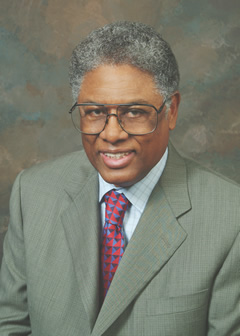
By Thomas Sowell
There is no question that liberals do an impressive job of expressing concern for blacks. But do the intentions expressed in their words match the actual consequences of their deeds?
San Francisco is a classic example of a city unexcelled in its liberalism. But the black population of San Francisco today is less than half of what it was back in 1970, even though the city's total population has grown.
Severe restrictions on building housing in San Francisco have driven rents and home prices so high that blacks and other people with low or moderate incomes have been driven out of the city. The same thing has happened in a number of other California communities dominated by liberals.
Liberals try to show their concern for the poor by raising the level of minimum wage laws. Yet they show no interest in hard evidence that minimum wage laws create disastrous levels of unemployment among young blacks in this country, as such laws created high unemployment rates among young people in general in European countries.
The black family survived centuries of slavery and generations of Jim Crow, but it has disintegrated in the wake of the liberals' expansion of the welfare state. Most black children grew up in homes with two parents during all that time but most grow up with only one parent today.
Liberals have pushed affirmative action, supposedly for the benefit of blacks and other minorities. But two recent factual studies show that affirmative action in college admissions has led to black students with every qualification for success being artificially turned into failures by being mismatched with colleges for the sake of racial body count.
The two most recent books that show this with hard facts are "Mismatch" by Richard Sander and Stuart Taylor, Jr., and "Wounds That Will Not Heal" by Russell K. Nieli. My own book "Affirmative Action Around the World" shows the same thing with different evidence.
In all these cases, and many others, liberals take positions that make them look good and feel good -- and show very little interest in the actual consequences for others, even when liberal policies are leaving havoc in their wake.
The current liberal crusade for more so-called "gun control" laws is more of the same. Factual studies over the years, both in the United States and in other countries, repeatedly show that "gun control" laws do not in fact reduce crimes committed with guns.
Cities with some of the tightest gun control laws in the nation have murder rates far above the national average. In the middle of the 20th century, New York had far more restrictive gun control laws than London, but London had far less gun crime. Yet gun crimes in London skyrocketed after severe gun control laws were imposed over the next several decades.
Although gun control is not usually considered a racial issue, a wholly disproportionate number of Americans killed by guns are black. But here, as elsewhere, liberals' devotion to their ideology greatly exceeds their concern about what actually happens to flesh and blood human beings as a result of their ideology.
One of the most polarizing and counterproductive liberal crusades of the 20th century has been the decades-long busing crusade to send black children to predominantly white schools. The idea behind this goes back to the pronouncement by Chief Justice Earl Warren that "separate educational facilities are inherently unequal."
Yet within walking distance of the Supreme Court where this pronouncement was made was an all-black high school that had scored higher than two-thirds of the city's white high schools taking the same test -- way back in 1899! But who cares about facts, when you are on a liberal crusade that makes you feel morally superior?
To challenge government-imposed racial segregation and discrimination is one thing. But to claim that blacks get a better education if they sit next to whites in school is something very different. And it is something that goes counter to the facts.
Many liberal ideas about race sound plausible, and it is understandable that these ideas might have been attractive 50 years ago. What is not understandable is how so many liberals can blindly ignore 50 years of evidence to the contrary since then.
3/23/2012
The coming Libertarian revolution? Part One

The other night Sue (my wife) and I were watching the news which at the time was dominated by the riots caused by the Koran "burning" in Afghanistan.
Sue turned to me and said something that I had been thinking for some time "So why are we not supposed to support Ron Paul?"
A good question, who any longer wants our troops in Afghanistan? According to polls not too many of us do and in this. like much else, we are coming to embrace Ron Paul's view (sort of) on the "conflict."
However the answer to the question, "why are we not supposed to support Ron Paul?" , is more nuanced. Simply put when it comes to some of his foreign policy positions Ron Paul is a nut job.
Ron Paul like many people who are obsessed with a certain ideology tend to see things in the extreme. They see the worst of motives in those that oppose them. Rather than believing that his opposition on the right have a differing vision on the solution to problems, he ascribes dark motives to his foes and ignores the very real concerns that they are attempting to address. In this respect he often times employs the tactics of Obama and the left, creating straw men arguments to slay foes who might otherwise give his views fair hearing.
Nowhere has this failure of Paul to confront reality been more pronounced than his unwillingness to face up to the threat to our national security posed by radical Islamist. He ascribes all blame to US foreign policy while ignoring the theological underpinning of the problem which will result in a continuance of the conflict irregardless of our policies. As the 9-11 Commission so aptly observed they are at war with us even if we are not at war with them. This state of "war" has little to do with our foreign policy, rather it is driven by a religious belief that the west, primarily the United States, are infidels and the enemy and must either be subjugated or destroyed.
Paul simply ignores this truth and ascribes all fault to the United States' "imperialism" which in itself is a demonstrably false narrative more in tune with far left anti American liberalism than Constitutional conservatism.
The shame of this is that much of what Paul advocates as a solution to our foreign policy ills are not only arguably acceptable policy prescriptions, but also gaining in acceptance, Furthermore there is an entire wing of the Republican Party and a huge segment of Independents who though not entirely in line with Paul's foreign policy prescriptions are at least receptive to them.
An example of this policy melding, if you will, would be Rick Perry's suggestion while he was a candidate that foreign aid needs to be zeroed out and allocated based on other nation's support for our national interest and policies. Paul's position is that there should be no foreign aid at all, a position which has not only constitutional backing but makes some practical and certainly fiscal sense as well.
Perry's position could be seen as a stepping stone from our current insane foreign aid policies moving towards Paul's position, or it could be seen as a compromise between the two. A compromise if you will between the neo-cons and the libertarians.
There in lies the seeds of the failure of Paulian libertaranism, the inability to compromise even when in doing so it leads to an incremental move towards your ultimate goal. This incremental strategy is what has allowed the left and the progressives to move the nation so far away from the libertarian nation that Paul and his followers claim to want to return to. Yet they seem unwilling to reverse this march with anything less than total capitulation of not only their ideological foes but those who are ideologically oriented and inclined to support them.
When it comes to domestic policy, on nearly every ideological front, on nearly every policy issue Paul and his libertarian followers are leading the way. More and more conservatives and independents are "seeing the light" and moving towards their views. Whether it be monetary policy, the Tenth Amendment, or the downsizing of government, nearly everyone in the grass roots right agrees with the Libertarians. Even on many of the social issues such as gay marriage and drug legalization most on the right are willing to allow these type issues to be decided by the states as long as the Federal Government stays out of them. Which is the Constitutional argument.
On so many issues libertarians and grass roots (the majority) of conservatives not only have common ground they are walking the same path. The only thing that stands in the way of a true partnership is in fact Ron Paul himself.
Ron Paul's extreme views on American foreign policy as stated above not only turn off many who would be willing to come to his side, but worse they draw into his following a segment of political thought which is antithetical to most of the rest of Paul's agenda. This following is closer to the OWS Movement than the Tea Party Movement and despite attempts to find common ground between these two movements by some they are worlds apart and can not and will not be merged. About the only real thing the two movements have in common is their opposition to TARP, but the motivation for that opposition is diametrical opposed to one another.
Paul's failure to address this, but rather, in some ways to endorse the OWS views is another reason for his inability to gain traction on the right where his ideological constituency of Constitutional conservatives should be.
It would seem that the libertarian movement, given Paul's failure to create a natural coalition due to his intransigence on key issues, would doom it to return to the fringe of political thought and power in the United States. Although this is possible , it is not likely for several reasons, not least of these being that the GOP establishment is not only not giving the grass roots constitutional conservatives a reason to support the Republicans, they seem to be marginalizing this dynamic and core constituency of the party. Indeed the Republican establishment seems intent on driving this foundational segment of their party away.
More on this in part two.
11/28/2010
The TSA and the box people

Nick Sorrentino
Probably the reason why I am a libertarian, deep down, is that I hate bullies. I despise people who feel they must inflict their particular brand of crap on those who are minding their own business. I loathe arbitrary rules. I loathe those who revel in such arbitrary rules even more. If I am not messing with you, don’t mess with me. Why do so many people have a problem with this concept? Why must some people have other people bend to their will? What is this deep need by a large portion of the population?
I am convinced that the main reason for this is that there are some people who just cannot stand being out of control. They know that if they are not in control, some unforeseen incident might throw them back on their heels and diminish their day, the balance in their bank account, or their place in society. Some people would rather live in a box, where at least everything is controlled, where no sun shines, than be subject to the winds of insecurity.
Because those who prefer the comfort of the box are often the people who make the rules, the rest of us are compelled to live their way. This, even though some of us consider a life in a box a fate on par with death, when we will have plenty of time to become acquainted with the peace and quiet of a box.
This is why many people have no problem with the TSA looking at them naked or even feeling them up. They are so damn scared that the plane will explode that many people just say, “Screw it, I have little dignity left anyway, I’m already prostrate to the bank, so what if the government wants to touch my genitals or those of my child. At least I can rest assured that my plane to Columbus won’t blow up midair.”
Of course the plane has as good a chance of crashing as it ever did, which is a much greater chance than it ever had of being blown up by a terrorist. But people want to feel like they have control, or the government has control, or somebody has control, so they comply. We bend over for “peace of mind,” despite how absurdly irrational this perceived peace is.
I know I am in the minority on this, but I am willing to take the chance that a terrorist is going to blow up a plane if it means I get to board the plane without some government worker looking at my admittedly Adonis like body, or feeling my “area,” or frankly without having to take my shoes off.
What is the damn point of living in “The Home of the Free” if we are being accosted by our own government every time we want to get on a plane?
It is true that there is no “right to fly” in the Constitution. But there is a provision against unreasonable searches and seizures. The problem is what is “reasonable” has been defined for too long by those who sneer when they hear the words, “Live Free or Die.” It has been defined by the box people.
Nick Sorrentino is the Editor of the Liberty and Economics Review, and the CEO of Exelorix.com a social media management company.
7/29/2010
The Unhealthy Motivations of Liberals

By Curtis Frantz
In general, low self-esteem and a lack of self-love are the basis for the ideology of liberals.
Liberals are those who would use government to reduce the freedoms of some people to provide benefits for others. Liberals argue for fairness and equality for all people, but neither is possible. Other than identical twins all people are genetically different and without exception each has unique life experiences that are interpreted differently. We are necessarily and naturally unequal in a worldly sense. (If "all men are created equal" in a Godly sense nothing more needs to be done to ensure it.) Liberals, progressives, socialists, fascists, communists, and statists seek similar means to the same end. They want control of an expansive, intrusive government using taxation, regulation, and takeover of private property and businesses to achieve an earthly equality. An equality that is unnatural, unhealthy, and unattainable. This irrational political ideology is rooted in psychological shortcomings.
The U.S. Constitution correctly identifies the purpose of government as protecting the freedoms of its people. Being free is the natural state of all life forms. Soldiers risk their lives and die fighting for freedom...not equality. The Statue of Liberty welcomes those "yearning to breathe free."
Having an internalized sense of being less than others drives a desire for equality. The liberal's internal motivation is: "if we are all the same, I can't be less." From a practical perspective, making people or situations equal involves punishing the successful; which can be a welcome expression of jealous anger for those with low self-esteem.
Having low self-esteem makes freedom something to fear. Freedom means being free to succeed or fail. For those with a low sense of self, the expectation is that one's failure is inevitable. Freedom is not desirable under those conditions.
Liberals' personal problems become a societal problem when liberals try to address them by requiring changes to the lives of others. They seek a government with extensive power and reach that can limit freedoms and penalize success so that we seem to be more equal. It's as if I were to address a problem of poor posture by requiring everyone else to slouch. The adequacy of self-love or self-esteem one has is not determined by comparison to others. It is not measured by net worth which government can adjust. Whether one has healthy levels of self-love and self-esteem is determined by personal physiology and psychology. No matter how much government can disrupt the lives of its citizens, it cannot make anyone love or esteem themselves more or make anyone happy.
What liberals really need -- greater self-esteem and self-love -- government is completely powerless to provide.
Given their motivations, statements and actions of liberal politicians and their supporters can be understood through awareness of the common characteristics of those with a low sense of self.
Low Sense of Self Characteristics
Feelings About Self
•Has a general sense of unhappiness, depression, unease, malaise
•Feels a victim, largely powerless
•Fears looking foolish and is unable to laugh at self
•Afraid of forming own opinion and having it challenged
•Takes disagreements as personal affronts, seeks revenge
•Prone to rapid and sudden anger or sadness
•Seeks to suppress "bad" emotions; afraid they may become all consuming
Thoughts About Self
•Tends towards negative attitude and pessimism
•Lacks confidence in self
•Rigid
•Blind to unpleasant realities, delusional
•Over dependence on people or things
•Inability to accept criticism
Presenting Self To Others
•Secretive
•Exaggerates, pretends, and lies to conceal their insecurity
•Arrogant and boastful (intended to appear as self-confident) or extremely shy (to avoid inspection)
•Cool, detached, aloof (intended to appear as "in control")
•Uses language for its emotive value to persuade others
•Seeks first for others to connect with them emotionally
•Denies mistakes and blames others when things for which they are responsible go badly
•Takes credit for others' achievements
•Irrational (psychology trumps philosophy)
•Breaks agreements, violates professed standards, hypocritical
•Performs poorly in pressure situations
Perception of Others
•Projects their own inadequacies and motives onto others
•Sees others as impotent victims
•Jealous and envious of others, especially those perceived as having a high sense of self
•Fear of or hostility towards others, blaming others for their own inner state
Relationships with Others
•Drawn to others with a low sense of self
•Has difficulty loving others
•Seeks control and power over others
•Outwardly aggressive or passively aggressive
•Discards people when they become a personal liability
Efforts at Self-Improvement
•Does not seek self-improvement as it requires acknowledging one is currently lacking
•Lacks self-discipline
•Closed minded, unwilling to accept new ideas
•Tends to have addictions-they serve as personal distractions.
Our sense of self-value is rooted in our childhood nurtured by the love and affirmation we received from our parental figures. Consider the nation's leading liberal, President Barack Obama, and how he embodies nearly all the characteristics of a person with a low sense of self. Barack Obama's teenage mom became pregnant out of wedlock, had two failed marriages, and apparently was a socialist. His dad was -- or became -- an alcoholic, physically abusive, polygamist and communist. The likelihood of such needy and damaged people being healthy, nurturing parents is nil.
Obama's childhood included an early abandonment by his father, abandonment by his step father, abandonment by his mother, frequent moves so he could not develop long-term childhood friendships, being teased by peers for being neither black nor white, for having big ears and for being skinny, and he had an elderly childhood mentor (Frank Marshall Davis) who was a communist and pedophile. (A poem written by 19 year old Barack Obama suggests he may have been violated by Davis). Obama predictably turned to illegal drugs (marijuana and cocaine) in his youth and remains addicted to nicotine. With this background, he could not escape being seriously psychologically damaged. From his behaviors and relationships, it is clear he has not successfully addressed his inner deprivations.
The liberals' emotional neediness leads them to identify and experience a bonding with others who also have low self-esteem and low self-love. Collectively they long for a greater sense of self and strive to attain it by achieving equality among people using the power of an ever-growing government and irrational arguments (for equality and against freedom) that they find emotionally compelling.
7/03/2010
The Spirit of Independence: The Social Psychology of Freedom

Intellectuals routinely give undue weight to people’s ideas. They tend to believe that ideas cause attitudes, though it is far more often the other way around. Consider the natural libertarians
By Lee Harris
Several years ago, while attending a street festival in the small town of Tucker, Georgia, I came across a booth sponsored by the local libertarian society. At the time, I did not realize that my encounter would generate my next book. I only remember being struck by the question asked of everyone who visited the booth that day: “So who owns you?”
Like any good carnival barker, the young libertarian who asked this knew from experience that it was an effective opener. It catches you off-guard. It forces you to stop and think. The correct answer, as I soon discovered, was that we own ourselves. We are not owned by the state, the church, or even by God. We are our own property, to dispose of as we wish, in any way we want. We can throw ourselves off a cliff. We can move to Nepal. We can stand at street corners and beg. It is all up to us, because we all own ourselves.
The “correct” answer did not sit well with me. I told the young libertarian that, as a human being, I was not the kind of thing that anyone could own, including myself. Tables and chairs could be owned. Chevrolets and BMWs could be owned. But not human beings. After all, if I owned myself, then I had the right to sell myself, the right to deprive myself of my rights. But if liberty was my inalienable right, as the great libertarian Thomas Jefferson had asserted in the Declaration of Independence, then how could I alienate it by selling myself into slavery?
Perhaps my objection was overly subtle, because I noticed that my reservations did not bother anyone else who wandered into the libertarian booth that day. To most of them, the question “So who owns you?” seemed to come with the force of a revelation, and they responded with a decided and often emphatic, “Nobody owns me.” Which is to say, someone may own other people, but certainly does not own me.
In retrospect, their answers were more profound than mine. My answer came from the head; theirs from the heart. Many of those who responded from the heart probably knew very little about the philosophy behind libertarianism. Perhaps some had read John Locke or John Stuart Mill back in college, but most of them might best be considered natural libertarians. They knew they couldn’t stand the idea of someone else owning them, someone else telling them what to do or how to think, of someone else bossing them around. They all felt competent to manage their own lives and deeply resented any attempt by other people, including the government, to manage their lives for them. Rightly or wrongly, natural libertarians are firmly convinced that no one else can know their best interests more than they do. They insist on remaining in charge of their own destinies and bristle whenever other people seem intent on taking charge of their lives. Because natural libertarians respect their own independence, they respect the independence of others. They do not aspire to control other people’s lives, but when other people aspire to control theirs, they will resist tooth and nail. The natural libertarian will behave this way not because of an ideology, but because of his or her distinctive attitude towards life.
The High Cost of Not Rebelling
Intellectuals routinely give undue weight to people’s ideas. They tend to believe that ideas cause attitudes, though it is far more often the other way around. The discipline known as social psychology recognizes attitude’s primacy. Furthermore, as its name implies, social psychology focuses on attitudes that groups of individuals share: the group can be small, like an office, or quite large, like an entire culture. The work of two American social psychologists, Julian Rotter and Martin Seligman, offers perhaps the best introduction to unraveling the social psychology of the natural libertarian.
In 1966, American psychologist Julian Rotter published a paper that introduced the concept known as locus of control. Human beings, according to Rotter, could be divided into two basic groups: those who believed their locus of control was within themselves, and those who see themselves as under the control of forces located outside themselves, such as luck, or fate, or other people whose will cannot be resisted. The first group, called internals, believe that they are the masters of their own destiny; they tend to be high-achievers, optimistic about their ability to improve their lot, and to discard bad habits. They believe in willpower and positive thinking. They are determined to control their own lives, for better or worse. Members of the second group are called externals. They look on themselves as victims of circumstances, the playthings of fate. If they go to bed drunk, light up a cigarette, and burn their house down, they explain the disaster as another instance of their bad luck, and not their poor judgment, much less their bad habits. On the other hand, if a drunk driver hits an internal, the internal will scold himself that he should have been more alert at the wheel, he should have seen the drunk coming and swerved in time to avoid him.
Rotter discovered that certain groups tended to be dense with internals, while others tend to display the social psychology of the external. Jews, for example, tend to be internals. Rotter himself came from a family of Jewish immigrants, and was a classic high-achiever who believed that by hard work and study he could improve his lot and rise in the world. He was a classic self-made man. But, then, Rotter’s success story was certainly not unique among Jewish immigrants to America—or indeed, other immigrants to America. Immigrants, after all, demonstrates the belief that they are in charge of their own destiny by electing to leave their homeland, in search of a new home that will permit them to exercise greater control over their own life. On the other hand, experiments have shown that the Japanese are more external than Americans. These cultural differences suggest that locus of control may be passed on as part of a culture’s tradition, both consciously and unconsciously.
In order to encourage a population rich in internals—i.e., natural libertarians—a society needs cultural traditions that emphasize the value of independence and ethical agency. It must teach the young that they are responsible for their own actions, and to never regard themselves as victims of circumstance. Anthropologists who have studied the huge variety of human cultures have encountered quite primitive societies, such as the Nuer of the Sudan, which raise children to be feisty and independent. They are taught from an early age to resist being bullied by others and to fight back at the first attempt at dominating them. But wherever it may be found, at the heart of the tradition of independence lives a set of imperatives. Be self-reliant. Don’t take other people’s word for something; think for yourself. Never become anyone’s follower. Bow down before no one. Stand up for your rights. Don’t let bullies intimidate you. Don’t permit yourself to become the slave of an addiction and thereby forfeit your all-important self-control. And do whatever you can to make sure that other members of your community uphold and cherish the same tradition of independence.
Of no less importance to the tradition of independence is the seemingly paranoid fear that power will fall into the wrong hands. The great nineteenth-century champion of liberty, Lord Acton, coined the famous maxim: “All power corrupts, and absolute power corrupts absolutely.” This obsessive fear of power is key to understanding why natural libertarians will automatically rebel when some overbearing elite threatens to rob them of their cherished tradition of independence. They rebel because they instinctively understand the high cost of not rebelling.
According to the American psychologist Martin Seligman, the cost of not rebelling is a pathological condition that he called “learned helplessness.” Seligman developed this concept after performing a set of experiments in which he exposed various lab animals, such as dogs, to painful stimuli. Some of the dogs could escape the pain by pressing against a button; other dogs, when they pressed their button, failed to receive any relief from the pain. The dogs with the opportunity of acting to control the painful stimuli suffered no adverse long-term effects. The dogs with no control over the painful stimuli simply gave up trying to control their situation, and afterward suffered from clinical depression. Worse, in other tests, those dogs that had learned that they were helpless in one environment behaved equally helpless in a second environment, even when the second environment was one in which they could have escaped the painful stimulus by jumping over a low barrier into safety. Convinced that nothing they did could change their wretched situation, the dogs simply lay down and cried. They had learned to be helpless.
Trained Helplessness
But Seligman’s conclusion can be put in another way: the dogs had been trained to be helpless. The tradition of independence trains us to struggle against adversity, in the belief that we are ultimately in charge of our own destinies. But a multitude of traditions instill the opposite lesson. These traditions invariably preach the same message: You must submit to the inevitable. You are the victim of fate, so that any resistance is pointless and frequently counterproductive. It is folly to rebel against those with power, since they will inevitably use their superior power to crush you beneath their heels. Resign yourself to what lowly lot has been assigned you. Accept your utter helplessness, for that is the way of wisdom.
Under systems of slavery and servitude, those intended to become human chattel will be raised by a tradition that will encourage learned helplessness. Their young will likely listen to stories like Aesop’s fable of the oak and the reeds—it is better to submit to force majeure than to try to stand up defiantly against it. If you are a reed, bend and survive. If you are an oak, refuse to bow and be broken. Yet, miraculously, there have always been some shining examples of men and women who, despite their servile status, have broken free of mental servitude.
In nineteenth-century America, Frederick Douglass escaped from slavery, and was determined to not only to remain free from chains, but to achieve the genuine independence that can only come from self-reliance and self-mastery. He succeeded, and instead of moaning that he was the victim of an unjust social system, Douglass set out, with immense courage and strength of will, to topple the unjust system under which he had suffered but never surrendered. Similarly, Seligman in his experiment on lab dogs found that not all the dogs reacted to the uncontrollable pain stimulus by learning to be helpless. Roughly one-third of the dogs did not respond this way, and kept attempting to escape the pain by whatever means they could. They continued to rebel against their harsh condition, despite the fact that they could not change it. To an outside observer, their rebellion might seem utterly pointless, yet it kept the irrationally rebellious dogs from a fate much worse than mere physical pain—namely, the fate of the majority of dogs who simply gave up, thereby resigning themselves forever to the misery of their hopeless situation.

The condition of learned helplessness can be induced by pain, but many kinder, gentler ways can achieve the same insidious results. When today’s natural libertarians express their alarm at the inroads of “the nanny state,” they are recognizing this fact. A good nanny’s duty is to protect from harm the children she watches. But it is all too easy for the nanny, despite her best intentions, to overprotect her wards. If they act independently of her wishes, they might hurt themselves. To prevent this, a nanny might require her wards to ask permission before they do anything. Her message is: “Come to nanny first. Let her decide what is best for you.” If the kids obey, they will imperceptibly become dependent on nanny to make decisions for them—indeed, they may become alarmed at the very idea of having to make decisions for themselves. By this point, the children have entered a state of learned helplessness, but one brought about by the most benevolent intentions.
5/27/2010
Subscribe to:
Posts (Atom)