The burden of those who love freedom is to not only to protect liberty but to explain the superiority of it.
7/11/2010
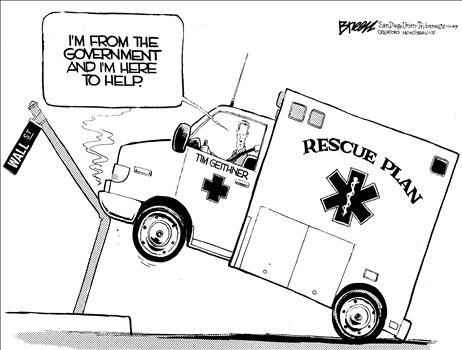
Tim Geithner's excuses for Obama
They can't cover up the president's distaste for private industry
Via-NY POST
Kyle Smith
This week Timothy Geithner got his Tea Party on.
But he forgot to invite the president.
Geithner did everything but put on a Paul Revere costume and wave a “Don’t Tread on Me” flag when he declared, “This president understands deeply that governments don’t create jobs, businesses create jobs. And our job as government is try to make sure we’re creating the conditions that allow businesses to prosper so they can hire people back, get this economy going again.
“We have a recovery led by private demand, private recovery,” he continued. “That is the most important thing we can do right now . . . of course, we recognize that if we’re going to have growth in the future we also need to be — make people confident that we’re going to have the will as a country here in Washington to act to bring those deficits down over time as growth strengthens, recovers.”
Lovely. Geithner also made soothing noises about keeping most of the across-the-board Bush-era tax cuts, the ones Obama spent his campaign denouncing as giveaways to merely “the rich.”
So — just how “deeply” does President Obama understand that “governments don’t create jobs”?
In April, Obama said, (emphasis mine) “Government on its own can’t replace the 8 million jobs that have been lost.” Yet he seemed confident that his stimulus on its own could replace a lot of them, bragging of his “investments in our infrastructure, from interstate highways to broadband networks. That not only creates private sector jobs, but is also creates the platform, a better environment, in which business can prosper.”
Except Obama is to the business environment what BP is to the real one.
Last week, in his radio address, Obama grandly announced that he had handpicked a couple of solar power companies and was lavishing them with nearly $2 billion in loan guarantees. To create jobs.
That money might spur employment. It might also be totally wasted on giddy overconfidence not unlike that which powered the dot-com boom of the late 1990s.
In Spain, home to what BusinessWeek dubbed “the solar power bubble,” the government has spent some $24 billion on solar since 2008. The same leadership is now reversing course, arguing that its massive subsidies — solar plant owners are paid roughly 12 times as much per kilowatt as producers of fossil fuels — must be ratcheted downward “to avoid damaging the competitiveness of industry,” Spain’s industry minister told the Spanish parliament.
Spain has a Socialist government, and it is more worried about how solar subsidies distort the marketplace than Obama is.
The day before his solar announcement, Obama announced $800 million in federal loans and grants, which he said will directly create 5,000 jobs and help spur economic development in some of the nation’s hardest-hit communities.
“Once we emerge from the immediate crisis, the long-term economic gains to communities that have been left behind in the digital age will be immeasurable,” Obama said. Maybe. But if there is long-term economic gain to be had, why don’t private investors jump in?
Every time Obama picks this or that company for government largess, he wounds its competitors, makes investors uncertain, steers industry in a new direction and increases the national debt, which in turn puts upward pressure on two more things businesses don’t like — taxes and inflation.
The president is “trying to micromanage industries,” complained the CEO of Verizon. But the president isn’t “trying.” He’s succeeding.
Geithner has been reduced to “working the phones telling business leaders that Obama doesn’t hate them because the administration is feeling the backlash and realizing that bashing corporate America is undermining the recovery,” a senior executive at a major bank told Charles Gasparino of Fox Business News. “But the damage may already be done.”
Even Obama crony and check-writer Jamie Dimon of JP Morgan has blasted Obamanomics. Gasparino reported that Dimon is angry about the cost of the new health-care entitlement.
“The chief business of the American people is business,” Calvin Coolidge said in 1925. The words are as true today as they were then. But Jeffrey Immelt, the CEO of General Electric, was obliged to provide an unfortunate update. The FT reported that he had said that “Business did not like the US president and the president did not like business.”
5/28/2009
The Indispensable Geithner
Via-American Thinker
Timothy Geithner was portrayed as the indispensable man, but now no matter how much the media continue to flack for him, he's still kissing the floor.
The Treasury Secretary aimed to cure the ills of the financial system by extracting toxic assets from bank balance sheets, replenishing the banks' capital resources, and bolstering the housing market to prevent further foreclosures so normal lending could resume.
Let us take a look at what he has "accomplished" thus far.
First, following a controversial vetting process and uninspiring beginning of his tenure, the Treasury Secretary finally struck fools gold after he utilized remnants of Henry Paulson's plans and created the Public-Private Investment Program to remove banks' toxic assets. The Dow rose, calls for his resignation ceased, and Newsweek immediately declared "Geithner Hits His Stride".
But the plan has been delayed because he hasn't garnered the support he had hoped for from the private entities needed in order to represent the private part of the program.
Second, Geithner has been erratic about exactly how much more capital he has at his disposal to infuse the banks while arguing at the same time they were solvent and fully capitalized.
The Potemkin model stress tests produced "largely encouraging results", but forget the fact that the banks are still undercapitalized and insolvent -- by billions of dollars -- and regulators are closing them at their fastest rate in years.
Did you get that? The banks need a lot more money, but they're doing well, when they're not. Got it?
Third, his plan to help refinance mortgages was -- in his words -- supposed to "show results quickly", but the plan was considered futile two months after its initiation. The mortgage companies have complained that the program is too complicated to set up and homeowners have had difficulty getting in touch with lenders or qualifying for the program. Ultimately, the criteria had to be expanded to include unemployed and upside-down homeowners to strengthen the program, and we're still being urged to "be patient."
So much for those quick results. Geithner further declares that "we're changing the things people couldn't change for decades.
Right, all this "change" yet lending still remains "severely depressed".
Only ignorance towards the failure of the Treasury Secretary to even instill some level of confidence that he can restore the viability of our financial system, would allow us to arrive at Politico's latest conclusion, " Timothy Geithner Gains New Strength".
The media can't detail anything that Geithner has actually done that could refute an assertion of failure up to this point, so they've retreated to style over substance -- the insignificance of his temperament and ideology. The "equanimity under fire" he has displayed would be celebrated if he were a relief pitcher for the Nationals, and his "life is about choices" mantra would suit a Hugh Prather calendar, but who cares?
Let us not forget that 60 Senators looked past a multitude of serious transgressions and confirmed Geithner because he was deemed "uniquely qualified" to handle the challenges of this recession attributable to the nation's deteriorating banking system. Despite the facts to the contrary, we're still subjected to the same nonsense. As a financial services industry spokesman told Politico:
Geithner's real ace in the hole [is] "He's one of a small, select group of people who could even be treasury secretary right now. If not him, who else?"
The initial problem was that we didn't look at all of the options. It was somehow pre-determined that it was Geithner or bust.
Rather than learn from that mistake, we are expected to further our obstinacy and ride him until his wheels fall off.
How could we believe in the delusion that an ineffective Geithner has miraculously managed to "hit his stride" or "gain strength" while the nation's struggling economy has been further weakened by pejorative measures?
Welcome to the new Orwellian America.
The media's inclination to celebrate the incongruence should remind us that they will go to any extreme to depict the glass that is the Obama Administration as forever half full and the principal figures will be praised even as they succeed in failing.
Forgotten is the fact that Geithner's failures imperil our future.
More...
5/19/2009
Government by Geithner
Via- Pajama Media
We are told that once again there are logjams at the Treasury Department. The Washington Post reports:
Government officials, inside the Treasury and out, say the unresolved issues are piling up in part because of vacancies in the department’s top ranks. But some of the officials also cite the Treasury’s ad-hoc management, which is dominated by a small band of Geithner’s counselors who coordinate rescue initiatives but lack formal authority to make decisions. Heavy involvement by the White House in Treasury affairs has further muddied the picture of who is responsible for key issues, the officials add.So we haven’t made much progress on getting former GM CEO Rick Wagoner off the payroll or getting the toxic asset purchase plan off the ground. And we haven’t seen roll out of the program to get credit to small business. Oh, and whatever happened to the financial regulation overhaul?
There is more to learn here than simply not to hire a “genius” who can’t manage his own taxes. Yes, it is apparent that Tim Geithner, who fiddled while the financial crisis burned and had some difficulty in responding to the Asian financial crisis, lacks critical communication skills and was not the best choice for the job. But this is about more than just one hapless Treasury secretary.
Let’s be honest: the entire American economy cannot be effectively micromanaged out of the Treasury building or the White House, let alone by a joint team of officials from both. The nature of a dynamic, nimble economy such as the one Americans have enjoyed is that it is not subject to the whims of politicians and the dictates of a few bureaucrats. A single company like GM, not to mention a sector of the economy or multiple sectors, is not amenable to the ponderous decision-making and political horse-trading which characterizes government decision-making.
GM, for example, now must not only figure out how to reorder its relationship with dealers and the union and make attractive cars and reduce costs. It also must please its handlers in Washington who have an agenda that often interferes with GM’s desire to make a profit (i.e., survive). The Obama team may want GM to build micro-cars in Detroit; the way for GM to survive may to make mini-vans in Mexico.
One can imagine that even a Treasury secretary superstar would be hard-pressed to run car companies, redesign banks, manage executive compensation, “eliminate the cycle of boom and bust,” set up and manage a toxic asset plan, stress test banks, negotiate banks’ exit from TARP, and then devise a whole new set of tax hikes to pay for the Obama agenda. Pundits observe that the president is trying to do too much; in fact the entire government and the Treasury in particular don’t have the “bandwidth” to run the economy as the Obama team envisions.
And this critical problem is at the core of the domestic policy vision which the Obama team has laid out. As David Brooks suggested in examining the response to the swine flu outbreak, command-and-control government responses are exactly what we do not need:
The correct response to these dynamic, decentralized, emergent problems is to create dynamic, decentralized, emergent authorities: chains of local officials, state agencies, national governments and international bodies that are as flexible as the problem itself. Swine flu isn’t only a health emergency. It’s a test for how we’re going to organize the 21st century. Subsidiarity works best.
But Obama shows no sign of recognizing the limits of government or seeing that his administration is already badly overwhelmed with new and complex tasks for which they are ill-suited to perform. No, we have only just begun.
Cap-and-trade is still alive despite the fears of Midwesterners that the result will be impoverishment for their residents. The president pushes on. Indiana Governor Mitch Daniels explained the folly of a grand scheme operated out of Washington
Quite simply, it looks like imperialism. This bill would impose enormous taxes and restrictions on free commerce by wealthy but faltering powers — California, Massachusetts and New York — seeking to exploit politically weaker colonies in order to prop up their own decaying economies. Because proceeds from their new taxes, levied mostly on us, will be spent on their social programs while negatively impacting our economy, we Hoosiers decline to submit meekly.
The Waxman-Markey legislation would more than double electricity bills in Indiana. Years of reform in taxation, regulation and infrastructure-building would be largely erased at a stroke. In recent years, Indiana has led the nation in capturing international investment, repatriating dollars spent on foreign goods or oil and employing Americans with them. Waxman-Markey seems designed to reverse that flow. “Closed: Gone to China” signs would cover Indiana’s stores and factories.
And health care “reform” — a top-to-bottom reworking of 16% of our economy — portends a system of infinite complexity and mind-numbing bureaucracy as the millions of individual health care decisions made by states, doctors, drug companies, employers, patients, hospitals, and private insurers are supplanted by a gigantic federal health care colossus that will come to decide what care is available to each of 300 million Americans.
Which brings us back to Geithner’s paralyzed Treasury Department. If a “genius” like him can’t handle the complex set of issues on his plate now, how are the mere mortals who inhabit the rest of government going to effectively take on all these new and agonizingly detailed responsibilities? Before the administration rounds up the votes to pass these new plans, perhaps they might take a breather, accomplish what they have already taken on, and then explain how they are going to micro-manage new areas of the economy.
And if Geithner is, as he was billed, the very best we could find then we should imagine how these policies will be run when mediocre or downright inept bureaucrats are in charge. There is a reason, after all, why command-and-control economies fail. After all not everyone is a Tim Geithner. Come to think of it, neither is Tim Geithner.
More...
2/24/2009
Mixed Messages
Chinese policymakers must be bemused, or at least confused.
US Secretary of State Hillary Clinton has pleaded with China to continue buying
US Treasury bonds amid mounting fears that Washington may struggle to finance
bank bail-outs and ballooning deficits over the next two years. "It's a safe
investment. The United States has a well-deserved financial reputation," she
told Chinese television stations at the end of her diplomatic tour of Asia.
President Barack Obama believes China is “manipulating” its currency, his choice
to head the U.S. Treasury said on Thursday....Washington will “aggressively” use
all its diplomatic tools to press Beijing to move faster on currency reform, New
York Federal Reserve Bank President Timothy Geithner said ...U.S. Treasury bond
prices fell on worries China could respond to Mr. Geithner’s frank comments by
dumping U.S. Treasury bonds.
More...
Complete Original Article
2/15/2009
2/03/2009
2/02/2009
1/29/2009
The Geithner Exception
Had he been judged under the current code of political justice, Timothy Geithner would be home in New York, phoning old IMF friends for a job. Instead, the former tax scofflaw is U.S. Treasury Secretary. Call it the Geithner Exception. I'm for it. Before it fades from memory, Mr. Geithner's near-death experience deserves a closer look.
More...
Working inside American politics is coming to resemble Stalinist Russia. In good standing one day, party loyalists or public officials can find themselves the next day taking a random bullet. How low the bar has fallen for summary execution became apparent during the presidential campaign.
In March, Obama foreign policy adviser Samantha Power was quoted by a newspaper in nearby Scotland calling Hillary Clinton a "monster." The Obama campaign immediately threw her out the window. Cowed and numbed, no one in politics raised an objecting peep at the absurd disproportion.
Next, Mrs. Clinton's chief strategist Mark Penn was put on a train to the gulag. Remember why? Time's up. For going to a meeting at the Colombia Embassy in his role as head of Burson-Marsteller. Under Washington rules, this was sufficient to decapitate the Clinton campaign.
More serious was the elimination of Paul Wolfowitz at the World Bank. After a media show trial that lasted several weeks, Mr. Wolfowitz lost his job running the Bank because apparatchiks inside concocted an ethics violation.
Judged by standards such as these, Tim Geithner -- a non-taxpaying Treasury Secretary -- should be toast.
Beyond these mockeries of useful standards lies Washington's double standard. Mr. Geithner is being waved through even as Rep. John Conyers and Sen. Carl Levin push their Orwellian "truth commissions" to put high Bush administration officials in the criminal dock. At this level of the game, an official doesn't just lose his job, comrade; he loses everything.
The just-issued Conyers report on "Reining in the Imperial Presidency" calls on the new Obama administration to "begin an independent criminal review (my emphasis) of activities of the outgoing administration, such as enhanced interrogation, extraordinary rendition, and domestic warrantless surveillance." As prelude, the House last February voted contempt of Congress against Bush White House officials Josh Bolten and Harriet Miers and referred them for prosecution.
Some may argue that a Tim Geithner or Eric Holder deserves no more quarter than the Democratic opposition has given former Justice Department official John Yoo or the other targets of the Democrats' calls for "criminal" prosecution of former government officials and CIA interrogators.
Others will say this is the normal rough and tumble of politics. It is not. It is more insidious than that. The system is on a downward spiral in which the notion that a sitting American government should be able to function is irrelevant.
Washington is falling to the level of a Web-based video game. Everyone is expendable. Treasury secretaries and presidential advisers are a dime a dozen. Put differently: The job-protected and gerrymandered lifers are driving out the competition. More often than not, Washington's worst people are destroying its better people.
In his report, Mr. Conyers cites a catalogue of good-government laws that flowed out of Richard Nixon's impeachment: the Federal Campaign Finance Act, the Foreign Intelligence Surveillance Act, the Independent Counsel Act, the Ethics in Government Act, and the Presidential Records Act.
Whatever the original rationale for such laws, the rankest impulses in politics soon turned them into weapons to take down officials in a government one can't overthrow by other means. You could fill the whole House chamber with men and women who since Watergate have been driven out and bankrupted by them. Criminalizing policy differences has become the modern version of bills of attainder.
President Obama has to decide whether to pursue prosecutions of former Bush officials, especially the CIA's terror interrogators. He must realize that the exterminating angels, who come in two colors -- blue and red -- are ready to chase down him and his appointees.
Thus arrives the Geithner Exception. Getting to be Treasury secretary may be more than Mr. Geithner deserves. This is an opportunity, though, to admit that giving someone's government a chance to function, assuming that's any longer possible, is a greater public good than witch-burning. Amid an economic crisis, the new president said Mr. Geithner had his confidence. Now he has him. Let voters and the markets judge their performance, not the phony and ruinous moral outrage of the Beltway.
1/27/2009
Partisanship is officially back
In the party’s first organized attempt to embarrass President Obama, Senate Republicans voted in unexpectedly heavy numbers against Timothy Geithner for Treasury secretary on Monday night, even though he was easily confirmed.
The vote was 60-34, with 30 Republicans opposed. Geithner was quickly sworn in Monday night at the Treasury Department, where President Obama praised his new secretary.
“At this moment of challenge and crisis, Tim’s work and the work of the entire Treasury Department must begin at once,” Obama said. “We cannot lose a day because every day the economic picture is darkening here and across the globe.”
But the nomination vote gave conservatives an opportunity to rail against Geithner, as conservative talk radio rallied a flood of calls to Capitol Hill on Monday opposing his nomination. A majority of Senate Republicans heeded those calls, making it clear that Geithner may have a credibility gap with the GOP.
More...
Rush Limbaugh said earlier this month: “Timothy Geithner. I can't let this go. He's the Treasury secretary nominee, and he didn't pay taxes. … This is the drive-by [mainstream media] sentiment: … Geithner is a genius — he's going to save the economy of the entire world. So what if he doesn't pay his taxes? These are serious times. We need the man! “
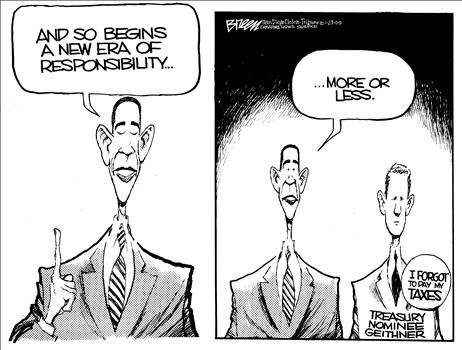
Geithner was dogged throughout the confirmation process by his failure to pay more than $34,000 in Social Security and Medicare taxes from 2001 to 2004. He’s since paid $42,704 in back taxes and interest for the four years.
“These were careless mistakes, they were avoidable mistakes, but they were unintentional,” Geithner told the Senate Finance Committee, which considered his nomination. “I want to apologize to the committee for putting you in the position of having to spend so much time on these issues.”
Senate offices from both parties said they had received a swarm of calls opposing Geithner.
One heartland Republican senator who voted against Geithner got several hundred calls of opposition to the nomination, and not a single one in favor.
Republicans voting “nay” included four of the party’s Senate leaders — Minority Leader Mitch McConnell (Ky.), Minority Whip Jon Kyl (Ariz.), Conference Chair Lamar Alexander (Tenn.). and Conference Vice Chair John Thune (S.D.).
McConnell said in a statement: “I have heard from Kentuckians over the last several days on the nomination of Timothy Geithner, and, I want to reassure them that I heard their concerns. While it is the prerogative of the President to choose his cabinet, I can’t, in good conscience, vote to confirm Mr. Geithner given the questions that still remain following his committee hearing.”
Sen. John McCain (Ariz.) also voted against Geithner.
Two GOP leaders — Sen. John Cornyn (Tex.), chairman of the National Republican Senatorial Committee, and Senate Republican Policy Committee Chairman John Ensign of Nevada — voted “yea.”
The non-Republicans who were opposed were Independent Bernie Sanders of Vermont and Democrats Tom Harkin of Iowa, Robert Byrd of West Virginia and Russ Feingold of Wisconsin.
But Democrats for the most part unified behind the nominee, hoping his personal tax controversy would fade as he takes control of the economic agenda.
“This powerful economic storm demands strong, decisive and wise leadership,” said Senate Majority Leader Harry Reid (D-Nev.). “No one is more qualified or prepared for the task than Tim Geithner.”
Not voting were Republican Kit Bond of Missouri and Democrats Sherrod Brown of Ohio, Edward Kennedy of Massachusetts and Ron Wyden of Oregon.
Complete Original Article from Politico
1/26/2009
1/24/2009
A Free Pass For The Indispensable Man
During the hothouse days of the presidential campaign, Joe Wurzelbacher became famous because he got Barack Obama to confess that he likes to spread the wealth around. Better known as Joe the Plumber, the Toledo, Ohio, laborer became the target of bottomless venom and scorn because he seemed like an obstacle to Obama's coronation.
One of the main talking points, particularly among left-wing bloggers, was that Wurzelbacher was a tax cheat because, it was revealed by ABC News, he had a tax lien of $1,182 for back Ohio state taxes. This fueled the argument that he was a fraud, his opinion didn't matter. Nothing to see here, folks. Move along.
Fast-forward to today. Timothy Geithner, President Obama's choice to be the next treasury secretary, quite clearly tried to defraud the government of tens of thousands in payroll taxes while working at the International Monetary Fund. The IMF does not withhold such taxes but does compensate American employees who must pay them out of pocket. Geithner took the compensation -- which involves considerable paperwork -- but then simply pocketed the money.More...
His explanations for his alleged oversight don't pass the smell test. When the IRS busted him for his mistakes in 2003
and 2004, he decided to take advantage of the statute of limitations and not pay the thousands of dollars he also failed to pay in 2001 and 2002. That is, until he was nominated to become treasury secretary.
Obama defends Geithner, saying that his was a "common mistake," that it is embarrassing but happens all the time. My National Review colleague Byron York reports that, at least according to the World Bank, Geithner's "mistakes" are actually quite rare. Indeed, it's almost impossible to believe that the man didn't know exactly what he was doing given that he would have had to sign documents, disregard warnings and all in all turn his brain off to make the same "mistake" year after year. And keep in mind, Geithner is supposed to run the IRS. So maybe sloppiness isn't that great a defense anyway.
The bulk of Senate Republicans seem willing to green-light his appointment because, in the words of many, "he's too big to fail." Wall Street likes this guy and so does Obama. So, who cares if he breaks and bends the rules? Who cares that he took a child-care tax credit to send his kids to summer camp? He's the right man for the job, no one else can do it, he's the financial industry's man of the moment.
This strikes me as both offensively hypocritical and absurd. Obama has made much of Wall Street greed. He and his vice president talk about paying taxes like it is a holy sacrament. They both belittled Wurzelbacher for daring to suggest that the Democratic Party isn't much concerned with how the little guy can get ahead.
Heck, Obama and pretty much the entire Democratic party insist that they speak for the little guy. But it appears they fight for the big guys.
You would think this is a perfect moment for Republicans to stand on principle, particularly since their votes aren't needed to confirm Geithner. What they will tell you is that Geithner is the indispensable man and, in the words of South Carolina Rep. Lindsey Graham,
"These are not the times to think in small political terms."
Never mind that there's nothing small about the belief that paying taxes in an honest fashion is a minimal requirement for the job of treasury secretary. What's absurd is that Geithner, who helped regulate Wall Street as head of the New York Fed, is the indispensable man now. He may indeed be qualified to be treasury secretary, but is he really the only man who can do the job? Really? Everyone said the same thing about Hank Paulson not long ago. How'd that work out?
I thought the Democrats believed the financial implosion was caused by arrogant and greedy men who thought the rules didn't apply to them because they were so important. I guess they didn't mean it.
Complete Original Article from Caglr Post
Geithner Accused of Lying About Tax Cheating
Art Cashin, one of the talking heads on CNBC, said early on Thursday morning that the stock market was going down in part because of a lack of confidence caused by the failure of the Senate to quickly confirm Timothy Geithner as Treasury Secretary. This was the party line of the Wall Street insiders who have a special interest in getting Geithner confirmed. Later on that day, Geithner was endorsed 18-5 by the Senate Finance Committee. A full Senate vote on the nomination may be held on Monday.
The American people can’t be blamed for thinking that if a tax cheat inspires confidence on Wall Street and can get an overwhelmingly positive vote in a Senate committee, the nation must indeed be headed for financial ruin.
But Geithner not only got caught cheating on his taxes, he is now being accused of lying about his cheating during his confirmation hearing when he attempted to blame the problem on his TurboTax computer software program.
But don’t expect this to be a major issue for business cable network CNBC.
In a major conflict of interest media scandal, General Electric’s media properties, which include CNBC, NBC News and MSNBC, are indirectly benefitting from the Wall Street bailout through a federal loan guarantee of $139 billion extended to GE Capital, the lending arm of GE.
What’s more, GE chairman Jeffrey Immelt is a member of the board of the New York Federal Reserve, headed by one Timothy Geithner. In fact, Immelt may be involved in finding a successor to Geithner as president of the New York Federal Reserve Bank.
When GE Capital got its federal loan guarantee, the story was covered on CNBC by reporter Steve Liesman. A transcript includes the obligatory notation that “GE is the parent company of CNBC” but the video of Liesman breaking the story didn’t mention that.
The mantra, “GE is the parent company of CNBC,” is supposed to protect GE’s media property from any charges of conflict of interest in its coverage of the financial meltdown.
One of CNBC’s most famous and outspoken talking heads, Jim Cramer, did an amazing turnaround, first opposing Geithner and then supporting him. “I’ve given up fighting this,” he blurted out. “Obama loves him.” Cramer said that “the guy got a free pass” and “everybody on Wall Street―all my buddies who lost billions for you, for the American people, told me, ‘Jim, he’s the greatest.’”
“Well, now, everybody has discovered the truth,” he added, alluding to the tax cheating. Cramer said that if he had committed similar offenses, he would be going to jail.
On Capitol Hill, some senators were listening to their constituents, thousands of whom were phoning in protest over the Geithner pick, rather than to CNBC.
“I cannot vote to confirm the nomination based on the record and the need to foster greater accountability in both big government and our financial institutions,” declared Senator Charles Grassley, the top Republican on the committee, in making a point that should have been obvious to other members. He quoted a constituent as saying, “If the man cannot handle his own finances, how is he going to handle the country’s?”
Nevertheless, only four members joined with Grassley in voting against Geithner. They were Senators Jon Kyl of Arizona, Jim Bunning of Kentucky, Pat Roberts of Kansas, and Michael B. Enzi of Wyoming.
“I cannot even believe we are voting on this nomination today,” is how Enzi described the situation. He couldn’t believe a person with tax problems like Geithner could even be considered for the position.
Enzi, the Senate’s only accountant, announced his opposition to Geithner by asking, “How do I explain to my constituents that I voted to confirm someone who will make them pay taxes, but sometimes does not pay his own taxes?”
Enzi called Geithner’s handling of his taxes “negligent behavior” that “deserves more than a simple slap on the wrist or half-hearted apology before a Senate committee.” He explained, “In previous years, nominees for positions that do not oversee tax reporting and collection have been forced to withdraw their nomination” because of similar issues.
All 13 Democrats on the committee voted for him. Five Republicans―Hatch, Snowe, Crapo, Ensign and Cornyn―did so as well.
Senator John Ensign, chairman of the Senate Republican Policy Committee, which is composed of GOP Senate leaders and the chairmen of the Senate’s standing committees, voted for Geithner despite being quoted by the BBC as saying that his switchboard had lit up with calls from constituents asking how someone who’d failed to pay their taxes could be put in charge of the IRS.
Republican Senator Orrin Hatch, once considered a conservative, said he would vote for Geithner because his tax cheating was nothing more than a series of “honest mistakes.”
The Hatch rationale for confirming Geithner reflected the influence of what Politico.com reported was a document of “talking points” originally prepared by the Obama transition office and “distributed to Capitol Hill, K Street and congressional reporters.” The “talking points” were designed to portray Geithner’s problems as “simple mistakes or oversights.”
In his confirmation hearing, however, Geithner dug a deeper hole by falsely suggesting that some of his tax dodging may have stemmed from use of the TurboTax computer software program that helps an individual file his tax returns.
While insisting that “these are my responsibilities, not the tax software’s responsibilities,” he was specifically asked by Grassley, “Did the software prompt you to report income and pay self-employment taxes on your IMF income?” He answered, “Not to my recollection, Senator.”
CNBC reported that shares of TurboTax-maker Intuit “fell to their low on the day on strong volume” after Geithner’s claims but did not include a rebuttal from TurboTax. But officials of the company flatly denied the allegation that their software could or should be blamed for his failure to pay taxes.
Dan Maurer, senior vice president and general manager of TurboTax, issued a statement saying that “Each year, millions of Americans use TurboTax to accurately prepare and file their federal and state tax returns. The software helps taxpayers report their income and find the deductions and credits they’re entitled to claim. TurboTax, and all software and in-person tax preparation services, base their calculations on the information users provide when completing their returns. TurboTax also has built-in error-checking tools that routinely catch common taxpayer mistakes.”
The headline, “Treasury Pick Misfiled Using Off-the-Shelf Tax Software,” over a story by business reporter Frank Ahrens of the Washington Post, suggested that the software was to blame. But inside the article Ahrens quoted an official of an international agency who handles these matters and understands the software as saying that TurboTax sends up a “red flag” in order to catch the “mistakes” that Geithner claims he made.More...
Complete Original Article from AIM
1/23/2009
1/22/2009
1/21/2009
Top Ten Disturbing Aspects of Obama’s Choice of Treasury Secretary
Barack Obama’s nomination of Timothy Geithner for Treasury Secretary, and the circumstances surrounding it, have raised many issues and questions — not only about the nominee himself, but also about senators and others reviewing it, the media’s coverage, and ultimately his presumptive boss’s leadership.
Here are the top ten disturbing aspects of the Geithner nomination, not in order of importance until number one.More...
10. His performance in his previous job
Geithner became president of the Federal Reserve Bank of New York in 2004. The New York Fed’s “about” page says that one of its duties is “to ensure a safe and sound banking system,” and that it “conducts onsite and offsite examinations of banks in New York, New Jersey, and Fairfield County in Connecticut.” Since so many major financial institutions are under the New York Fed’s jurisdiction, Geithner’s New York Fed has an outsized role in ensuring the soundness of the banking system nationwide.
But in the same November 24 New York Times article that describes him as “a 47-year-old wonder boy,” reporter Andrew Ross Sorkin quotes several anonymous Wall Street CEOs who “question whether he’s up to the challenge.” His roles in managing the unravelings at Bear Stearns, AIG, and Merrill Lynch, the bankruptcy at Lehman, and the ongoing implosion at Citigroup deserve scrutiny. They appear to be getting none.
Beyond that, the suddenness of these collapses should lead nomination-vetting senators to question the quality of and follow-up relating to “examinations” done on Geithner’s watch. Can the money center blowups be traced to years of inadequate oversight?
9. His role in the Troubled Asset Relief Program (TARP)
Within days of its enactment by Congress, TARP, now fully funded by Congress to the tune of $700 billion, morphed from the asset-buying program originally advertised to one of direct, “(figurative) gun to the head” investments in banks. Geithner was a key behind-the-scenes player in all of this — Sorkin called him “the point person for weeks of sleep-deprived bailout weekends.”
To what extent is Geithner responsible for the schizophrenic, misleading, and confidence-shaking mishandling of what I have been calling the SUCKUP (Seemingly Unlimited Cash Kitty Under Paulson)?
8. Likely tax evasion, not “mere” avoidance
“Wonder boy” Geithner failed to pay $34,000 in self-employment taxes on his earnings at the International Monetary Fund from 2001 through 2004, even though the IMF partially reimbursed him for these taxes each year.
The IRS caught his (cough, cough) “honest mistake” in 2006 and made Geithner pay up for 2003 and 2004. But he didn’t do so for 2001 and 2002 until just before Barack Obama nominated him. Why? Because the three-year statute of limitations, based on when a return is filed, had expired for those two years.
But the statute of limitations does not apply “in the case of a false or fraudulent return with intent to evade any tax.” Given that he had tax problems going back to 1993 over paying taxes on wages paid to domestic help, it should be obvious that Geithner knew full well when he filed his 2001 and 2002 returns that Uncle Sam demands his 15.3% for Social Security and Medicare no matter where and for whom you work inside the U.S. Thus, I believe that he knowingly filed false returns, engaging in tax evasion, not avoidance.
7. False attestations
Further supporting my evasion assertion, Geithner told the IMF in writing year after year that he would pay the tax, but didn’t. As Byron York reported at National Review on January 14:
At the end of the tax allowance form were the words, “I hereby certify that all the information contained herein is true to the best of my knowledge and belief and that I will pay the taxes for which I have received tax allowance payments from the Fund.” Geithner signed the form. He accepted the allowance payment. He didn’t pay the tax. For several years in a row.
6. Senate reaction
Democrats like Max Baucus insist that Geithner’s confirmation is “a given.” Republicans? Orrin Hatch says, “He’s a very competent guy.” Lindsey Graham doesn’t want “to play gotcha on this.” Ohio’s George Voinovich is among the few who get it: “People who work here — who are big shots — should pay their taxes. I think he’s got a real problem with me and my constituents.”
5. Pundit reaction
Charles Krauthammer apparently believes these things are trivial mistakes. Hugh Hewitt cops out, saying that “a president deserves his cabinet choices because he has won the election and been charged with executing the laws.” How about somebody who obeys them, Hugh?
4. Press coverage
The Associated Press and other media outlets relentlessly drone on about tax “discrepancies,” “tax goofs,” and the nomination’s supposed inevitability. Geithner’s partial reimbursements for taxes he didn’t pay and the related false attestations, which York obtained from Senate sources, are being ignored. There is no chance that a GOP president could nominate someone with Geithner’s tax problems for any cabinet position, let alone Treasury secretary, and get such a pass from the press.
3. Possible press conflicts of interest
Cliff Kincaid at Accuracy in Media points out that some press outlets are parts of larger firms with financial stakes in the financial bailout. Example: General Electric, which owns NBC, also owns bailout recipient GE Capital. GE CEO Jeffrey Inmelt is also on the New York Fed’s board.
2. Disparate treatment of previously pulled nominees
Zoe Baird (Clinton, 1993), Kimba Wood (Clinton, 1993), and Linda Chavez (Bush, 2001) all had relatively minor or potential issues with self-employment taxes on household help. Geithner’s unpaid amounts were exponentially larger. Is there a whiff of male chauvinism in the air?
1. Barack Obama’s reaction
No president in my lifetime would have dared to nominate Geithner. But “44″ Obama calls Geithner’s problems a mere “embarrassment.”
It leaves you wondering if anyone in Washington knows or cares about the difference between right and wrong. We’re expected to overlook Geithner’s problems because he is supposedly the only person in a nation of 200 million adults who can do the job. Give me a break.
If he really knows the pertinent facts, Barack Obama’s ringing defense of Geithner should cause the American people to question his fundamental “judgment to lead.”
Or were those “just words“?
Complete Original Article
1/20/2009
1/18/2009
The Big Money Behind Geithner
A guy who can’t figure out his own taxes is supposed to fix the economy? This is the absurd rationale being offered by media figures such as Andrea Mitchell of NBC News for confirming Timothy Geithner as Obama’s Treasury Secretary after it was disclosed that he was a serial tax evader. He did his own taxes for a couple years and got into trouble, Mitchell chuckled. And everybody can relate to that, right? Mitchell is the one who deserves to be laughed at. This guy is supposed to be so smart we can entrust him with managing the entire U.S. economy? She must be kidding. Does she seriously expect us to believe that?
Anybody watching this bizarre spectacle unfold has to suspect there is something more to the story. Who is behind Geithner and why? And why does Obama want him? This is where the media fear to tread. As we have pointed out, major media companies such as GE (parent of NBC News) and the Washington Post Company have their own connections to Geithner through their own officials and board members. They have a conflict of interest that will never be reported by the news organizations themselves.
The real story, which can only emerge through talk radio and alternative media, is that Geithner has very powerful political and financial connections, not only to the media but the banking interests and lobbies that try to orchestrate U.S. policy behind the scenes.
The President of the New York Federal Reserve Bank, the Chinese-speaking Geithner is an associate of Henry Kissinger who can be counted on to convince the Chinese Communists to continue to buy U.S. debt and finance Obama’s massive expansion of federal government power. That is why Obama and his fellow Democrats are putting so much faith in him.
As Henry Kissinger recently put it, when he was celebrating U.S.-China relations on the floor of the New York Stock Exchange, Obama’s mission is to usher in a “New World Order.” He forgot to mention, of course, that it is a China-dominated New World Order in which the U.S. has become a subsidiary of China Inc.More...
Kissinger did comment that Obama had “appointed an extraordinarily able group of people in both the international and financial fields.” He didn’t name names, but that obviously includes Geithner, who used to work for Kissinger Associates.
It also turns out that Geithner’s father, Peter F. Geithner, serves on the board with Kissinger of the National Committee on U.S.-China Relations. This is the group that rang the opening bell at the New York Stock Exchange, celebrating Chinese investments in the U.S. economy. In another interesting connection, it turns out that Peter F. Geithner was with the Ford Foundation and oversaw the work of Obama’s mother, Ann Dunham, developing what are called microfinance programs in Indonesia.
It should be apparent by now that the major media aren’t interested in holding Geithner accountable for his tax “mistakes” or anything else. Only the American people can do that. Fortunately, there is still time for the public to weigh in. The Senate Finance Committee has now announced that a “Hearing to Consider the Nomination of Timothy F. Geithner, to be Secretary of the Treasury” has been postponed to January 21, 2009, at 10:00 a.m., in room 215 of the Dirksen Senate Office Building.
Based on what Obama has said about Geithner, and what the media have repeated ad nauseam, we are supposed to believe that he made some mistakes that were typical of an employee who had worked for an international organization, the International Monetary Fund. But this doesn’t hold up because he admits he was told by the IMF about the procedures and necessity of paying those taxes. So the failure to pay these taxes looks like a case of tax cheating. If it wasn’t cheating, then he didn’t understand the tax code or didn’t pay enough attention to get it done right. This doesn’t seem like a proper credential for the post of Treasury Secretary, with jurisdiction over the IRS.
There has to be something more to the rationale for confirming somebody who is this much of a conniver or this dumb to the post. What is it?
It doesn’t take much digging. For anybody in the dark about this, please consult and closely study his bio. Geithner is a wheeler-dealer for powerful special interests.
If you examine the nature of the “Group of Thirty,” an affiliation which appears at the bottom of his biography, right after his Council on Foreign Relations membership, you will quickly learn that the President of the New York Federal Reserve Bank is an associate of the governor of the Chinese central bank through this mysterious organization of bankers and other top current and former officials from various countries. You will notice that other Obama nominees and associates are members, including Paul Volcker and Lawrence Summers.
You will also learn that this organization has been funded by―surprise―some of the same financial institutions getting federal bailout money. These include American International Group, Goldman Sachs and Citi, among others. Because it has a website and publishes an annual report, all of this seems open and above board. But the fine print reveals that some of the meetings are by “invitation only.”
The entire list of “contributors and supporters” of the “Group of Thirty” is quite impressive. You will find not only U.S. financial institutions getting bailout money, but central banks around the world and Arab financial interests. In addition, you also find private financial interests, including the hedge fund operated by billionaire and Obama contributor George Soros.
But I can find no stories in the major U.S. media critically examining the history and purpose of this organization. Could it be because selected reporters are invited to its meetings on a deep background basis? And that they develop financial sources at these meetings that they swear to protect and defend?
On Wednesday, discussing the Geithner tax evasion problem on the Fox News “Special Report” show, Fred Barnes warned that “if there is a huge public reaction to this against him, well, he might go down. But short of that, I agree, he will probably be confirmed.” This helps explain why we are constantly hearing the media parrot Obama’s claims that Geithner’s “mistakes” were “innocent” or “common.” They are determined to quell any possible “public reaction” against him. That is why we are being told it is much ado about mostly nothing. It looks like the media have succeeded in convincing most Senate Republicans, except for Jeff Sessions of Alabama, not to raise a stink.
However, in addition to the tax evasion, there is also the matter of Geithner having some “household help” while not knowing whether they were legally in the U.S. and not bothering to check when the legal status of one of the housekeepers expired. This aspect of the problem is being largely ignored by the media, rather than just being played down, because they realize that while most people fear the tax code and understand how somebody could make a “mistake” or two, the hiring or employment of illegals is another matter. Most members of the public are not rich enough to hire this kind of outside help.
But many members of the inside-the-beltway media are. As Michael Lind, a fellow at the New America Foundation once noted, journalists do not oppose illegal immigration because they benefit from it. He noted that journalists belong to an affluent class in America that employs immigrant maids, nannies and gardeners.
Perhaps they shared some of Geithner’s household help.
Complete Original Article