Tip Jar

Showing posts with label This can't be good. Show all posts

1/24/2009

AP IMPACT: Freedom looms for terrorist


NEW YORK — In 1973, a young terrorist named Khalid Duhham Al-Jawary entered the United States and quickly began plotting an audacious attack in New York City.

He built three powerful bombs — bombs powerful enough to kill, maim and destroy — and put them in rental cars scattered around town, near Israeli targets.

The plot failed. The explosive devices did not detonate, and Al-Jawary fled the country, escaping prosecution for nearly two decades — until he was convicted of terrorism charges in Brooklyn and sentenced to 30 years in federal penitentiary.

But his time is up

More...

In less than a month, the 63-year-old Al-Jawary is expected to be released. He will likely be deported; where to is anybody's guess. The shadowy figure had so many aliases it's almost impossible to know which country is his true homeland.

Al-Jawary has never admitted his dark past or offered up tidbits in exchange for his release. Much of Al-Jawary's life remains a mystery — even to the dogged FBI case agent who tracked him down.

But an Associated Press investigation — based on recently declassified documents, extensive court records, CIA investigative notes and interviews with former intelligence officials — reveals publicly for the first time Al-Jawary's deep involvement in terrorism beyond the plot that led to his conviction.

Government documents link Al-Jawary to Black September's murderous letter-bombing campaign targeting world leaders in the 1970s and a botched terrorist attack in 1979. Former intelligence officials suspect he had a role in the bombing of a TWA flight in 1974 that killed 88 people.

"He's a very dangerous man," said Mike Finnegan, the former FBI counterterrorism agent who captured Al-Jawary. "A very bad guy."

The events linked to Al-Jawary happened long ago, when the conflagration in the Middle East spread around the world; he is being released into another century, one in which the scale of terrorism has grown exponentially, even bringing down two of New York's skyscrapers.

Al-Jawary has long insisted that he was framed and that the government has the wrong guy. Al-Jawary declined an interview through prison officials and has since failed to answer letters mailed to him in the last year and a half, but his former lawyer, Ron Kuby, insists he "wasn't a threat in 1991 and he's not a threat now."

Federal prosecutors didn't see it that way. They point to his trip to the United States in the 1970s as proof.

A slender, nattily dressed man with a thin mustache, Al-Jawary walked into the U.S. Embassy in Beirut in November 1972 and applied for a visa using a phony Iraqi passport. He answered some routine questions, had his picture taken and was granted a visa.

On Jan. 12, 1973, Al-Jawary flew to Boston via Montreal and then to New York City.

Five days later, after the bureau's office in Tel Aviv received a tip in connection to another investigation, agents tried to locate a man who later turned out to be Al-Jawary.

They found him in New York City and conducted a perfunctory interview. Where do you live? Baghdad. Why did you come here? Flight training at Teterboro Airport in New Jersey.

The agent asked if Al-Jawary was affiliated with any political groups. He said he was "nonpolitical."

The agent asked how long he was staying. Al-Jawary said he planned to return to the Middle East after his training ended in about a month and get a job as a commercial pilot, according to FBI documents obtained under the Freedom of Information Act.

Al-Jawary befriended a woman named Carol and her young son Todd. Carol and Al-Jawary grew close, with Al-Jawary taking her son on trips to Manhattan. Unbeknownst to the woman, the boy was a decoy. Al-Jawary had no interest in a relationship with her or Todd. He was scouting targets for a terrorist attack, and the presence of the boy would help him avoid suspicion.

He picked two Israeli banks on Fifth Avenue and the El-Al cargo terminal at Kennedy Airport.

Possibly working with two or more people, Al-Jawary rented three cars and assembled three bombs comprised of large containers filled with gasoline, propane tanks, plastic explosives, blasting caps and batteries, according to FBI and federal court records. The propane tanks were particularly diabolical, adding shrapnel to the blast.

Two of the bombs used alarm clocks, but a third employed a sophisticated electronic-timing device commonly referred to as an "e-cell," said Terence G. McTigue, who worked on the New York Police Department's bomb squad. It was twice as powerful as the other two bombs.

On March 4, Al-Jawary — and possibly others — readied the cars in anticipation of Israeli Prime Minister Golda Meir's visit to the city.

Each car contained a Hebrew language newspaper with propaganda from Black September — the terrorist organization that carried out the massacre of Israeli athletes at the Munich Olympics just months earlier — tucked inside.

But the bombs failed to explode. It is not clear why. They were discovered after the two cars on Fifth Avenue were towed, and the FBI learned about the third car at JFK and notified police.

McTigue disarmed the e-cell bomb at JFK and found the components for the fourth one in the car. It was cutting edge, the work of a professional.

"It was a sea change because it was the first time we encountered an electronic timer rather than a simple alarm clock or mechanical timer," recalled McTigue, who would be badly injured in 1976 when he tried to dismantle a bomb left by a Croatian terrorist.

McTigue also recognized something else as he examined the car bomb: a plastic explosive called Semtex from Czechoslovakia. It had been used in scores of letter bombs sent around the world the previous year, targeting Jews and Israelis and even U.S. Secretary of State William Rogers. One had killed an agricultural counselor at the Israeli embassy in London and another mangled the hands of a 26-year-old postal worker in the Bronx.

McTigue knew those letter bombs. He had handled them. The letters had pressure-release firing devices and were the work of Black September, Palestinian guerrillas believed by intelligence officials to be controlled by Palestine Liberation Organization leader Yasser Arafat.

Rogers called the attempted New York City attack a "disturbing development" in a confidential memo to President Richard Nixon — it was, he said, the first time Black September had "mounted an operation on American soil."

As it turns out, Al-Jawary's car bombs and the letter explosives contained similarities that made authorities suspect they were linked.

"The explosive material found in the rental cars was imported and found to be identical to that used in the recent worldwide letter bomb campaign," according to declassified State Department documents obtained from the U.S. National Archives in College Park, Md.

The FBI began a large investigation, "one of the most intensive in the history of the FBI," called "Tribomb," deploying 300 agents and interviewing hundreds of people.

The FBI lifted 60 fingerprints; they all matched Al-Jawary's. They uncovered a fake Jordanian passport behind an air conditioning duct and bomb materials from a room Al-Jawary had rented at a hotel near JFK. Agents recovered a copy of a Jordanian driver's license he had used to rent the cars.

Agents quickly realized that Al-Jawary was involved in the attempted attack and issued an arrest warrant. But he had already slipped out of the country.

The FBI focused on Lebanon because Al-Jawary had gotten his visa there. But Lebanon was the Wild West of the Middle East at that time, a safe haven where Arab and PLO terrorists circulated without fear of arrest. If he was there, Al-Jawary was out of reach.

Al-Jawary brazenly sent postcards to Carol from Paris, Rome, Beirut.

Years passed. The FBI gave up the hunt.

But their elusive quarry resurfaced in 1979, not long after Israel assassinated a top Black September terrorist. Border police stopped Al-Jawary's car as he and another man tried to cross into Germany from Austria, according to federal court documents.

In the trunk of the car, police found 88 pounds of high explosives, electronic timing-delay devices and detonators hidden in a suitcase. They also unearthed cash and nine passports inside a portable radio that could be used to monitor transmissions from ships, airplanes or the police.

Al-Jawary was traveling under the alias "Yousif Salim Sejaan" and refused to talk. He was carrying a French passport indicating he was born in Lebanon, and riding with a man who was a PLO officer.

German authorities soon learned why Al-Jawary was in the country. They had nabbed a total of 11 Palestinians and 40 pounds of explosives around the time of Al-Jawary's arrest. Two of the men admitted they were going to bomb targets in Germany — most likely, Jewish and Israeli ones.

All the explosives seized from Al-Jawary and the other men bore the same wrapping from a pastry shop in Beirut which served as a front for Fatah, the military arm of the PLO. Al-Jawary's fingerprints were on the wrapping.

Still, Germany released Al-Jawary long before the FBI knew that he had been taken into custody.

And he disappeared once again.

But those e-cell bombs did not. A group known as the 15 May Organization — named for the date that Israel was founded — began carrying out terror attacks from Lebanon, Tunis and Baghdad in the 1980s. Suitcase bombs made with e-cells were the 15 May trademark. Its leader was a skilled bomb-maker named Husayn al-Umari, commonly referred to as Abu Ibrahim. Ibrahim had an education in chemical and electrical engineering and a proclivity for targeting airliners. He also received KGB training.

In one high-profile attack in 1982, an explosion rocked a Pan Am jet flying to Honolulu from Tokyo, killing a 16-year-old Japanese boy and injuring several others.

Denny Kline was an explosives guru for the FBI and worked the 15 May cases. He also transported Al-Jawary's 1973 e-cell bomb to FBI headquarters in Washington.

As Kline recollects, the bombs were compared. Yes, both Al-Jawary and Ibrahim had used e-cells, but that was the only common denominator. This similarity didn't mean the bombs were built by the same person, Kline said.

The FBI's bomb expert worked closely with the CIA and never received any evidence or information to suggest that Al-Jawary was involved with 15 May.

But other investigators have since learned of the e-cell connection and believe it's a powerful one, because they were such sophisticated devices and so few people knew how to operate and create them.

"That's a big commonality especially since I don't know of anyone else using the e-cells in the bomb," said Billie Vincent, the former FAA security chief from 1982 to 1986 who studied the Ibrahim devices.

CIA investigative notes obtained by the AP, based on human intelligence and communication intercepts, indicate that Al-Jawary's nom de guerre was Abu Walid al-Iraqi. The notes link Al-Jawary to a man named Abdullah Labib, aka Col. Hawari, who took his orders from Arafat. The notes say that Al-Jawary also worked as a document forger for the PLO and Hawari.

Hawari, a senior Fatah security official and Arafat confidant, "inherited" elements of Black September, according to the CIA notes. Declassified State Department and CIA documents say Hawari took over 15 May in the mid-1980s while Ibrahim continued to supply his expertise.

According to declassified CIA records, Hawari orchestrated the 1986 attack on a TWA flight from Rome to Athens that killed four Americans, including an infant, after they were sucked out of the plane. The explosives used in the attack were linked to Ibrahim.

Hawari reportedly died in a car crash in 1991. Ibrahim, who was charged in the 1982 Pan Am attack, remains at large, possibly hiding out in Iraq.

Besides the use of e-cells, Al-Jawary had another link to 15 May. Ibrahim was suspected of being Black September's bomb maker, Kline and other former intelligence officials said.

Al-Jawary acted on behalf of Black September in 1973 when he rigged the car bombs in New York, federal prosecutors asserted in court documents.

FBI agent Mike Finnegan didn't know any of this when he arrived at work one day in 1988 to find the entire case file — many volumes and thousands of pages — sitting on his desk with a note that said: "Find Him" — find Al-Jawary.

Finnegan thought to himself: "I am screwed."

It took Finnegan a year to review the entire file. He followed every lead and re-interviewed witnesses. Nothing. He asked the CIA for help. Nothing.

Finnegan also looked at other terrorism cases involving bombs. There was one in particular that drew his attention: TWA Flight 841 crashed Sept. 8, 1974, in the Ionian Sea near Greece after an explosive device detonated.

Seventy-nine passengers and nine crew members were killed. Among them were 17 Americans on the flight that originated in Tel Aviv and was headed ultimately for John F. Kennedy International Airport in New York.

Thirteen days earlier, the same flight had landed in Rome. When a ramp agent opened the rear cargo compartment, smoke was found coming from a suitcase.

The fire was extinguished. Italian authorities wrongly determined it had started accidentally when batteries inside a tape recorder caused lighter fluid to ignite. One of the flight's passengers — Jose Maria Aveneda Garcia — stepped forward and identified the bag, according to recently declassified FBI files.

Garcia, who was probably using a fake Chilean passport, wasn't detained. Garcia's address in Rome was bogus.

The suitcase and contents were sent to an FBI laboratory in the U.S., which concluded it was a bomb.

The FBI tried to find Garcia. They never located him. The National Transportation Safety Board said the suitcase was "an attempt at the same form of sabotage" that downed the flight over the Ionian Sea.

Neither attack was ever solved. The suitcase was later destroyed.

Finnegan thought Al-Jawary had been behind the suitcase bomb. It employed an e-cell, according to the FBI. At that time, he was told, the use of an e-cell was a bomb signature.

"It had a very distinct timing device," said Finnegan, who retired in 2004. "It was almost like a foregone conclusion. This was my guy. I desperately wanted to resurrect that case."

James R. Lyons, a retired FBI agent who worked many big cases such as the World Trade Center bombing in 1993, said the use of e-cells in 1973 and 1974 would have been considered the signature of a bomb-maker, making Al-Jawary a prime suspect.

"Absolutely," said Lyons, who was also an FBI bomb technician. "I'd be going after the same guy. No doubt about it."

Another top FBI explosives expert, Dave Williams, said: "Look back in the '70s and '80s and there weren't too many bomb builders out there. So it was very likely that some of these bomb builders got their instructions from the same person or persons. If I were investigating it back then, I would have come to the conclusion that he was an integral part of that conspiracy."

But it wasn't Finnegan's call to pursue the 1974 attack. Street agents don't make those decisions. He had to focus on the New York investigation.

Finnegan had "computer-aged" pictures of Al-Jawary — ones from Al-Jawary's visits to the U.S. Embassy in Beirut in 1971 and 1972. He also had one from a Jordanian driver's license that had been obtained from the investigation.

He now had a good idea what Al-Jawary looked like as a 45-year-old man, and he passed the photos along to foreign intelligence agencies.

In the fall of 1990, Finnegan learned Al-Jawary was residing on Cyprus — a center of terrorism — as the PLO's "cultural attache" under the name of Khaled Mohammed El-Jassem.

Finnegan finally had Al-Jawary in his sights, but then he was gone: In December, Al-Jawary escaped to Iraq, after he figured out the FBI was on to him. Finnegan was furious.

Then, some luck. In January 1991, Al-Jawary left Iraq to attend a funeral in Tunis for his good friend, Saleh Khalef, the leader of Black September and Arafat deputy known as Abu Iyad who had been gunned down by a rival Palestinian group.

But Al-Jawary's travel plans were derailed. He tried to go to Cyprus first but was denied entry. He was put on a plane to Athens. Again, denied entry. He flew to Italy.

Finnegan alerted the Italians that Al-Jawary was on his way. As he passed through Rome, Italian authorities detained him for using a fake Jordanian passport.

But the Italians were reluctant to give him to the FBI, said Robert Blitzer, who served in the FBI's International Terrorism Operations Section from 1986 to 1995.

"They didn't want to release him," Blitzer said. "They were afraid to release him."

After many months of diplomatic wrangling, Finnegan and Bassem Youssef, an Arabic-speaking FBI agent, flew to Rome on a military transport plane to take Al-Jawary back to the U.S.

Under intense security that included the closing of the Rome airport and its air space, Al-Jawary arrived on a helicopter gunship. He had iron plates protecting the front and back of his torso. He was wearing a Kevlar hood.

Inside the plane, Finnegan took off Al-Jawary's hood. Finnegan introduced himself to a bewildered Al-Jawary: "I am Mike Finnegan, New York office FBI."

Youssef began speaking to Al-Jawary in Arabic. Startled, Al-Jawary responded briefly, allowing Youssef enough time to detect a Palestinian dialect along with a Libyan one.

But Al-Jawary quickly switched back to English and began yelling, believing Youssef was an Israeli agent.

"I am not going to talk to you," an animated Al-Jawary told Youssef. "I am not talking to the Mossad."

Convinced, finally, that he was in the custody of the FBI, Al-Jawary collapsed in a chair, relieved. He allowed Finnegan to question him.

Youssef listened.

"The guy was definitely lying about a lot of things," Youssef said. "He did not want to telegraph anything about the truth."

Al-Jawary told Finnegan he wasn't in New York when the bombs were planted. The FBI had the wrong guy. The Mossad had framed him. He's not from Mosul, Iraq. He's not an Iraqi national as the American government asserted.

He's Khaled Mohammed El-Jassem, father of five and devoted husband. He's a victim of Israeli aggression and bombs, which killed his brother and an infant son.

In time, he would say that he was born in Palestine in 1947 but was forced to flee from his home after Israel was established in 1948 and war erupted with its Arab neighbors.

Al-Jawary claims in court filings that he grew up in refugee camps in Jordan. When he was 18, in 1965, he joined Arafat's PLO.

While mired in poverty, a resourceful Al-Jawary managed to earn a bachelor's degree in Palestinian history in Deraa, Jordan, in 1972. Later, he says, he was arrested in Damascus, Syria, from September 1972 to July 1973 — the period of the New York bombing attempts — for publishing an anti-Syrian letter in a local newspaper.

After graduation, Al-Jawary claims he taught history and Arabic in Jordan and married a woman named Rima Omar in 1975.

In 1977 the family moved to Beirut, where Al-Jawary claims he worked as a teacher. Five years later, Al-Jawary left Lebanon, choosing to start a new life in Nicosia, Cyprus, where he operated a legitimate business importing electronic equipment from Japan and exporting it to various Middle Eastern countries.

The store folded in a couple of years, according to his version. At some point, he became the PLO's cultural attache.

A Brooklyn jury didn't buy any of this. It took about three hours for the jury to convict Al-Jawary in 1993 — just days after the first attack on the World Trade Center — based on evidence that included his fingerprints on one of the bombs.

Judge Jack B. Weinstein sentenced Al-Jawary to 30 years in prison on April 16, 1993. Weinstein later rejected his pleas for mercy in a written opinion issued after the trial, saying the bombs would have "killed and maimed hundreds, caused large fires and terrorized thousands of people."

Al-Jawary, the judge wrote, was a serious threat.

"It is highly likely that were this defendant released he would continue his dangerous terrorist activities," the judge said.

Since his conviction, many top Palestinian officials have written to the judge on Al-Jawary's behalf, seeking his release. There's even a death certificate in court files along with witnesses claiming Al-Jawary was killed by Israeli shelling in 1988.

None of it was convincing. Al-Jawary's appeals foundered.

But those countless hours behind bars are almost over. Freedom looms for this gaunt and graying terrorist who has spent about a quarter of his life in maximum-security prisons. He was transferred recently to a federal detention center in Manhattan.

Al-Jawary is scheduled to be released Feb. 19 after completing only about half his term, including time served prior to his sentencing and credit for good behavior, according to the federal Bureau of Prisons.

Once he's released, Al-Jawary will be handed over to U.S. Immigration and Customs Enforcement and held until his deportation.

It remains unclear where he'll go, largely because Al-Jawary's true identity remains in question — even to this day.

Those who helped put Al-Jawary behind bars believe he'll pick up where he left off.

"What is he going to do when he gets out?" McTigue said. "He'll be deported and received as a hero and go right back into his terrorist activities. He's had years to think about nothing else but causing havoc and destruction."


Complete Original Article from AP

California’s Tipping Point


This goes along with what I was writing about the other day. The problem is that it is reaching national proportions and it is just a matter of time until the lid blows-Jer


I think a threshold or tipping point exists in the ratio between the political power of those who pay taxes and those who consume taxes directly. After that tipping point is reached, those who pay taxes become the economic slaves of those who consume taxes.

I think California has passed that point. [h/t Instapundit] Tax consumers now control the state government and can vote themselves almost any level of personal income and benefits they wish while taxpayers cannot muster the political capital to defend themselves.

This might seem overwrought but it has a precedent in the concept of the military-industrial complex. When that arch-leftist Eisenhower created the concept he warned that those who benefited from military spending, from stockholders and CEOs of defense companies to strippers who work the clubs outside military bases, would bring political pressure to distort defense priorities. He was right. The problem has bedeviled us ever since WWII. We keep bases we don’t need and buy new toys instead of spending money on training ammo.

Now, in addition to the existing vested interest in military spending, imagine that the 3 million active and reserve service members along with 500,000 civilian military employees all belonged to a single compulsory union. Imagine that the union endorsed candidates and policies, donated a lot of money to campaigns, assigned soldiers to go door-to-door and man phone banks. Imagine that the majority of people in Washington were in the union and had constant access to politicians. Unions provide a ready-made organizational framework that makes unions much more politically effective than a similar number of unorganized citizens of the same size would be. Their ability to buy advertising alone dwarfs that of any other group. The military union could bring enormous pressure to bear on any politician and force them to vote for more military spending. How much more distorted would military spending be than it is now? How much harder would it be to reduce military spending?

This is the condition that California and other states with powerful public-sector unions find themselves in. California has ~2.3 million unionized government workers and ~18.6 million civilians. With so many people organized with a laser-like focus on increasing taxes and spending, the private working citizens of California find it nearly impossible to prevent government workers from voting their own paychecks.More...

In effect, government workers have hijacked democracy. Instead of state employees working for the people, the people now work for the state employees. As far as the state government is concerned, people in the private sector work merely so that they can be taxed for the benefit of the tax consumers. They’ve entered a condition not unlike like that of pre-industrial serfs.

Of course no one is being whipped, but in effect an ordinary citizen of California cannot get their desires for reduced state spending implemented due to the disproportionate power of the State’s employees and allied interest. It appears now that the government unions will not accept any solution to California’s budget crisis except increased taxes in a declining economy. Ordinary citizens have no choice but to either emigrate or just lie there and take it.

By long custom and law, the U.S. military has remained ruthlessly apolitical. Serving members do not endorse candidates, organize politically in any fashion or make independent public statements about campaign issues. That standard evolved due to the obvious danger of having a military with a positive feedback loop into the political system that controls its budget. The same danger exists for all other state employees, albeit in a slower and less dramatic fashion.

No one should be able to vote their own paycheck. Government-employee unions should be legally restricted from engaging in any kind of political activity. If not, it is only a matter of time before civil servants become civil masters.

Complete Original Article from Chicago Boyz

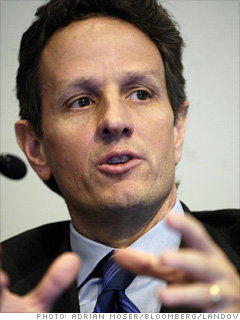
Geithner Accused of Lying About Tax Cheating


Art Cashin, one of the talking heads on CNBC, said early on Thursday morning that the stock market was going down in part because of a lack of confidence caused by the failure of the Senate to quickly confirm Timothy Geithner as Treasury Secretary. This was the party line of the Wall Street insiders who have a special interest in getting Geithner confirmed. Later on that day, Geithner was endorsed 18-5 by the Senate Finance Committee. A full Senate vote on the nomination may be held on Monday.

The American people can’t be blamed for thinking that if a tax cheat inspires confidence on Wall Street and can get an overwhelmingly positive vote in a Senate committee, the nation must indeed be headed for financial ruin.

But Geithner not only got caught cheating on his taxes, he is now being accused of lying about his cheating during his confirmation hearing when he attempted to blame the problem on his TurboTax computer software program.

But don’t expect this to be a major issue for business cable network CNBC.

In a major conflict of interest media scandal, General Electric’s media properties, which include CNBC, NBC News and MSNBC, are indirectly benefitting from the Wall Street bailout through a federal loan guarantee of $139 billion extended to GE Capital, the lending arm of GE.

What’s more, GE chairman Jeffrey Immelt is a member of the board of the New York Federal Reserve, headed by one Timothy Geithner. In fact, Immelt may be involved in finding a successor to Geithner as president of the New York Federal Reserve Bank.

When GE Capital got its federal loan guarantee, the story was covered on CNBC by reporter Steve Liesman. A transcript includes the obligatory notation that “GE is the parent company of CNBC” but the video of Liesman breaking the story didn’t mention that.

The mantra, “GE is the parent company of CNBC,” is supposed to protect GE’s media property from any charges of conflict of interest in its coverage of the financial meltdown.

One of CNBC’s most famous and outspoken talking heads, Jim Cramer, did an amazing turnaround, first opposing Geithner and then supporting him. “I’ve given up fighting this,” he blurted out. “Obama loves him.” Cramer said that “the guy got a free pass” and “everybody on Wall Street―all my buddies who lost billions for you, for the American people, told me, ‘Jim, he’s the greatest.’”

“Well, now, everybody has discovered the truth,” he added, alluding to the tax cheating. Cramer said that if he had committed similar offenses, he would be going to jail.

On Capitol Hill, some senators were listening to their constituents, thousands of whom were phoning in protest over the Geithner pick, rather than to CNBC.

“I cannot vote to confirm the nomination based on the record and the need to foster greater accountability in both big government and our financial institutions,” declared Senator Charles Grassley, the top Republican on the committee, in making a point that should have been obvious to other members. He quoted a constituent as saying, “If the man cannot handle his own finances, how is he going to handle the country’s?”

Nevertheless, only four members joined with Grassley in voting against Geithner. They were Senators Jon Kyl of Arizona, Jim Bunning of Kentucky, Pat Roberts of Kansas, and Michael B. Enzi of Wyoming.

“I cannot even believe we are voting on this nomination today,” is how Enzi described the situation. He couldn’t believe a person with tax problems like Geithner could even be considered for the position.

Enzi, the Senate’s only accountant, announced his opposition to Geithner by asking, “How do I explain to my constituents that I voted to confirm someone who will make them pay taxes, but sometimes does not pay his own taxes?”

Enzi called Geithner’s handling of his taxes “negligent behavior” that “deserves more than a simple slap on the wrist or half-hearted apology before a Senate committee.” He explained, “In previous years, nominees for positions that do not oversee tax reporting and collection have been forced to withdraw their nomination” because of similar issues.

All 13 Democrats on the committee voted for him. Five Republicans―Hatch, Snowe, Crapo, Ensign and Cornyn―did so as well.

Senator John Ensign, chairman of the Senate Republican Policy Committee, which is composed of GOP Senate leaders and the chairmen of the Senate’s standing committees, voted for Geithner despite being quoted by the BBC as saying that his switchboard had lit up with calls from constituents asking how someone who’d failed to pay their taxes could be put in charge of the IRS.

Republican Senator Orrin Hatch, once considered a conservative, said he would vote for Geithner because his tax cheating was nothing more than a series of “honest mistakes.”

The Hatch rationale for confirming Geithner reflected the influence of what Politico.com reported was a document of “talking points” originally prepared by the Obama transition office and “distributed to Capitol Hill, K Street and congressional reporters.” The “talking points” were designed to portray Geithner’s problems as “simple mistakes or oversights.”

In his confirmation hearing, however, Geithner dug a deeper hole by falsely suggesting that some of his tax dodging may have stemmed from use of the TurboTax computer software program that helps an individual file his tax returns.

While insisting that “these are my responsibilities, not the tax software’s responsibilities,” he was specifically asked by Grassley, “Did the software prompt you to report income and pay self-employment taxes on your IMF income?” He answered, “Not to my recollection, Senator.”

CNBC reported that shares of TurboTax-maker Intuit “fell to their low on the day on strong volume” after Geithner’s claims but did not include a rebuttal from TurboTax. But officials of the company flatly denied the allegation that their software could or should be blamed for his failure to pay taxes.

Dan Maurer, senior vice president and general manager of TurboTax, issued a statement saying that “Each year, millions of Americans use TurboTax to accurately prepare and file their federal and state tax returns. The software helps taxpayers report their income and find the deductions and credits they’re entitled to claim. TurboTax, and all software and in-person tax preparation services, base their calculations on the information users provide when completing their returns. TurboTax also has built-in error-checking tools that routinely catch common taxpayer mistakes.”

The headline, “Treasury Pick Misfiled Using Off-the-Shelf Tax Software,” over a story by business reporter Frank Ahrens of the Washington Post, suggested that the software was to blame. But inside the article Ahrens quoted an official of an international agency who handles these matters and understands the software as saying that TurboTax sends up a “red flag” in order to catch the “mistakes” that Geithner claims he made.More...

Complete Original Article from AIM

1/22/2009

An Uneasy Feeling


All Americans must appreciate the outpouring of good will, unity, and hope for a successful Obama administration. But I had a certain feeling of uncertainty yesterday at the coverage of the festivities.

Let me preface that worry: I did not think much of Bill Clinton our modern-day Alcibiades. But all through his administration, and of course before and after it, I thought a great deal of the United States, especially in comparison to the alternative.

Before Clinton bombed Milosevic in 1998 I believed that it would have been wiser to have gone to Congress and gotten an authorization to use force (as in the case of Bush in 2002). He might have also at least tried to convince the UN (as Bush attempted in fall 2002). But no matter: he began bombing he said to stop genocide, and I wrote an op-ed at the time for the Wall Street Journal calling for unity to ensure an American victory over Milosevic.

Whether Obama is President or McCain had won, no matter; it is still the US, and as a Jacksonian I pretty much pull for America--all the time. I am not a Socratic citizen of the world--given the thugs that rule most of Africa, the creepy places such as Iran or Russia or North Korea, the land of the Lotus-eaters in Europe, or the tribal dictatorships I've seen in the Middle EastMore...

I thought Jimmy Carter proved a self-righteous disaster and endangered the nation--remember the hostages in Iran, and the rise of radical Islam, the commies in Afghanistan and Central America, the holocaust in Cambodia, the oil mess, the sanctimonious preachy lectures, etc.--but I never thought that only with the ascension of Reagan could I really be again proud of the US.

The point? I distilled from the press coverage and the crowds and the punditry Tuesday that for all too many suddenly a vote for Obama redeems America. Now, to paraphrase Michelle Obama, for the first time in their lives they are apparently proud of the United States. (Had we not had the financial meltdown in mid-September, and had Obama stayed three points back in the polls, would millions have stayed soured on America and now in sullen silence licked their wounds?).

So I am surprised that suddenly the election of a single individual means that we are united, patriotic, proud of America? Suddenly Okinawa or Antietam, or all those who died at the Argonne, are ours to claim again? (This reminds of elementary school, when our third-grade split up into two sides, as the teacher quizzed us on geography-and the losers of the contest cried and said unfair and how they didn't like school or Mrs. Wilson, and then when they won the next day, how suddenly third grade became glorious, and Mrs. Wilson and her games were once again wonderful).

But America was always ours, the public, and the nation transcends the proposition of whether Obama gets elected or not--given that the United States, in its worst hour, was better than the alternatives at their best. So I think it would be wise to cool it on the "I am now proud of America" rhetoric. If getting your way means suddenly the dead at Iwo or those who were blown up in B-17s over Germany are at last your own and matter, then we are in deep trouble.

Complete Original Article

1/21/2009

Interesting Charts of the Day


The chart above shows the monthly employment levels since 1969 in: a) the construction and manufacturing sectors combined, and b) government. Back in 1969, there were almost 2 manufacturing and construction jobs for every government employee. Since then, government employment almost doubled from 12 million in 1969 to almost 24 million today, as manufacturing and construction jobs have remained flat and have recently fallen, to the point that there are now more workers employed by government than are employed in the manufacturing and construction sectors.

Complete Article from Carpe Diem

1/20/2009

Code Pink sits up front


You know things have changed in Washington when Code Pink gets seats up front at the inauguration.

Medea Benjamin, the group's founder, and Desiree Fairooz, one of the group's most visible members, are in Section 10, about 100 feet from the stage.

I asked if someone in Congress had given Medea her tickets. She just smiled and said, "We do have friends."

Both women are wearing -- what else? -- all pink and carrying homemade signs made out of pink sheets.

"Obama, lead us out of Iraq," says Medea's sign.

Desiree's says, "Yes we can, can end the wars."

Article from the Wahington Times

Photo is not


More...

Complete Original Article

1/18/2009

Questions for Obama's science guy


IN NOMINATING John Holdren to be director of the Office of Science and Technology Policy - the position known informally as White House science adviser - President-elect Barack Obama has enlisted an undisputed Big Name among academic environmentalists. Holdren is a physicist, a professor of environmental policy at Harvard, a former president of the American Association for the Advancement of Science, director of the Woods Hole Research Center, and author or coauthor of many papers and books.

He is also a doom-and-gloomer with a trail of erroneous apocalyptic forecasts dating back nearly 40 years - and a decided lack of tolerance for environmental opinions that conflict with his.

The position of science adviser requires Senate confirmation. Holdren's nomination is likely to sail through, but conscientious senators might wish to ask him some questions. Here are eight:More...

1. You were long associated with population alarmist Paul Ehrlich, and joined him in predicting disasters that never came to pass. For example, you and Ehrlich wrote in 1969: "If . . . population control measures are not initiated immediately and effectively, all the technology man can bring to bear will not fend off the misery to come." In 1971, the two of you were adamant that "some form of ecocatastrophe, if not thermonuclear war, seems almost certain to overtake us before the end of the century." In the 1980s, Ehrlich quoted your expectation that "carbon dioxide-induced famines could kill as many as a billion people before the year 2020." What have you learned from the failure of these prophecies to come true?

2. You have advocated the "long-term desirability of zero population growth" for the United States. In 1973, you pronounced the US population of 210 million as "too many" and warned that "280 million in 2040 is likely to be much too many." The US population today is 304 million. Are there too many Americans?

3. You opposed the Reagan administration's military buildup in the 1980s for fear it might "increase the belligerency of the Soviet government." You pooh-poohed any notion that "the strain of an accelerated arms race will do more damage to the Soviet economy than to our own." But that is exactly what happened, and President Reagan's defense buildup helped win the Cold War. Did that outcome alter your thinking?

4. You argued that "a massive campaign must be launched . . . to de-develop the United States" in order to conserve energy; you also recommended the "de-development" of modern industrialized nations in order to facilitate growth in underdeveloped countries. Yet elsewhere you observed: "Affordable energy in ample quantities is the lifeblood of the industrial societies and a prerequisite for the economic development of the others." Which is it?

5. In Scientific American, you recently wrote: "The ongoing disruption of the Earth's climate by man-made greenhouse gases is already well beyond dangerous and is careening toward completely unmanageable." Given your record with forecasting calamity, shouldn't policymakers view your alarm with a degree of skepticism?

6. In 2006, according to the London Times, you suggested that global sea levels could rise 13 feet by the end of this century. But the latest assessment from the Intergovernmental Panel on Climate Change is that sea levels are likely to have risen only 13 inches by 2100. Can you explain the discrepancy?

7. "Variability has been the hallmark of climate over the millennia," you wrote in 1977. "The one statement about future climate that can be made with complete assurance is that it will be variable." If true, should we not be wary of ascribing too much importance to human influence on climate change?

8. You are withering in your contempt for researchers who are unconvinced that human activity is responsible for global warming, or that global warming is an onrushing disaster. You have written that such ideas are "dangerous," that those who hold them "infest" the public discourse, and that paying any attention to their views is "a menace." You contributed to a published assault on Bjorn Lomborg's notable 2001 book "The Skeptical Environmentalist" - an attack the Economist described as "strong on contempt and sneering, but weak on substance." In light of President-elect Obama's insistence that "promoting science" means "protecting free and open inquiry," will you work to soften your hostility toward scholars who disagree with you?

Complete Original Article

1/17/2009

Scrap The Consumer Product Safety Improvement Aci


Self-congratulation makes for bad law.


If someone you know volunteers at a thrift store or crochets baby hats for the crafts site Etsy or favors handmade wooden toys as a baby shower gift, you've probably been hearing the alarms about the Consumer Product Safety Improvement Act (CPSIA).More...

Hailed almost universally on its passage last year--it passed the Senate 89 to three and the House by 424 to one, with Ron Paul the lone dissenter--CPSIA is now shaping up as a calamity for businesses and an epic failure of regulation, threatening to wipe out tens of thousands of small makers of children's items from coast to coast, and taking a particular toll on the handcrafted and creative, the small-production-run and sideline at-home business, not to mention struggling retailers. How could this have happened?


Congress passed CPSIA in a frenzy of self-congratulation following last year's overblown panic over Chinese toys with lead paint. Washington's consumer and environmentalist lobbies used the occasion to tack on some other long-sought legislative goals, including a ban on phthalates used to soften plastic.

The law's provisions were billed as stringent, something applauded by high-minded commentators as a way to force the Mattels and Fisher-Prices of the world to keep more careful watch on the supply chains of their Chinese factories.

Barbed with penalties that include felony prison time and fines of $100,000, the law goes into effect in stages; one key deadline is Feb. 10, when it becomes unlawful to ship goods for sale that have not been tested. Eventually, new kids' goods will all have to be subjected to more stringent "third-party" testing, and it will be unlawful to give away untested inventory even for free.

The first thing to note is that we're not just talking about toys here. With few exceptions, the law covers all products intended primarily for children under 12. That includes clothing, fabric and textile goods of all kinds: hats, shoes, diapers, hair bands, sports pennants, Scouting patches, local school-logo gear and so on.

And paper goods: books, flash cards, board games, baseball cards, kits for home schoolers, party supplies and the like. And sporting equipment, outdoor gear, bikes, backpacks and telescopes. And furnishings for kids' rooms.


1/13/2009

*Goodbye California


Years ago there was a book of that name, I don't remember if I read it or not, if I did it must not have left much of an impression, though I do remember the basic plot line, probably from the cover. It was your standard disaster novel of an earthquake sinking California into the Pacific and the consequences, come to think of it I believe they made a TV movie something like that too. This has nothing to do with earthquakes, though it is a mounting disaster.

I recently read an article about how people were leaving California in record numbers, second only to those leaving New York, think about the commonality there. Here is part of the reason given.

Among other things: California's unemployment rate hit 8.4 percent in November, the third-highest in the nation, and it is expected to get worse. A record 236,000 foreclosures are projected for 2008, more than the prior nine years combined, according to research firm MDA DataQuick. Personal income was about flat last year.

With state government facing a $41.6 billion budget hole over 18 months, residents are bracing for higher taxes, cuts in education and postponed tax rebates. A multibillion-dollar plan to remake downtown Los Angeles has stalled, and office vacancy rates there and in San Diego and San Jose surpass the 10.2 percent national average.

Median housing prices have nose-dived one-third from a 2006 peak, but many homes are still out of reach for middle-class families. Some small towns are on the brink of bankruptcy. Normally recession-proof Hollywood has been hit by layoffs.


Now people leaving a state or even a region during bad times is not unusual, as a matter of fact California was heavily migrated to during the dust bowl years and the Great depression. The mid-west rust belt exodus in the 80's and 90's being another good example. In fact Michigan which has been suffering economically for several years is also loosing people at a pretty significant rate.

But California? When times are tough in the Garden of Eden where do you go? Detroit?
It is not exactly like the rest of the country is just rolling along either. Here in Florida the housing bust has hit as bad as anywhere in the country and has deeply affected the economy. From the Miami Herald

...The national recession converged with Florida's collapsing housing market to produce the highest unemployment rate in 15 years, the highest job losses of any state, and deep cuts in public education to balance a faltering budget.


Yet people are still flooding into the Sunshine State as the old joke here goes, "in Florida they pay you in sunshine." Which leads back to California another state known for its sunshine and without the humidity too, kind of like our springs all the time. If you have to be poor you might s well be comfortable right?

This sort of got me stumped until I started looking at some of the other reasons for the California exodus. In the article they interviewed a native who was leaving for Colorado.

With a house purchase near Denver in the works, the 38-year-old engineering contractor plans to move his family 1,200 miles away from his home state's lemon groves, sunshine and beaches. For him, years of rising taxes, dead-end schools, unchecked illegal immigration and clogged traffic have robbed the Golden State of its allure.


Well it is just my opinion, but I think a great deal of California's problems lies in its liberal government structure. We have many of the same problems that are facing California, indeed facing the nation, yet people are still moving in-and staying. Notice some of the items that were pointed out above rising taxes, dead-end schools, unchecked illegal immigration and clogged traffic

Let's take two of those, Florida has no State Income taxes to raise-period. Florida is going through some serious state budget cuts whereas California is trying to solve their financial crisis by burdening an already over burdened citizenry. Just last year as the economy was starting to tank, Florida cut property taxes. While California's governor and government is trying to figure out how to go more green, Florida is just trying to stay out of the red.

Now we have our fair share of illegal immigrants, but unlike California our state and local government doesn't endorse them. There are three sanctuary cities in Florida with Miami being the only one that would by most accounts even be called a city. In California there are sixteen including the three largest, San Diego, San Francisco and Las Angeles.

Finally I happened upon this over at Carpe Diem


What was his take?

The eight states enjoying the greatest net in-migration of people from other states between 2000-2008 all have Right to Work laws. But of the eight states suffering the worst out-migration, only Katrina-hit Louisiana has such a law


See, in Florida we do pay in sunshine, but at least you can find work without being hassled.

I sure hope California gets its act together, there is only so much room in Florida and Texas, perhaps Georgia will take more in.


More...


12/17/2008

This can't be good

Who Will Bail Out Uncle Sam?

By EXAMINER EDITORIAL HOT ZONE
- 12/16/08

The United States of America is bankrupt. Don’t believe it? Consider this: Federal obligations now exceed the collective net worth of all Americans, according to the New York-based Peter G. Peterson Foundation. Washington politicians and bureaucrats have essentially mortgaged everything We the People own so they can keep spending our tax dollars like there’s no tomorrow.

The foundation’s grim calculations are based on Sept. 30 consolidated federal statements, which showed that Americans’ total household net worth, diminished by falling stock prices and home equity, is $56.5 trillion. But rising costs for unfunded social programs like Medicare, Medicaid and Social Security increased to $56.4 trillion – and that was before the more recent stock market crash, $700 billion bank bailout, and monster federal deficits chalked up in October and November.

“Given more recent developments, it’s clear that America now owes more than its citizens are worth,” said Foundation president David M. Walker, the former Comptroller-General of the United States who has been trying to warn Americans of the coming financial tsunami for years, to no avail. So, after Uncle Sam bails out bankers, Wall Street gamblers, carmakers and over-their-head homeowners, who’ll bail out Uncle Sam?

12/13/2008

This can't be good

Oil Companies Voting With Their Feet

By INVESTOR'S BUSINESS DAILY | Posted Friday, December 12, 2008 4:20 PM PT

Energy: Another day, another oil company fleeing the country. No, this isn't Ecuador, the banana republic that just defaulted on its debt after chasing out investors. It's the United States, and what we're seeing is self-defense.

Much political hay has been made in Congress about "unpatriotic" corporations that move operations abroad. Weatherford International is the latest, taking its headquarters from Houston to Switzerland. The oil services company said that it wants to be closer to its markets. But what it really meant was that it no longer saw the future in the U.S.

In a political atmosphere of blaming corporations, it's no wonder. Halliburton fled to Dubai in 2007. Tyco International, Foster Wheeler and Transocean International all went to Switzerland. As a pattern emerges, America's global standing diminishes, in part because it's based on the willingness of companies to invest. It's an especially bad sign when domestic companies flee.

"The U.S. is an important market," Weatherford CEO Bernard J. Duroc-Danner told the Houston Chronicle Thursday. But, "it's just a market. It's not the primary market."

How does that sound for a loss of global leadership? If that's not clear enough, try this: "In the hierarchical pecking order, (Houston's) not going to be Rome anymore."

What accounts for this vote of no confidence in the U.S.?

Start with the demonization of oil companies. Executives have been hauled before Congressional star chambers, held up to abuse and ridicule, and then blamed for high oil prices as if they wanted to kill their markets. Rising global demand, nationalizations and Congress' failure to open the country to drilling go ignored.

Huge companies such as Exxon Mobil, whose market cap exceeds the GDP of most countries, create $100 billion in earnings in quarters when oil prices soar. It looks high, but over the years, the industry's average returns, at 9%, are less than other industries.

Nevertheless, Exxon's profits are evidence of its success at extracting oil from miles below the earth's surface, even underwater, and from unbelievably hostile environments, such as the Arctic. Instead of being objects of national pride for their productivity and efficiency, and subjects of heroic Hollywood movies, their success is considered to be dishonest.

Congressional hostility affects oil companies' operations abroad, too: Exxon, remember, noted that Congress' animus toward oil profits directly encouraged Hugo Chavez's uncompensated expropriations of $1 billion of Exxon's assets in Venezuela, which drove oil prices higher.

With an expanded Democratic Congress and an incoming Democratic president determined to create "patriot corporations," it's no surprise to see companies try to get out while they can. Make no mistake — it's investment fleeing the country. As this goes, foreign capital could flee next.

Congress' abuse sets the political tone for the worst to come.

First, oil companies, like all corporations, endure the second-highest taxation in the developed world (39.25% of their income), which dampens their competitiveness. The 2007 OECD average is 27.6% and falling. Worse still, U.S. firms are taxed on operations around the world, unlike the global standard, making a move of headquarters a defensive move.

Meanwhile, politicians openly say they want to hike taxes on oil firms. President-elect Obama seems to have backed off, but questions remain as to whether he can stand up to a rapacious and economically ignorant Congress that hasn't.

Second, Big Labor is feeling its oats, swaggering confidently with newfound political power. United Steelworkers approved a "national oil bargaining policy" for higher wages and beefed up its "strike defense fund," both of which point to plans to squeeze oil companies, if not launch strikes.

"You have to prepare your membership for 2009," according to USW International Vice President Gary Beevers on a union Web site. "The oil companies are ready for us; we have to be ready for them." With Congress at their back, oil companies are unlikely to lose.

None of this portends well for the U.S. business environment. That's why top-performing firms, such as Weatherford, are exiting. Until Congress learns to appreciate and value oil firms, this will continue, leading to less U.S. investment and influence as more competitive climes beckon.

12/05/2008

Proposed fee on smelly cows, hogs angers farmers


Proposed fee on smelly cows, hogs angers farmers

MONTGOMERY, Ala. – For farmers, this stinks: Belching and gaseous cows and hogs could start costing them money if a federal proposal to charge fees for air-polluting animals becomes law.

Farmers so far are turning their noses up at the notion, which is one of several put forward by the Environmental Protection Agency after the U.S. Supreme Court ruled in 2007 that greenhouse gases emitted by belching and flatulence amounts to air pollution.

"This is one of the most ridiculous things the federal government has tried to do," said Alabama Agriculture Commissioner Ron Sparks, an outspoken opponent of the proposal.

It would require farms or ranches with more than 25 dairy cows, 50 beef cattle or 200 hogs to pay an annual fee of about $175 for each dairy cow, $87.50 per head of beef cattle and $20 for each hog.

The executive vice president of the Wyoming Farm Bureau Federation, Ken Hamilton, estimated the fee would cost owners of a modest-sized cattle ranch $30,000 to $40,000 a year. He said he has talked to a number of livestock owners about the proposals, and "all have said if the fees were carried out, it would bankrupt them."

Sparks said Wednesday he's worried the fee could be extended to chickens and other farm animals and cause more meat to be imported.

"We'll let other countries put food on our tables like they are putting gas in our cars. Other countries don't have the health standards we have," Sparks said.

EPA spokesman Nick Butterfield said the fee was proposed for farms with livestock operations that emit more than 100 tons of carbon emissions in a year and fall under federal Clean Air Act provisions.

Butterfield said the EPA has not taken a position on any of the proposals. But farmers from across the country have expressed outrage over the idea, both on Internet sites and in opinions sent to EPA during a public comment period that ended last week.

"It's something that really has a very big potential adverse impact for the livestock industry," said Rick Krause, the senior director of congressional relations for the American Farm Bureau Federation.

The fee would cover the cost of a permit for the livestock operations. While farmers say it would drive them out of business, an organization supporting the proposal hopes it forces the farms and ranches to switch to healthier crops.

"It makes perfect sense if you are looking for ways to cut down on meat consumption and recoup environmental losses," said Bruce Friedrich, a spokesman in Washington for People for the Ethical Treatment of Animals.

"We certainly support making factory farms pay their fair share," he said.

U.S. Rep. Robert Aderholt, a Republican from Haleyville in northwest Alabama, said he has spoken with EPA officials and doesn't believe the cow tax is a serious proposal that will ever be adopted by the agency.

"Who comes up with this kind of stuff?" said Perry Mobley, director of the Alabama Farmers Federation's beef division. "It seems there is an ulterior motive, to destroy livestock farms. This would certainly put them out of business."

Butterfield said the EPA is reviewing the public comments and didn't have a timetable for the next steps

11/30/2008

This can't be good

Russia anchors in US backyard

President Dmitry Medvedev has completed a four-nation tour of Latin America aimed at boosting trade and Russian influence in the region. He ended his trip with the words: “we are back in South America” – a region the U.S. has traditionally considered its backyard.

While flying back home, President Medvedev recorded an entry for his video blog. In it he stressed the importance for Russia of engaging with Latin America.

In a hectic round of diplomacy, Medvedev visited four countries in a week. Although Moscow had a different agenda in each country, there was one overriding intention - to mark Russia’s return to the region.

Peru

On November 22, the President touched down in Peru on the first leg of the tour. In the capital Lima Medvedev discussed the world economic crisis and all aspects of security with APEC leaders who had gathered for their 16th summit.

On the sidelines of the forum Medvedev held bilateral talks with the Presidents of the U.S., Chile, Indonesia, the Ministers of Japan, Australia and Thailand. He also spoke with the leader of China and the Sultan of Brunei.

It was the first visit by a Russian leader to Peru, and President Alan Garcia was so moved by the fact that he awarded Medvedev with the Order of the Sun (La Orden El Sol del Peru) – the country’s highest honour.

And the only sour note at their meeting was a local beverage, obligatory for guests to try - Pisco Sour cocktail.

Brazil

Having attended the APEC meeting, Medvedev landed in Brazil, Latin America’s largest country. It is also Russia’s largest trade partner in the region.

Both are members of the BRIC economic bloc, and both are being hit by the financial storm sweeping the globe.

“We must do our utmost to use the benefits of our partnership and cooperation so that our nations emerge from this crisis even stronger,” President Da Silva said.

Right now Russia-Brazil trade is limited to agriculture. Russia is keen to expand that, and hopes energy will soon become a money spinner.

Latin America Sergey Brilev expert says that while Brazil is on the way to substituting oil with biofuel, “countries which export and import oil should coordinate their efforts.”

“We are seeing the energy security as imagined by Russia during the G8 presidency,” Brilev said.

Medvedev even found time to check on Rio’s landmarks like the statue of Christ the Redeemer and the Maracana Stadium which is among the largest stadiums in the world.

Venezuela

President Hugo Chavez is a frequent guest in Russia, but this was the first time a Russian leader visited the country.

To mark the historic moment local soldiers sang the Russian anthem.

Days before Medvedev reached Venezuela, Russian military vessels docked at its shores. Cannons fired a salute as a greeting to a friend and perhaps also as a warning to opponents.

This visit received a frosty reception in the West.

But as Medvedev took Chavez on a tour around the ships, it was clear the criticism was falling on deaf ears.

This time the sides focused on civil agreements - visa-free travel and energy cooperation. They also paved the way for Russia to help Venezuela build a nuclear power plant.

Cuba

Last but not least, Medvedev touched down in Cuba, a communist island just off the southern coast of the United States.

The Soviet leaders sent missiles – but Medvedev brought an icon. This was a gift for an Orthodox church recently built in the historic centre of Havana.

Together with Raul Castro they took part in an opening ceremony at the church and later made a tour around the old city with Castro as a guide.

Later Medvedev met with Fidel himself, Cuba’s former leader and legendary leader of the communist revolution.

Russia’s relations with Latin America are modest in comparison to those of China and the EU, but Medvedev is determined to change that.

“We've only just started fully-fledged and hopefully mutually rewarding cooperation with the authorities of these countries and there economies. There is no need to be shy or fear competition. What we need to do is jump into the fight,” Medvedev said in Havana.

And he promised cooperation in all areas - economic, humanitarian and military.