Mexican citizen living in Marion sentenced to 4 1/2 years in prison for operating documents mill that produced 1,000 false identification documents, as well as stealing the identity of another: https://t.co/autC9GGbIa @ICEgov @CBP
— NDOHnews (@NDOHnews) October 31, 2018
Showing posts with label immigration. Show all posts
Showing posts with label immigration. Show all posts
10/31/2018
As Seen On Twitter

6/17/2018
8 U.S. Code § 1325 - Improper entry by alien
8 U.S. Code § 1325 - Improper entry by alien
Any alien who (1) enters or attempts to enter the United States at any time or place other than as designated by immigration officers, or (2) eludes examination or inspection by immigration officers, or (3) attempts to enter or obtains entry to the United States by a willfully false or
3/13/2018
Could Trump and Sessions send federal troops to California over immigration?
Could Trump and Sessions send federal troops to California over immigration?
President Eisenhower sent federal troops to enforce school desegregation in Little Rock over the Arkansas governor's opposition. Sessions is warning California on immigration. Is California the next Little Rock? Recent statements by Attorney General Jeff Sessions suggest that it might be. Last week I wrote about folks in California who want to split the state in various ways.
3/07/2018
Trump DOJ sues California over ‘interference’ with immigration enforcement.
Trump DOJ sues California over 'interference' with immigration enforcement
The Trump Justice Department filed a lawsuit Tuesday night against California, saying three recently-passed state laws were deliberately interfering with federal immigration policies. It marked the latest legal and political confrontation with the nation's most populous state, which the federal government says has repeatedly stood in the way of its plans to step up enforcement actions in the workplace and against criminal aliens.
1/16/2018
As Seen On Twitter
This video was taken in Orange County, California recently.
— Ryan Saavedra 🇺🇸 (@RealSaavedra) January 16, 2018
It is over 10-minutes long, only 2:20 can be uploaded to Twitter.
This is the result of socialism and left-wing politics. pic.twitter.com/8BYWuXo0ly
7/08/2013
Why Obamacare Threatens Immigration Reform
Via-NRO
 In delaying the employer mandate, Obama shows his disregard for the rule of law.
By John Fund
Chuck Todd, the political director of NBC News, startled much of Washington on Sunday morning when he announced on Meet the Press that White House aides he’s spoken to have lost confidence that immigration reform will pass. He reported that “suddenly the White House doesn’t see a path” to passing a bill through the House this year.
There are many reasons why immigration reform is in trouble, ranging from the fact that immigration is not currently a burning political issue to the inherent complexity and internal contradictions of a 1,200-page bill.
But there is another less-discussed reason. The Obama administration’s instinctive dishonesty and contempt for the rule of law are finally catching up with it. Few Republicans in the House — even those who devoutly want immigration reform — trust the Obama administration to enforce with consistency and integrity anything that passes Congress.
Take the 900-page monstrosity of a law that’s been dubbed “Obamacare.” When it passed back in 2010, the law was clear on many points. It decreed that beginning in 2014, any company with more than 50 full-time employees would be required to offer them health-care insurance or pay stiff fines. But it’s been impossible, in the three years since the law’s passage, to work out the Byzantine requirements of that mandate. Max Baucus (D., Mont.) said in a congressional hearing he feared that Obamacare’s implementation would result in a “train wreck,” and many other Democrats have come to share his anxiety. White House aides fretted that enforcing the mandate’s timetable would hurt job creation in the run-up to the 2014 midterm elections and put Democratic control of the Senate in jeopardy.
The White House could have handled the problem as the Constitution envisioned and opened up negotiations with Congress to change the law. But it quickly concluded that the Republican House would demand too much in exchange for any adjustment to the law. So instead the administration had a blog item quietly posted on the Treasury’s website just before the July Fourth holiday. Under the Orwellian headline “Continuing to Implement the ACA [Affordable Care Act] in a Careful, Thoughtful Manner,” Assistant Secretary for Tax Policy Mark Mazur announced that enforcement of the employer mandate would be delayed until 2015. A Treasury official claimed that the administration has “longstanding administrative authority to grant transition relief when implementing new legislation like the ACA.” Oh, really? Even though the law is quite clear that the mandate shall be effective as of 2014?
Representative Darrell Issa (R., Calif.), chairman of the House Oversight and Government Reform committee, says the announcement represents “policy by blog post” and that it is “another in a string of extra legal actions” that President Obama has used to evade laws and the intent of Congress. He noted earlier this year that the Obama administration was interpreting the health-care law to provide tax credits in health exchanges even if states refused to set them up.
“As a former constitutional-law teacher, President Obama must know that this action gets into very questionable constitutional territory,” Issa told the Capitol Hill newspaper Roll Call. “It also paves the way for future administrations to simply not enforce parts of Obamacare they don’t believe are functioning well.”
Rick Klein of ABC News concluded that the announcement was “a blow in every conceivable way to the Obama administration — an admission that its signature legislative accomplishment isn’t ready for prime time, just as the law’s critics have been arguing and arguing.”
Ultimately, the greatest damage from delaying the employer mandate may come in the way it solidifies House Republican doubts about the immigration bill. Representative Phil Roe (R., Tenn.), chairman of an Education and Workforce subcommittee, says that he doubts the administration can be trusted to enforce the will of Congress when it comes to border security or any other part of the immigration bill. “They have shown no respect for traditional Constitutional separation of powers, and that makes it difficult to pass laws where the fear is that they will simply ignore the parts they don’t like,” he tells me. The Obama administration has not hesitated to simply ignore the clear language of Obamacare. Why wouldn’t it disregard the immigration bill in the same way? In addition, the Gang of Eight bill is stuffed with instances of discretion – in other words, opportunities for administrative meddling. It includes 222 mentions of the word “may” and 153 uses of “waive.” That’s an awful lot of discretion to hand to an administration that is expert at interpreting laws creatively to suit whatever political advantage it desires.
In the classic 1960s free-market poem “Tom Smith and His Incredible Bread Machine,” an entrepreneur is pursued and prosecuted by an ideologically driven Justice Department on trumped-up charges. Just before he is sentenced, he asks the judge presiding over his trial what is happening to him. “The rule of law, in complex times, has proved itself deficient,” she sneers at him. “We much prefer the rule of men! It’s vastly more efficient.”
But our system wasn’t designed by the Founding Fathers to be efficient. Indeed, it was designed to rein in the arbitrary and capricious use of power. The growing belief that the Obama administration can’t be trusted to respect the rule of law may prove to be one of the biggest obstacles it faces in passing the immigration reform it so powerfully desires.

By John Fund
Chuck Todd, the political director of NBC News, startled much of Washington on Sunday morning when he announced on Meet the Press that White House aides he’s spoken to have lost confidence that immigration reform will pass. He reported that “suddenly the White House doesn’t see a path” to passing a bill through the House this year.
There are many reasons why immigration reform is in trouble, ranging from the fact that immigration is not currently a burning political issue to the inherent complexity and internal contradictions of a 1,200-page bill.
But there is another less-discussed reason. The Obama administration’s instinctive dishonesty and contempt for the rule of law are finally catching up with it. Few Republicans in the House — even those who devoutly want immigration reform — trust the Obama administration to enforce with consistency and integrity anything that passes Congress.
Take the 900-page monstrosity of a law that’s been dubbed “Obamacare.” When it passed back in 2010, the law was clear on many points. It decreed that beginning in 2014, any company with more than 50 full-time employees would be required to offer them health-care insurance or pay stiff fines. But it’s been impossible, in the three years since the law’s passage, to work out the Byzantine requirements of that mandate. Max Baucus (D., Mont.) said in a congressional hearing he feared that Obamacare’s implementation would result in a “train wreck,” and many other Democrats have come to share his anxiety. White House aides fretted that enforcing the mandate’s timetable would hurt job creation in the run-up to the 2014 midterm elections and put Democratic control of the Senate in jeopardy.
The White House could have handled the problem as the Constitution envisioned and opened up negotiations with Congress to change the law. But it quickly concluded that the Republican House would demand too much in exchange for any adjustment to the law. So instead the administration had a blog item quietly posted on the Treasury’s website just before the July Fourth holiday. Under the Orwellian headline “Continuing to Implement the ACA [Affordable Care Act] in a Careful, Thoughtful Manner,” Assistant Secretary for Tax Policy Mark Mazur announced that enforcement of the employer mandate would be delayed until 2015. A Treasury official claimed that the administration has “longstanding administrative authority to grant transition relief when implementing new legislation like the ACA.” Oh, really? Even though the law is quite clear that the mandate shall be effective as of 2014?
Representative Darrell Issa (R., Calif.), chairman of the House Oversight and Government Reform committee, says the announcement represents “policy by blog post” and that it is “another in a string of extra legal actions” that President Obama has used to evade laws and the intent of Congress. He noted earlier this year that the Obama administration was interpreting the health-care law to provide tax credits in health exchanges even if states refused to set them up.
“As a former constitutional-law teacher, President Obama must know that this action gets into very questionable constitutional territory,” Issa told the Capitol Hill newspaper Roll Call. “It also paves the way for future administrations to simply not enforce parts of Obamacare they don’t believe are functioning well.”
Rick Klein of ABC News concluded that the announcement was “a blow in every conceivable way to the Obama administration — an admission that its signature legislative accomplishment isn’t ready for prime time, just as the law’s critics have been arguing and arguing.”
Ultimately, the greatest damage from delaying the employer mandate may come in the way it solidifies House Republican doubts about the immigration bill. Representative Phil Roe (R., Tenn.), chairman of an Education and Workforce subcommittee, says that he doubts the administration can be trusted to enforce the will of Congress when it comes to border security or any other part of the immigration bill. “They have shown no respect for traditional Constitutional separation of powers, and that makes it difficult to pass laws where the fear is that they will simply ignore the parts they don’t like,” he tells me. The Obama administration has not hesitated to simply ignore the clear language of Obamacare. Why wouldn’t it disregard the immigration bill in the same way? In addition, the Gang of Eight bill is stuffed with instances of discretion – in other words, opportunities for administrative meddling. It includes 222 mentions of the word “may” and 153 uses of “waive.” That’s an awful lot of discretion to hand to an administration that is expert at interpreting laws creatively to suit whatever political advantage it desires.
In the classic 1960s free-market poem “Tom Smith and His Incredible Bread Machine,” an entrepreneur is pursued and prosecuted by an ideologically driven Justice Department on trumped-up charges. Just before he is sentenced, he asks the judge presiding over his trial what is happening to him. “The rule of law, in complex times, has proved itself deficient,” she sneers at him. “We much prefer the rule of men! It’s vastly more efficient.”
But our system wasn’t designed by the Founding Fathers to be efficient. Indeed, it was designed to rein in the arbitrary and capricious use of power. The growing belief that the Obama administration can’t be trusted to respect the rule of law may prove to be one of the biggest obstacles it faces in passing the immigration reform it so powerfully desires.
4/17/2013
Immigration Sophistry
from The American Spectator

by Thomas Sowell
Most laws are meant to stop people from doing something, and to penalize those who disregard those laws. More generally, laws are meant to protect the society from the law breakers.
But our immigration laws are different. Here the whole focus is on the “plight” of those who have broken the laws, and on what can be done to lift the stigma and ease the pressures they feel, so that they can “come out of the shadows” and “normalize” their lives.
Merely using the word “illegal” to describe their breaking the law is considered to be a sign of mean-spiritedness, if not racism. The Associated Press refuses to let their reporters refer to people who sneaked across the border into this country, in violation of American immigration laws, as “illegal immigrants.”
On the other hand, if an ordinary American citizen breaks a law, no one cares if he has to live in fear for years — “in the shadows,” as it were— worrying that his illegal act will be discovered and punished. No one bothers to come up with euphemisms to keep from calling what he did illegal.
No cities announce that they will provide “sanctuary,” so that American shoplifters, or even jay-walkers, will be protected from the law. But, in some places, illegal immigrants are treated almost as if they were in a witness protection program.
What is even more remarkable about this special treatment is that you are not supposed to think about it as special treatment. When a new immigration law is proposed that simply overlooks violations of the old law, that is not supposed to be called “amnesty” — even though the word “amnesty” has the same root as “amnesia.” It is all about forgetting.
Why is it not supposed to be called “amnesty”? Because illegal immigrants must “earn” their citizenship. But if an ordinary American citizen gets a traffic ticket, the law is not going to just forget about it, no matter what good deeds he does afterwards.
People who come here perfectly legally have to earn their citizenship. Why is earning citizenship some special reason for ignoring the illegality of others?
Impressive feats of sophistry have become the norm in discussions of illegal immigration.
For example, we are told that there is no way that the government can find all the people who are in the country illegally and deport them. Does anyone imagine that the government can find all the embezzlers, drunk drivers or bank robbers in the country? And does anyone think that this is a reason why the government should stop trying to enforce laws against embezzlement, drunk driving or bank robbery? Or let embezzlers, drunk drivers and bank robbers “come out of the shadows” and “normalize” their lives?
Even if the government does not lift a finger to find illegal immigrants, many will come to the attention of law enforcement officials because of their violations of other laws. But, even then, there is no assurance that they will be deported — and certainly not in “sanctuary” cities.
Why are there immigration laws in the first place? For the benefit of the American people — not for the benefit of people in other countries who want to come here.
But political and media elites treat the American people as if they are the problem — a problem to be circumvented with sophistry and pious promises about border security that have not been kept in all these years since the last amnesty, decades ago.
Making an irreversible decision to add millions of people — and their dissimilar cultures — permanently to the American body politic is something that should take months of careful examination and discussion, both inside and outside of Congress. But it is likely to get less time than you would take to decide whether to buy a house, or perhaps even a car.
What should American immigration policy be? It doesn’t matter what any of us think that policy should be if the borders are not secure, because whoever wants to come across that border will come across anyway, in defiance of whatever the policy might be.
If legal benefits are conferred on illegal immigrants before the border is secured, we may as well give up any pretense that we have an immigration policy, because benefits conferred are never going to be taken back, no matter how porous the border remains.
2/01/2013
Amnesty Versus Bigotry
American Spectator

By ROSS KAMINSKY
Why Marco Rubio and his gang are correct — and it has nothing to do with amnesty.
It has recently become fashionable in conservative circles to attack Senator Marco Rubio (R-FL) and the bipartisan “Gang of Eight” for putting forward a framework of principles for reform of America’s broken immigration system. The critiques from serious thinkers such as Utah Senator Mike Lee (perhaps my single favorite member of the U.S. Senate) and my American Spectator colleague Larry Thornberry, usually revolve around the word “amnesty” and suggest that Sen. Rubio is somehow caving in to leftist ideas in the way we normally expect from RINO and “establishment” Republicans, not from Tea Party champions.
These criticisms, both of the framework and of Senator Rubio, are misguided. They represent — but not for the reasons most people think — a primary cause of President Obama’s winning a second term and the primary reason that the GOP will have little chance at better future results unless the party — and the perception of the party — change dramatically.
The importance of the immigration debate is not mostly about its impact on several million Spanish-speaking illegal aliens (a term I don’t shy away from using). It is not even mostly about the economic impacts of immigration (a debate for another day). Instead, it is about how an ever-increasing number of voters view the Republican Party even if they have little interest in the details of immigration policy.
It is understandable that many on both sides of the political aisle argue over whether Hispanic voters are a naturally “conservative” constituency which has been turned off by the Republican position on immigration and related issues (such as in-state tuition for illegal aliens who were brought here at a young age by their parents) or whether they are a low-education, low-skill group whose desire or need for welfare and other public benefits makes them a target-rich environment for big-government Democrats.
Those who argue for the latter often point out that polls show Hispanics are no more interested in the immigration issue than the American electorate as a whole, concluding that Republicans are fooling themselves by thinking that caving into liberal immigration reform will increase the GOP share of the Hispanic vote.
Whether correct or not, this argument, like the current criticisms of the Gang of Eight framework, misses the point.
Republicans are not losing Hispanics because the party is perceived as anti-Hispanic or even hawkish on border enforcement. After all, that would not adequately explain the fact that according to exit polls Asian-Americans (who are not Hispanic and who tend to immigrate here legally) voted for Barack Obama by one percentage point more than Hispanics did.
The political impact of the immigration issue should not be seen principally as about immigrants. Rather, combined with Republican opposition to civil unions or gay marriage, it is part of a picture easily painted by Democrats and liberal media of the GOP as intolerant and bigoted.
The results among Hispanics and Asians reflect not that they have strong opinions about immigration, but that they see the Republican Party as bigots. They may not care very much about immigration as an issue, but that does not mean they do not view the political landscape through a lens of (in)tolerance and (un)openness for which a party’s immigration position is the most visible proxy.
It is the difference between a mat at your front door that says “Welcome” and one that says “Go Away.”
Read entire article

By ROSS KAMINSKY
Why Marco Rubio and his gang are correct — and it has nothing to do with amnesty.
It has recently become fashionable in conservative circles to attack Senator Marco Rubio (R-FL) and the bipartisan “Gang of Eight” for putting forward a framework of principles for reform of America’s broken immigration system. The critiques from serious thinkers such as Utah Senator Mike Lee (perhaps my single favorite member of the U.S. Senate) and my American Spectator colleague Larry Thornberry, usually revolve around the word “amnesty” and suggest that Sen. Rubio is somehow caving in to leftist ideas in the way we normally expect from RINO and “establishment” Republicans, not from Tea Party champions.
These criticisms, both of the framework and of Senator Rubio, are misguided. They represent — but not for the reasons most people think — a primary cause of President Obama’s winning a second term and the primary reason that the GOP will have little chance at better future results unless the party — and the perception of the party — change dramatically.
The importance of the immigration debate is not mostly about its impact on several million Spanish-speaking illegal aliens (a term I don’t shy away from using). It is not even mostly about the economic impacts of immigration (a debate for another day). Instead, it is about how an ever-increasing number of voters view the Republican Party even if they have little interest in the details of immigration policy.
It is understandable that many on both sides of the political aisle argue over whether Hispanic voters are a naturally “conservative” constituency which has been turned off by the Republican position on immigration and related issues (such as in-state tuition for illegal aliens who were brought here at a young age by their parents) or whether they are a low-education, low-skill group whose desire or need for welfare and other public benefits makes them a target-rich environment for big-government Democrats.
Those who argue for the latter often point out that polls show Hispanics are no more interested in the immigration issue than the American electorate as a whole, concluding that Republicans are fooling themselves by thinking that caving into liberal immigration reform will increase the GOP share of the Hispanic vote.
Whether correct or not, this argument, like the current criticisms of the Gang of Eight framework, misses the point.
Republicans are not losing Hispanics because the party is perceived as anti-Hispanic or even hawkish on border enforcement. After all, that would not adequately explain the fact that according to exit polls Asian-Americans (who are not Hispanic and who tend to immigrate here legally) voted for Barack Obama by one percentage point more than Hispanics did.
The political impact of the immigration issue should not be seen principally as about immigrants. Rather, combined with Republican opposition to civil unions or gay marriage, it is part of a picture easily painted by Democrats and liberal media of the GOP as intolerant and bigoted.
The results among Hispanics and Asians reflect not that they have strong opinions about immigration, but that they see the Republican Party as bigots. They may not care very much about immigration as an issue, but that does not mean they do not view the political landscape through a lens of (in)tolerance and (un)openness for which a party’s immigration position is the most visible proxy.
It is the difference between a mat at your front door that says “Welcome” and one that says “Go Away.”
Read entire article
1/12/2013
Marco Rubio: Riding to the Immigration Rescue
Via-WSJ

Marco Rubio, Florida's GOP senator, unveils his reform ideas to 'modernize' the system and put illegal immigrants on a path to citizenship.
By MATTHEW KAMINSKI
Coral Gables, Fla.
Marco Rubio—41-year-old son of working-class Cuban exiles—has lived the upwardly mobile immigrant experience. In his fast rise, the Florida Republican has also experienced the politics of immigration. That story isn't so inspirational.
During his successful Senate campaign two years ago, an attack leaflet picturing "the Real Rubio" alongside an image of Che Guevara was sent to GOP voters. The mailer noted that Mr. Rubio championed laws in the state legislature to give children of illegal immigrants in-state tuition and health benefits. After going to Washington, he was then criticized for not doing enough on immigration reform. The Congressional Hispanic Caucus branded him "a wolf in sheep's clothing" and a Miami-based Hispanic group called him "a Benedict Arnold."
That may be mild compared to what's coming. Florida's junior senator and one of America's most prominent Hispanic politicians wants to take the Republican lead on immigration reform. Getting out front of President Obama's campaign pledge to overhaul the system in his second term, Mr. Rubio is laying out his ideas for possible legislation.
Whether Mr. Rubio is courageous or foolhardy, the outcome on Capitol Hill and the impact on his career will tell the story. Immigration has long been a profitable wedge issue for Democrats and Republicans. On Wednesday at the Biltmore Hotel near his home here, Mr. Rubio spells out a reform plan that charges up the middle.

Marco Rubio, Florida's GOP senator, unveils his reform ideas to 'modernize' the system and put illegal immigrants on a path to citizenship.
By MATTHEW KAMINSKI
Coral Gables, Fla.
Marco Rubio—41-year-old son of working-class Cuban exiles—has lived the upwardly mobile immigrant experience. In his fast rise, the Florida Republican has also experienced the politics of immigration. That story isn't so inspirational.
During his successful Senate campaign two years ago, an attack leaflet picturing "the Real Rubio" alongside an image of Che Guevara was sent to GOP voters. The mailer noted that Mr. Rubio championed laws in the state legislature to give children of illegal immigrants in-state tuition and health benefits. After going to Washington, he was then criticized for not doing enough on immigration reform. The Congressional Hispanic Caucus branded him "a wolf in sheep's clothing" and a Miami-based Hispanic group called him "a Benedict Arnold."
That may be mild compared to what's coming. Florida's junior senator and one of America's most prominent Hispanic politicians wants to take the Republican lead on immigration reform. Getting out front of President Obama's campaign pledge to overhaul the system in his second term, Mr. Rubio is laying out his ideas for possible legislation.
Whether Mr. Rubio is courageous or foolhardy, the outcome on Capitol Hill and the impact on his career will tell the story. Immigration has long been a profitable wedge issue for Democrats and Republicans. On Wednesday at the Biltmore Hotel near his home here, Mr. Rubio spells out a reform plan that charges up the middle.
11/13/2012
The Amnesty Delusion
Via-National Review
 Having suffered not one but several humiliating defeats on Tuesday, Republicans are in danger of embracing “comprehensive” immigration reform — which is to say, amnesty — out of panic. The GOP does need to do better among Hispanics and other voters, but this is not the way to achieve that — and, more important, it is bad policy. A formal policy of refusing to enforce the law is not obviously the best substitute for an informal policy of refusing to enforce the law.
But first, credit should be given where it is due: The Obama administration, by keeping economic growth at anemic levels, has managed to control illegal immigration better than most of its predecessors. The Reagan-era Immigration Reform and Control Act conferred amnesty upon some 3 million illegals in exchange for promises of stepped-up enforcement at the border and in the back office, but the sanctions never quite materialized. Even though some improved security measures were implemented after 9/11, the Bush years saw a 40 percent increase in the population of illegals, according to the Migration Policy Institute.

But first, credit should be given where it is due: The Obama administration, by keeping economic growth at anemic levels, has managed to control illegal immigration better than most of its predecessors. The Reagan-era Immigration Reform and Control Act conferred amnesty upon some 3 million illegals in exchange for promises of stepped-up enforcement at the border and in the back office, but the sanctions never quite materialized. Even though some improved security measures were implemented after 9/11, the Bush years saw a 40 percent increase in the population of illegals, according to the Migration Policy Institute.
10/02/2012

10/08/2010
Tweedledee & Tweedledum feud as America is invaded

By: Barbara Hollingsworth
A draft Government Accountability Office (GAO) report has confirmed what The Examiner has been reporting since February: federal land managers are actively preventing the Border Patrol from sealing the southern border with Mexico. Worse, this nearly decade-old feud between Homeland Security and Interior Department officials is undermining the core mission of both departments.
“The severity of the crisis along the border cannot be underestimated,” says Rep. Rob Bishop, R-Utah, who joined other members of Congress to commission the GAO report. “This report reveals shocking details that illustrate how so-called environmental policies are contributing to the ongoing crime and violence along the southern U.S.-Mexico border.”
Although the report is highly critical of Interior officials, it also points the finger at BP officials who refuse to press the issue. “Positive projects are being stymied at a local level by both the Border Patrol bureaucracy and land managers,” GAO found.
Instead of working together, these two departments remain at cross purposes.
“Certain land management laws present some challenges to Border Patrol’s operations on federal lands – limiting, to varying degrees, the agency’s access to patrol and monitor some areas. With limited access for patrols and monitoring, some illegal entries may go undetected. This challenge can be exacerbated as illegal traffic shifts to areas where Border Patrol has previously not needed, or requested, access,” the report concluded.
Border Patrol must first obtain permission from Interior land managers before they are allowed to maintain roads and place surveillance equipment on federal wilderness areas. Despite a 2006 Memorandum of Understanding between the two departments, the permission process is fraught with six-to-nine-month delays and restrictions – even in areas that are widely used by traffickers and smugglers.
“Seventeen of 26 stations report that land management laws have caused delays and restrictions on agents’ patrolling and monitoring these lands,” the GAO reports. So despite the fact that the Border Patrol has nearly doubled the number of agents during the past five years and spent $1.6 billion on its Secure Border Initiative, the southwestern border is at its most unprotected precisely where it is under federal management.
Interior will not even let BP operate mobile surveillance vehicles, much less install underground cameras, sensors and other technology. “At Organ Pipe National Monument it took four months to approve moving a ‘mobile’ surveillance unit, in which time the traffic shifted to another place, and during which time Border Patrol was unable to observe a seven-mile range,” GAO auditors found.
The irony is that by preventing BP from doing its job, Interior is not doing its job either.
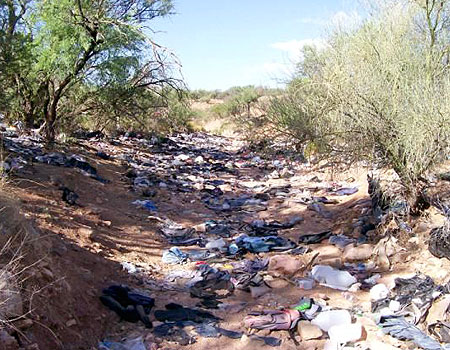
“At Cabeza Prieta National Wildlife Refuge, AZ, Wilderness Act restrictions have limited the extent to which Border Patrol agents can use vehicles for patrols and technology resources to detect border crossers. Nearly 8,000 miles of trails created by undocumented aliens throughout the refuge have been identified by refuge staff. Border Patrol believes if they had a east-west road they could make arrests closer to the border instead of throughout the refuge, thereby benefiting the environment,” the GAO report noted.
This ridiculous state of affairs effectively gives Interior’s environmental regulations a higher priority than Homeland Security’s mission to keep terrorists, human traffickers, foreign criminals and drug smugglers out of the country. Without operational control of the border, DHS cannot prevent these and other undesirable invaders from entering the U.S. at will – or from trashing the same wilderness areas Interior is trying to protect.
8/09/2010
Perry greets Obama with request for 1,000 more deployed to border

By Alex Pappas
Texas Republican Gov. Rick Perry, donning a tan suit and cowboy boots, welcomed President Obama to the Lone Star State today with a hearty handshake on a Texas tarmac. But that’s not all the Republican had for the president.
After greeting Obama at Austin Bergstrom International Airport Monday morning, Perry pulled a letter from his suit pocket and handed it to presidential adviser Valerie Jarrett — who was right behind the president — warning the president about the “dire threat amassing on our southern border,” and asking for 1,000 more National Guard
troops to be stationed along the Texas border.
In the letter, provided by the governor’s office, Perry said that since 2006, the drug cartels have killed 28,000 people. “Absent stronger federal action, it’s only a matter of time before that violence affects more innocent Americans,” he wrote.
While the Obama administration plans to send 1,200 National Guard troops to the southwest border, Perry said, the less than 300 personnel expected in Texas is “clearly insufficient.”
“The need for border security along the Rio Grande should no longer be underestimated by the federal government, Mr. President,” Perry wrote. “An unsecured border is a threat to our national security and to the safety and security of all our citizens.”
Perry also renewed a standing request for Obama, Homeland Security Secretary Janet Napolitano and Defense Secretary Robert Gates to meet with him and his staff about the issue.
White House spokesman Bill Burton, speaking with the reporters traveling with the president on Air Force One before Perry greeted Obama, said Obama has no plans to hold a lengthy discussion with Perry on the issue during today’s trip.
The White House declined comment when reached by The Daily Caller.
related-Bill White Avoids Obama in Texas, Rick Perry Campaign Pounces
8/06/2010
If Not Now, When?

By Bargain Citizen
In today's America, the federal government can choose to ignore a constitutional responsibility at its whim, even when it results in citizens and states being left vulnerable to foreign invasion. Adding insult to injury, the Feds impound taxes from the injured citizens for the express purpose of providing this contractual protection.
In the matter of securing our borders and dealing with illegal aliens, we have an interesting twist. Washington has long acted beyond the powers granted to it by merely assigning itself additional authority. In this instance, however, the officials in Washington are effectively waiving authority, refusing to do what they are obligated to do per the U.S. Constitution.
Yet inside "The Matrix," where the powers that be in Washington make it up as they go along, the elite ruling class and their media lackeys insist that securing our border is the strict responsibility of the federal government.
According to Eric Holder's Justice Department and U.S. District Court Judge Susan Bolton, whether or not they do so adequately has no bearing on the matter. Regardless of the details within their respective lawsuit and rulings, the bottom line is that Washington maintains that states are powerless to take actions necessary to defend themselves, and so it is.
Someone needs to convince me that this is what the Constitution actually says.
Indeed, the U.S. government's mandate to "provide for the common defense" -- a phrase located in the Constitution's Preamble as well as Article I, Section 8 -- makes clear that the Feds bear a primary responsibility to protect us from foreign sources. Article IV, Section 4 dictates even more succinctly, "The United States ... shall protect each of them [the states] against Invasion[.]"
Obviously, the United States is not fulfilling this obligation. That is no secret. The question at hand is -- are states denied the right to defend themselves?
At least there are still a number of state attorneys general who believe so. In response to U.S. Attorney General Eric Holder and his so-called Justice Department's suit against Arizona SB1070, Michigan Attorney General Mike Cox filed a brief on behalf of nine states in support of Arizona's actions.
Article I, Section 10 of the Constitution specifies what individual states are prohibited from doing: making treaties, coining money, etc. In this section, we find the document's clause most directly pertaining to the issue: "No State shall, without the consent of Congress ... engage in War, unless actually invaded, or in such imminent Danger as will not admit of delay."
Though states are not at war in the classic or technical sense, they are clearly being invaded. Regardless of whether or not we consider them "at War," it would be difficult to reason that this clause prohibits a state from defending itself.
Note the use of the different forms of the word "invade" in these various passages. Surely, they must be interpreted in the same manner.
If the Feds, on one hand, maintain their authority to secure the border and prohibit illegal immigration is granted by Article IV's guarantee to "protect against invasion," then Article I makes clear that it is not their sole domain to do so. Here, states are granted the same power when "actually invaded."
Further, just how exactly shall we interpret being "invaded," or "in imminent danger" for that matter, and who shall make that determination? Most assuredly, citizens in states along our southern border (and in some states and cities, well beyond the border) have a far different opinion from Washington's.
In sum, it seems that Article I, Section 10 must explicitly provide states the right to act on their own behalf when they are being invaded, or else it does not prohibit them from doing so. The clause would be irrelevant in circumstances other than an official state of war, thus no prohibition otherwise.
This effectively leaves the federal government attempting to convince us that states are not to defend themselves while waiting indefinitely for Washington to determine if they are in "imminent danger."
f we are to accept the current federal government's interpretation on this matter, then federalism is indeed dead. If Washington is to routinely defy the contract which empowers it, where does that leave the states? If this is not a constitutional crises, then what shall we call it?
The federal government has been on a roll for decades, routinely usurping proper authority and effectively running roughshod over the entities (the states) that created it in the first place. However, there is one important component they lack. Now, more than ever, they do not have the people on their side. Poll after poll indicates that they are governing against our will.
Washington has drastically overreached, leaving itself vulnerable to a power shift, perhaps more so than at any other time in our nation's history.
Present circumstances facilitate the opportunity for states to boldly assert their powers. A substantial majority of citizens are solidly behind them on one issue after another, none more so than the issues of securing our borders and illegal immigration.
Just as Jan Brewer and the Arizona legislature have thrown down the gauntlet, so it is time for the next state to step forward and take the matter to the next level. We are living in times which demand bold action. The people are not only ready for it, but they thirst for it.
This is a unique point in history. The time to force the issue of states' rights is now. State leaders have an opportunity to move this debate onto the national stage unlike ever before. Forget all the wishy-washy political calculations and analysis. Such things have long since become secondary.
Besides, not only is a state protecting itself the right thing to do, not only is it constitutional, but right now, it is a winner electorally.
8/05/2010
Illogical Immigration

By Victor Davis Hanson
Some 11 million to 15 million illegal aliens are now residing in America, most after crossing into America unlawfully. Once a federal law is arbitrarily not enforced, all sorts of bizarre paradoxes arise from that original contradiction. As proof, examine the following illogical policies and contradictions involving illegal immigration.
Take, for example, profiling -- the controversial questioning of those who appear likely to be illegal aliens. Apparently, American border guards have developed criteria for profiling those deemed likely to be unlawful aliens. Otherwise, how would they have arrested and deported hundreds of thousands in 2009?
Yet apparently, at some arbitrary point distant from the border, those who cross illegally are not supposed to be asked about their immigration status. OK, but exactly why did procedures so radically change at, say, five, 10, 20, or is it 100 miles from the border? A border patrolman often profiles, but a nearby highway patrolman cannot?
The federal government is suing Arizona for the state's efforts to enforce the federal immigration law. The lawsuit alleges that Arizona is too zealous both in enforcing immigration law and encroaching on federal jurisdiction.
But wait -- for years, several American cities have declared themselves sanctuary cities. City officials have even bragged that they would not allow their municipalities to enforce federal immigration statutes. So why does Washington sue a state that seeks to enhance federal immigration laws and yet ignore cities that blatantly try to erode them?
Something is going very wrong in Mexico to prompt more than half a million of its citizens to cross the border illegally each year. Impoverished Mexican nationals variously cite poor economic conditions back home, government corruption, a lack of social services, and racism. In other words, it is not just the desirability of America but also the perceived undesirability of Mexico that explains one of largest mass exoduses in modern history.
But why, then, would Mexican President Felipe Calderon, whose country's conditions are forcing out its own citizens, criticize the United States, which is receiving so many of them? And why, for that matter, would many of those illegal immigrants identify, if only symbolically, with the country that made them leave, whether by waving its flag or criticizing the attitudes of the Americans who took them in?
And how does Mexico treat the hundreds of thousands of aliens who seek to illegally cross its own southern border with Central America each year? Does Mexico believe in sovereign borders to its south but not to its north?
Is Mexico more or less humane to illegal aliens than the country it so often faults? Why, exactly, does Mexico believe that nearly a million of its own nationals annually have claims on American residency, when Chinese, Indian, European and African would-be immigrants are deemed not to? Is the reason proximity? Past history?
Proponents of open borders have organized May Day rallies, staged boycotts of Arizona, sued in federal and state courts, and sought to portray those who want to enforce existing federal immigration law as racially insensitive. But about 70 percent of Americans support securing our borders, and support the Arizona law in particular. Are a clear majority of Americans racist, brainwashed or deluded in believing that their laws should be enforced? And if so, why would immigrants wish to join them?
It is considered liberal to support open borders and reactionary to want to close them. But illegal immigration drives down the hourly wages of the working American poor. Tens of thousands of impoverished people abroad, from Africa to Asia, wait patiently to enter America legally, while hundreds of thousands from Latin America do not. How liberal can all that be?
America extends housing, food and education subsidies to illegal aliens in need. But Mexico receives more than $20 billion in American remittances a year -- its second-highest source of foreign exchange, and almost of it from its own nationals living in the United States. Are Americans then subsidizing the Mexican government by extending social services to aliens, freeing up cash for them to send back home?
These baffling questions are rarely posed, never addressed and often considered politically incorrect. But they will only be asked more frequently in the months ahead.
You see, once a law is not considered quite a law, all sorts of even stranger paradoxes follow.
8/04/2010
Immigration enforcement union took a no-confidence vote in its leadership

By: Joel S. Gehrke Jr.
Immigration and Customs Enforcement agents believe overwhelmingly that their department leadership has become so politicized as to compromise the effectiveness of ICE and the safety of American people. Their union has released a letter announcing its recent unanimous “vote of no confidence” in ICE agency heads, accusing them of “misleading the American public” regarding illegal immigration in order to further a pro-amnesty agenda.
In June, the National Immigration and Customs Enforcement Council — an AFL-CIO affiliate — and affiliated local councils cast a unanimous 259-0 vote of no confidence in ICE Director John Morton and Assistant Director Phyllis Coven. In a letter announcing the vote, the National Council criticized the directors for “misguided and reckless initiatives,” and said their leaders have “abandoned the Agency’s core mission of enforcing United States immigration laws and providing for public safety, and have instead directed their attention to campaigning for policies and programs related to amnesty.”
Janice Kephart at the Center for Immigration Studies has the letter, which includes several biting indictments of ICE failures by ICE agents. For instance:
Senior ICE leadership dedicates more time to campaigning for immigration reforms aimed at large scale amnesty legislation, than advising the American public and Federal lawmakers on the severity of the illegal immigration problem, and the need for more manpower and resources within the ICE ERO to address it. ICE ERO is currently overwhelmed by the massive criminal alien problem in the United States resulting in the large-scale release of criminals back into local communities.
Kind of puts the Arizona illegal immigration enforcement in perspective, doesn’t it?
While ICE reports internally that more than 90 percent of ICE detainees are first encountered in jails after they are arrested by local police for criminal charges, ICE senior leadership misrepresents this information publicly in order to portray ICE detainees as being non-criminal in nature to support the Administration’s position on amnesty and relaxed security at ICE detention facilities.
The majority of ICE ERO Officers are prohibited from making street arrests or enforcing United States immigration laws outside of the institutional (jail) setting. This has effectively created “amnesty through policy” for anyone illegally in the United States who has not been arrested by another agency for a criminal violation.
Good to know.
Unconstitutional or Inconvenient

By Aaron Goldstein
Several weeks ago, I made this observation about the Obama Administration's lawsuit against the State of Arizona and Governor Jan Brewer:
When the DOJ argues that S.B. 1070 "will impose significant and counterproductive burdens on federal agencies" what they mean is that the ICE operated Law Enforcement Support Center in Williston, Vermont could get a lot more phone calls from Arizona. So it could blow the overtime budget of DHS. This is an administrative issue, not a constitutional one. Perhaps it will cause some inconvenience for the feds. But let us never confuse inconvenience with unconstitutionality.
Yet this is exactly what U.S District Court Judge Susan Bolton did when she blocked parts of the Arizona's immigration law last week. One of the key arguments that led to Bolton's decision was put forward by David Palmatier, the Unit Chief of the Law Enforcement Support Center (LESC), a hotline available to federal, state and local officials 24 hours a day, seven days a week to determine an individual's immigration status. Palmatier filed a declaration with the U.S. District Court in Arizona, stating his objections to S.B. 1070:
In my professional judgment, Arizona S.B. 1070 will inevitably results in a significant increase in the number of IAQs (Immigration Alien Queries). The LESC processed just over 1,000,000 IAQs in FY 09. According to the FBI Criminal Justice Information Services (CJIS), in FY 09 criminal justice agencies in Arizona submitted 563,474 arrest records to CJIS, but just over 80,000 IAQs originated from all agencies within the state of Arizona in FY 09. Thus, Arizona's SB 1070's requirement that "(a)ny person who is arrested shall have the person's immigration status determined before the person is released" could, by itself, dramatically increase the LESC's workload. Moreover, because Arizona's law calls for status verifications for lawful stops -- whether or not such stops result in an arrest -- the number of IAQs will increase dramatically. If even a small percentage of these stops, detentions, and arrests lead to new IAQs, the LESC will be forced to process thousands of additional IAQs annually. Moreover, Arizona's new law will result in an increase in the number of U.S. citizens and lawful permanent residents being queried through the LESC, reducing our ability to provide timely responses to law enforcement on serious criminal aliens.Needless to say, Judge Bolton was sympathetic to Palmatier's argument:
Mr. Palmatier states in his Declaration that LESC resources are currently dedicated in part to national security objectives such as requests for immigration status determination from the United States Secret Service, the FBI, and employment-related requests at "national security related locations that could be vulnerable to sabotage, attack or exploitation." Thus an increase in the number of requests for determinations of immigration status, such as is likely to result from the mandatory requirement that Arizona law enforcement officials and agencies check the immigration status of any person who is arrested, will divert resources from the federal government's other responsibilities and priorities.For these reasons, the United States has demonstrated that it is likely to succeed on its claim that the mandatory immigration verification upon arrest requirement contained in Section 2(B) of S.B. 1070 is preempted by federal law.
There is no way the State of Arizona ever intended to have its law enforcement officials check the immigration status of every single person arrested in their jurisdiction. In fact, the State of Arizona said as much in its arguments before Judge Bolton and it is a point she acknowledged in her decision. Yet that did not stop Judge Bolton from writing, "The Court cannot interpret this provision as Arizona suggests."
Judge Bolton's thinking (and for that matter Palmatier's) begs this question. If a person produces a passport, a driver's license or some other government issued identification during a lawful stop, detention or arrest by an Arizona law enforcement official, why would said law enforcement official then develop a reasonable suspicion that person was in the country illegally? If, in fact, it was Arizona's intention to check the immigration status of every single person they arrested, then I would argue that Arizona would be doing the very opposite of racial profiling. Yet somehow I don't think critics of S.B. 1070 would be inclined towards such generosity.
But putting aside the question of whether it is actually mandatory for Arizona law enforcement officials to contact the LESC following every single arrest, let us assume that Palmatier is correct in his assessment that the implementation of S.B. 1070 would result in a dramatic increase of IAQ requests to his agency. So what if does? The LESC will simply have to find a way to deal with it whether by lobbying for more resources or reallocating existing ones. I am not suggesting the implementation of the Arizona immigration law doesn't present administrative, budgetary and other logistical challenges for the LESC. But it does not present a constitutional challenge. According to 8 United States Code, Section 1373(c) -- Obligation to respond to inquiries:
The Immigration and Naturalization Service shall respond to an inquiry by a Federal, State, or local government agency, seeking to verify or ascertain the citizenship or immigration status of any individual within the jurisdiction of the agency for any purpose authorized by law, by providing the requested verification or status information.Whether Palmatier likes it or not, the State of Arizona and its municipalities have as much right as the FBI, the Secret Service or any other federal agency to inquire about an individual's immigration status even if it makes life at the LESC more inconvenient. Let it be said once more. Inconvenience must never be confused with unconstitutionality. One can only hope a higher court will recognize this and overturn Judge Bolton's shortsighted decision.
8/02/2010
The Pottery Barn Rule

By Jed Skillman
A few years ago, regarding Iraq policy, Colin Powell warned George W. Bush of the Pottery Barn Rule: "You break it, you own it." It's time conservatives started emphasizing this when it comes to key issues like the border.
By shutting out local authorities and insisting that the enforcement of borders and immigration is solely a federal job, the Obama administration has taken complete ownership of the issue and all of the problems that result from it. Call this the "Barack Obama Insurance Policy." President Obama is putting his name on the immigration problem and telling residents of Arizona and the rest of the country that he's up to the job of tackling it: "Relax. I'll take care of things."
Okay, Mr. President, you're in charge. From here on out, if anything breaks, you get the bill. That includes shootings, kidnappings, and headless bodies found in the desert.
Moving the official command and control center from Phoenix to Washington, D.C. -- about as far away from Arizona as is possible to get -- seems like a dumb idea. Arizona residents will not sleep better knowing that help is only 2,300 miles away. Continued dawdling on sending National Guard troops does not reassure.
The president does not seem to understand that because of his own Justice Department's case and Judge Bolton's ruling, he now owns the problem. All of the crime and violence, the shootings and kidnappings are his problem now. While he can count on a continued news blackout on the part of the MSM, it is a safe bet that Fox News will continue to report (you decide) and air hidden-camera footage of drug smugglers and human traffickers crossing the border at will.
It is not a pretty picture. Inevitably, the Obama administration will get tangled up in some unpleasant border incident. When that happens, the president will attempt to shift the blame, and the people of Arizona will bear the cost. Our job will be to make sure that Obama is not able to shirk the responsibility he has taken with his District Court victory.
We were looking for a bright side to the story. That's about as bright as it gets.
Simultaneously, there is a dark cloud that seems to have escaped notice. The Republican Party had a hand in Judge Bolton's decision. All you Tea Party people take note.
In 2000, Judge Susan Bolton was nominated to the District Court by none other than President Bill Clinton. No surprises there. Problem is, U.S. Senator John Kyl, Republican of Arizona, is the one who suggested her. Further, at that time, the U.S. Senate was in Republican control, and Trent Lott was Majority Leader.
Fade Out -- Fade In: Ten years later...
When Democrats needed a judge to do them a favor, they had one in the right place, and the Republicans put her there. This is what America gets as a result of Republican "collegiality" and going-along-to-get-along.
The purpose here is not to bang on John Kyl. He's a pretty good senator. But the Pottery Barn-rule applies to him, too, and to all of our elected officials. They have to know that they are accountable to us, not "Them." We do not hold elections and send people to Washington to represent someone else's interests. They are to represent our interests.
Keep the Arizona decision in mind when Elena Kagan's name comes up for a vote.
To those reading this in Maine, Massachusetts, or South Carolina, now would be a good time to contact your Republican senator. Remind them that if they break something, they bought it.
7/30/2010

Subscribe to:
Posts (Atom)