Tip Jar

Showing posts with label Obama Forign Policy. Show all posts

2/22/2009

Le·gal In·sur·rec·tion: Obama To Appoint "The Vacuum Cleaner" To Plum Ambassadorship


Ah, hope and change. Near silence from the American mainstream media, but this news item from the Brits about Obama appointing one of his key fundraisers as Ambassador to Great Britain:

Barack Obama has been embroiled in a cronyism row after reports that he intends to make Louis Susman, one of his biggest fundraisers, the new US ambassador in London.

The selection of Mr Susman, a lawyer and banker from the president's hometown of Chicago, rather than an experienced diplomat, raises new questions about Mr Obama's commitment to the special relationship with Britain.

American commentators denounced the selection of a rich friend to the plumb post, regarded as one of the most prestigious in the president's gift, as worthy of a "banana republic". They said it was proof that Mr Obama has turned his back on his campaign pledge to end politics as usual....

Mr Susman's reputation for hoovering large amounts of cash from deep pockets saw him nicknamed "the vacuum cleaner" when he raised more than $240million for John Kerry's White House bid in 2004.

He was one of Mr Obama's biggest campaign cash "bundlers", fundraisers who collect contributions from hundreds of others. He also gave $300,000 to the president's inauguration fund.


More...

Complete Original ArticleLe·gal In·sur·rec·tion: Obama To Appoint "The Vacuum Cleaner" To Plum Ambassadorship#links#links

2/19/2009

An 'Impulsive' America?


By Victor Davis Hanson

President Barack Obama's first TV interview was with the Dubai-based, partly Saudi-funded Al Arabiya satellite channel. In passing, he faulted past American policy for too readily "dictating" in the Middle East. He had better things to say about Saudi King Abdullah's "courage" in trying to solve the Middle East crisis.

Vice President Joe Biden likewise has promised the world a sharp break from the prior Bush administration that, from his references, was apparently to blame for bouts of anti-Americanism abroad. He assured the Europeans at the Munich Security Conference that it was time to press the reset button in foreign policy, and pledged a new chapter in America's overseas relations.

On her initial tour abroad, Secretary of State Hillary Clinton re-emphasized the Obama and Biden message, announcing that she would follow an approach that "values what others have to say." And then Clinton elaborated on this now well-worn "blame Bush" theme: "Too often in the recent past, our government has acted reflexively before considering available facts and evidence or hearing the perspectives of others." America, Clinton promised, from now on would be "neither impulsive nor ideological."

Contrast such admirable talk with recent events:

North Korea has just announced that it plans to launch a new Taepodong-2 missile capable of reaching the United States.

China, which holds hundreds of billions of dollars in U.S. Treasury bonds and will be asked to loan us billions more, advised the Obama administration to drop the "buy American" talk in the new Democratic stimulus program.

Iranian President Mahmoud Ahmadinejad recently bragged that his country would soon go nuclear, and that President Obama's offer to talk without preconditions revealed a new passivity in the West.

Russia just announced that it had developed a new strategic relationship with Iran, and warned that American-sponsored missile defense for Eastern Europe was unpalatable.

About the same time, the former Soviet republic of Kyrgyzstan, on Russian advice, disclosed that it may no longer allow Americans to use a base in their country to supply the war effort in Afghanistan.

Pakistan just released from house arrest A.Q. Khan, the father of the Pakistani nuclear bomb, who had sold nuclear technologies to the likes of Libya and North Korea.

This rather provocative behavior reminds us that President Obama's laudable assurances of a new age of American diplomacy may often be ignored -- or exploited -- rather than always appreciated. North Korea, for example, may agree with Hillary Clinton's criticism of the United States the last eight years -- and thereby announce to her that it feels less obligated to keep promises once made with an "impulsive" United States.

European governments in France, Germany, Italy and most of Eastern Europe have long been pro-American. India is friendly; so is most of Asia. Africa has received billions of dollars in recent American help to combat AIDS.

These friends of ours., despite their serial complaining about the U.S., may privately be worrying that a kinder, more eloquent antithesis to George Bush will lead to too much dialogue and not enough leadership. After all, the agendas of Mahmoud Ahmadinejad, Hugo Chavez, Kim Jong Il, the leaders of Hamas and Hezbollah, Vladimir Putin and other roguish leaders transcend the Bush presidency.

We have already learned from Barack Obama's adjustments from his original positions on the Patriot Act , the FISA accords, the surge and overseas rendition that often the past administration faced only bad choices -- which were easier to criticize as a candidate than to reject outright as president.

Now, by so loudly broadcasting a near-divine morality, rather than just quietly putting its own imprint on us foreign policy, the Obama administration only sets itself up for the charge of hypocrisy.

True, it is wise to drop the unnecessary smoke-'em out dead-or-alive lingo that sometimes characterized the Bush administration. But it would be foolish to reject many of its successful initiatives simply because they were poorly articulated or sometimes couched in unfortunate tough-guy rhetoric.

The last president to promise such a grandiose break from the American past was Jimmy Carter. As he entered office in the post-Watergate, post-Vietnam age, he lectured the world about human rights. Carter promised an end to America's inordinate fears of communism, and vowed to show more kindness abroad -- and as recompense earned in a mere three years the Soviets in Afghanistan, communist insurgencies in Central America, and American hostages in Tehran.

Given the depressing nature of the world abroad, the more we now keep promising to be gentle, the bigger the stick later on we will have to carry.
More...

Complete Original Article

2/02/2009

Obama preserves renditions as counter-terrorism tool

The role of the CIA's controversial prisoner-transfer program may expand, intelligence experts say.

Reporting from Washington -- The CIA's secret prisons are being shuttered. Harsh interrogation techniques are off-limits. And Guantanamo Bay will eventually go back to being a wind-swept naval base on the southeastern corner of Cuba.

But even while dismantling these programs, President Obama left intact an equally controversial counter-terrorism tool.

Under executive orders issued by Obama recently, the CIA still has authority to carry out what are known as renditions, secret abductions and transfers of prisoners to countries that cooperate with the United States.

Current and former U.S. intelligence officials said that the rendition program might be poised to play an expanded role going forward because it was the main remaining mechanism -- aside from Predator missile strikes -- for taking suspected terrorists off the street.

The rendition program became a source of embarrassment for the CIA, and a target of international scorn, as details emerged in recent years of botched captures, mistaken identities and allegations that prisoners were turned over to countries where they were tortured.

The European Parliament condemned renditions as "an illegal instrument used by the United States." Prisoners swept up in the program have sued the CIA as well as a Boeing Co. subsidiary accused of working with the agency on dozens of rendition flights.

But the Obama administration appears to have determined that the rendition program was one component of the Bush administration's war on terrorism that it could not afford to discard.

The decision underscores the fact that the battle with Al Qaeda and other terrorist groups is far from over and that even if the United States is shutting down the prisons, it is not done taking prisoners.

"Obviously you need to preserve some tools -- you still have to go after the bad guys," said an Obama administration official, speaking on condition of anonymity when discussing the legal reasoning. "The legal advisors working on this looked at rendition. It is controversial in some circles and kicked up a big storm in Europe. But if done within certain parameters, it is an acceptable practice."

One provision in one of Obama’s orders appears to preserve the CIA's ability to detain and interrogate terrorism suspects as long as they are not held long-term. The little-noticed provision states that the instructions to close the CIA's secret prison sites "do not refer to facilities used only to hold people on a short-term, transitory basis."

Despite concern about rendition, Obama's prohibition of many other counter-terrorism tools could prompt intelligence officers to resort more frequently to the "transitory" technique.

The decision to preserve the program did not draw major protests, even among human rights groups. Leaders of such organizations attribute that to a sense that nations need certain tools to combat terrorism.

"Under limited circumstances, there is a legitimate place" for renditions, said Tom Malinowski, the Washington advocacy director for Human Rights Watch. "What I heard loud and clear from the president's order was that they want to design a system that doesn't result in people being sent to foreign dungeons to be tortured -- but that designing that system is going to take some time."

Malinowski said he had urged the Obama administration to stipulate that prisoners could be transferred only to countries where they would be guaranteed a public hearing in an official court. "Producing a prisoner before a real court is a key safeguard against torture, abuse and disappearance," Malinowski said.

CIA veterans involved in renditions characterized the program as important but of limited intelligence-gathering use. It is used mainly for terrorism suspects not considered valuable enough for the CIA to keep, they said.

"The reason we did interrogations [ourselves] is because renditions for the most part weren't very productive," said a former senior CIA official who spoke on condition of anonymity because of the sensitive nature of the subject.

The most valuable intelligence on Al Qaeda came from prisoners who were in CIA custody and questioned by agency experts, the official said. Once prisoners were turned over to Egypt, Jordan or elsewhere, the agency had limited influence over how much intelligence was shared, how prisoners were treated and whether they were later released.

"In some ways, [rendition] is the worst option," the former official said. "If they are in U.S. hands, you have a lot of checks and balances, medics and lawyers. Once you turn them over to another service, you lose control."

In his executive order on lawful interrogations, Obama created a task force to reexamine renditions to make sure that they "do not result in the transfer of individuals to other nations to face torture," or otherwise circumvent human rights laws and treaties.

The CIA has long maintained that it does not turn prisoners over to other countries without first obtaining assurances that the detainees will not be mistreated.

More...

In a 2007 speech, https:// www.cia.gov/news-information/speeches-testimony/2007/general-haydens-remarks-at-the-council-on-foreign-relations.html "> www.cia.gov/news-information/speeches-testimony/2007/general-haydens-remarks-at-the-council-on-foreign-relations.html the agency had to make a determination in every case "that it is less, rather than more, likely that the individual will be tortured." He added that the CIA sought "true assurances" and that "we're not looking to shave this 49-51."

Even so, the rendition program became a target of fierce criticism during the Bush administration as a series of cases surfaced.

In one of the most notorious instances, a German citizen named Khaled Masri was arrested in Macedonia in 2003 and whisked away by the CIA to a secret prison in Afghanistan. He was quietly released in Albania five months later after the agency determined it had mistaken Masri for an associate of the Sept. 11 hijackers.

Masri later described being abducted by "seven or eight men dressed in black and wearing black ski masks." He said he was stripped of his clothes, placed in a diaper and blindfolded before being taken aboard a plane in shackles -- an account that matches other descriptions of prisoners captured in the rendition program.

In another prominent case, an Egyptian cleric known as Abu Omar was abducted in Italy in 2003 and secretly flown to an Egyptian jail, where he said he was tortured. The incident became a major source of embarrassment to the CIA when Italian authorities, using cellphone records, identified agency operatives involved in the abduction and sought to prosecute them.

Defenders of the rendition program point out that it has been an effective tool since the early 1990s and was often used to bring terrorism suspects to courts in the United States. Among them was Ramzi Ahmed Yousef, who was captured in Pakistan and was convicted of helping orchestrate the 1993 World Trade Center bombing.

Because details on the rendition program are classified, the scale of the program has been a subject of wide-ranging speculation.

An exhaustive investigation by the European Union concluded that the CIA had operated more than 1,200 flights in European airspace after the Sept. 11 attacks.

The implication was that most were rendition-related, with some taking suspects to states where they faced torture.

But U.S. intelligence officials contend that the EU report greatly exaggerated the scale of the program and that most of the flights documented by the Europeans involved moving supplies and CIA personnel, not prisoners.

Instead, recent comments by Hayden suggest that the program has been used to move no more than a handful of prisoners in recent years and that the total is in the "midrange two figures" since the Sept. 11 attacks.

Complete Original Article

2/01/2009

KUHNER: Lethal olive branch


COMMENTARY:

President Barack Obama has disgraced himself and the United States. His first formal television interview as commander in chief was not with CNN, MSNBC, ABC or Fox News - American media outlets. Instead, it was with Al Arabiya, a Saudi-funded Arabic-language news channel.

Mr. Obama's intent: To provide an olive branch to Muslims in the Middle East. Mr. Obama's goal is to send a clear message that his administration represents a dramatic break from President Bush's policies. "My job to the Muslim world is to communicate that the Americans are not your enemy," he said.

Moreover, Mr. Obama admitted the United States committed "mistakes" in the past, but he now wants to restore "the same respect and partnership that America had with the Muslim world as recently as 20 or 30 years ago."
More...

He called for a new partnership with the Muslim world "based on mutual respect and mutual interest." Mr. Obama also did something he refused to do as a candidate: play the Muslim card. During the election, the mainstream media and his campaign spokesmen denounced as bigots anyone who raised the issue of Mr. Obama's Islamic ties. It was taboo to even mention it. It is now fair game - provided it comes from the president. In the interview, he talked about growing up in Indonesia, the Muslim world's most populous nation, and noted that he has Muslim relatives. Hence, Mr. Obama seeks to woo the notorious "Arab street" by demonstrating his multicultural credentials: He understands the Islamic faith and possesses the empathy to forge a durable peace.

There is something unseemly - and pathetic - about a U.S. president groveling in front of the Middle East's tyrants and tin-pot dictators, asking for their understanding. The fundamental problem in the region is not American mistakes or Mr. Bush's assertive diplomacy, but its theological backwardness and dysfunctional political culture.

The Arab world's leaders are a motley crew of fanatics, mass murderers and kleptocrats. Decades of misrule, oppression and Islamist propaganda have created the climate for youngsters to embrace jihadism.

There is nothing new in Mr. Obama's approach. It amounts to a return to the realpolitik and appeasement of Arab autocracies championed by U.S. administrations since the 1950s - policies that in the long-run have proved disastrous. If the Sept. 11, 2001, attacks should have taught us anything, it is that diplomatic "engagement" with Middle Eastern thugs guarantees neither stability nor peace.

It is no wonder Mr. Bush's policies were despised by Arab political elites. He was never a conservative - at least, not in the traditional sense. Rather, he was a liberal revolutionary, who sought to transform the Middle East by bringing democracy and political pluralism. He understood that the only way to eliminate the root cause of terrorism is to sweep away the old autocratic structures.

Mr. Bush's pro-democracy, pro-freedom agenda threatened the rotting status quo, the powerful princes and corrupt clerics who have kept the Arab masses in poverty and ignorance for generations. This has allowed hatreds and resentments to fester, eating away at the region's body politic - enabling radical Islam to fill the void.

For the first six years of his presidency, Mr. Bush awakened the impulses of liberty and encouraged the rise of democratic movements once thought impossible.

The long-term consequences of the Bush Doctrine are still not known - and will not be known for some time, especially whether Iraq remains a pro-American democracy in the heart of the Middle East.

But this much we know: The United States does not owe the Muslim world an apology. No country has done more to liberate Muslims than America.

Under Mr. Bush's leadership, the United States toppled the Taliban regime in Afghanistan, overthrew Saddam Hussein's fascist dictatorship in Iraq, helped drive Syria from its occupation of Lebanon, laid a path to an independent Palestinian state (provided it renounces terrorism), forced Libya to abandon its weapons of mass destruction, saved millions of African Muslims from the scourge of AIDS, and prevented Pakistan from falling into the hands of Islamist extremists.

Prior to the Bush administration, Washington bombed the Serbs to protect the Muslim populations of Bosnia and Kosovo. U.S. soldiers were killed - their dead bodies dragged through the streets of Mogadishu - trying to prevent famine in Somalia. American forces liberated Kuwait from Saddam's brutal occupation. None of this is applauded or acknowledged in the Muslim world. Yet America's accomplishments are no less real.

Mr. Obama's vow to "listen" instead of "dictating" to Muslim leaders shows how little he understands his own country, the Middle East or the seminal reality of our time. At his core, Mr. Obama is a post-modernist leftist who champions an anti-American, transnationalist agenda. Whenever there is an international problem, America is always to blame and "aggressive diplomacy" (a meaningless and incoherent phrase) is always the answer.

Yet, it is not America's flaws that need to be focused on; it is the Muslim world's deep-seated flaws. The region is dysfunctional, and the only thing that can fix it is real reform - the kind ushered in by the Bush administration. "Listening" to venal Saudi princes or inept Palestinian leaders or corrupt Egyptian strongmen will not lead to a new strategic partnership. It will lead to another dead end - one that enables the region's autocrats to stay in power.

Call it diplomacy by self-induced delusion. Mr. Obama may want to deny we are in a war against radical Islam, but it doesn't mean there isn't one. He may choose not to fight it.

We did that once before. The result was 3,000 dead and the worst attack ever on U.S. soil. What price will America pay the next time we refuse to face this ugly reality?

Jeffrey T. Kuhner is a columnist at The Washington Times.

Complete Original Article


More...

Complete Original Article
1/31/2009

Turkey Looking Like The Next Iran

Turkish Prime Minister Recep Tayyip Erdogan, who heads an Islamist party, recently ripped into Shimon Peres, President of Israel at the Davos forum, telling Peres "when it comes to killing, you know well how to kill.” Peres gave it right back to Erdogan, accusing Erdogan of ignoring the long history of Arab violence against Israel, causing Erdogan to storm off the stage. The video is here (Peres' response starts at 39:25). Erdogan was given a hero's welcome when he returned to Turkey. (h/t Little Green Footballs and IsraellyCool)

Perhaps it's time to talk a little Turkey. First, let's talk Kurds. The Turks have killed an estimated 20,000 Kurds, attempted to destroy Kurdish language and culture, launched invasions of Kurdish northern Iraq, and denied to the millions of Kurds within and without Turkey's borders the right to an independent state. In fact, the Kurds outnumber the Palestinians several times over, yet because the Kurds have not spent the last 50 years demanding the destruction of Israel, the cause of Kurdish independence has not caught the fancy of the Western media and political elites. Now that Prime Minister Erdogan has expressed such profound sympathies for suppressed national movements, perhaps it is time that Erdogan put his actions where his mouth is, and free the Kurds.

Next, let's talk Armenians. Since Erdogan wants to right historical wrongs, why doesn't Erdogan apologize for the genocide the Ottoman Empire committed against the Armenians. Since the first step in recovery is acknowledgement of a problem, at least stop the denials that it happened, even if you won't apologize.

Many people in Turkey and elsewhere feared what would happen if an Islamist party took over the helm of a secular state. You are beginning to see the results as Erdogan whips up popular support at home by joining the anti-Israel cause.

My prediction: Turkey is the next Iran, unless Obama stops blaming the U.S. for Islamist aggression and gives support to Turkey's secular institutions, including the Turkish army. Jimmy Carter tried the blame America first tactic; it didn't win us any friends and led to 30 years of tyranny and human rights abuses in Iran. Don't repeat the same mistake in Turkey.

Le·gal In·sur·rec·tion: Turkey Looking Like The Next Iran

The UN's insanity continues


The United Nations "anti-racism" forum, known as Durban II, is becoming a more important test for President Obama's multilateralist ambitions with each passing day. Durban I was the anti-Semitic hatefest that ended three days before 9/11. Durban II - the UN equivalent of the Son of Sam - will take place in April in Geneva. Israeli Foreign Minister Tzipi Livni has called on Obama not to legitimize the meeting, or its message, and not to attend. Canada has decided to stay away. But Obama has still not decided whether the United States will go. This Wednesday, however, the stakes got a lot higher with the UN's release of the latest negotiating text.

Negotiators have now put on the table claims that (1) a homeland for the Jewish people is racism - a "racially based law of return," (2) Israel is guilty of "apartheid" and (3) the veracity of the murder of one-third of the Jewish people during the Holocaust is subject to question. A reference to Holocaust facts has now been "square-bracketed" because Iran and Syria have questioned the numbers of Jews that died and consensus is the only guiding principle governing the decision-making process.

In total, six provisions are dedicated to demonizing Israel as racist. Not one of the other 191 UN states is mentioned. The intention is clear: the political defeat of Israel in the same vein as apartheid South Africa, because repeated attempts at a military defeat of Israel have failed.

But Israel is not the only target of Islamic and Arab states and their developing world partners. More...The draft takes straight aim at freedom of expression and counterterrorism. Free speech should supposedly be curtailed by new laws against "projecting negative, insulting and derogatory images of religions and religious personalities" and the introduction of "a code of ethical conduct" for the media. Counterterrorism activities are "obstacles hampering progress in the collective struggle against racism."

At the top of the agenda is the creation of a hierarchy of human rights victims with "Muslim minorities" topping matters of concern. "The intellectual and ideological validation of Islamophobia" is a "most disturbing phenomenon," the agenda says. "Anti-Arabism" is introduced as intolerance of a religious minority. Religions, instead of individuals, can be defamed. Calls are made to preserve "religious and cultural identities" without reference to universal rights and freedoms. Broad condemnation of "any advocacy of racial or religious hatred which constitutes incitement to discrimination, hostility or violence" is coupled with a refusal to require any finding by a competent, independent and impartial tribunal and a fair and public hearing.

In other words, Durban II is a frontal assault on universal human rights and freedoms by religious fundamentalists.

The European Union members have consistently participated in the Durban process from 2001 until today, approving the conference and its agenda. Although some EU states have vigorously protested the offensive draft provisions, they have been totally unable to prevail at each step of the way. Because full democracies are a minority in the UN, and the Organization of the Islamic Conference dominates the developing world, they stand no chance of winning on the numbers alone. Western diplomats, therefore, encourage the operating principle of consensus.

The consensus requirement leaves the radicals with a controlling interest. As a result, Iran is a vice president of the executive committee of the Durban II drafting group and took the floor to voice its "human rights" preferences more often than any other state during last week's negotiating session. The chairman of the drafting committee repeatedly asked Iran if it agreed with proposals, or suggested to the EU that it negotiate agreed language with Iran. When the meeting ended last Friday, the very first state to express its satisfaction with the preparations for this conference was Iran. Though the Iranian president openly advocates genocide and denies the Holocaust, his representative cooed, "We hope we will continue in the same spirit with our work. Thank you, Mr. Chairman."

Most important for the new Obama administration, this is not a dialogue from which democratic states or values can emerge triumphant. The multilateral reality is that without the numbers to prevail, the EU will agree on an outcome regardless of the sacrifices required to achieve consensus. The first lamb to be sacrificed will be "racist Israel," just as the EU allowed in Durban I. In fact, the first Durban conference - where the United States and Israel walked out - is a good indicator of EU strategy at the United Nations: It is not prepared to walk away. This outlook, of course, is well-known to the anti-human-rights crowd. Consequently, they hold out until the end, throw the EU a bone as a "compromise" and watch them hold news conferences for the hometown crowds feigning success.

Durban II, therefore, presents a major test of Obama's multilateral prowess. If he decides to go, he will legitimize a human rights fraud. American values and interests will be pushed to the fringes while the Europeans hang onto center stage - negotiating with anti-human-rights extremists. In the end, Obama will either have to abandon human rights victims, including Jews, or be forced to walk out and denounce the "consensus" - leaving him marginalized early in his administration.

The obvious solution is both to maintain the status quo for the last 71/2 years - U.S. nonparticipation in the Durban forum - and launch energetic efforts to fashion a more advantageous playing field for multilateral engagement. Skillfully addressed, this is an opportunity to encourage multilateralism that promotes, rather than defeats, universal rights and freedoms.

Bayefsky is a professor at Touro College New York and a senior fellow at the Hudson Institute.


Complete Original Article From NY Daily News

1/30/2009

Outreach, Yes. Apology, No.


We've Never Been Islam's Enemy

Every new president flatters himself that he, kinder and gentler, is beginning the world anew. Yet, when Barack Obama in his inaugural address reached out to Muslims by saying "to the Muslim world, we seek a new way forward, based on mutual interest and mutual respect," his formulation was needlessly defensive and apologetic.

Is it "new" to acknowledge Muslim interests and show respect to the Muslim world? Obama doesn't just think so, he said so again to millions in his al-Arabiya interview, insisting on the need to "restore" the "same respect and partnership that America had with the Muslim world as recently as 20 or 30 years ago."

Astonishing. In these most recent 20 years -- the alleged winter of our disrespect of the Islamic world -- America did not just respect Muslims, it bled for them. It engaged in five military campaigns, every one of which involved -- and resulted in -- the liberation of a Muslim people: Bosnia, Kosovo, Kuwait, Afghanistan and Iraq.

The two Balkan interventions -- as well as the failed 1992-93 Somalia intervention to feed starving African Muslims (43 Americans were killed) -- were humanitarian exercises of the highest order, there being no significant U.S. strategic interest at stake. In these 20 years, this nation has done more for suffering and oppressed Muslims than any nation, Muslim or non-Muslim, anywhere on Earth. Why are we apologizing?

And what of that happy U.S.-Muslim relationship that Obama imagines existed "as recently as 20 or 30 years ago" that he has now come to restore? Thirty years ago, 1979, saw the greatest U.S.-Muslim rupture in our 233-year history: Iran's radical Islamic revolution, the seizure of the U.S. Embassy, the 14 months of America held hostage.

Which came just a few years after the Arab oil embargo that sent the United States into a long and punishing recession. Which, in turn, was preceded by the kidnapping and cold-blooded execution by Arab terrorists of the U.S. ambassador in Sudan and his chargé d'affaires.

This is to say nothing of the Marine barracks massacre of 1983, and the innumerable attacks on U.S. embassies and installations around the world during what Obama now characterizes as the halcyon days of U.S.-Islamic relations.

Look. If Barack Obama wants to say, as he said to al-Arabiya, I have Muslim roots, Muslim family members, have lived in a Muslim country -- implying a special affinity that uniquely positions him to establish good relations -- that's fine. But it is both false and deeply injurious to this country to draw a historical line dividing America under Obama from a benighted past when Islam was supposedly disrespected and demonized.

As in Obama's grand admonition: "We cannot paint with a broad brush a faith as a consequence of the violence that is done in that faith's name." Have "we" been doing that, smearing Islam because of a small minority? George W. Bush went to the Islamic Center in Washington six days after the Sept. 11 attacks, when the fires of Ground Zero were still smoldering, to declare "Islam is peace," to extend fellowship and friendship to Muslims, to insist that Americans treat them with respect and generosity of spirit.

And America listened. In these seven years since Sept. 11 -- seven years during which thousands of Muslims rioted all over the world (resulting in the death of more than 100) to avenge a bunch of cartoons -- there's not been a single anti-Muslim riot in the United States to avenge the massacre of 3,000 innocents. On the contrary. In its aftermath, we elected our first Muslim member of Congress and our first president of Muslim parentage.

"My job," says Obama, "is to communicate to the American people that the Muslim world is filled with extraordinary people who simply want to live their lives and see their children live better lives." That's his job? Do the American people think otherwise? Does he think he is bravely breaking new ground? George Bush, Condoleezza Rice and countless other leaders offered myriad expressions of that same universalist sentiment.

Every president has the right to portray himself as ushering in a new era of this or that. Obama wants to pursue new ties with Muslim nations, drawing on his own identity and associations. Good. But when his self-inflation as redeemer of U.S.-Muslim relations leads him to suggest that pre-Obama America was disrespectful or insensitive or uncaring of Muslims, he is engaging not just in fiction but in gratuitous disparagement of the country he is now privileged to lead.

Iran has already responded to the Obama overture. In perfect tune with Obama's defensiveness, President Mahmoud Ahmadinejad declared that better relations might be possible -- after America apologized for 60 years of crimes against Iran. Note the 60 years. The mullahs are as mystified by Obama's pre-1979 (or 1989) good old days as I am.

More...

Complete Original Article from WAPO

1/29/2009

Dancing Among Landmines--The Obama Al-Arabiya Interview


President Barack Obama is being praised for choosing an Arabic TV network for his first formal television interview on the Dubai-based, Saudi-owned Al-Arabiya news channel. I think we can all appreciate the thinking behind such bold outreach, given that the media at home has chortled to the world that our new guy's unusual background, in sort of Zen-fashion, has befuddled the radical Islamic movement.

The subtext of our satisfaction has been that Obama--African-American, son of a Muslim father, erstwhile resident of Muslim Indochina, with Hussein as his middle name--makes it far harder for the Arab Islamic world to typecast America unfairly as the Great Satan than would be true in the case of an evangelical, Texas-drawling, hard-core conservative Chief Executive like good 'ole boy George Bush.

True enough, no doubt.

But triangulation is a touchy art and it takes the genius of a Dick Morris cum soulless Bill Clinton to pull off such disingenuousness. In less experienced hands it can be explosive and turn on its user. And Obama will soon learn the dangerous game he is playing. Consider:More...
1) When abroad it is not wise to criticize your own country and praise the antithetical world view of another--especially if yours is a democratic republic and the alternative is a theocratic monarchy that has a less than liberal record on human rights, treatment of women and homosexuals, and tolerance for religious plurality.

But here's what Obama said:

"... All too often the United States starts by dictating...in the past on some of these issues...and we don't always know all the factors that are involved. So let's listen...Well, here's what I think is important. Look at the proposal that was put forth by King Abdullah of Saudi Arabia...I might not agree with every aspect of the proposal, but it took great courage...to put forward something that is as significant as that. I think that there are ideas across the region of how we might pursue peace."

The end, if unintended, result is that the Saudi King comes across as courageous, while the U.S. President and State Department (e.g., "the United States") are portrayed as dictatorial-like ("dictating") in the region.

2) An unspoken rule of American statesmanship is not to be overtly partisan abroad. And in Obama's case it is high time to arrest the campaign mode, cease the implied "Bush did it" (which ipso facto has a short shelf life), and begin dealing with the world as it is, rather than the world you feel was unfairly presented to you by someone more blameworthy in the past. But again consider:

"But if you look at the track record, as you say, America was not born as a colonial power, and that the same respect and partnership that America had with the Muslim world as recently as 20 or 30 years ago, there's no reason why we can't restore that. And that I think is going to be an important task... And so what we want to do is to listen, set aside some of the preconceptions that have existed and have built up over the last several years. And I think if we do that, then there's a possibility at least of achieving some breakthroughs... but I think that what you'll see is somebody who is listening, who is respectful, and who is trying to promote the interests not just of the United States, but also ordinary people who right now are suffering from poverty and a lack of opportunity. I want to make sure that I'm speaking to them, as well."

Perhaps. But once again, the impression comes across as 'past America bad /present and future America good.' (Even the senior George Bush learned that lesson at home with his serial "kinder, gentler nation" [e.g., kinder than what?]). And nothing is offered here (other than our lack of a colonial past) about the actual impressive record: amazing American good will in saving Kuwait, objecting to the Kuwaiti deportations of thousands of Palestinians, speaking out against Russia on behalf of the Chechens, trying to save the Somalis, bombing a Christian European Serbia to save the Kosovar and Bosnian Muslims, helping the Afghans against the Soviets, removing the Taliban and Saddam Hussein and trying to invest a $1 trillion in fostering democracy in their places, billions in disease relief for black (and often Muslim) Africa, timely help to the Muslim victims of the tsunami, and liberal immigration laws that welcome in millions of Arabs and/or Muslims. I could go on but you get the picture left out that America, far better than China, Russia, or Europe, has been quite friendly to the Muslim world.

Instead the supposition is that somehow the culpability is largely ours--and therefore ours to rectify. In fact, the widespread hatred in the Islamic world, manifested, and sometime applauded, on September 11, was largely a result of the failures of indigenous autocracy--whether in the past Pan-Arabist, Baathist, theocratic and Islamic, Nasserite, or pro-Soviet statism.

Such repression and failed economic policies, coupled with the sudden ability of a long-suffering populace in a globalized world to fathom that things were bad in the Middle East but no so bad elsewhere, led to growing anger and frustration. That state megaphones (in a devil's bargain with radical Islamists) preached that the real culprit of general Muslim misery was neither Islamic terrorism nor state dictators nor gender apartheid nor religious intolerance nor state-run economies, but solely the fault of America and the Jews hardly helped.

We should also remember that the Bush record was often quite good: we have not been hit in over seven years; Pakistan's nuclear proliferation was stopped; Libya gave up its nuclear program; Syria is out of Lebanon; Hamas and Hezbollah have suffered a great deal of damage as a result of their aggressions; there are constitutional governments at work in place of the Taliban and Saddam; the leadership of al Qaeda is scattered and depleted and its brand is diminished in Iraq. The fact that Middle East authoritarian governments might not like all of that; or that radical Muslims find this disturbing; or even that the spokesmen for the unfree populations of the Arab world object--simply does not change the truth. I wish President Obama better appreciated that simple fact, because he surely is a beneficiary of it.

3). Beware of the dangerous two-step. For nearly two years the unspoken rule of the campaign (ask former Senator Bob Kerry or Hillary Clinton herself or talk-show host Bill Cunningham) was that mentioning Obama's Muslim ancestry was taboo. It was illiberal to evoke his Muslim-sounding name or his Indonesian ancestry, as if one were deliberately trying to suggest his multicultural fides made him less appealing to the square majority in America. But Obama apparently himself is immune to such prohibitions--at least abroad. If he appreciates the off-limits landscape at home, overseas it is suddenly to be showcased to reemphasize his global, multicultural and less parochial credentials. E.g., it comes off as something like: 'between you and me--typical Americans could not relate to you the way I can--even though back in America to even suggest that I am not typical is sometimes the greatest of sins--albeit in the manner I adjudicate.' Consider again:

"Now, my job is to communicate the fact that the United States has a stake in the well-being of the Muslim world, that the language we use has to be a language of respect. I have Muslim members of my family. I have lived in Muslim countries...The largest one, Indonesia. And so what I want to communicate is the fact that in all my travels throughout the Muslim world, what I've come to understand is that regardless of your faith -- and America is a country of Muslims, Jews, Christians, non-believers -- regardless of your faith, people all have certain common hopes and common dreams."

4) At some point, soaring rhetoric makes banality the harder to accept. For all the talking about path- breaking new/old envoy George Mitchell, and the new President's background, and the novel sensitivity, Obama offered nothing new on the Middle East and Iran, because (1) there is very little new to be offered; and (2) George Bush, apart from the caricatures, was by 2004 about as multilateral as one can be; consider the Quartet, the EU3, the UN efforts at international disarmament with Iran, the use of NATO forces in Afghanistan, the Coalition in Iraq, the efforts to promote constitutional government in the Middle East, and on and on.

There is a danger here that Obama's hope and change on the Middle East will start to resemble his hope and change on new governance in Washington: utopian promises about absolutely new ethics, followed by the same old, same old as exemplified by the ethical problems encountered by Geithner, Holder, Lynn, Richardson--and by extension Blago, Dodd, Frank, and Rangel. Again, saintly rhetoric only highlights earthly behavior.

I am glad Obama confounds the radical and hostile Islamic world, if it is in fact true that he does. But we are witnessing a delicate balancing act in which he seems to be saying to us "I am best representing you by distancing myself from you and your past".

Again, that may well work, but also in time may prove not to be what Americans thought they were voting for. So a final Neanderthal thought: some of us would like our President in calm, polite and diplomatic tones to emphasize the past positive Middle East work of his predecessor Presidents Ford, Carter, Reagan, Bush, Clinton and Bush. He should make the case that the United States has tried hard and will try hard again to promote peace in the Middle East, but that certain fundamental facts make that awfully difficult, and often are beyond our control, resting largely in the decisions that others make for themselves--and the inevitable reactions that will follow from a liberal democracy like our own, faced with clear signs of religious intolerance, illiberality, violent aggression, and complicity in the promotion of terror as a political means. In other words, I think Syria, Iran, Hamas, Hezbollah, Pakistan--and to a lesser extent Saudi Arabia, Yemen, and others--know exactly what are they doing and thus the problems that arise between us transcend occasional and unfortunate smoke 'em out/bring 'em on lingo.

Just a modest thought.


Complete Original Article

1/28/2009

Weasels vs. AIDS Relief


Some of the personnel stumbles of the Obama administration -- including the abortive nomination of Bill Richardson as commerce secretary -- resulted from incompetent vetting. William Lynn's reception as deputy secretary of defense has been complicated by hypocrisy -- the administration's attempt to gain political credit for a restrictive lobbying ban it swiftly violated to get a qualified appointee.

But one major personnel error was made from malice. And it calls into question the depth and duration of President Obama's "new politics."
More...

During Obama's transition, Dr. Mark Dybul was initially asked to stay on as the coordinator of the President's Emergency Plan for AIDS Relief (PEPFAR) for several months until a replacement could be found and confirmed. Because Dybul was the main architect of the program and one of its guiding visionaries, few were surprised by the offer. With Ambassador Randall Tobias, Dybul organized the most staggeringly successful foreign assistance effort since the Marshall Plan -- eventually helping support lifesaving AIDS therapy for more than 2 million people.

While I worked at the White House -- from 2001 to 2006 -- I saw Dybul combine the ability to build bipartisan consensus for PEPFAR on Capitol Hill with exceptional compassion for the victims of a cruel and wasting sickness. It mattered little to the Bush administration that Dybul was openly gay or that he had contributed to Democratic candidates in the past. He was recognized as a great humanitarian physician -- a man of faith and conscience -- almost universally respected among legislators, AIDS activists, foreign leaders and health experts. Almost.

A few radical "reproductive rights" groups -- the fringe of a fringe -- accused Dybul of advocating "abstinence only" programs in AIDS prevention. It was always a lie. Dybul consistently supported comprehensive prevention efforts that include abstinence, faithfulness and condom use -- the approach that African governments themselves developed. In fact, Dybul was sometimes attacked from the right for defending a broad definition of AIDS prevention, including programs to address prostitution and transgenerational sex. Over the years, PEPFAR distributed 2.2 billion condoms -- hardly an "abstinence only" approach.

By encouraging Dybul to stay until his successor was in place, the Obama administration displayed a generous spirit, as well as a practical concern for continuity in a vital program.

Then, the day after the inauguration, Dybul received a call asking him to submit his resignation and to leave by the end of the day. There was no chance to reassure demoralized staffers, or PEPFAR teams abroad, or the confused health ministers of other nations. The only people who seemed pleased were a few blogging extremists, one declaring, "Dybul Out: Thank you, Hillary!!!"

As in most political hit-and-run attacks, the perpetrator was not anxious to take credit. It seems unlikely to be Hillary Clinton herself -- Dybul's ultimate boss at the State Department -- who had not even been confirmed when Dybul received his call. But someone at State or the White House determined that sacrificing Dybul would appease a few vocal, liberal interest groups. One high-ranking Obama official admitted that the decision was "political." Yet the AIDS coordinator is not a typical political job, distributed as spoils, like some deputy assistant position at the Commerce Department. It involves directing a massive emergency operation to provide lifesaving drugs, through complex logistics, to some of the most distant places on Earth. And now that operation may be months without effective leadership -- undermining morale, complicating interagency cooperation, delaying new prevention initiatives and postponing budget decisions.

It is difficult to imagine what vision of public service could cause any Obama official to celebrate a victory by sabotaging a good man and a good cause. And it is difficult to conceive what political gain Obama has achieved. This type of captivity to extreme interests is precisely what has discredited Democrats so often in the past. It is a kind of politics with all the "newness" of a purge, all the "freshness" of a mugging.

Governing, admittedly, is not badminton. But it costs little to be graceful. And pettiness, in this case, may impose a cost on the world's most vulnerable people.

"We, who seven years ago," wrote William Butler Yeats, "Talked of honour and of truth,/Shriek with pleasure if we show/The weasel's twist, the weasel's tooth." For some in the Obama administration, the baring of the weasel's tooth took merely a day.

But none of this should bother Mark Dybul, who sleeps well in the knowledge that he helped save millions of lives -- an experience his critics will never share.

Complete Original Article from WAPO
HT/Red State

Bill Clinton made millions from foreign sources


WASHINGTON (AP) - Financial documents filed by Secretary of State Hillary Rodham Clinton show that her husband earned nearly $6 million in speaking fees last year, nearly all of it from foreign companies.

The documents obtained Tuesday by The Associated Press indicate that $5 million of the former president's reported $5.7 million in 2008 honoraria came from foreign sources. They included Kuwait's National Bank, a Hong Kong-based company, and other firms and groups in Canada, Germany, India, Malaysia, Mexico and Portugal.

All senior officials in the Obama administration are required to complete a detailed disclosure of their personal finances, including spouse and children, which is updated yearly.


More...

Complete Original Article

Obama allows short-term CIA sites


So much for all that transparency. I wonder how many of these little minuets with the truth of his campaign he has already side stepped-Jer


Loophole shows new shades of Bush 'war on terror'


President Obama's executive order closing CIA "black sites" contains a little-noticed exception that allows the spy agency to continue to operate temporary detention facilities abroad.

The provision illustrates that the president's order to shutter foreign-based prisons, known as black sites, is not airtight and that the Central Intelligence Agency still has options if it wants to hold terrorist suspects for several days at a time.

Current and former U.S. officials, who spoke on the condition that they aren't identified because of the sensitivity of the subject, said such temporary facilities around the world will remain open, giving the administration the opportunity to seize and hold assumed terrorists.

The detentions would be temporary. Suspects either would be brought later to the United States for trial or sent to other countries where they are wanted and can face trial.

The exception is evidence that the new administration, while announcing an end to many elements of the Bush "war on terror," is leaving itself wiggle room to continue some of its predecessor's practices regarding terrorist suspects.

According to the executive order, "The terms 'detention facilities' and 'detention facility' in section 4(a) of this order do not refer to facilities used only to hold people on a short-term, transitory basis."

Analysts inside and outside government say this refers to so-called safe houses, which are buildings where operatives can go to protect themselves from pursuers or can hide people they have taken into custody.

"This executive order does not close down all operations. There are still facilities on a temporary basis, often called safe houses, for holding someone for a matter of days," an administration official said.

Ken Gude, the associate director of international rights and responsibilities at the Center for American Progress, said the temporary facilities operated by the CIA should not be confused with the Bush administration's black sites.

"My understanding is that these types of temporary facilities can be in no way described as a prison," Mr. Gude said. "They are temporary holding facilities that the CIA has used in the past for decades, ... often parts of exchange agreements with other foreign intelligence agencies."


More...

Complete Original Article fromWashinon Times

1/24/2009

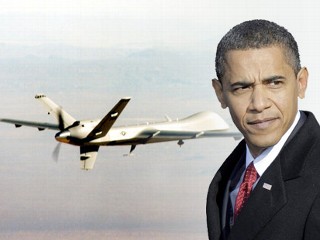
Obama to CIA: Bombs Away! No Let Up in US Drone Attacks

Please note the new look media coverage. Heroic President Obama kills 8 Al Queda, in first week in office. Note the picture also, how Commander and Chiefish. Also note no big hoopla about civilian casualties, as was the case during Bush Administration and Pakistan protests are buried at the bottom. At the bottom of the page I've posted a picture from The LAT which surely would be the picture, or something like it, if this had occurred a week ago. Also note how they make it sound as if this was Obama's plan and Bush implemented it until he showed up. The MSM spin is up to speed Our Heroic Leader has come to save the world-JER


New President Approves Continued Attacks That Have Killed 8 of al Qaeda's Top 20

The CIA's bombing campaign against al Qaeda leadership in Pakistan continued with two more attacks today, an indication, senior officials say, that President Barack Obama has approved the U.S. strategy that has killed at least eight of al Qaeda's top 20 leaders since July 2008.

The two attacks today in Pakistan were the first since President Obama took office on Tuesday.

Asked about it at his daily press briefing, White House Press Secretary Robert Gibbs said, "I'm not going to discuss that matter."

During the campaign, Obama called for cross-border attacks against high-value al Qaeda targets in Pakistan, even before the CIA campaign began.

Pakistani officials and villagers told ABCNews.com that 17 people were killed in two successive strikes against compounds in North and South Waziristan.

Al Qaeda Leader May Be Among the Dead

A senior U.S. official said one of al Qaeda's top 20 leaders may be among the dead today, although it is too soon to be certain.

Since July, the CIA has carried out a relentless bombing campaign against that has targeted the top leadership of al Qaeda, based on a sophisticated intelligence collection effort similar to what was used against insurgents in Iraq.

Eight of the top 20 have been killed in the attacks, according to the U.S. official.

"Al qaeda leaders are freaking out over this," said one person briefing on the bombing campaign. "They have begun to punish local tribesmen who they suspect have tipped off the U.S. to their presence and this is beginning to drive a wedge between the al Qaeda people and the locals."

With the arrest earlier this week by Pakistani authorities of another senior al Qaeda leader, the total number of killed or captured would be nine.

The U.S. attacks have created a firestorm of controversy in Pakistan and some politicians expressed hope the new President would put a halt to bombing campaign.

The new round of CIA bombings came one day after Secretary of State Hillary Clinton phoned Pakistani President Asif Ali Zardari. Pakistani officials said the 30-minute call was mostly limited to "pleasantries" but did include a discussion of the need to fight militants in the tribal areas.

Today, some 1000 people attended a rally in Islamabad to protest the latest U.S. bombings.


Complete Original Article from ABC

1/23/2009


More...

Complete Original Article

President Obama 'orders Pakistan drone attacks'


Missiles fired from suspected US drones killed at least 15 people inside Pakistan today, the first such strikes since Barack Obama became president and a clear sign that the controversial military policy begun by George W Bush has not changed.

Security officials said the strikes, which saw up to five missiles slam into houses in separate villages, killed seven "foreigners" - a term that usually means al-Qaeda - but locals also said that three children lost their lives.

Dozens of similar strikes since August on northwest Pakistan, a hotbed of Taleban and al-Qaeda militancy, have sparked angry government criticism of the US, which is targeting the area with missiles launched from unmanned CIA aircraft controlled from operation rooms inside the US.

The operations were stepped up last year after frustration inside the Bush administration over a perceived failure by Islamabad to stem the flow of Taleban and al-Qaeda fighters from the tribal regions into Afghanistan. Mr Obama has made Afghanistan his top foreign policy priority and said during his presidential campaign that he would consider military action inside Pakistan if the government there was unable or unwilling to take on the militants.

The strikes come just a day after Mr Obama appointed Richard Holbrooke, a former UN ambassador, as a special envoy for the region.

Eight people died when missiles hit a compound near Mir Ali, an al-Qaeda hub in Pakistan's North Waziristan region. Seven more died when hours later two missiles hit a house in Wana, in South Waziristan. Local officials said the target in Wana was a guest house owned by a pro-Taleban tribesman. One said that as well as three children, the tribesman's relatives were killed in the blast.

Pakistan has objected to such attacks, saying they are a violation of its territory that undermines its efforts to tackle militants. Since September, the US is estimated to have carried out about 30 such attacks, killing more than 220 people. More...


Complete Original Article From Times On Line

Comment: Is CIA Director Nominee a Hypocrite?


On January 6, I wrote that the President’s nominee for CIA Director, Leo Panetta, draws many of his intellectual positions from the progressive wing of the Democratic Party –most notably in the case of torture, of which he is a strong opponent. It is for this reason that many in the CIA hesitate to embrace Panetta, who is seen as representing “the left flank of the Democratic Party”. It is worth bearing in mind, however, that what passes as “left” in the eyes of the CIA is not necessarily –and should not be– considered “left” in the real world of politics. Leo Panetta’s stance on the practice of extraordinary rendition might be a case in point.

A few days ago, The Washington Times revealed that Republican lawmakers on the Hill are preparing to quiz Leo Panetta about his role in that controversial practice, which was institutionalized in the mid-1990s under former US President Bill Clinton. The practice involves extrajudicial kidnappings of wanted terrorism suspects by CIA or FBI paramilitaries, often abroad, followed by extrajudicial transfers of same suspects to third countries, such as Egypt or Syria, where they are usually tortured. The extracted information is then utilized by US law enforcement and intelligence agencies in their pursuit of the “war on terrorism”.More...


The conservative paper correctly noted that the notorious practice, which became widespread under the first George W. Bush Administration, was first implemented under Clinton. What is more, there is ample evidence that the extradition of prisoners to countries known to practice institutionalized forms of torture bore the seal of approval by the highest authority at the Clinton White House. After carefully examining all of the known early cases of extraordinary rendition, Human Rights Watch has concluded that “[t]he Clinton policy in practice meant torture”. Michael Scheuer, a former CIA official who was involved in extraordinary rendition cases during the Clinton Administrations, logically speculated that “[t]he Egyptians were not stupid. When we asked, they would not say they tortured our people. But everyone knew what was going on. The White House must have known”.

The question is, did Leo Panetta know? And if he did, what was his personal stance on the subject? The Washington Times cites numerous Clinton Administration insiders who assert that, in his role as aide to President Clinton, Panetta was “a consumer of intelligence at the highest level”. Would it not be hypocritical of Mr. Panetta to publicly affirm that the US “cannot and [...] must not use torture under any circumstances”, after failing to object to several cases of renditioned torture under Clinton?

The paper is correct in raising this important issue. Republican lawmakers –and the left of the Democratic Party, which has remained largely silent on this case– should probe any and every inconsistency in Leo Panetta’s administrative record. However, three parameters must be considered in evaluating this issue.

First, as the paper itself notes, “Mr. Panetta’s role in setting the overall [extraordinary rendition] policy is less clear” than one may expect. It quotes Richard A. Clarke, counterterrorism coordinator for the National Security Council under President Clinton, who says “Panetta was not in the [Oval Office] when individual cases [of rendition] were discussed”. He goes on to state that “Panetta would not have been involved in extraordinary rendition cases, which were handled by [a lower-level interagency panel called the Counterterrorism Security Group], which I chaired”.

Second, it is possible that Panetta did object to the practice, which even at that early stage must have been controversial among members of the Executive, but failed to stop it. His political role as aide to the President was one of importance, yet with clear limits when it came to decision-making. Still, one would expect from a committed humanitarian like Mr. Panetta to have resigned his post in protest against the practice or, at the very least, dutifully expose it to the American public. If he decided that, having failed to stop it, he would try to remain close to the President in an effort to convince him to terminate it, we should be told.

Thirdly, it is likely that Panetta did once approve of the ethical compromise that is extraordinary rendition, but has since changed his mind. It is only reasonable to permit a government administrator the privilege that all of us indiscriminately exercise daily, namely the right to review our stated positions on various subjects and –either publicly or privately– revise them.

Leo Panetta’s purported role in the practice of extraordinary rendition during Bill Clinton’s Presidency does not automatically render hypocritical his stated condemnation of torture. Nevertheless, the CIA Director nominee should be expected to clarify this potential inconsistency at his Congressional hearings later on this month. Ultimately, The Washington Times revelation and subsequent editorial, though politically loaded, raise the important issue of double standards of many Democrats. It is indeed hypocritical to condemn certain intelligence procedures as unethical when practiced by a Republican Administration, and remain silent when these very same procedures are exercised under Democratic rule. Leo Panetta and his colleagues in the new Administration would do well to remember that their occasional remarks on ethical matters inevitably become part of the public record, and will come back to haunt them should they fail to uphold the moral standards they so fervently proclaim.
Complete Original Article

1/22/2009

Have you met the French, Mr. Obama?


Well kind of in line with something I wrote awhile back. Our allies with the exception some of the liberated East European countries and Britain (sometimes) really do not give a hoot about us that much regardless of who is president-JER

God bless France. You knew, once Obama was sworn in, that Paris would welcome the new president with open arms and not get all passive-aggressive-y like they always frequently occasionally do.

What's that? There's a Reuters story about this?

France will reject any immediate request by US president Barack Obama for reinforcements to Afghanistan because it has already deployed enough troops, French Defence Minister Herve Morin said on Wednesday.

While many European leaders have welcomed Obama’s multilateral approach to diplomacy, they are less eager to send their soldiers on risky missions that are unpopular with voters.

Asked in a radio interview how France would react if Obama were to call for more contributions to the Nato-led International Security Assistance Force, Morin pointed out that his country already sent additional troops in 2007 and 2008.

”So for France, we have made the necessary effort. Considering additional reinforcements is out of the question for now,” he told broadcaster Europe 1.


In the immortal words of Emily Litella, never mind.

It should be pointed out that France is hardly the only country in Europe to feel this way:

[A] Harris poll for the FT shows that clear majorities of people in the UK, France, Italy and Germany believe that their governments must not send more forces to Afghanistan, irrespective of demands that the new American head of state might make.

Less than five percent of those polled believed that European countries should send troops to Afghanistan as a gesture of solidarity with Obama.

It will be interesting to see whether Obama will be able to change those minds in the coming year.


More...

Complete Original Article

Obama can’t withdraw troops before one year unless Iraq agrees - expert


BAGHDAD / Aswat al-Iraq: Legal expert Tareq Harb on Wednesday said that new U.S. President Barack Obama can not withdraw his troops from Iraq before one year from notifying the Iraqi side, noting that he can withdraw the forces only if the Iraqi government agrees.
Commenting on Obama’s speech upon taking office, Harb said “the president vowed to withdraw troops from Iraq but he did not mention the articles of the agreement in this respect.”
“The agreement stipulates the withdrawal of troops in one year after notifying the Iraqi side,” he said, noting that the agreement does not allow the withdrawal before this period unless the Iraqi government agrees.
New U.S. President Barack Obama said on Tuesday that the United States will leave Iraq to Iraqis.
In a speech upon taking office, Obama echoed key promises from his historic election campaign by saying: “we will begin to responsibly leave Iraq to its people.”
Yesterday, Barack Hussein Obama took the oath of office as the 44th president of the United States.
More...

Complete Original Article