6/05/2010

What Now?
Via-Power Line
President Obama was in the Gulf region yesterday, trying, somehow, to get ahead of the environmental/political disaster that is the oil spill there. The Associated Press covers his visit, no longer treating Obama as untouchable.
As a practical matter, Obama has been reduced to railing against British Petroleum and vowing that the oil company someday will pay. There are several problems with this approach. First, "railing" is never the image that a President wants to project. Second, as the oil begins to wash ashore in Alabama and Florida, and the spill goes on and on--what is this, day 46? Something like that--the inadequacy of money damages years down the road is painfully obvious. Obama risks looking impotent, as he and his aides can't keep their story straight: is BP just a puppet that has been taking orders from the feds from the first day of the spill, or are the federal agencies so constrained as to be virtually powerless to do anything about the crisis?
Further, Obama demanded yesterday that BP not pay its shareholders a dividend. This is beyond impotent, it's silly. If there were some legitimate concern about BP's solvency and its ultimate ability to pay cleanup costs and damages, such a demand might make some kind of sense. But there isn't. Once again, Obama just looks petulant.
Likewise with his ban on exploratory drilling in the Gulf, a classic case of shutting the barn door long after the cows are gone. A study by the Louisiana Mid-continent Oil and Gas Association concludes that Obama's moratorium will cost Gulf Coast workers $330 million per month in lost wages--exactly what the hard-hit Gulf economy doesn't need.
The AP story linked above includes this vignette:
Here is a photo of the building; the AP didn't mention the Jindal for President sign:

"What now?" is unfortunately a question to which the Obama administration has no apparent answer.
President Obama was in the Gulf region yesterday, trying, somehow, to get ahead of the environmental/political disaster that is the oil spill there. The Associated Press covers his visit, no longer treating Obama as untouchable.
As a practical matter, Obama has been reduced to railing against British Petroleum and vowing that the oil company someday will pay. There are several problems with this approach. First, "railing" is never the image that a President wants to project. Second, as the oil begins to wash ashore in Alabama and Florida, and the spill goes on and on--what is this, day 46? Something like that--the inadequacy of money damages years down the road is painfully obvious. Obama risks looking impotent, as he and his aides can't keep their story straight: is BP just a puppet that has been taking orders from the feds from the first day of the spill, or are the federal agencies so constrained as to be virtually powerless to do anything about the crisis?
Further, Obama demanded yesterday that BP not pay its shareholders a dividend. This is beyond impotent, it's silly. If there were some legitimate concern about BP's solvency and its ultimate ability to pay cleanup costs and damages, such a demand might make some kind of sense. But there isn't. Once again, Obama just looks petulant.
Likewise with his ban on exploratory drilling in the Gulf, a classic case of shutting the barn door long after the cows are gone. A study by the Louisiana Mid-continent Oil and Gas Association concludes that Obama's moratorium will cost Gulf Coast workers $330 million per month in lost wages--exactly what the hard-hit Gulf economy doesn't need.
The AP story linked above includes this vignette:
On Obama's trip to the Grand Isle on the Louisiana coast, his motorcade passed a building adorned with his portrait reminiscent of posters of him during his presidential campaign. Instead of "hope" or "change," the words "what now?" were on his forehead.
Here is a photo of the building; the AP didn't mention the Jindal for President sign:

"What now?" is unfortunately a question to which the Obama administration has no apparent answer.
"Dreams Of Our Fathers"

"A popular Government, without popular information, or the means of acquiring it, is but a Prologue to a Farce or a Tragedy; or, perhaps both. Knowledge will forever govern ignorance: And a people who mean to be their own Governors, must arm themselves with the power which knowledge gives."
—James Madison, letter to W.T. Barry, 1822
Arrogance in the Executive

What the oil spill has revealed about the Obama presidency.
BY Andrew B. Wilson
Real leadership means never having to say you’re the boss. There is no surer sign of weakness and insecurity than the repeated assertion of your own power and authority. This truth has somehow eluded Barack Obama. Hence the unending (and off-putting) self-puffery in his recent presidential press conference.
Again and again, the president felt obliged to remind us of the centrality of his own position in responding to the Gulf oil spill, as if this would counteract the horrible pictures of thousands of gallons of oil gushing out of the ocean floor. Quoth the president:
The American people should know that from the moment this disaster began, the federal government has been in charge of the response effort. . . .
Make no mistake: BP is operating at our direction. Every key decision and action they take must be approved by us in advance. . . .
There has never been a point during this crisis in which this administration, up and down the line, in all these agencies, hasn’t understood that this was my top priority. . . .
It is my job to make sure that everything is done to shut this down.
All of this is wildly over the top. No one blames Barack Obama for the Gulf oil spill. No one is asking him to swim down and plug the hole. Nevertheless, his response to the crisis is revealing. It points to several deeply troubling aspects of the Obama presidency.
Most striking is his unbounded faith in government—and an equally unbounded faith in his own abilities as a self-proclaimed transformational leader. Then there is his contempt (not too strong a word, in my judgment) for the private sector. Government, he seems to think, is a supermagnet for supersmart idealists from academia, while the business world is populated by dullards motivated by a crass and shortsighted desire for profit.
Obama apparently believes that government should be able to stop all man-made disasters before they happen. “As we continue our response effort,” he said, “we’re also moving quickly on steps to ensure that a catastrophe like this never happens again.” In fact, neither he nor anyone else can “ensure” any such outcome, unless he proposes to call an end to all of the progress that has been made since the beginning of the industrial revolution, if not before.
There is no way to guarantee that accidents will not happen as long as people are people, and as long as some of the most creative and imaginative among us continue to push the envelope in engineering and scientific disciplines—whether it is human flight, the exploration of space, hunting for oil in deep water, the development of new forms of energy, or the construction of awe-inspiring bridges or buildings.
My favorite observation on engineering comes from Frank E. Mosier, formerly a top executive at Standard Oil, because it recognizes both the possibility of greatness and the impossibility of perfection. In a commencement address at the University of Pittsburgh School of Engineering in 1989, Mosier said, “All engineering is glorified failure analysis, and great feats of engineering are nothing more than successful bets that your ideas will be more economical or efficient or beautiful without being disastrous.”
It is a pity the same kind of failure analysis—subjecting every assumption to rigorous testing and scrutinizing all the ways in which a grand design might fail to deliver the desired result—is rarely if ever applied to major social legislation. The passage of the hastily conceived and sloppily written health care bill ranks as an obvious example.
The blowout in the Gulf occurred in “ultra deep water.” Drilling for oil at a depth of a mile or so below the surface became economically feasible about a decade ago, when the price of oil shot up above $20 a barrel. Still, it was a considerable technical challenge to go from deepwater drilling (depths of about 1,000 feet) to ultra deep (5,000 feet).
Until the explosion on April 20 that destroyed the Deepwater Horizon rig, oil companies had experienced only one significant spill in drilling hundreds of wells in the Gulf over a period of more than 60 years, including many in ultra deep water. It has taken just one disaster to call an exceptionally good safety record into question. After the eventual postmortem, we may decide that wisdom dictates a long moratorium on ultra deep water drilling. Or not. It may be possible to learn quickly from whatever mistakes were made in this instance and move on.
In his analysis of the situation, Obama has been quick to blame this disaster on the supposed sins of free enterprise and private companies seeking private gain, the public be damned. Without citing any evidence of wrongdoing, he talked about the “oil industry’s cozy and sometimes corrupt relationship with government regulators” and how that has meant “little or no regulation at all.” Clearly, it does not occur to him that the oil companies have a powerful motive to self-regulate—in light of the physical threat to their own workers and the huge potential damage to the long-term viability of their companies that awaits anything less than an exceptional safety performance.
In thinking so poorly of business and business people, it may be only natural for Obama to look upon himself and his friends from academia as being—well—a cut above the ordinary (and quite possibly corrupt) people doing actuarial work for insurance companies, or toiling in the engineering departments of companies like BP. This holier-than-thou, smarter-than-everyone-else ivory tower elitism has unfortunately become a defining element of the Obama presidency
6/04/2010
The Gathering Storm In The Middle East

by Paul A. Rahe
There is very little difference between what intelligence analysts do and what ordinary folks try to accomplish when they pick up a newspaper, listen to the evening news, or read the posts on this and other sites. In every case, wittingly or not, they attempt to separate the revealing details from the background noise.
That is what we should do with regard to the violent incident that took place when the Israelis boarded the six ships constituting the so-called Gaza Flotilla. Most of what we have learned in the aftermath is true and appalling but, in the long run, inconsequential.
The Israeli soldiers who landed on the Mavi Marmara (in Turkish, the Blue Sea of Marmara) in preparation for conducting the ship to an Israeli port – from which the goods being carried could be sent on to Gaza – were, in fact, ambushed, as Allison Kaplan Sommer indicates in her lucid analysis of the evidence that has become available, and all of the usual suspects quickly lined up to condemn Israel for crimes she did not commit.
This is a tiresome, all-too-predictable business reminiscent of the campaign launched in the wake of the clearing action undertaken some years ago at the Jennin refugee camp and of the campaign launched after the Israelis intervened in in 2008 to put an end to Hamas’ firing of missiles into Israel from their stronghold in Gaza. It is part and parcel of a long struggle on the part of the PLO in days gone by and of Hamas now to stage incidents and rally world public opinion against the Israelis for doing what they have to do to defend themselves.
I do not mean to say that the Israelis have never erred. They have. Nor would I want to be taken to suggest that they did not overstep in establishing some of the settlements set up on the West Bank. There, also, I believe they did wrong. But what they did in Jennin, in Gaza, and on the Mavi Marmara was a matter of self-defense. All of this should be obvious.
Liz Cheney statement

“Yesterday, President Obama said the Israeli action to stop the flotilla bound for the Gaza Strip was “tragic.” What is truly tragic is that President Obama is perpetuating Israel’s enemies’ version of events. The Israeli government has imposed a blockade around Gaza because Hamas remains committed to Israel’s destruction, refusing to recognize Israel’s right to exist and using territory under their control to launch attacks against Israeli civilians. The Israeli blockade of Gaza, in order to prevent the re-arming of Hamas, is in full compliance with international law. Had the Turkish flotilla truly been interested in providing humanitarian aid to Gaza, they would have accepted the Israeli offer to off-load their supplies peacefully at the Israeli port of Haifa for transport into Gaza. President Obama is contributing to the isolation of Israel, and sending a clear signal to the Turkish-Syrian-Iranian axis that their methods for ostracizing Israel will succeed, and will be met by no resistance from America. There is no middle ground here. Either the United States stands with the people of Israel in the war against radical Islamic terrorism or we are providing encouragement to Israel’s enemies—and our own. Keep America Safe calls on President Obama to reverse his present course and support the state of Israel immediately and unequivocally.”
Liz Cheney
Obama fails the test of leadership

White House press secretary Robert Gibbs tweeted to the world recently that President Barack Obama had on his night table “The Rise of Theodore Roosevelt,” Edmund Morris’s rip-roaring, Pulitzer Prize-winning account of the formative years of America’s most colorful president.
Presumably, Gibbs was implying that the great man now occupying the White House was taking pointers from the great man who preceded him.
Politicians just love to see themselves as leaders like Teddy Roosevelt or Winston Churchill — giants who trampled over obstacles with unyielding doggedness and even a kind of childlike insouciance.
As Obama underachieves his way through the Gulf of Mexico oil spill crisis, Gibbs’s effort to link the president to Roosevelt makes the opposite point intended: Great leaders are a very rare thing, and the man in the White House today ain’t one of them — at least not yet.
Obama’s detached performance with respect to this massive and growing crisis — the ripple effects of which could still be with us on Election Day 2012 — is generally portrayed as a PR meltdown and a simple failure to step up by an understandably beleaguered Obama.
“It’s impossible not to feel sorry for President Obama,” writes Maureen Dowd in The New York Times, “pummeled by the cascading disasters, at home and abroad.”
Well, it’s possible.
Obama’s failure to convey any hint of genuine emotion, to rouse the American people to turn their hearts toward the Gulf and to assure them that their world — still built on the plentiful supply of fossil fuels — is not falling apart, is a profound failure of leadership.
Instead of offering reassurance, the president is using the crisis to promote his political agenda, hankering for alternative energy and climate change legislation in Congress — though there won’t be any significant replacement of carbon-based power sources for years to come.
Instead of an uplifting message of unity rallying the country to confront the horror and assuring all Americans that we will deal successfully, one way or another, with its disastrous effects, the nation is treated to petty lecturing of BP — even a refusal to let BP evildoers sully the stage the administration uses to discuss the latest failures.
The very company the administration needs to work with to stop the bleeding is vilified and threatened with criminal prosecution.
This separates Obama from the “bad guys.” But it also likely harms the stoppage effort by creating a climate of suspicion and forcing BP to focus on PR and legal CYA operations while trying to plug the well.
The spill is becoming one of the great catastrophes the country has faced. Think of how other presidents have risen to the occasion under similar circumstances.
Who can forget that moment when, touring the ruins of the World Trade Center, former President George W. Bush — with a spontaneity hard to imagine from Obama — grabbed a bullhorn and declared to the workers at ground zero that revenge was coming:
“I can hear you! I can hear you! The rest of the world hears you! And the people — and the people who knocked these buildings down will hear all of us soon! The nation — the nation sends its love and compassion — to everybody who is here.”
Or remember President Bill Clinton’s emotional meeting in April 1995, a few days after the Oklahoma City tragedy, with the families of those killed in the truck-bomb attack on the Alfred P. Murrah Federal Building and his moving speech at the memorial service afterward.
That moment helped the country work through its grief and began Clinton’s political rebirth after the massive GOP sweep of November 1994.
And what do we get from Obama?
A bloodless news conference at which even his description of his daughter beseeching him as to whether the crisis was solved was given with all the emotion of, say, Michael Dukakis.
We get a trip to the Gulf — only his second since the crisis began — where he lands on a beach spiffed up in advance for his visit.
The White House dutifully puts out a longish press release each night, detailing the latest effort in the Gulf and which, I can guarantee you, the White House press corps dutifully ignores or deletes in spin avoidance mode.
Churchill is, of course, best known for becoming one with his country as he led it through World War II.
But there’s a photo of him much earlier in life, as home secretary, intently directing a massive police siege on the hideout of a gang of criminals. He’d heard about the activity while in his bath, rushed to the office and, finding nothing to do, went directly to the theater of action.
“I must ... admit that convictions of duty were supported by a strong sense of curiosity which perhaps it would have been well to keep in check," Churchill later modestly wrote.
But while he got some bad PR for his move, Churchill was a fountain of ideas on the scene and may have saved lives.
Roosevelt, of course, has a similarly long CV detailing his qualities as a man of action. As the de facto leader of the Navy Department, for example, he prepared the country for the Spanish-American War and then resigned his post to go fight it.
The point is that great men such as these are congenitally incapable of not taking a hands-on leadership role during a crisis.
Obama instead went to a sanitized beach.
As of last week, he hadn’t even spoken to BP CEO Tony Hayward. He’s due to make his third trip to the region Friday, more than six weeks after the crisis began.
If he’s actually reading that Roosevelt bio, he’d know that his predecessor would have been — when not himself knee-deep in mucky oil — immersed in the local population during strolls from his personal command post in New Orleans.
Obama would be lucky if he was just having a PR disaster.
Unfortunately for the country, he is failing the test of leadership.
Down,Down, Down

Are Journalists Finally Getting Over their Pro-Teacher-Union Fetish?

by Terry Cowgill
Let’s face it. From the 2004 New York Yankees to that statue of Saddam Hussein, most of us get a kick out of seeing the mighty fall. And that’s essentially what’s happening to teachers’ unions all over this nation. For all the good they did when they were first formed 50 to 75 years ago, teachers’ unions have devolved into opponents of meaningful educational reform.
Teaching is steady work and in most states the pay is now about the same as a mid-level manager in business, but the profession requires substantially fewer days of work per year. And sure, there have been recent layoffs, but even in bad economic times, those who remain in the classroom manage to secure substantial raises and maintain their Cadillac health care plans while most of the rest of us in the private sector must beg our employers for a paltry increase and hope we don’t get sick. Still, good teachers themselves remain largely popular in their respective communities — and justifiably so.
Rush to the Altar

By Jay D. Homnick
The other day at a party a lovely lady asked me if I had read the best-selling work, Men Are From Mars, Women Are From Venus, one of those self-help books which you cannot help yourself to for less than $29.95. In a moment of perversity, with malice aforethought and afterthought, I responded in the negative.
"Why not," she asked gamely.
"Because everyone knows women are from Mercury."
Still, you can't live with 'em and the Bible won't let you live without 'em, so what's a fella to do? In the case of Rush Hudson Limbaugh IV, he has decided to take Kathryn Rogers as Mrs. Limbaugh IV on June IV, which shows you the ivy can be as potent as the mistletoe. In an effort to throw a bit of smoke, Rush closed his radio program Wednesday by saying he will be out until June 16 because he is off to add "another puppy" to his household, a gag that may well be jammed down his throat later, with or without chloroform.
The national audience may have been fooled, but here in South Florida we are in the know, fully aware our neighborhood will soon be housing Mister Rogers.
Limbaugh is a legend whose admirers are legion, and I think I speak for all the folks at The American Spectator when I say we are proud to number in those ranks. Besides for his greatness as a broadcaster inducted into that industry's Hall of Fame, he has done a great service for America these past two decades by enunciating a point of view mostly distorted by conventional media. Honest liberals will admit that he has played this role with courage and aplomb, never wilting under the glare of angry opposition.
It has become a slogan of the American left to denounce Limbaugh as dangerous. It is hard to see how a man struggling on a non-visual medium to explain the viewpoint of half the country's electorate can be said to pose a threat to anything but censorship. If both sides need to be heard but one side controls the P.A. system, there is great virtue in grabbing a soapbox and trying to level the playing field just a whit, and wittily too.
His personal struggles have received broad attention, but the man has persevered mightily. To be a successful radio guy using a cochlear implant to manage his deafness makes him a poster child for the ability to overcome disability. Hopefully this marriage will bring him the missing puzzle piece to complete his picture of happiness. Hopefully, too, it will last forever.
The last word as always must go to H.L. Mencken: "Men have a better time than women: for one thing, they marry later; for another thing, they die earlier." Okay, enough with the humor. All together then: congratulations, Rush and Kathryn.
'Go for the Jugular'

The collapse of Greece's economy, and its domino effect on Spain, Portugal, and other countries in the euro currency zone, is in many ways a replay of an earlier financial crisis--the break-up of the continent's Exchange Rate Mechanism in 1992. Then, as now, Europe's policymakers showed little patience with--or understanding of--markets. Then, as now, Germany often seemed contemptuous of the less competitive economies on the periphery of Europe.
The 1992 crisis came to a head on Friday September 9, when currency speculators forced the devaluation of the Italian lira. By the following Tuesday, Britain was facing the same fate. In this excerpt from More Money Than God, his new history of hedge funds, Sebastian Mallaby tells the story of the crisis from inside the cockpit of George Soros's Quantum Fund.
On Tuesday, September 15, the pound took another beating. Spain's finance minister telephoned Norman Lamont, his British counterpart, to ask him how things were. "Awful," Lamont answered.
That evening Lamont convened a meeting with Robin Leigh-Pemberton, the governor of the Bank of England. The two men agreed that the central bank should buy the pound aggressively the next morning. As the meeting wound down, Leigh-Pemberton read out a message from his press office. Helmut Schlesinger, the president of the German Bundesbank, had given an interview to the Wall Street Journal and a German financial newspaper, Handelsblatt. According to a news agency report on his remarks, Schlesinger believed there would have to be a broad realignment of Europe's currencies.
Lamont was stunned. Schlesinger's remark was tantamount to calling for the pound to devalue. Already his public statements had triggered an assault on Italy's lira. Now the German central banker was attacking Britain. Lamont asked Leigh-Pemberton to call Schlesinger immediately, overruling Leigh-Pemberton's concern that the punctilious Bundesbanker did not like to have his dinner interrupted.
Read entire article here

U.S. Jobs Report Compounds Europe's Woes

By ISHAQ SIDDIQI And ANDREA TRYPHONIDES
LONDON—European stocks slumped as a disappointing U.S. jobs report added to worries about the health of the European economy.
The euro sank, with traders citing official comments on Hungary's woes and rumors of derivative problems at Société Générale.
"We won't comment on market rumors," a spokeswoman for France's third-largest bank said, adding, "if we had something to say, we would have said it."
Its stock was recently down 6.7%.
HSBC Bank caused jitters with a research note to clients in which it downgraded Europe excluding the U.K. to underweight from neutral. "There remains too much uncertainty about the health of banks, about the future arrangements for the euro, about sovereign debt and about growth for us to want to take risk in this region for the moment," said HSBC.

Lincoln at Gaza

Like our own constitution, international law is not a suicide pact.
BY Gabriel Schoenfeld
Is the conflict between Israel and Hamas-ruled Gaza between two belligerents, or is Israel facing an internal insurgency? The distinction is important for evaluating the legality of the blockade that Israel is determined to enforce to stop Hamas from receiving arms from countries like Iran, determined to wipe it from the map. Blockades on the high seas are lawful under customary international law, but only under certain conditions: one of them is that there be an armed conflict or state of war between the blockading and the blockaded party.
Is Israel in a state of war with Hamas-ruled Gaza? Israel would be loath to consider itself so, for that would be tantamount to acknowledging that Gaza is the equivalent of a legitimate belligerent with all attending rights and powers under international law.
Sorting this out in the Wall Street Journal, Eric Posner contends that Israel's blockade is nonetheless legal and founded on precedent. A chapter from American history provides one of the keys. During our Civil War, Abraham Lincoln imposed a blockade on the Confederacy “while at the same time maintaining that the Confederacy was not a sovereign state but an agent of insurrection.” Lincoln’s contention was then backed up by the Supreme Court in what Posner describes as “an ambiguous opinion that held that an armed conflict existed, even though one side was not a sovereign state.” A blockade of the Confederacy was legal even if the blockaded party still did not enjoy the privileges of a belligerent power. The opinion, writes Posner, “suggests a certain latitude for countries to use blockades against internal as well as external enemies.”
Morning Bell: The Jobless Obama Recovery

This Wednesday in Pittsburgh, President Barack Obama defended his administration’s economic policies telling the audience at Carnegie Mellon University: “Now, I’ve never believed that government has all the answers. Government cannot and should not replace businesses as the true engine of growth and job creation.” But that is exactly what the President’s big government policies are doing. Last week, USA Today reported that in the first quarter of 2010, thanks to President Obama’s failed $862 economic stimulus, paychecks from private business shrank to their smallest share of personal income in U.S. history while government-provided benefits — from Social Security, unemployment insurance, food stamps and other programs — rose to a record high.
read entire article here
The Convenient Villain

by Jonah Goldberg
On May 29, two days before Israel's botched raid of six "humanitarian" ships bound for Gaza, Robert Naiman, the policy director of something called "Just Foreign Policy," wrote an item on the Huffington Post headlined "Gaza Freedom Flotilla Shows Awesome Power of Nonviolent Resistance."
Naiman waxed lyrical about how the moral authority of nonviolence had compelled Turkish-controlled Cyprus to help the flotilla while Greek-controlled Cyprus had allegedly caved to Israeli pressure in refusing to help the heirs of Gandhi (it couldn't have been because the Turks were up to no good).
"All this," Naiman gushed, "and the main confrontation between the Israeli occupation authorities and the Gaza Freedom Flotilla has not yet begun."
Roughly 48 hours later, the "main confrontation" unfolded. In fairness, the majority of "peace activists" on the ships were nonviolent, offering passive resistance. But on the last boat Israelis boarded, the supposed disciples of peace attacked the Israeli commandos. These new Gandhians beat the Israelis with metal bars and even threw one Israeli overboard.
Funny, I'm no expert, but that's not how Gandhi behaved in the movie. Maybe there was a sequel with Chuck Norris as the Mahatma? "Gandhi's back, and this time it's personal!"
Sestak a no-go for any job. So what was the deal?

By: Byron York
The White House admitted Thursday that it offered Colorado Senate candidate Andrew Romanoff a job at the U.S. Agency for International Development, but it has never said specifically what it offered Rep. Joe Sestak to keep him from challenging Arlen Specter in the Pennsylvania Senate primary.
"Efforts were made in June and July of 2009 to determine whether Congressman Sestak would be interested in service on a presidential or other senior executive branch advisory board," counsel Robert Bauer wrote in the one-and-a-half-page White House "report" on the matter. Neither Bauer nor White House spokesman Robert Gibbs gave any more details.
Serving on an advisory board, Bauer said, would allow Sestak to keep his seat in the House -- having a Democrat in that seat was a key part of the White House plan -- and still serve "in a high-level advisory capacity."
So former President Clinton made his famous call to Sestak, reportedly to discuss a spot for Sestak on the President's Intelligence Advisory Board. "I heard 'presidential board,' and I think it was intel," Sestak later said of his conversation with Clinton. Sestak said he rejected the idea out of hand.
Shortly after the release of the White House report, however, we learned that the rules of the intelligence board expressly forbid employees of the federal government from serving. As a member of Congress, Sestak is ineligible to be on the board.
6/03/2010
Beating swords into welfare cheques

MARK STEYN: Hedonistic benefits, low birth rates—Europe needs protection from itself
The trick in this line of work is not to be right too soon. A couple of years back, I wrote a bestselling hate crime. Don’t worry, I’m not in plug mode; indeed, I shall eschew even mentioning the book’s title. But its general thesis is that the jig is up for much if not most of the Western world. “Alarmist,” pronounced Maclean’s, reflecting the general consensus of polite society here and in Europe.
Polite society has spent the years since playing catch-up. So if you don’t want your fin du civilisation analysis from a frothing right-wing loon you can now get it from the house-trained chaps at the New York Times:
“Europeans have boasted about their social model, with its generous vacations and early retirements, its national health care systems and extensive welfare benefits, contrasting it with the comparative harshness of American capitalism . . . ‘The Europe that protects’ is a slogan of the European Union.”
Protects from what? Right now, Europe mostly needs protection from itself, and its worst inclinations:
58% Say No to Citizenship for Children of Illegal Immigrants

Fifty-eight percent (58%) of U.S. voters say a child born to an illegal immigrant in this country should not automatically become a citizen of the United States, according to a new Rasmussen Reports national telephone survey.
Thirty-three percent (33%) disagree and say if a women enters the United States as an illegal alien and gives birth to a child here, that child should automatically be a U.S. citizen. That’s what the current law allows and many believe it would require a Constitutional Amendment to change the law.
Voter sentiments are basically unchanged from four years ago when the Senate was considering the immigration issue. The Senate was eventually forced to drop its plans and surrender to public opinion on the topic.
On another aspect of the debate, voters overwhelmingly oppose allowing illegal immigrants to be eligible for state and federal government benefits. Just nine percent (9%) say illegals should receive such benefits, but 85% say they should not....
Read entire article here
Unpresidential Obama

by Andrea Billups
Perhaps this is the “change” portion of the agenda.
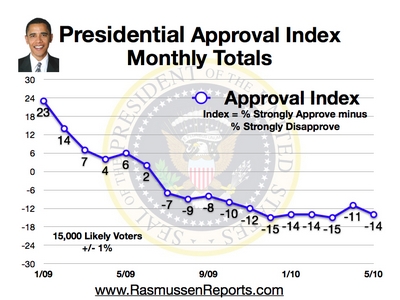
In recent days, President Barack Obama has eclipsed his unflappable campaign image, exposing himself as man with a melting point, a Mr. Once-Cool turned hot. After 18 months, his approval ratings continue to drop as his losses outpace his wins and his rock-star status of 2008 feels more garage-band as the dog days of summer descend on deflated Washington.
The media, even those squarely in his corner, are using words like snappish, on the edge, even testy and defensive to describe Mr. Obama’s response to an increasing host of issue woes that have tested his administration’s ability to govern and strained his loping, athletic portrait and sleek “I’ve got this” visage. It appears that as his frustration mounts, confidence even among some Democrats has waned, his considerable influence declining as he stumps for vulnerable congressional candidates with a midterm election looming.
“It’s clear the President is finding the job more challenging than he anticipated,” observes GOP strategist Cheri Jacobus of Obama's public whining. “Governing is not campaigning, and making promises is quite different than keeping them – especially when the details are revealed."
“While there is an obvious personality flaw emerging with Obama’s recent snappishness, of considerable concern is that the job of President seems too big and too difficult for him to handle,” adds Miss Jacobus, who serves as president of Capitol Strategies PR.
“His recent claim that this has been the most challenging 18 months or any 18-month period since the 1930’s was very telling – and even more alarming. Especially since he has a Democrat-majority House and Senate,” she said. “It appears he may not be up to the job even in the easiest of circumstances.”
The BP oil spill, still churning in the stained Gulf Waters, is fast becoming Mr. Obama’s own Katrina-stye debacle. As oil drifts toward Gulf beaches and wildlife estuaries, it is bound to get worse, even if the leak is somehow plugged. Some television stations are now broadcasting running meters of just how many gooey gallons – 12,000 to 19,000 per day by government estimates -- continue to pour into once clear blue waters, the urgency increasing even as President Obama uneasily shifts course on responsibility for the growing disaster. Where is his Brownie to blame? The Minerals and Management Service seems a less juicy substitute for someone hapless to take the fall.
First his White House asserted that the global oil giant was in charge of the spill, but then last Wednesday, the President seemed to reverse that tact, “defensively and sometimes testily,” the Associated Press described, asserting that he took full responsibility “to make sure this thing is shut down.”
But his BP disaster talk -- “plug the damn hole” - was not the first time his remarks turned blunt. Karl Rove, the White House adviser to former President George W. Bush, described Obama’s incivility on the job as “sulfuric rhetoric.”
“For a man who is enormously self-aware, Mr. Obama could also use a little bit more self-awareness. He should consider how powerful – and inappropriate – a model he sets by his own frequent course and uncivil language.”
Just this past week, in a closed meeting with Senate Republicans – the first in a year -- the discourse turned rancorous, causing some to dub Mr. Obama “thin-skinned.”
“He needs to take a Valium before he comes in and talks to Republicans” said Sen. Pat Roberts, in an account of the meeting reported by the Washington Post.
“This is closed press,” Mr. Obama reportedly chided Sen. John Barrasso, suggesting that he was playing to the cameras that were not in the private confab.
Not that such a meeting moved his agenda forward. Some senators questioned his motives with larger issues like financial and healthcare reform continuing to divide Congress and voters. They chided the President for his partisanship and his distance from their concerns.
““The pattern is they’re pretty good at reaching out when they need you, and when they don’t, they don’t mind running over you,” said Sen. Lindsey Graham last week to Politico.
“The distrust level right now is pretty high among our guys — and on both sides,” Mr. Graham said.
As the pressure mounts, Mr. Obama must take notice that a majority of Americans say they don’t’ like what they are seeing. And that his message of hope and change has been squandered through a seeming “I know what’s best for you” internalization.
Miss Jacobus, in a column she writes for The Hill, described his behavior as “presidential petulance,” calling Mr. Obama “weak but hardly humbled.” Mr. Obama, she added, “is in dire need of a tutorial on how to win friends and influence people."
“Senate Republicans have been smacked over the head with the olive branch too many times, so the dearth of trust should come as no surprise,” she writes. “Obama’s ‘my way or the highway’ approach is truly stinking up the joint.”
The $64,000 Question Is...

Will people now change their minds and realize this was a cowardly attempt by terrorists, guised under noble, humanitarian clothing to smuggle weapons in (and thus in part admit there is now a desire of lefter leaning elements to combined forces with terrorism) and therefore condemn it
or
Will they refuse to admit they're wrong and tacitly support terrorism because their leftist ideology blinds them from any kind of capacity for intellectual honesty
or
They will cowardly claim this report is false and that the Israeli's made it up.
It is a very important question because it's going to test whether people (primarily of the lefter persuasion) can set aside their ideologies and as adults acknowledge they were wrong and condemn terrorism or if their ideology is so strong they will still maintain their positions and thus tacitly APPROVE OF TERRORISM.
I shall now sit back and watch this unfold like a movie, much like a did the housing crash, without an utter care or concern because simply it's a lost cause and life is too short to worry about things you don't control. So, enjoy the decline!
ObamaCare Propaganda Mailer

Jack Curtis
Kathleen Sibelius (Obama's Health czarina) sent me a reassuring message about Medicare under Obama's new law. It came as a shiny, expensive pamphlet inside the first-class official business envelope from the Department of Health and Human Services (Penalty for Private Use $300) titled: "Medicare and the New Health Care Law -- What it Means for You." The brochure includes "A Message from Kathleen Sibelius" -- complete with her official title. She seems afraid I might be worried about what the new health care law really means for me.
She starts out on page one: "The Affordable Care Act passed by Congress and signed by President Obama this year will provide you and your family greater savings and increased quality health care." Clearly, she's going to give me better care for less money. She adds: "...you, your family, and your doctor -- not insurance companies -- have greater control over your care." Better yet! Then she promised me: "Your guaranteed Medicare benefits won't change -- whether you get them through Original Medicare or a Medicare Advantage plan. Instead, you will see new benefits...." Now, I'm feeling great! After all the doubts the nasty Republicans spread about ObamaCare, thank you Kathleen, I should have had more faith!
I opened the shiny brochure and read the inside: Sibelius is sending me $250 if my Medicare prescription benefit tops out this year. That's about one month's worth of some of my pills, but it's more than I get now on reaching the ceiling. If I reach the cutoff in later years, she'll give me a 50% discount on: "...covered, brand-name, prescription drugs"; that discount will rise later. Guess I'd better hope my meds are covered!
Next year, she promises new preventive cancer screening, mammograms and a free annual physical. But my wife and I have those now with Medicare Advantage. She's giving me something I already have -- but folks with the regular Medicare should benefit.

The limits of the welfare state

GEORGE F. WILL
Today, as it has been for a century, American politics is an argument between two Princetonians -- James Madison, class of 1771, and Woodrow Wilson, class of 1879. Madison was the most profound thinker among the Founders. Wilson, avatar of "progressivism," was the first President critical of the nation's founding. Barack Obama's Wilsonian agenda reflects its namesake's rejection of limited government.
Lack of "a limiting principle" is the essence of progressivism, according to William Voegeli, contributing editor of the Claremont Review of Books, in his new book "Never Enough: America's Limitless Welfare State." The Founders, he writes, believed that free government's purpose, and the threats to it, is found in nature. The threats are desires for untrammeled power, desires which, Madison said, are "sown in the nature of man." Government's limited purpose is to protect the exercise of natural rights that pre-exist government, rights that human reason can ascertain in unchanging principles of conduct and that are essential to the pursuit of happiness.
Wilsonian progressives believe that History is a proper noun, an autonomous thing. It, rather than nature, defines government's ever-evolving and unlimited purposes. Government exists to dispense an ever-expanding menu of rights -- entitlements that serve an open-ended understanding of material and even spiritual well-being.
The name "progressivism" implies criticism of the Founding, which we leave behind as we make progress. And the name is tautological: History is progressive because progress is defined as whatever History produces. History guarantees what the Supreme Court has called "evolving standards of decency that mark the progress of a maturing society."
Video-Christy and the Teacher Unions
Via-Hot Air
| Christie speaks in Washington DC, calling Newark schools 'absolutely disgraceful' |
6/02/2010
Andrew Romanoff: W.H. offered three jobs

Colorado U.S. Senate candidate Andrew Romanoff confirmed Wednesday that Jim Messina, President Barack Obama’s deputy chief of staff, suggested three administration jobs that would be available to him last September if he dropped his plans to run against U.S. Sen. Michael Bennet, who had the support of the White House.
Romanoff said he informed the White House that he would stay in the race. The revelation comes days after the White House confirmed that Rep. Joe Sestak was approached about an unpaid position in the administration if he dropped his campaign against Sen. Arlen Specter. But in this case, Romanoff was offered paid positions in the administration, a clear difference from the Sestak case.
In a statement to the media, Romanoff attached an email from Messina – dated Sept. 11, 2009 – listing the three jobs, two at USAID and one as director of the U.S. Trade and Development Agency, with a page-long set of job descriptions.
Earlier, the White House had confirmed that administration officials had “conversations” last year with Romanoff about possible positions inside the administration. But the White House didn’t confirm which jobs were involved, or that Messina was the emissary to Romanoff.
Did You Plug The Hole With A Blue Dress Yet, Daddy?

Ann Coulter
Oil is spewing from beneath a British Petroleum oil rig into the Gulf of Mexico at a rate of about 1 million gallons a day. There's no end in sight -- although White House officials have made it clear their goal is to stop the leak before the midterm elections in November.
Obama now spends at least half of every day answering pointed, increasingly aggressive questions about the oil spill, most of them from his daughter Malia.
The president finally went down to take a look at the oil disaster last week –- which is weird because I didn't even know there were golf courses near the Gulf. To show his concern, Obama is thinking about returning some of the nearly $1 million the oil industry donated to his campaign.
Ha, ha -- just kidding. He's not returning any oil money. But the situation has gotten so urgent that Obama did take time off from his golf game to praise the Phoenix Suns for protesting Arizona’s new immigration law.
He really did endorse the Phoenix Suns, which -- like most of his endorsements -- has resulted in their being eliminated by the Los Angeles Lakers over the weekend. (Did I dream this, or was it just yesterday that President Obama was congratulating Al and Tipper Gore on their long and happy marriage?)
Calling a State Sponsor a State Sponsor

Via-The American
By Roger F. Noriega
This month a dozen U.S. senators fired the opening salvo in what promises to be an aggressive oversight campaign to get to the bottom of Venezuelan dictator Hugo Chávez’s support for terrorism. A May 25 letter challenges Secretary of State Hillary Clinton to explain what the administration knows about Venezuela’s support for a sprawling network of terrorist states and groups, including Iran, Hezbollah, Colombian “narcoterrorists,” Cuba, and Syria.
Rallied by John Ensign (R-Nevada) and George LeMieux (R-Florida), the senators are asking that Secretary Clinton explain what the administration knows about alleged arms shipments, high-level contacts, and financial dealings linking Venezuela to a rogue’s gallery of, well, rogues. The detailed letter signals that the senators already know more than the administration has been willing or able to substantiate about dictator Chávez’s collaboration with anti-American terror groups and hostile regimes.
“We are deeply concerned about Venezuelan president Hugo Chávez’s growing ties to U.S.-designated foreign terrorist organizations and state sponsors of terrorism,” the letter begins. Following a litany of examples of how Chávez economically bolsters terrorist regimes (including Cuba and Iran) and provides material support to terrorist groups (from Hezbollah to the Revolutionary Armed Forces of Colombia), the senators ask Clinton to explain why Venezuela evades designation under U.S. law as a state sponsor of terrorism.
Among Chávez’s notorious actions the senators cite:
• The provision of “sanctuary” and the “flow of guns and money”—including the provision of portable missiles, anti-tank rockets, and other weaponry—to Colombian guerrillas;
• Complicity in the illegal narcotics trade that fuels terrorism—including the burgeoning traffic from Venezuelan territory to west and north Africa;
• The “presence and activities of Hezbollah inside Venezuela,” and a November 2009 shipment of Russian weapons from a Venezuelan arms cache to that group;
• “Extensive support of the Castro regime in Cuba,” and Chávez’s reliance on Castro henchman Ramiro Valdes to repress internal opponents;
• Possible support for “Iran’s covert nuclear enrichment program” in exchange for Iran’s providing “nuclear knowhow” to Chávez;
• Venezuela’s delivery of gasoline to Iran and its help for Iran to evade international sanctions; and
• Suspicious air traffic and lax immigration controls on Caracas-Damascus-Tehran airline flights.
The Ensign-LeMieux letter was co-signed by John McCain (R-Arizona), Robert Bennett (R-Utah), Scott Brown (R-Massachusetts), Sam Brownback (R-Kansas), Jim Bunning (R-Kentucky), John Cornyn (R-Texas), James Inhofe (R-Oklahoma), Republican Whip Jon Kyl (R-Arizona), James Risch (R-Idaho), and Roger Wicker (R-Mississippi). LeMieux’s involvement is significant because he was one of several senators who held up multiple diplomatic nominations last year over concerns regarding the administration’s policy toward Latin America.
This stepped-up congressional oversight is bound to build on the growing body of evidence pointing to Chávez’s singular role in supporting terrorism and related criminality. The Obama administration’s decision to the pull the trigger on Venezuela may hinge on whether the United States can afford to forfeit petroleum exports from that South American country.
Anticipating the argument that Venezuela’s oil supply is too essential to the U.S. economy to risk slapping that country with the terrorist label, the senators ask the administration to explain its “contingency plan” for dealing with a “sudden and prolonged unavailability of Venezuelan oil exports to the United States.”
The reality is, although the United States will likely find new sources of oil on the international market within a few weeks, Venezuela’s economy will be crippled by the loss of oil revenue and consumer imports. Moreover, Chávez has wrecked Venezuela’s state-owned oil company and has failed to identify new importers with the special refineries required to distill the viscous heavy crude his country produces. Ironically, oil-rich Venezuela may be one of the few countries against which these anti-terror sanctions may have a decisive impact.
Since the last years of the George W. Bush administration, U.S. diplomats have steered clear of Chávez for fear of “provoking” him. Thanks to congressional oversight, we are about to confront the terrible downside of that naïve, passive policy.
Roger F. Noriega was Ambassador to the Organization of American States from 2001-2003 and Assistant Secretary of State from 2003-2005. He is a visiting fellow at the American Enterprise Institute and managing director of Vision Americas LLC, which represents U.S. and foreign clients
10 Biggest Oil Spills in History
No, the 1989 Exxon-Valdez spill doesn’t make the list.

Read story and see photos at Popular Mechanics

Read story and see photos at Popular Mechanics
Joining the Jackals

The Obama administration abandons Israel.
Via-The Weekly Standard
BY Elliott Abrams
At the United Nations, a lynch mob for Israel is always just a moment away. The Islamic countries are a reliable source of venom, led by the Arab bloc; what we used to call the “non-aligned” are all aligned against Israel and happy to join the fun; and the Europeans can be counted on for hand-wringing rather than staunch resistance. Only the United States, and a few brave allies like Canada and Australia, can be counted upon to oppose diplomatic lynchings year after year; and only the United States can stop them in the Security Council.
In the American government, it is never the State Department bureaucracy that wishes to brave the endless assaults at the UN. Normally the resistance comes not from the various regional bureaus or from the International Organizations bureau, where Israel is so often viewed as a giant pain, but from the White House and sometimes (example: George Shultz) the Secretary of State.
This week the mob formed again, instantly, after the Gaza flotilla disaster, reinforced this time by the leadership of Turkey, whose language at the UN was more vicious than that used by the Arabs. As usual there was really only one question once the mob began to gather. It is the question that arose repeatedly in the Bush years—when the Hamas leaders Sheik Yassin and Abdel Aziz Rantisi were killed by Israel, when Israel acted in Gaza, when Israel put down the intifada in the West Bank, and during the 2006 war in Lebanon and the late 2008 fighting in Gaza: would Israel stand alone, or would the United States stand with her and prevent the lynching? Would the U.S., in Daniel Patrick Moynihan's memorable phrase, "join the jackals?"
46% Say Tea Party Good for America, 31% Disagree

Via-Rasmussen Report
Forty-six percent (46%) of U.S. voters say the Tea Party movement is good for the country, according to a new Rasmussen Reports national telephone survey. Thirty-one percent (31%) disagree and say it’s bad for the country. Another 13% say it’s neither.
But just 16% of voters say they are actually members of the so-called Tea Party, a loose knit group of Americans nationwide protesting big government and high taxes. This is down eight points from a month ago and but little changed from two months ago. The spike in identification with the Tea Party followed passage of the health care law. Most voters continue to favor repeal of that law.
Read Article here
Blackballed

White congressional candidate banned from forum because she’s not black
Via-Daily Caller
Because Liz Carter is white, she’s banned from debating Democrat Rep. Hank Johnson and the other black candidates running for his Georgia congressional seat at a candidate forum in Atlanta tonight.
The forum, moderated by Newsmakers Live, is solely for the black Republicans and Democrats running for Johnson’s 4th Congressional District seat, Carter took to the internet to say.
Carter, a Republican, expressed her disappointment on Twitter Wednesday, asking, “What happened to diversity?”
“We called them, we asked to participate,” said Carter’s campaign manager, Cheryl Prater. But she said Newsmaker Live’s event moderator, Maynard Eaton, told the campaign that because Carter is white, she’s only allowed to sit in the audience and not participate.
Newsmakers Live is a black media organization, which according to its website has a “global urbane perspective” and publishes a weekly journal and video show that “embodies a unique ‘infotainment’ concept that specializes in intense interviewing of prominent personalities and political figures.” Its website includes videos titled, “Are Black Babies An Endangered Species,” and “Moving African-American Businesses to the Next Level.”
Maynard, the editor-in-chief of Newsmakers Live, did not immediately respond to a request for comment by e-mail. But a flier advertising the event’s guests only shows the photos of the three black Democrats and one black Republican running for the seat: Hank Johnson,Vernon Jones and Connie Stokes, all Democrats, and Republican candidate Cory Ruth.
“By inviting this black Republican, they’ve made it racial,” said Prater. There are a couple other white candidates who were not invited to the program, Prater said.
Carter, she said, has worked to garner black support in the heavily black district and was endorsed by the College Republicans at Atlanta’s predominantly black Morehouse College.
Tonight the candidate will at least make an attempt to get on stage. “We’re showing up,” Prater said.
This reliably Democratic district congressional district has been the subject of embarrassment over the years, as firebrand conspiracist Cynthia McKinney once held the seat. Among Johnson’s gaffes, he became an Internet sensation this year by suggesting, on camera during a congressional hearing, that the island of Guam could “tip over and capsize” due to overpopulation.
Georgia’s primary is on July 20.
Obama's 'Chicago Way' plunders the private sector

By: Michael Barone
An interesting thing about Barack Obama is that he chose, on two occasions, to live in Chicago -- even though he didn't grow up there, had no family ties there, never went to school there.
It was a curious choice. Chicago has a civic culture all its own and one that is particularly insular. Family ties and personal connections are hugely important. Professionals who have lived and worked there for a quarter-century are brusquely reminded, "You're not from here."
Nonetheless Obama moved upward in the Chicago civic firmament with apparent ease. The community organizer joined the Rev. Jeremiah Wright's church in search of street credibility in the heavily black South Side. The adjunct law teacher made friends around the University of Chicago from libertarian academics to radical organizer William Ayers. The young state senator designed a new district that included the Loop and the rich folk on the Near North Side.
Obama could not have risen so far so fast without a profound understanding of the Chicago Way. And he has brought the Chicago Way to the White House.
The Rush To Judge Israel
Via-Creators.com
 David Harsanyi
Unsure whether Israel has acted in self-defense? Just check whether the United Nations has called for an "emergency session." At the U.N., Jews' wielding guns always precipitates an international crisis.
Now, I'm not one of those who reflexively accuse critics of Israel of anti-Semitism. That would be preposterous. Or nearly as preposterous as pretending that Judaism has nothing to do with the defense, criticism or the never-ending war waged against Israel.
And it is undeniable that there are those who consistently and disproportionately vilify the Jewish state as an impediment to peace and rationalize or ignore far greater injustices and dangers in the world — often simultaneously.
The brouhaha over the skirmish on a Turkish flotilla with humanitarian aid headed to Gaza — to help fix a self-inflicted crisis — was only the latest case in point.

Unsure whether Israel has acted in self-defense? Just check whether the United Nations has called for an "emergency session." At the U.N., Jews' wielding guns always precipitates an international crisis.
Now, I'm not one of those who reflexively accuse critics of Israel of anti-Semitism. That would be preposterous. Or nearly as preposterous as pretending that Judaism has nothing to do with the defense, criticism or the never-ending war waged against Israel.
And it is undeniable that there are those who consistently and disproportionately vilify the Jewish state as an impediment to peace and rationalize or ignore far greater injustices and dangers in the world — often simultaneously.
The brouhaha over the skirmish on a Turkish flotilla with humanitarian aid headed to Gaza — to help fix a self-inflicted crisis — was only the latest case in point.
Rod Blagojevich trial rattles insiders

The corruption trial of former Illinois Gov. Rod Blagojevich is already shaping up to be a political circus, promising to lay bare the underbelly of Chicago politics.
But while the stakes are clear for Blagojevich – he could be the fourth Illinois governor in 40 years to retire to a federal prison – some of the most powerful Washington insiders are braced for potential political damage from the trial, which begins Thursday.
President Barack Obama, Rahm Emanuel, Valerie Jarrett, Senate Majority Leader Harry Reid and Rep. Jesse L. Jackson Jr. all have at least some skin in the game, according to documents produced by prosecutors, defense lawyers and the White House counsel. Blagojevich has been charged with engaging in state-level kickback schemes, but Washington is much more focused on allegations he tried to sell Obama’s old Senate seat.
None of these Washington insiders have been accused of wrongdoing. But their names are sure to come up in testimony.
“It’s like a soap opera,” said Rep. Jan Schakowsky (D-Ill.). “Everyone will be watching it.”
Here’s a cheat sheet on those who may face some political exposure.
Read more: here
The Sound and the Fury

Via-RCP
By William Murchison
"Never let a crisis go to waste" -- a watchword of the present administration -- finds its deepest, as it were, meaning in the offshore oil rig crisis. There, the idiocy of modern politics impatiently waits discovery.
We're sure to find it. The idiocy of modern politics is that politics has less to do with solving problems than with making racket to cover up the fact that politics rarely solves problems.
Part One: Are We Still.....
.......One Nation under God indivisible with liberty and justice for all ?

Interesting question really. Considering that God is being expunged from the public discourse where once God was believed to be the guiding force of the American experience.
So much of our history, traditions and the very fabric of our society has been torn asunder by those of my generation who have a myopic view of their own country while demanding absolution for the tyranny and evils of others.
I have never been opposed to a more unified world, I believe in the ultimate global community. I believe that this is not only the best thing for mankind and our planet it is an evolutionary certainty. As mankind evolves as a species and our technologies progress the idea of a world community is inevitable and necessary.
However globalization for the sake of globalization is not only a foolish policy, in the end it will be self-defeating. Whenever you attempt to create an organization based upon the lowest common denominator the results, are always destructive. The reason is simple those who are more advanced , more intelligent, more ambitious, stronger, etc. will eventually rebel against the constraints put on them by the less advanced, less intelligent, less ambitious and weaker who attempt to chain them to that which they know to be a less fulfilling life. This may be a political incorrect analysis but the truth nonetheless, the stifling of natural ambition is an affront to the human spirit and a destructive agenda whenever and wherever it has been attempted.
As someone recently observed on the stupidity of political correct youth sports, "Guess what the kids are still keeping score." Well the winners are still keeping score whether they win the game or not. You either keep score and become motivated towards improvement or you give up and envy the winners.
Those who do not see or more importantly are not taught that life is about overcoming challenges embrace the theology of political correctness. They are those who through a childish outlook set even more rules to restrict the achievers in society in order to make life “fair”. Either out a sense of righteousness or out of an envy that only those of low self esteem can poses as they cover their bereft schemes with the cloak of the elitism.
What does one world government and youth sports have to do with the Pledge of Allegiance? Quite a bit actually, the idea that we Americans and our form of governance is somehow on the same playing field with the likes of Kim LL Jung or even Saudi Arabia where women can be punished for simply conversing with a male, or Iran where Gays are openly hung for their sexuality is not only a repugnant moral equivalency it is in the end destructive.
Consider the out dated philosophy that women must be in total subservience to men to the point that a violation of this strict code can mean an acid washing of the offenders face. Compare this archaic belief structure to the ideal that all men/women are created equal and endowed by their creator with certain unalienable rights. It is true that equality of the sexes is a recent development in the United States as in the rest of the Western World, but this advancement in our culture is directly tied to the political structure embedded in our founding documents and our form of governance. That republican form of governance not only insured the ultimate end of slavery and the women's suffrage movement, by the very nature of it's principles it predetermined that outcome. So long as the United States holds fast to its principles nothing but an evolution of liberties can spring forth.
Where is the suffrage movement in Saudi Arabia? Or the Gay rights dialogue in Iran? There are no such movements and as long as they continue to be ruled by their current forms of government, there never will be. The government must change in order that the cultural evolution can take place and only a government based on individual liberty can foster such change.
Where is the compromise between ideological beliefs when one is based upon oppression and the other upon individual liberty? There really isn’t any. Other than a total acceptance that cultures and beliefs are different and we must just avoid cultural contact.
But we cannot really do that now can we? We live in a global society with a global economy and we ,now more than ever, are destined to confront our differences. Do we confront these differences by promoting what we believe is imoral and oppressive while condemning that which we know to be true and just? Deluding our principles in order to be liked by governments whom are more corrupt and oppressive than we would ever tolerate for ourselves?
Like political correctness in the youth sports arena we must recognize that there are certain truths. Just as there will always be winners and losers on the playing field whether we keep score or not, there will always be superior forms of government whether we recognize it or ignore it. When however we “dumb down” the more enlightened and superior to accommodate the backward and the inferior all that we accomplish is allowing weak outdated philosophies to sap human progress. This does not mean we need necessarily confront with force or ridicule less enlightened forms of governments but it most certainly means we should never dilute our own strengths to accommodate an inferior and outdated set of beliefs and policies.
Which brings us back to: Are we still, One Nation under God indivisible with liberty and justice for all ? Not if a significant portion of our population and an even larger percentage of our elected officials and un-elected bureaucracy believe that some form of global governance is more important than the very principles which have allowed the United States to evolve into a superior society. We are not superior as indviduals from any other peoples in the world, we are just blessed with a superior form of government and we best stop messing with it. We live in a a free society based upon individual human achievement contributing to the advancement of all through the unfettered unalienable rights of all.
If we continue to delude ourselves in the belief that somehow there is a compromise between the freedom of our form of government based upon individual liberty and the varying degrees of individual servitude served up as being somehow superior or acceptable substitutes, we will find ourselves as the laughingstock of history. A great nation that sold itself to lower bidders.
We are divided between those who hold true to a belief in the dignity and positive progress of mankind and those who believe that if only we would compromise a bit of our individual liberty for a “greater good” life would be better for all. Life can never be better for all when in order to make it so you must diminish the opportunities and freedoms of all. It is as insane as attempting to spend your way out of debt.

Interesting question really. Considering that God is being expunged from the public discourse where once God was believed to be the guiding force of the American experience.
So much of our history, traditions and the very fabric of our society has been torn asunder by those of my generation who have a myopic view of their own country while demanding absolution for the tyranny and evils of others.
I have never been opposed to a more unified world, I believe in the ultimate global community. I believe that this is not only the best thing for mankind and our planet it is an evolutionary certainty. As mankind evolves as a species and our technologies progress the idea of a world community is inevitable and necessary.
However globalization for the sake of globalization is not only a foolish policy, in the end it will be self-defeating. Whenever you attempt to create an organization based upon the lowest common denominator the results, are always destructive. The reason is simple those who are more advanced , more intelligent, more ambitious, stronger, etc. will eventually rebel against the constraints put on them by the less advanced, less intelligent, less ambitious and weaker who attempt to chain them to that which they know to be a less fulfilling life. This may be a political incorrect analysis but the truth nonetheless, the stifling of natural ambition is an affront to the human spirit and a destructive agenda whenever and wherever it has been attempted.
As someone recently observed on the stupidity of political correct youth sports, "Guess what the kids are still keeping score." Well the winners are still keeping score whether they win the game or not. You either keep score and become motivated towards improvement or you give up and envy the winners.
Those who do not see or more importantly are not taught that life is about overcoming challenges embrace the theology of political correctness. They are those who through a childish outlook set even more rules to restrict the achievers in society in order to make life “fair”. Either out a sense of righteousness or out of an envy that only those of low self esteem can poses as they cover their bereft schemes with the cloak of the elitism.
What does one world government and youth sports have to do with the Pledge of Allegiance? Quite a bit actually, the idea that we Americans and our form of governance is somehow on the same playing field with the likes of Kim LL Jung or even Saudi Arabia where women can be punished for simply conversing with a male, or Iran where Gays are openly hung for their sexuality is not only a repugnant moral equivalency it is in the end destructive.
Consider the out dated philosophy that women must be in total subservience to men to the point that a violation of this strict code can mean an acid washing of the offenders face. Compare this archaic belief structure to the ideal that all men/women are created equal and endowed by their creator with certain unalienable rights. It is true that equality of the sexes is a recent development in the United States as in the rest of the Western World, but this advancement in our culture is directly tied to the political structure embedded in our founding documents and our form of governance. That republican form of governance not only insured the ultimate end of slavery and the women's suffrage movement, by the very nature of it's principles it predetermined that outcome. So long as the United States holds fast to its principles nothing but an evolution of liberties can spring forth.
Where is the suffrage movement in Saudi Arabia? Or the Gay rights dialogue in Iran? There are no such movements and as long as they continue to be ruled by their current forms of government, there never will be. The government must change in order that the cultural evolution can take place and only a government based on individual liberty can foster such change.
Where is the compromise between ideological beliefs when one is based upon oppression and the other upon individual liberty? There really isn’t any. Other than a total acceptance that cultures and beliefs are different and we must just avoid cultural contact.
But we cannot really do that now can we? We live in a global society with a global economy and we ,now more than ever, are destined to confront our differences. Do we confront these differences by promoting what we believe is imoral and oppressive while condemning that which we know to be true and just? Deluding our principles in order to be liked by governments whom are more corrupt and oppressive than we would ever tolerate for ourselves?
Like political correctness in the youth sports arena we must recognize that there are certain truths. Just as there will always be winners and losers on the playing field whether we keep score or not, there will always be superior forms of government whether we recognize it or ignore it. When however we “dumb down” the more enlightened and superior to accommodate the backward and the inferior all that we accomplish is allowing weak outdated philosophies to sap human progress. This does not mean we need necessarily confront with force or ridicule less enlightened forms of governments but it most certainly means we should never dilute our own strengths to accommodate an inferior and outdated set of beliefs and policies.
Which brings us back to: Are we still, One Nation under God indivisible with liberty and justice for all ? Not if a significant portion of our population and an even larger percentage of our elected officials and un-elected bureaucracy believe that some form of global governance is more important than the very principles which have allowed the United States to evolve into a superior society. We are not superior as indviduals from any other peoples in the world, we are just blessed with a superior form of government and we best stop messing with it. We live in a a free society based upon individual human achievement contributing to the advancement of all through the unfettered unalienable rights of all.
If we continue to delude ourselves in the belief that somehow there is a compromise between the freedom of our form of government based upon individual liberty and the varying degrees of individual servitude served up as being somehow superior or acceptable substitutes, we will find ourselves as the laughingstock of history. A great nation that sold itself to lower bidders.
We are divided between those who hold true to a belief in the dignity and positive progress of mankind and those who believe that if only we would compromise a bit of our individual liberty for a “greater good” life would be better for all. Life can never be better for all when in order to make it so you must diminish the opportunities and freedoms of all. It is as insane as attempting to spend your way out of debt.
“The sacred rights of mankind are not to be rummaged for among old parchments or musty records. They are written, as with a sunbeam, in the whole volume of human nature, by the hand of the divinity itself; and can never be erased.”
- Alexander Hamilton
6/01/2010
Do Liberals Suffer from Arrested Moral Development?

What 10-year-olds and liberals have in common.
Via-REASON
Ronald Bailey
Do kids outgrow socialism? A fascinating new study, “Fairness and the Development of Inequality Acceptance,” [subscription required] published last week in the journal Science by researchers at the Norwegian School of Economics and Business Administration sheds some light on individual moral development. It turns out that as people move from childhood through adolescence to young adulthood they become increasingly meritocratic, that is, they come to believe that people deserve unequal rewards based on their individual achievements.
The Norwegian researchers studied about 500 children beginning in the fifth grade through the 13th grade (ages 11 through 19) as they played modified versions of the dictator game. In the standard dictator game, a sum of money, say $100, is divided up between two players. The dictator decides how much to keep and how much to give the second player, the responder. Interestingly, research shows consistently that most dictators do not keep all the money.
The Norwegian researchers modified the game allowing for a 45-minute production phase in which players could earn points by finding and clicking on specific numbers in a series of computer screens. The researchers also set up alternative tasks allowing students to choose to play video games or watch cartoons instead of trying to collect points. Most of the participants turned out to be workaholics who clicked away full time trying to gain points. Later the points could be exchanged for money, but in some cases the amount of money was randomly given a multiplier, so that some lucky participants ended up earning more than others who had been equally productive.
Harvard Law Dean Kagan Replaced Constitution Studies With International Law

Joe Wolverton, II
On May 10, 2010, President Obama nominated Elena Kagan to the Supreme Court to fill the vacancy from the impending retirement of Justice John Paul Stevens at the end of the Supreme Court's 2009–2010 term. A significant entry in the catalog of Ms. Kagan’s remarkable achievements is her deanship of the über-prestigious Harvard Law School. In 2003, she was named, as the school’s first female dean, to succeed Robert C. Clark, who had held that post for over a decade. While manning the helm at Harvard Law, she attracted attention of alumni and observers for steering the ship away from the tried and true “case-law method” of studying the law.
A central plank in Kagan’s revolutionary platform is the abandonment of the requirement that first year law students study U.S. constitutional law. The course’s place in the curriculum was replaced by classes examining the laws of other nations and international law.
In fact, according to the requirements for receiving a J.D. as listed on the Harvard Law School website, the study of our republic’s founding document is nowhere to be found.
In 2006, after the changes were proposed by Kagan and approved by the faculty committee evaluating the suggestions, the school published a news release to explain the changes and Kagan offered the following justification for the abandonment of constitutional law studies:
“From the beginning of law school, students should learn to locate what they are learning about public and private law in the United States within the context of a larger universe — global networks of economic regulation and private ordering, public systems created through multilateral relations among states, and different and widely varying legal cultures and systems. Accordingly, the Law School will develop three foundation courses, each of which represents a door into the global sphere that students will use as context for U.S. law.”
Subscribe to:
Posts (Atom)